Every week, one of my GLP-1 patients pulls out a list of supplements someone on TikTok told them to start taking. The list is always long. The promises are always large. The actual evidence behind half of those bottles is thin.

GLP-1 Skin + WeightMay 18, 2026 · 10 min read
Vitamins on a GLP-1: What's Actually Worth Taking

Dr. Brandon Kirsch, MD, FAAD
Chief Medical Officer
I want to give you the version of this conversation I would give a friend. Plain language. What I think actually helps. What I think is mostly marketing. And the one thing that does more for your skin, hair, and energy on a GLP-1 than any pill in the cabinet.
Start with Protein, Not Pills
If I could only tell a GLP-1 patient one thing, it would not be a vitamin name. It would be a number. Ninety grams of protein a day, at minimum, while you are actively losing weight.
When you eat less, you have to be more deliberate about what shows up in each bite. Protein matters disproportionately because it preserves muscle during weight loss, supports hair growth, helps the skin remodel, and keeps you full between smaller meals. The patients who do best on GLP-1 medications are almost universally the ones who got intentional about protein early. The patients who struggle with hair shedding, fatigue, and rebound weight gain are almost universally the ones who did not.
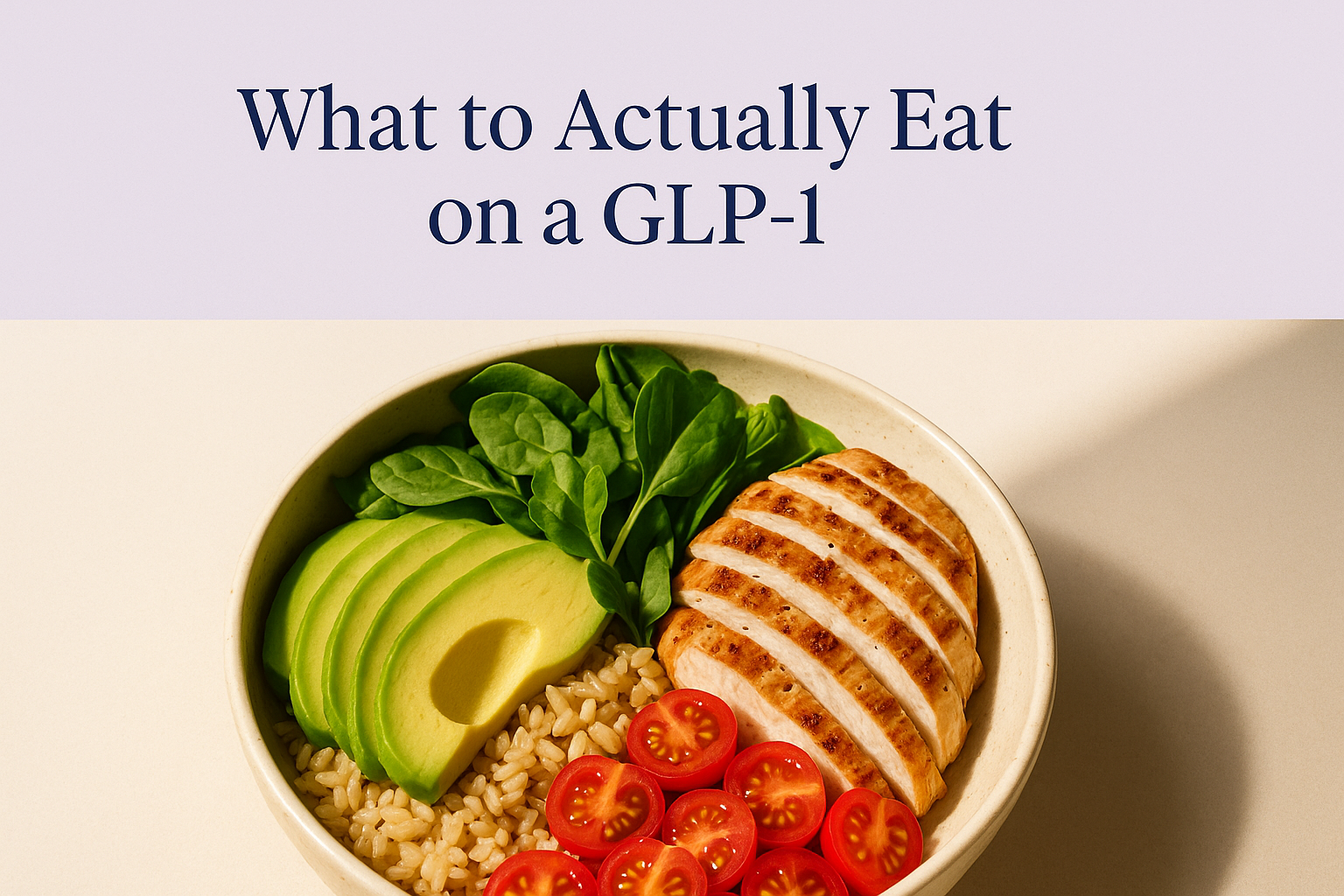
Ninety grams sounds like a lot. In practice it looks like a Greek yogurt at breakfast, six ounces of chicken or fish at lunch, a protein shake or cottage cheese in the afternoon, and another lean protein at dinner. It is achievable with intention. It is hard to hit by accident.
Vitamin D
I think vitamin D is worth taking on a GLP-1 for most patients. The reasoning is twofold. First, vitamin D status is commonly suboptimal in the United States even at baseline. Second, when calorie intake drops, the patient is no longer getting the small amount of dietary vitamin D that fortified dairy and fatty fish typically provide.
A daily dose of 1000 to 2000 IU is a reasonable maintenance range for most adults. Higher doses (5000 IU or more) should only be taken under clinician guidance because vitamin D is fat-soluble and can build up. Vitamin D supports immune function, bone health, and mood. The mood piece matters on a GLP-1 because the early weeks of therapy can bring fatigue and low energy, and underlying vitamin D insufficiency makes that worse.
B12
B12 is the second supplement I think is broadly reasonable on a GLP-1, particularly for patients on tirzepatide or semaglutide who are eating less animal protein than they used to. B12 comes almost exclusively from animal foods. A patient who has shifted toward a vegetable-and-grain pattern, even unintentionally, can drift toward low B12 within months.
B12 deficiency presents as fatigue, brain fog, and in some patients as hair changes. A standard B12 supplement (500 to 1000 mcg daily, sublingual or oral) is inexpensive and well tolerated. It is one of the few supplements where I do not think the cost-to-benefit ratio is questionable.
Some GLP-1 telehealth platforms add B12 directly to the compounded medication. If yours does, you do not need a separate supplement. If yours does not, a daily oral B12 is reasonable.
Iron, but Only If You Need It
This is the one I am most cautious about. Iron is genuinely important for hair growth, energy, and skin integrity. Low iron is one of the most common drivers of hair shedding I see in my clinic, particularly in menstruating women, vegetarians, and anyone who has reduced calorie intake substantially.
The catch is that iron supplementation is not benign. Too much iron causes GI symptoms, can be toxic over time, and in patients without a real deficiency it does nothing useful. I do not recommend that GLP-1 patients start an iron supplement on their own without knowing whether they need it. If you have noticed unusual fatigue, hair changes, or other symptoms that might be iron-related, talk to your clinician about whether iron makes sense for you specifically.
Magnesium
Magnesium is one of the more underrated supplements for GLP-1 patients. The case is partly direct (it supports muscle function, sleep, and constipation prevention, all of which matter on a GLP-1) and partly metabolic. Magnesium glycinate, taken as 200 to 400 milligrams before bed, helps sleep quality and reduces the muscle cramping some patients experience during rapid weight loss.
Constipation is one of the more common GLP-1 side effects. Magnesium citrate (a different form) at lower doses can help with that specifically, although hydration and fiber should be the first line.
A Daily Multivitamin
For patients who do not want to think about supplements at all, a daily multivitamin is a reasonable floor. It will not do what protein does, but it covers the small daily intakes of zinc, copper, selenium, B-complex, and vitamin K that get harder to hit when total food intake drops. I do not have strong opinions about specific brands. Centrum, One A Day, or a women's or men's formulation from a reputable store-brand is fine. Avoid the high-priced "for women on GLP-1" multivitamins. They are the same vitamins in a more expensive bottle.
Omega-3 Fatty Acids
This one is more individualized. Omega-3 fatty acids (EPA and DHA, the active forms found in fish oil) have real evidence for cardiovascular benefit, anti-inflammatory effects, and skin barrier function. Whether you need a supplement depends on how much fish you eat. If you have salmon, sardines, or mackerel two or three times a week, you probably do not need a fish oil supplement. If you do not eat much fish, 1 to 2 grams of EPA + DHA per day from a reputable brand is reasonable.
For patients with inflammatory skin disease (psoriasis, eczema, HS), there is some additional rationale to consider omega-3 supplementation. The anti-inflammatory effects are modest but real, and they complement the metabolic improvements GLP-1 therapy is already producing. Our piece on visceral fat and inflammation covers the underlying mechanism.
What I Do Not Think Is Worth Your Money
I am skeptical of GLP-1-specific supplement bundles, "metabolism support" formulas, ketone supplements, and anything that promises to enhance or replicate the effects of semaglutide or tirzepatide. None of those have good evidence. Most of them are expensive vitamins repackaged with a glossier label.
I am also skeptical of collagen powders for GLP-1 hair shedding. The data is thin, the dose of useful amino acids in a typical collagen powder is small, and the same money spent on a serious protein shake gives you more protein per dollar and more value for hair and skin.
Biotin in particular gets pushed for hair growth and almost never helps unless the patient has a real biotin deficiency, which is rare. It also can interfere with certain lab tests (notably thyroid panels) at high doses, which complicates everything else.
What I Do for My Own Patients
When a patient asks me what to take while on a GLP-1, my default answer is short. Vitamin D. B12, especially if their compounded medication does not already include it. Magnesium glycinate before bed. A daily multivitamin if they want the floor covered. Iron only if there is a specific reason. Protein every meal, ninety grams a day, no shortcuts.
Everything else gets a real conversation about whether the patient has a specific issue the supplement might address. Most of the time, the answer is that they are better off putting the money toward better protein sources and a quality multivitamin than a separate bottle for every claim.
For more on what to actually eat while you are losing weight, our meals on a GLP-1 piece walks through specific food choices. For the broader view on side effects to expect and how to manage them, our side effects article covers hair shedding, facial volume loss, and skin changes in more depth.
Important Information
Compounded medications are prepared by accredited US compounding pharmacies under a licensed prescriber and are not FDA-approved drug products in the way that brand-name medications such as Wegovy, Ozempic, Mounjaro, and Zepbound are. Supplements are not regulated as drugs by the FDA. Discuss any supplement regimen with your clinician, particularly if you take other medications. GLP-1 medications carry possible side effects including nausea, constipation, gallbladder issues, pancreatitis risk, and temporary hair shedding. GLP-1 therapy requires evaluation and prescription by a licensed clinician. This article is educational and is not medical advice.
Sources
- GLP-1 receptor agonists in inflammatory skin disease: a comprehensive review. J Eur Acad Dermatol Venereol. August 2025. doi:10.1111/jdv.20694
- GLP-1 receptor agonists in dermatology: a clinical review. J Clin Aesthet Dermatol. 2025. PMC11932103.
- "GLP-1 in Dermatology" feature, Dermatology World, American Academy of Dermatology. January 2026.
- STEP-1: Wilding JPH, et al. Once-weekly semaglutide in adults with overweight or obesity. N Engl J Med. 2021;384(11):989-1002. doi:10.1056/NEJMoa2032183
- SURMOUNT-1: Jastreboff AM, et al. Tirzepatide once weekly for the treatment of obesity. N Engl J Med. 2022;387(3):205-216. doi:10.1056/NEJMoa2206038
- Trüeb RM. Diffuse hair loss: pathophysiology and clinical patterns. Int J Trichology. 2009;1(2):75-81.
- Holick MF. Vitamin D deficiency. N Engl J Med. 2007;357(3):266-281.