
An August 2025 comprehensive review in the Journal of the European Academy of Dermatology and Venereology (doi 10.1111/jdv.20694) made a quiet argument that should change how we think about inflammatory skin disease. The review walked through the cumulative evidence linking visceral adiposity to inflammatory dermatologic conditions, from psoriasis to hidradenitis suppurativa to atopic dermatitis, and showed that the relationship runs through a small number of shared inflammatory signals. The same review pointed at the GLP-1 receptor agonists as the most promising metabolic-first intervention to address those signals. It is the most thorough single document on this topic to date.
GLP-1 Skin + WeightMay 18, 2026 · 9 min read
Visceral Fat, IL-6, and Why Your Skin Cares What's Around Your Waist

Dr. Brandon Kirsch, MD, FAAD
Chief Medical Officer
A separate 2025 review in the Journal of Clinical and Aesthetic Dermatology (PMC11932103) covered the emerging clinical experience of GLP-1 medications in dermatology, including case reports of inflammatory skin disease improving on therapy independent of weight loss.
I want to walk through the science behind both reviews in a way that respects your time. The short version is this: visceral fat is not silent. It produces inflammation. That inflammation reaches your skin. Reducing visceral fat reduces inflammation. The medications that reduce visceral fat most effectively also reduce inflammation directly. This is why a dermatologist would build a weight management program.
The Two Kinds of Fat
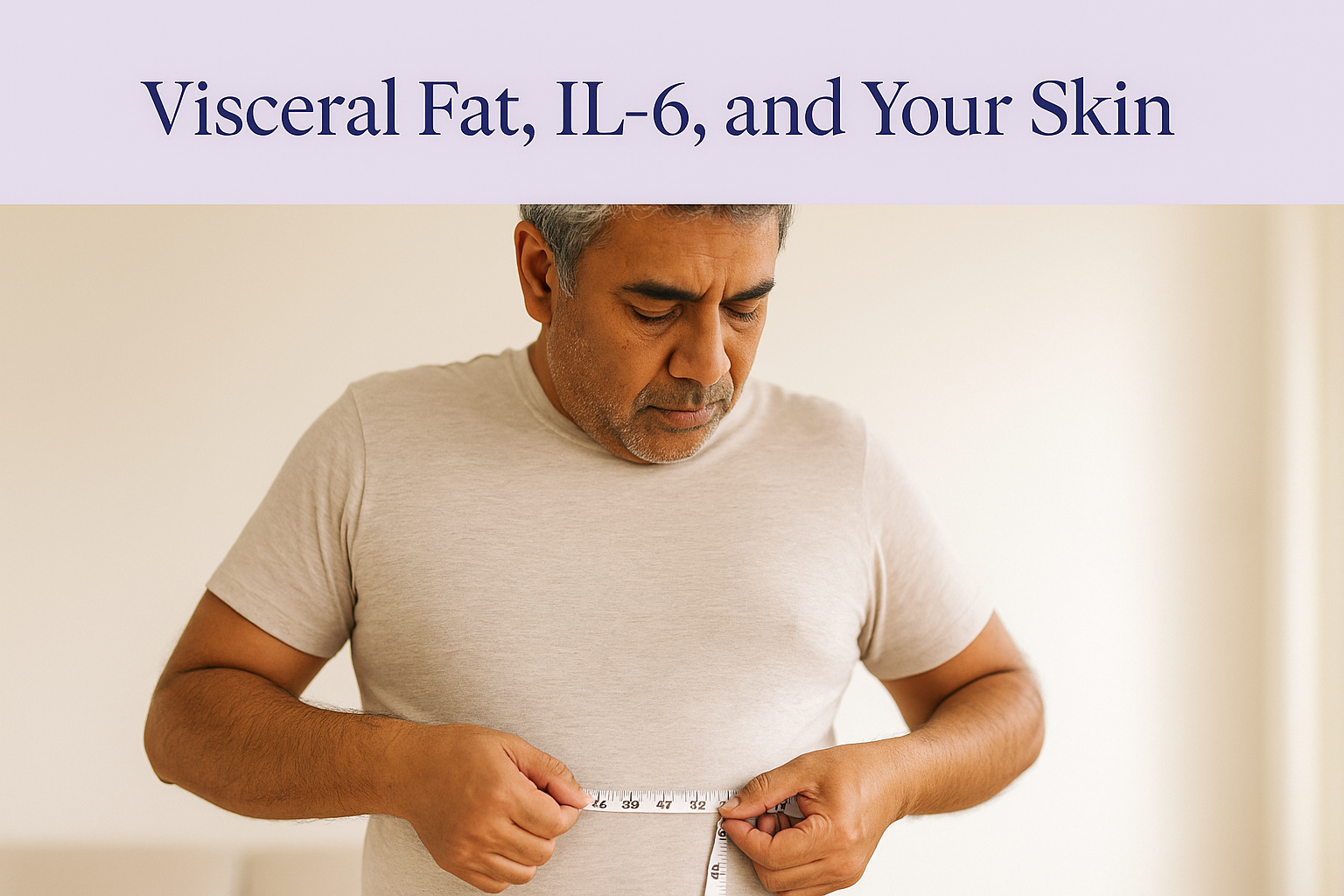
The fat in your body lives in two main compartments. Subcutaneous fat sits between the skin and the muscle. It is the fat you can pinch. It is metabolically active but relatively quiet. Visceral fat sits deeper, packed around the abdominal organs. It is the fat that drives waist circumference up. It is not the fat you can pinch.
Visceral fat is the metabolically loud one. Per ounce, it produces more pro-inflammatory cytokines than subcutaneous fat. It is more responsive to stress hormones. It contributes more to insulin resistance. And it is the fat compartment that has the strongest relationships with cardiovascular disease, type 2 diabetes, fatty liver, and the inflammatory skin diseases I treat.
When a patient loses weight, both compartments shrink, but visceral fat tends to shrink faster and proportionally more. That is one reason why even modest weight loss, in the range of five to ten percent of body weight, has measurable effects on inflammation markers and on disease severity in conditions like psoriasis.
The Cytokine Story
The inflammatory cascade that connects visceral fat to skin disease runs through a handful of signaling molecules. The most important for dermatology are IL-6, TNF-alpha, and IL-17.
IL-6 is produced abundantly by visceral adipose tissue. It travels through the bloodstream and acts on many tissues, including the liver, where it drives the production of acute-phase proteins like C-reactive protein. Higher circulating IL-6 means higher CRP. Higher CRP correlates with worse psoriasis severity, higher cardiovascular risk, and worse HS flare frequency.
TNF-alpha is similar. It is produced by macrophages inside visceral adipose tissue and contributes to a chronic low-grade inflammatory state. TNF-alpha is one of the targets of the older psoriasis biologics like adalimumab and infliximab. The reason those drugs work is that TNF-alpha is a real driver of disease. Lowering body weight lowers TNF-alpha. Without a biologic.
IL-17 is the workhorse cytokine of the modern psoriasis biologic class. Drugs like secukinumab, ixekizumab, bimekizumab, and risankizumab were designed around the IL-23 to IL-17 axis. Visceral fat does not produce IL-17 directly in the same way it produces IL-6, but the metabolic milieu of visceral obesity favors Th17 differentiation, the immune cell type that produces IL-17. The pathway is connected.
The clinical consequence is that two patients with the same nominal psoriasis severity can have very different inflammatory backgrounds depending on what is happening around their waist. The patient with more visceral fat has more circulating inflammatory signal. More fuel for the disease. Less response to the same dose of biologic.
Why Drug Exposure Per Kilogram Matters
There is also a dosing wrinkle worth knowing if you are on a biologic. Most psoriasis biologics are given at a fixed dose, so exposure per kilogram of body weight is lower in heavier patients, and response rates fall accordingly. Reducing body weight improves that exposure without changing the prescription. The same drug works better.
Our piece on GLP-1 for psoriasis works through that dosing math in detail, and our HS primer covers the parallel story in hidradenitis suppurativa. The short version is the same in both conditions: lower the weight, quiet the inflammatory background, and the medications you are already taking tend to work better.
Where GLP-1 Medications Fit
GLP-1 receptor agonists, semaglutide and tirzepatide, do two things relevant to this picture. The first is weight reduction. Patients on these medications lose fifteen to twenty-two percent of body weight on average over twelve to eighteen months, with disproportionate loss in visceral adipose. That reduces the inflammatory burden of the visceral fat compartment, lowers CRP and IL-6, and improves the per-kilogram exposure of any concurrent biologic.
The second is direct anti-inflammatory effect. GLP-1 receptors are expressed on immune cells. Monocytes carry them. Macrophages carry them. T lymphocytes and dendritic cells carry them. Activating those receptors dampens cytokine release, reduces CRP, and quiets several of the same inflammatory pathways that drive inflammatory skin disease. This is why there are case reports of psoriasis clearing on GLP-1 therapy in patients who have not yet lost meaningful weight. The medication appears to be doing something the weight loss alone cannot account for.
The combination, weight reduction plus direct anti-inflammatory activity, makes GLP-1 medications a uniquely well-suited tool for the metabolic-inflammatory pattern that drives so much chronic dermatology. For the full mechanism, our explainer on how GLP-1 medications work walks through it at a higher level.
Why a Dermatologist Built This
Most weight management programs are designed by primary care or by endocrinology, with weight as the primary endpoint and metabolic risk markers as the supporting story. That framing is correct as far as it goes. It just misses the patient whose skin is the visible expression of the same metabolic state.
The psoriasis patient who has been on three biologics. The HS patient who has tried every combination antibiotic and is considering a third surgery. The patient with stubborn rosacea who is also pre-diabetic. The atopic dermatitis patient whose flares correlate with weight gain. These are dermatology patients first. The weight is part of the disease, and the disease is the reason they walked in.
A dermatology-led weight management program understands that the skin endpoints matter. The intake asks about psoriasis severity, HS flare pattern, and current dermatologic therapy. The follow-through includes anticipatory guidance about hair shedding and facial volume changes, which our piece on GLP-1 side effects covers in detail. The clinician coordinates with the patient's dermatologist if there is one, or is the patient's dermatologist if they want consolidated care.
That is the version of weight management I would want for someone in my own family with inflammatory skin disease.
For the questions to ask before you start, our five questions article covers the eligibility and contraindication decisions that should happen up front.
Important Information
Compounded medications are prepared by accredited US compounding pharmacies under a licensed prescriber and are not FDA-approved drug products in the way that brand-name medications such as Wegovy, Ozempic, Mounjaro, and Zepbound are. GLP-1 medications carry possible side effects including nausea, constipation, gallbladder issues, pancreatitis risk, and temporary hair shedding. GLP-1 therapy requires evaluation and prescription by a licensed clinician. This article is educational and is not medical advice.
Sources
- GLP-1 receptor agonists in inflammatory skin disease: a comprehensive review. J Eur Acad Dermatol Venereol. August 2025. doi:10.1111/jdv.20694. The marquee reference.
- GLP-1 receptor agonists in dermatology: a clinical review. J Clin Aesthet Dermatol. 2025. PMC11932103.
- "GLP-1 in Dermatology" feature, Dermatology World, American Academy of Dermatology. January 2026.
- National Psoriasis Foundation primer on GLP-1 receptor agonists in psoriasis (advocacy organization summary).
- STEP-1: Wilding JPH, et al. Once-weekly semaglutide in adults with overweight or obesity. N Engl J Med. 2021;384(11):989-1002. doi:10.1056/NEJMoa2032183
- SURMOUNT-1: Jastreboff AM, et al. Tirzepatide once weekly for the treatment of obesity. N Engl J Med. 2022;387(3):205-216. doi:10.1056/NEJMoa2206038
- Drucker DJ. Mechanisms of action and therapeutic application of glucagon-like peptide-1. Cell Metab. 2018;27(4):740-756.
- Puig L. Obesity and psoriasis: body weight and body mass index influence the response to biological treatment. J Eur Acad Dermatol Venereol. 2011;25(9):1007-1011.
Related Articles
→
Psoriasis
When Weight Is Part of the Psoriasis Story: The Conversation That Often Gets Missed
May 18, 2026 · 11 min read

→
GLP-1 Skin + Weight
GLP-1s and Hidradenitis Suppurativa: The Quiet Shift in Care
May 18, 2026 · 9 min read

→
GLP-1 Skin + Weight
The Side of Weight Loss Nobody Warns You About: Your Dermatologist Should
May 18, 2026 · 11 min read