A patient walked into my clinic last spring carrying a Ziploc bag. The bag had hair in it. Not a small amount. Two handfuls, maybe more, that she had collected over a week from her brush, the shower drain, and her pillow.

GLP-1 Skin + WeightMay 18, 2026 · 11 min read
The Side of Weight Loss Nobody Warns You About: Your Dermatologist Should

Dr. Brandon Kirsch, MD, FAAD
Chief Medical Officer
She was three months into a GLP-1 prescription she had gotten from one of the online weight loss platforms. She had lost twenty pounds. She was thrilled with the weight loss and panicking about the hair. The platform had a portal but no clinician she could actually talk to, and the standard response from their support line was "consult a doctor." So she did. She came to me, a dermatologist, because nobody else had told her this was a known side effect.
It is a known side effect. It is reversible. It is not the only one. And the fact that she got blindsided by it is the part I want to fix.
If you are on a GLP-1 medication or thinking about starting one, this is the article I would want you to read before you fill the first prescription. The weight loss is real. The body composition changes are real. The skin and hair changes are also real, and a dermatologist is the right specialist to anticipate them.
What Happens to Your Hair
The medical name is telogen effluvium. The hair on your head normally cycles through three phases. The growing phase (anagen) lasts two to seven years. The transition phase (catagen) is short. The resting phase (telogen) lasts two to three months, after which the hair sheds and a new strand starts to grow in its place. At any given time, about ten to fifteen percent of your hair is in the resting phase.
When the body undergoes a stress, including significant weight loss, a much larger fraction of hair follicles get pushed into the resting phase at the same time. The shedding does not happen immediately. It shows up two to three months after the stress, which is why so many GLP-1 patients are blindsided. They lose the first ten pounds, feel great, and around month three their hair starts coming out.
It is not subtle. It can affect twenty to forty percent of scalp density. The pull test is positive. The shower drain is full. The ponytail is visibly thinner. Patients describe it as terrifying because it does not match the usual gradual hair changes they may have experienced before.
Here is the good news. Almost all of it grows back. About ninety-eight percent of patients see full regrowth once weight stabilizes. The shedding typically continues for six to nine months after the weight stabilizes before it stops. From there, visible regrowth takes another three to six months, and full density recovery takes a year or more.
What I do for patients in active shedding looks like this. I push protein intake to ninety grams a day at minimum, which sounds like a lot but is achievable with intention. For patients who are good candidates, I prescribe oral minoxidil at a low dose, often 1.25 to 2.5 milligrams daily, which has good data for accelerating the recovery phase. I tell every patient about hair toppers and clip-ins because they make the visible phase of the shedding much more bearable. Most importantly, I tell them what to expect on the timeline, because the panic about the shedding is almost always worse than the shedding itself.
What I do not do is recommend stopping the GLP-1. The medication is not the underlying problem. The underlying problem is the rate of weight loss. Stopping the medication does not bring the hair back faster. It just gives back the weight.
What Happens to Your Face
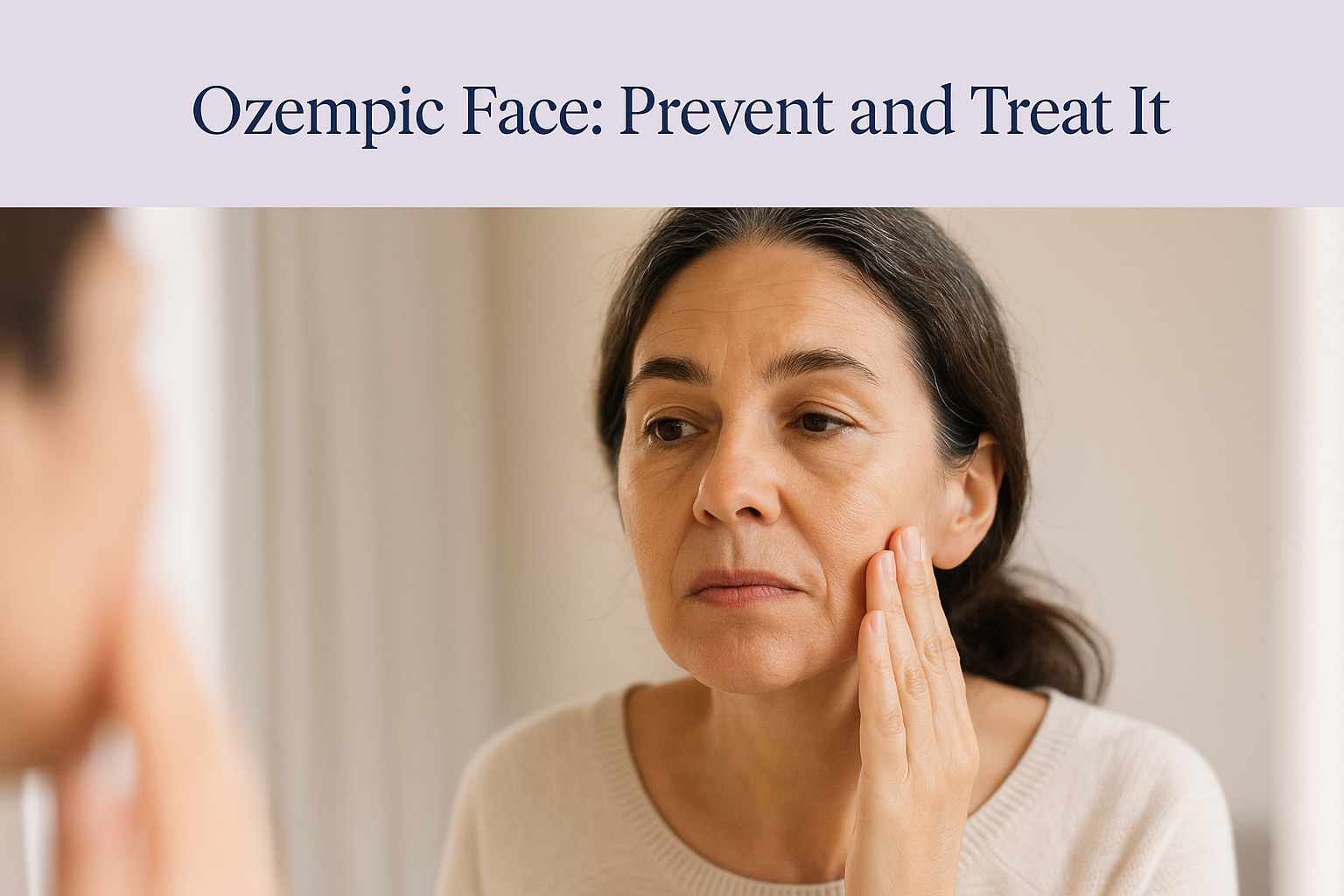
The clinical term is loss of facial fat. The colloquial term has become "Ozempic face" or "GLP face." Both describe the same thing, which is the visible deflation of the cheeks, temples, periorbital region, and jawline that follows significant weight loss.
Adipose tissue gives the face youthful fullness. When weight comes down, the face loses volume in the same way the rest of the body does. The skin that was draped over that volume now has more surface area than it needs, and it does not snap back the way it did at twenty-five. The result is a face that looks older and more tired than it did before the weight loss, even though the patient is healthier in every measurable way.
This is biology, not a flaw in the medication. Any path to significant weight loss creates the same problem. Bariatric surgery patients see it. People who lose weight through diet alone see it. The difference with GLP-1 medications is the speed. Volume loss that would have taken two or three years through traditional weight loss can happen in twelve months on a GLP-1. The face does not have time to remodel.
There are real interventions that help. Hyaluronic acid fillers placed in the cheeks, temples, and periorbital region can restore lost volume effectively. The treatment is in-office, the results are immediate, and the volume restoration tends to last twelve to eighteen months. Bio-stimulatory injectables like calcium hydroxylapatite or poly-L-lactic acid work differently, by stimulating native collagen production over time, and can complement fillers for patients who want more durable volume restoration. Radiofrequency microneedling can improve skin tightness, particularly in the lower face and neck.
The point is not that every GLP-1 patient needs filler. The point is that this is a foreseeable consequence of weight loss, and a dermatologist can anticipate it and plan for it. A program built only to ship semaglutide usually is not set up for that.
What Happens to Your Skin
Loose skin is the third category. It is more often a concern in patients who lose larger amounts of weight, more than fifty pounds, and it tends to be most visible on the abdomen, the inner arms, the inner thighs, and the breasts.
Skin elasticity depends on collagen and elastin, both of which decline with age and both of which take time to remodel. Younger patients with less prior skin damage tend to redrape better. Older patients, and patients with longer histories of weight cycling, redrape less completely. Hydration, protein intake, and resistance training during the weight loss phase all help, but none of them prevent loose skin entirely if the underlying weight loss is significant.
What dermatology can offer here is honest framing. For some patients, the loose skin will be modest and time will improve it. For others, body contouring procedures, energy-based skin tightening devices, or referral to a plastic surgeon for surgical skin removal are the right options. None of those are first-line conversations. They are the conversation after the weight is stable for six to twelve months and the skin has had time to remodel as much as it is going to remodel on its own.
The relevant thing for our purposes is that none of this gets discussed in a typical online weight loss intake. The patient signs up, gets the prescription, loses the weight, and then has to figure out the dermatologic consequences on their own.
Where GLP-1-Only Platforms Fall Short
This is not a criticism of the platforms. They are efficient at the mechanics of weight management. They handle intake, prescription, refills, and shipping at scale, and they do it for prices that are reasonable. For a patient whose only concern is weight, they work.
The problem is that they are not staffed to handle the dermatologic consequences of their own product. The patient who comes back at month four with a Ziploc bag of hair gets pointed to a "consult a doctor" message. The patient who shows up at month eight looking gaunt around the temples does not get a filler conversation. The platform was not designed for those moments, and adding a dermatologist to the back end is not something a GLP-1-only platform is set up to do.
A dermatology-led program is set up for it. The clinician explains the telogen effluvium pattern up front so the patient is not blindsided. The plan includes anticipatory guidance about facial volume loss for patients who care about that, with options to address it when the time comes. The medication is the same. The wrap-around care is different.
Patients already on a GLP-1 from another platform who are seeing these changes are not locked into staying there. Dermatology-led programs can take over both the weight management and the dermatologic follow-through.
What I Tell My Own Patients
The frame I use is this. GLP-1 medications are the most effective tool for sustained weight loss in the history of medical weight management. They will change body composition, blood pressure, lipid panels, and cardiovascular risk in ways that traditional weight loss has never quite achieved.
They will also produce predictable dermatologic side effects. The hair will shed around month three. The face will lose volume around month six. The skin will need time to remodel after weight stabilizes. None of this is a reason not to take the medication. All of it is a reason to have a dermatologist in the loop.
A program built only to ship semaglutide is a bit like driving a car without a dashboard. The car still drives. You just cannot see how fast you are going.
For the full picture on what to expect before you start, our five questions to ask before starting a GLP-1 walks through the eligibility, contraindication, and ongoing-care decisions that should happen at the intake. For the deeper view on why weight matters to the skin in the first place, our piece on visceral fat and inflammation covers the mechanism.
Important Information
Compounded medications are prepared by accredited US compounding pharmacies under a licensed prescriber and are not FDA-approved drug products in the way that brand-name medications such as Wegovy, Ozempic, Mounjaro, and Zepbound are. GLP-1 medications carry possible side effects including nausea, constipation, gallbladder issues, pancreatitis risk, and temporary hair shedding (telogen effluvium). GLP-1 therapy requires evaluation and prescription by a licensed clinician. This article is educational and is not medical advice.
Sources
- GLP-1 receptor agonists in inflammatory skin disease: a comprehensive review. J Eur Acad Dermatol Venereol. August 2025. doi:10.1111/jdv.20694. Covers dermatologic side effect spectrum.
- GLP-1 receptor agonists in dermatology: a clinical review. J Clin Aesthet Dermatol. 2025. PMC11932103.
- "GLP-1 in Dermatology" feature, Dermatology World, American Academy of Dermatology. January 2026.
- STEP-1: Wilding JPH, et al. Once-weekly semaglutide in adults with overweight or obesity. N Engl J Med. 2021;384(11):989-1002. doi:10.1056/NEJMoa2032183
- SURMOUNT-1: Jastreboff AM, et al. Tirzepatide once weekly for the treatment of obesity. N Engl J Med. 2022;387(3):205-216. doi:10.1056/NEJMoa2206038
- Drucker DJ. Mechanisms of action and therapeutic application of glucagon-like peptide-1. Cell Metab. 2018;27(4):740-756.
- Trüeb RM. Diffuse hair loss: pathophysiology and clinical patterns. Int J Trichology. 2009;1(2):75-81.
- Coleman SR, Grover R. The anatomy of the aging face: volume loss and changes in 3-dimensional topography. Aesthet Surg J. 2006;26(1S):S4-S9.