
GLP-1 medications take care of the hardest part of weight loss. They quiet the constant background chatter about food, slow the speed at which food leaves the stomach, and lower the volume on hunger between meals. What they do not do is decide what goes on the plate. That part is still on you.
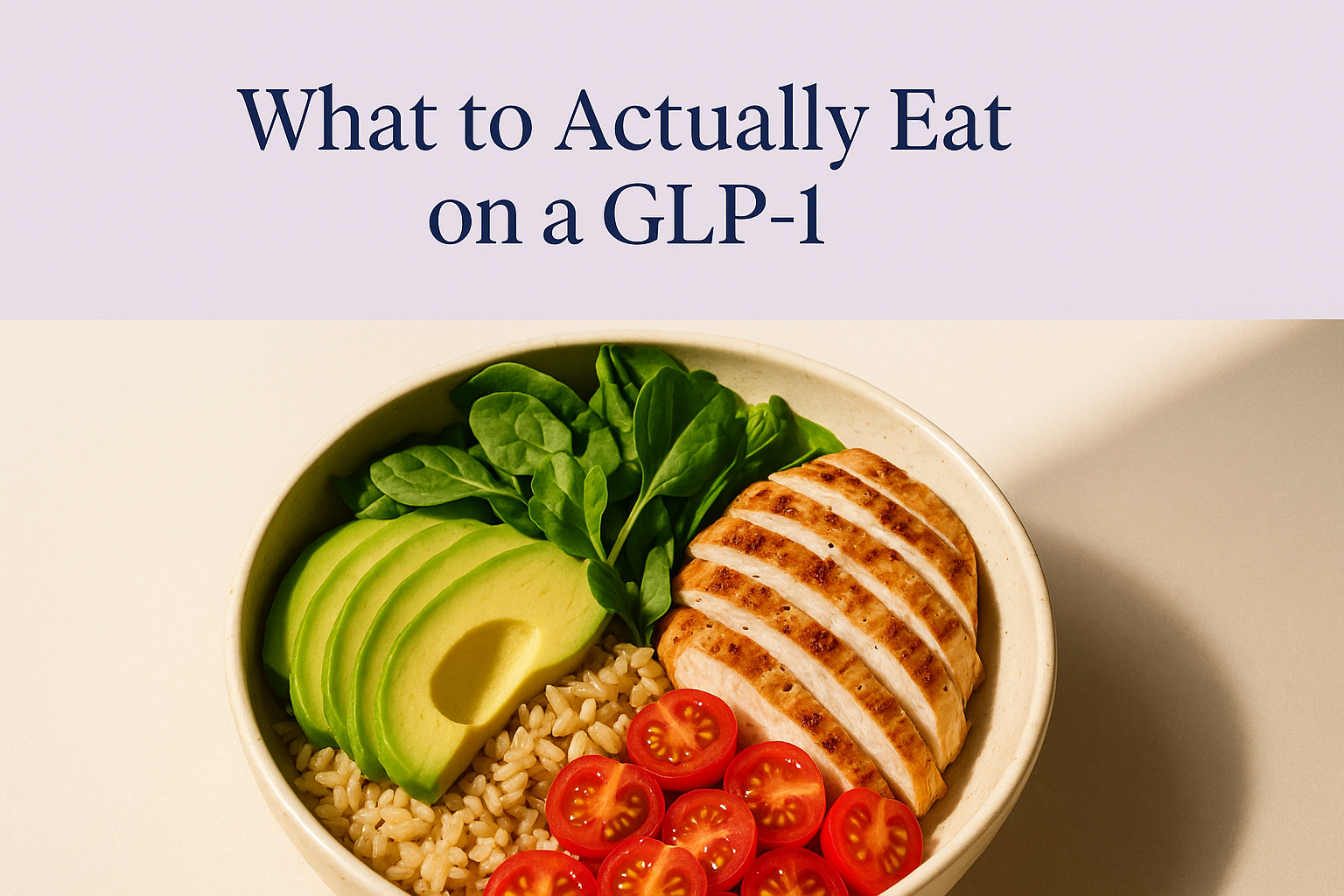
GLP-1 Skin + WeightMay 18, 2026 · 11 min read
What to Actually Eat on a GLP-1

Dr. Brandon Kirsch, MD, FAAD
Chief Medical Officer
I see two patterns in my patients. The first pattern is the patient who lost twenty or thirty pounds, kept their hair, kept their energy, and is six months in and doing well. The second is the patient who lost the same amount of weight but is dealing with hair shedding, fatigue, constipation, and a face that looks ten years older than it did. The difference between those two patterns is almost never the medication. It is almost always what they ate during those six months.
Here is what I tell my own patients.
The Protein Target
If you remember nothing else from this article, remember this. Ninety grams of protein per day, every day, while you are actively losing weight.
That is more than most people eat at baseline, and it is significantly more than the average GLP-1 patient is eating once their appetite is quieter. The reason it matters is that protein is what preserves muscle during weight loss, supports hair and skin, and signals satiety more effectively than carbohydrate or fat at the same caloric density. The patients who get this right tend to lose fat. The patients who skip protein tend to lose fat plus muscle, plus hair, plus the structural support that keeps the face looking like itself.
In practice, ninety grams looks like this:
A Greek yogurt or two eggs at breakfast (15 to 25 grams). Six ounces of chicken, fish, or lean beef at lunch (30 to 40 grams). A protein shake, cottage cheese, or string cheese in the afternoon (15 to 25 grams). Another lean protein at dinner (20 to 30 grams). It adds up if you are paying attention. It does not add up by accident.
How to Eat When Nausea Is Active
The early weeks of GLP-1 therapy, and the first week or two of every dose increase, are usually when nausea is most pronounced. The instinct is to avoid food entirely. The better strategy is to change what and how you eat, not whether.
Smaller meals more often. Three or four small meals beats two large ones during the adjustment phase. Even when your appetite is low, getting a small amount of protein in every three or four hours keeps blood sugar steady and prevents the late-day crash that often makes nausea worse.
Bland, low-fat options. Greasy, rich, or very spicy foods slow gastric emptying further and make nausea worse. The foods that tend to sit best are lean proteins (grilled chicken, baked fish, eggs), simple carbohydrates (rice, oatmeal, plain toast), and cooked vegetables. Save the heavy meals for after the adjustment period.
Cold or room-temperature foods often sit better than hot foods during the worst of the nausea. Greek yogurt, cottage cheese, deli turkey, smoothies, and cold sandwiches go down when hot food does not. The smell of hot food can be its own trigger in the early weeks.
Hydration with the right timing. Drink water between meals, not during them. Drinking large amounts of fluid with food fills the already-slow stomach and intensifies nausea. Aim for 64 to 80 ounces of water spread across the day, and sip rather than gulp.
Ginger and peppermint. Both have real (if modest) evidence for nausea relief. Ginger tea, ginger candies, peppermint tea, or peppermint lozenges are reasonable additions during the first few weeks at a new dose.
What a Real Day Looks Like
I want to be specific. Vague advice like "eat lean protein" is not actionable when you are standing in the kitchen at seven in the morning trying to figure out breakfast. Here is what a real day might look like for a patient at the mid-point of GLP-1 therapy who is hitting the protein target.
Breakfast. Two-egg omelet with spinach and a tablespoon of cheese, plus half a piece of whole-grain toast. Coffee or tea. Approximately 20 grams of protein.
Mid-morning, if needed. A small Greek yogurt (5.3 oz, plain or low-sugar) with a teaspoon of honey or a few berries. Approximately 15 grams of protein.
Lunch. A salad with six ounces of grilled chicken, mixed greens, avocado, tomato, cucumber, olive oil and lemon. Approximately 35 grams of protein.
Afternoon. A protein shake with whey or pea protein and unsweetened almond milk, or a serving of cottage cheese with berries. Approximately 20 grams of protein.
Dinner. Baked salmon (5 oz), roasted broccoli, half a cup of quinoa or sweet potato. Approximately 30 grams of protein.
Total: approximately 120 grams of protein. Caloric intake naturally lands in the 1,200 to 1,500 range without counting because the GLP-1 has already adjusted appetite downward. This is not a diet plan you have to enforce with willpower. It is a structure that fits comfortably inside the appetite suppression the medication is already doing.
What to Avoid or Reduce
Highly processed, calorie-dense foods are the obvious answer. They are also harder to overeat on a GLP-1 than they were before, because the appetite suppression makes the next handful of chips genuinely less appealing. The bigger trap on a GLP-1 is the foods that make side effects worse.
Greasy, fried, and high-fat meals worsen nausea and slow gastric emptying further. Alcohol is harder for the body to clear when food intake is lower and metabolism is shifting; many patients find they tolerate it less well on a GLP-1. Large, late dinners sit in the stomach longer than they did before and often trigger reflux symptoms overnight. Sugar-heavy foods can cause sharper energy crashes when total calories are lower.
None of this is moralistic. A piece of birthday cake at a birthday party is fine. A pattern of greasy late-night meals every weekend will pull at your tolerance of the medication and at the trajectory of the weight loss. Eat in the way that makes the medication work with you, not against it.
Constipation Is Often a Food Problem
Constipation is one of the most common GLP-1 side effects, and it usually has a food and hydration solution before it needs a medication solution. Fiber from vegetables, fruit, and whole grains. Water all day, between meals. A magnesium glycinate supplement at night for some patients. Coffee in the morning. Walking after meals.
If the basics are in place and constipation is still an issue, a clinician-guided plan that may include magnesium citrate, polyethylene glycol (Miralax), or other interventions is reasonable. Our piece on side effects covers more of the side effect spectrum.
The Plate I Want You to Build
Half the plate is vegetables, ideally with some variety of color and texture. A quarter of the plate is a lean protein, sized to deliver 25 to 35 grams (about the size of your palm). A quarter of the plate is a complex carbohydrate (quinoa, sweet potato, brown rice, whole-grain pasta) or, if you are running lower on hunger that meal, a serving of a complex carb you can finish.
A little olive oil, butter, or healthy fat is fine and helpful for satiety. Drink your water between meals rather than during.
Repeat across three or four eating moments a day. That is the foundation. The supplements (vitamin D, B12, magnesium) covered in our vitamins piece are the supporting cast. The medication does the appetite work. The plate does the rest.
A Note on Long-Term Sustainability
The patients who do well on GLP-1 medications long-term are not the ones who white-knuckle through a diet plan. They are the ones who shift their relationship with food in a way that survives appetite returning. The medication may help for years, or you may eventually transition off it, or your dose may change. The habits you build during the active weight loss phase are the ones that decide what happens when the medication is doing less of the work.
Resistance training is the other half of this. Protein gives the body the building blocks to preserve muscle, but the body needs a reason to keep that muscle around. Two or three short resistance sessions a week (bodyweight, bands, or dumbbells, whatever fits the schedule) protects the muscle you are working to keep and protects your metabolism for the long run.
Protein every meal. Vegetables in volume. Hydration between meals, not during. A reasonable plate that you can repeat without thinking about it. That structure is more durable than any specific diet, and it does not require willpower the way starting over does.
For more on what to expect across the first 90 days on therapy, see our first three months piece.
Important Information
Compounded medications are prepared by accredited US compounding pharmacies under a licensed prescriber and are not FDA-approved drug products in the way that brand-name medications such as Wegovy, Ozempic, Mounjaro, and Zepbound are. Specific nutritional needs are individual. Patients with diabetes, kidney disease, eating disorder history, or other complex conditions should discuss meal planning with a qualified clinician or registered dietitian. GLP-1 medications carry possible side effects including nausea, constipation, gallbladder issues, pancreatitis risk, and temporary hair shedding. GLP-1 therapy requires evaluation and prescription by a licensed clinician. This article is educational and is not medical advice.
Sources
- GLP-1 receptor agonists in inflammatory skin disease: a comprehensive review. J Eur Acad Dermatol Venereol. August 2025. doi:10.1111/jdv.20694
- STEP-1: Wilding JPH, et al. Once-weekly semaglutide in adults with overweight or obesity. N Engl J Med. 2021;384(11):989-1002. doi:10.1056/NEJMoa2032183
- SURMOUNT-1: Jastreboff AM, et al. Tirzepatide once weekly for the treatment of obesity. N Engl J Med. 2022;387(3):205-216. doi:10.1056/NEJMoa2206038
- Phillips SM, et al. Protein "requirements" beyond the RDA: implications for optimizing health. Appl Physiol Nutr Metab. 2016;41(5):565-572.
- Drucker DJ. Mechanisms of action and therapeutic application of glucagon-like peptide-1. Cell Metab. 2018;27(4):740-756.
- American Gastroenterological Association. Clinical practice guideline on pharmacological interventions for adults with obesity. Gastroenterology. 2022;163(5):1198-1225.
Related Articles
→
GLP-1 Skin + Weight
Vitamins on a GLP-1: What's Actually Worth Taking
May 18, 2026 · 10 min read

→
GLP-1 Skin + Weight
Ozempic Face: How to Reduce the Risk and How to Treat It
May 18, 2026 · 11 min read

→
GLP-1 Skin + Weight
The Side of Weight Loss Nobody Warns You About: Your Dermatologist Should
May 18, 2026 · 11 min read