Around month six on a GLP-1, I start hearing the same line from patients. Their friends are telling them they look great, but they themselves look in the mirror and see someone older. The cheeks are flatter. The temples have hollowed. The jawline does not have the same sharp transition it did a year ago. They cannot quite name what is different. The number on the scale is the only number going in the direction they wanted, but the face is doing something else.
GLP-1 Skin + WeightMay 18, 2026 · 11 min read
Ozempic Face: How to Reduce the Risk and How to Treat It

Dr. Brandon Kirsch, MD, FAAD
Chief Medical Officer
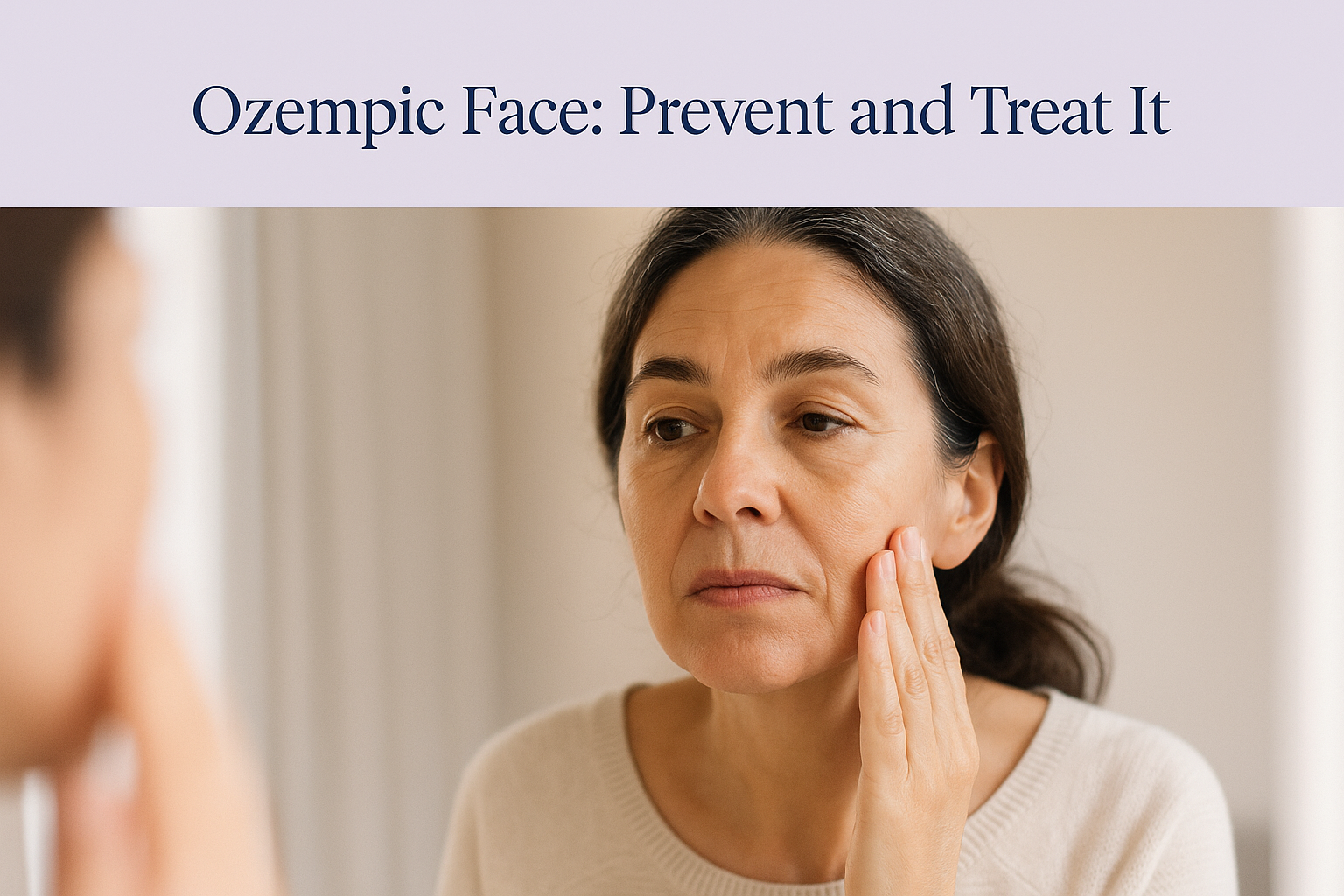
What they are describing is real. The clinical term is facial volume loss. The colloquial term has become Ozempic face or GLP face, and it captures something true. The skin that was draped over the fuller version of the face now has more surface area than it needs, and the underlying fat pads that gave the face its youthful contours have shrunk along with the rest of the body.
This is not a flaw in the medication. Any path to substantial weight loss creates the same problem. The difference with GLP-1 medications is the speed. Volume loss that would have taken two or three years through traditional weight loss can happen in twelve months on a GLP-1. The face does not have time to remodel.
The good news is that almost all of this can be reduced, slowed, or directly reversed. Here is the order in which I think about it for my own patients, and what I tell them at each stage.
The Biology Worth Knowing
Facial youthfulness comes from a layered structure of fat pads, muscle, bone, and skin. The fat pads sit in distinct compartments (cheek, temple, periorbital, jawline, perioral) and shrink in a relatively predictable order as the body ages. They also shrink when total body adipose drops. The skin that was draped over fuller volume now has to redrape over less volume, and skin redraping is slow.
The biology that drives that skin remodeling is collagen and elastin. Both decline with age. Both take months to remodel. And both are influenced by sun exposure, hydration, protein intake, and a handful of skincare ingredients that are worth knowing about. The face that loses volume slowly tends to redrape better. The face that loses volume fast tends to deflate visibly before redraping catches up.
What to Do at Home, Starting Day One
The interventions that matter most are the ones you start before you see the problem. I tell every new GLP-1 patient about these on day one, not month six.
Sunscreen, every day, no exceptions. This is the single best anti-aging move there is, and it matters more on a GLP-1 because the skin is in a more vulnerable remodeling state. A broad-spectrum SPF 30 to 50 in the morning, reapplied if you are outside for extended periods. I prefer mineral sunscreens (zinc oxide, titanium dioxide) for daily wear, but the right sunscreen is the one you will actually put on.
A retinoid at night. Topical retinoids (tretinoin, adapalene, or a stable over-the-counter retinol) are the only topical with strong evidence for stimulating collagen synthesis over time. Patients who are already on a retinoid before they start a GLP-1 have a head start. Patients who start one within the first three months still get most of the benefit. Start low (every third night for two weeks, then every other night, then nightly) to avoid irritation. Pair with a good moisturizer.
Hydration and protein. Both matter. Water intake supports skin turgor and helps with constipation, which is a common GLP-1 side effect. Protein supports collagen synthesis and skin barrier function. Ninety grams of protein a day, every day, while you are losing weight. Our piece on vitamins and supplements covers the rest of the nutrition floor.
A good moisturizer with ceramides or peptides. I do not have brand religion. CeraVe, La Roche-Posay, Avene, EltaMD, SkinCeuticals, Skinbetter, Skinmedica all make formulations that work. The pattern of use matters more than the brand. Twice a day, after cleansing, before sunscreen in the morning.
Resistance training two or three times a week. Muscle loss accelerates the facial deflation pattern, because the lower face loses some of the underlying support that lean tissue provides. Preserving muscle slows the visible aging that comes with GLP-1 weight loss. Bodyweight, bands, or dumbbells all work. The point is that the body has a reason to keep the muscle around.
Slower dose titration if your prescriber is open to it. The faster the weight comes off, the harder the face has to redrape. A clinician who titrates conservatively (not pushing to the maximum dose if a lower dose is producing steady, sustainable loss) is the most direct way to protect the face.
When to Consider In-Office Treatment
Most patients do not need anything in-office for the first six months. The face is still adjusting, the weight loss is still active, and any volume restoration done too early will need to be redone as the face continues to change.
Around month six to nine, if you and the people who see you every day are noticing volume loss in the cheeks, temples, or periorbital area, it is a reasonable time to start the conversation. I think about the in-office options in three tiers.
Tier One: Hyaluronic Acid Fillers
This is the most direct intervention. Hyaluronic acid fillers (Restylane, Juvederm, RHA, Belotero) are placed in the deflated compartments to restore lost volume. The treatment is in-office, takes thirty to sixty minutes, results are visible the same day, and the volume restoration lasts about twelve to eighteen months on average.
The art of filler is choosing the right product for the right area. The cheeks usually take a thicker, more lifting product (Voluma, RHA 4, Restylane Lyft). The temples take a similar product but smaller volumes. The periorbital area (under-eye) takes a thinner, less hydrophilic product (RHA Redensity, Belotero Balance, Restylane-L) because the skin there is thin and pulls water aggressively. The lower face (jawline, chin) takes thicker products to provide structural support.
I tell patients that filler is the most predictable in-office option for GLP-1 facial volume loss. The downside is the cost (typically $700 to $1500 per syringe, and most patients need two to four syringes to address the volume loss meaningfully) and the maintenance interval. Filler is not risk-free. Vascular occlusion (filler entering a blood vessel) is rare but serious. Choose an injector who has trained extensively in facial vascular anatomy and reversal protocols.
Tier Two: Biostimulatory Injectables
Biostimulatory injectables work differently than hyaluronic acid fillers. Instead of replacing volume directly, they stimulate the body to produce native collagen over time. The two main options are calcium hydroxylapatite (Radiesse) and poly-L-lactic acid (Sculptra).
Sculptra in particular has a good reputation for GLP-1 facial volume loss because it builds collagen gradually over three to six months and the results can last two years or longer. It is less predictable than hyaluronic acid filler in the short term (you cannot see exactly what you are getting on day one) but the long-term value proposition is strong for patients who want durability.
I often pair Sculptra with hyaluronic acid filler. The Sculptra builds the foundation. The HA filler refines the specific areas that need targeted volume.
Tier Three: Radiofrequency Microneedling and Energy Devices
Energy-based treatments (radiofrequency microneedling, fractional CO2 laser, ultrasound-based devices like Ultherapy) work on skin tightening rather than volume restoration. They are useful for patients whose primary concern is skin laxity (loose skin along the jawline, sagging in the cheeks) rather than volume loss specifically.
The honest assessment is that energy devices help around the edges. They are not magic. A single treatment produces modest improvement. A series of three or four treatments spaced four to six weeks apart produces more visible change. The results build over months as new collagen is produced.
For most GLP-1 facial volume loss, I prefer volume restoration (filler or biostimulator) as the primary intervention and energy devices as a complement for skin quality.
When to Wait
Not every face needs in-office treatment. Younger patients (under 40) often redrape well over six to twelve months as the skin remodels. Patients with mild volume loss may find that protein, sunscreen, retinoid, and time produce enough recovery that no procedural intervention is needed.
The trap I want patients to avoid is rushing into filler in the first three months of weight loss. The face is still changing. Volume restoration done while weight is still actively dropping will need to be redone. Wait until the weight is stable for at least three months before making major filler decisions.
What I Tell My Own Patients
The frame I use is this. GLP-1 medications produce some of the most dramatic improvements in metabolic health we have ever seen. They also produce facial volume loss that is predictable, expected, and partially within your control. Sunscreen, retinoid, protein, hydration, and time do most of the work for younger patients with mild volume loss. Older patients and patients with substantial volume loss benefit from filler or biostimulator restoration in-office.
The GLP-1-only telehealth platforms are not set up to have this conversation with you. A dermatology-led program is, because it is built around gradual dose titration and dermatologic follow-through, with the same clinician handling intake and ongoing care.
For more on the broader side effect picture, including hair shedding and loose skin, see our side effects article. For the supplement question, see our vitamins piece. For the underlying science of why weight matters to the skin, see our piece on visceral fat and inflammation.
Important Information
Compounded medications are prepared by accredited US compounding pharmacies under a licensed prescriber and are not FDA-approved drug products in the way that brand-name medications such as Wegovy, Ozempic, Mounjaro, and Zepbound are. Dermatologic procedures (filler, biostimulator injection, microneedling, laser) carry their own risks including bruising, infection, vascular occlusion, and rare serious complications. Consult an experienced injector. GLP-1 medications carry possible side effects including nausea, constipation, gallbladder issues, pancreatitis risk, and temporary hair shedding. GLP-1 therapy requires evaluation and prescription by a licensed clinician. This article is educational and is not medical advice.
Sources
- GLP-1 receptor agonists in inflammatory skin disease: a comprehensive review. J Eur Acad Dermatol Venereol. August 2025. doi:10.1111/jdv.20694
- GLP-1 receptor agonists in dermatology: a clinical review. J Clin Aesthet Dermatol. 2025. PMC11932103.
- Coleman SR, Grover R. The anatomy of the aging face: volume loss and changes in 3-dimensional topography. Aesthet Surg J. 2006;26(1S):S4-S9.
- Sundaram H, Cassuto D. Biophysical characteristics of hyaluronic acid soft-tissue fillers and their relevance to aesthetic applications. Plast Reconstr Surg. 2013;132(4 Suppl 2):5S-21S.
- Vleggaar D, et al. Consensus recommendations on the use of injectable poly-L-lactic acid for facial and nonfacial volumization. J Drugs Dermatol. 2014;13(4 Suppl):s44-s51.
- STEP-1: Wilding JPH, et al. Once-weekly semaglutide in adults with overweight or obesity. N Engl J Med. 2021;384(11):989-1002.
- SURMOUNT-1: Jastreboff AM, et al. Tirzepatide once weekly for the treatment of obesity. N Engl J Med. 2022;387(3):205-216.