
If you have psoriasis and you are carrying extra weight, there is a conversation you probably have not had with your dermatologist. Not because your dermatologist does not care. It is that the visit is twelve minutes, the room is small, the topic is awkward, and writing a prescription is easier than asking about what you eat.
PsoriasisMay 18, 2026 · 11 min read
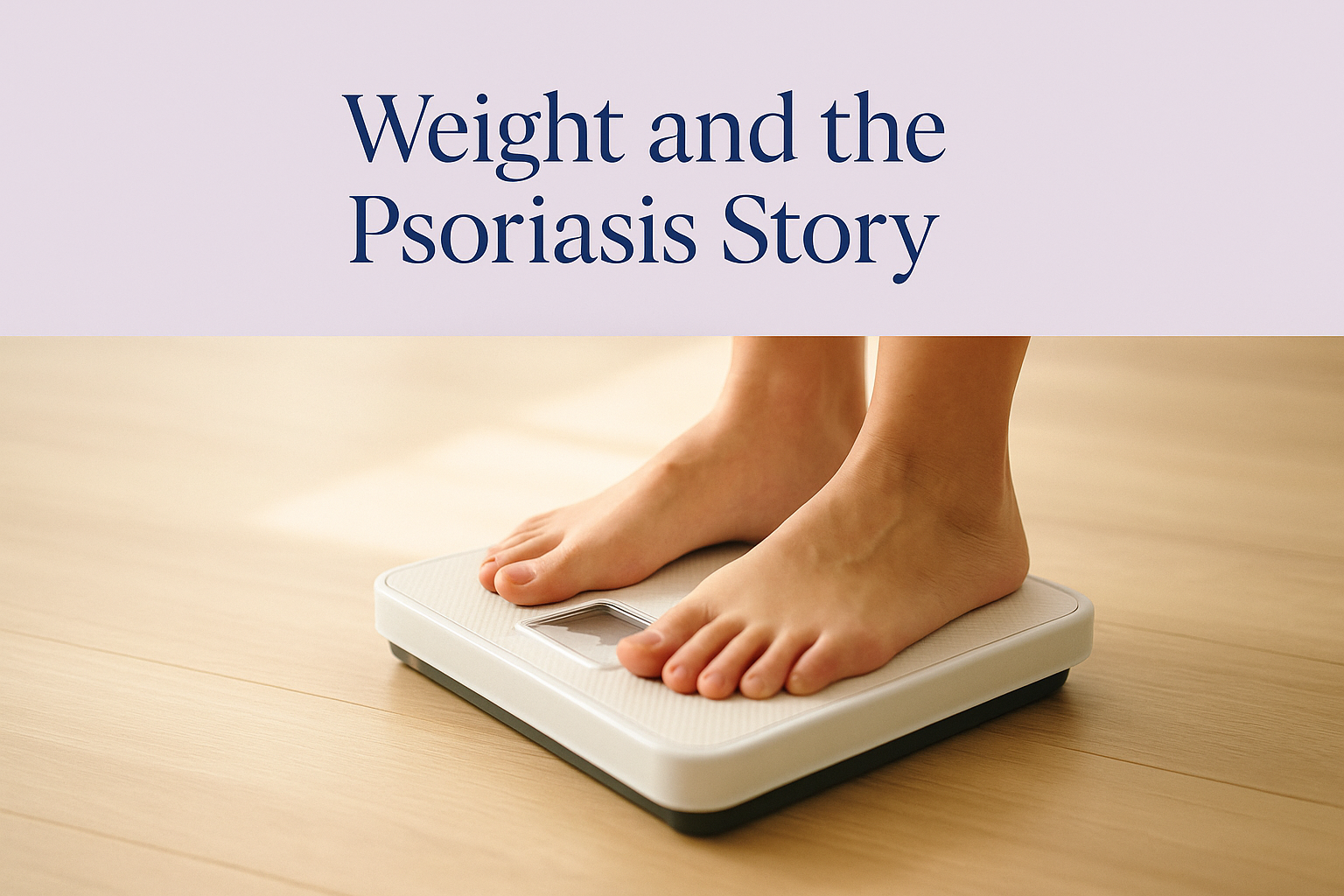
When Weight Is Part of the Psoriasis Story: The Conversation That Often Gets Missed

Dr. Brandon Kirsch, MD, FAAD
Chief Medical Officer
That conversation matters more than most patients realize.
The January 2026 GLP-1 in Dermatology feature in the AAD's Dermatology World made the link plain. Body mass index above 35 is associated with roughly double the risk of developing psoriasis compared to normal-weight adults. Among people who already have psoriasis, body surface area involvement scales with BMI. The heavier you are, on average, the more skin the disease covers, and the harder it is to clear. A comprehensive August 2025 review in the Journal of the European Academy of Dermatology and Venereology (doi 10.1111/jdv.20694) brought together the cumulative evidence linking adipose tissue, systemic inflammation, and inflammatory dermatologic disease into a single picture.
This is not a moral story. It is a biology story. And it changes how care should be delivered.
What the Data Actually Shows
The connection between weight and psoriasis is one of the most consistent findings in modern dermatology research. Multiple large cohort studies have shown that higher body weight is associated with higher PASI scores (the standard severity index), greater body surface involvement, higher risk of progression from mild to severe disease, higher rates of psoriatic arthritis, and poorer response to systemic therapy.
The relationship is dose-dependent. The higher the BMI, the worse the average severity. And it works in the other direction too. The Jensen 2013 JAMA Dermatology randomized trial showed that patients on a low-calorie diet who lost roughly 5 to 10 percent of body weight had measurable PASI improvement compared to controls, even without changing their psoriasis medication. Multiple follow-on cohorts have supported the same pattern.
This is not subtle. It is one of the most reliable disease-modifying findings we have in inflammatory dermatology.
Why Visceral Fat Drives the Disease
The mechanism is not mysterious. Adipose tissue is not inert storage. It is an active endocrine organ. Visceral fat in particular, the deeper fat around abdominal organs, produces pro-inflammatory cytokines including IL-6 and TNF-alpha. Those are the same cytokines that drive psoriasis at the immune level. The more visceral fat you carry, the more inflammatory signal in circulation. The more inflammatory signal in circulation, the more fuel for the IL-23 and IL-17 pathway that produces the plaques on your elbows and scalp.
There is also a biologic-dose problem. Most psoriasis biologics are dosed at a fixed amount, not adjusted for body weight (ustekinumab is the partial exception, with a weight-tiered dose). A patient at 270 pounds on a fixed-dose biologic gets the same dose as a patient at 170 pounds. The math is unflattering. Drug exposure per kilogram is lower in the heavier patient, and the response data reflects that. Studies of adalimumab and the IL-17 inhibitors show reduced response rates at higher body weights. If you have been on a biologic for two years and you have plateaued, weight may be the variable you have not yet adjusted.
And then there is the metabolic neighborhood. Psoriasis patients carry higher rates of insulin resistance, type 2 diabetes, fatty liver, and cardiovascular disease than the general population. These conditions are themselves inflammatory. They make the underlying disease harder, and they raise the stakes of leaving it undertreated.
For more on the mechanism, our piece on how visceral fat drives systemic inflammation in the skin walks through the science in more detail. Or read our companion article on the GLP-1 for psoriasis evidence if you want the treatment-focused take.
Why This Almost Never Comes Up in Clinic
A twelve-minute dermatology visit is not designed for a weight conversation. The patient comes in for a skin check, a refill, or a flare. The dermatologist looks at the skin, reviews labs, writes the prescription, and moves to the next room. The system is built for throughput, not for the slow, careful, sometimes uncomfortable work of changing a body.
Even when a dermatologist wants to bring it up, the conversation is fraught. Weight is one of the most sensitive subjects in medicine. It is tangled up with self-image, family history, food culture, prior failed attempts, the bathroom scale that the patient may have stopped trusting years ago. The clinician does not want to add shame to an already heavy office visit. So the conversation gets deferred. Often forever.
There is also the easier-path problem. Writing a prescription for a biologic takes thirty seconds and the patient leaves happy. Counseling someone on weight takes twenty minutes if you do it well, and the patient leaves uncertain. The system rewards prescriptions. So you get prescriptions.
I have been on both sides of this. I have written biologic scripts for patients I knew were carrying weight that was working against them. I told myself I would bring it up next visit, and next visit was a flare visit, and the visit after that was a med change. The weight conversation kept getting pushed.
It should not get pushed anymore. Weight is part of the disease. Treating one without the other leaves a known disease driver in place.
What a Weight-Aware Psoriasis Plan Actually Looks Like
The version of care I would build if I were starting over is not exotic. It is just deliberate about treating the disease as the metabolic-inflammatory condition it actually is.
Step one is honest framing. The patient hears, in plain language, that weight is one of the strongest modifiable drivers of their disease. Not as a finger-wagging moment. As a clinical fact, the same way we discuss UV exposure or smoking. The framing matters. The patient is not being scolded. They are being told something true that almost nobody told them in the prior decade of skin care.
Step two is acknowledging that willpower is not the failure point. The biology of obesity involves hormones, brain pathways, gut signaling, and food environments that conspire against intentional weight loss. Most patients who have tried have tried hard. The medications now available, the GLP-1 receptor agonists like semaglutide and tirzepatide, change the math by working with that biology rather than against it. They are the most effective pharmacologic tool for sustained weight reduction we have ever had.
Step three is keeping the psoriasis care intact. GLP-1 therapy is a weight management intervention. It does not replace topicals, biologics, methotrexate, apremilast, or any other psoriasis-specific care. Those continue. If anything, they get more effective as weight comes down, because drug exposure per kilogram improves and the inflammatory background quiets.
Step four is the long view. Weight loss is gradual. Most patients see the biggest reductions over the first six to twelve months. Skin improvement tends to follow the weight reduction, not lead it. Setting that expectation up front matters. So does keeping a dermatologist in the loop the whole way, because psoriasis is the reason the patient walked in, and skin endpoints are the reason this work is worth doing.
Who This Is Not For
If your BMI is in the normal range and your psoriasis is well controlled, none of this applies. Weight is not part of every psoriasis story. It is part of many of them, and the data is strong enough that it deserves a conversation, but it is not universal.
If you have psoriasis and a normal BMI and your disease is mild, GLP-1 therapy is not for you. If you are pregnant or planning pregnancy in the near term, GLP-1 therapy is not for you. If you have a personal or family history of medullary thyroid cancer or multiple endocrine neoplasia type 2, GLP-1 therapy is not for you. If you have a history of pancreatitis, the decision is individualized and your clinician needs to know.
The point of this article is not to push a medication. It is to surface a connection that gets quietly ignored in routine dermatology and to be honest about why.
The Bigger Picture
The thing I want patients to walk away with is this: psoriasis is treated best when the whole picture is on the table. That includes weight when weight is in the picture. It includes joint involvement when there is joint involvement. It includes mental health, because the rates of depression and anxiety in psoriasis are well above population baseline. It includes sleep, alcohol, and stress.
The twelve-minute visit cannot hold all of that. The model has to change, not the patient.
What I want is a place where the conversation actually happens. Where the same clinician who knows your skin can talk about your weight without sending you to a separate specialist who has never seen a plaque. That is the version of care I would want for someone in my own family.
If your weight is part of your psoriasis story, you deserve to know that, and you deserve a plan that treats it as part of the disease. Not a side note. Not a footnote. Part of the work.
For more on the science, see our companion piece on visceral fat and inflammation. For the treatment-decision view, see the five questions to ask before starting a GLP-1. For an overview of how GLP-1 medications actually work in the body, see our explainer on GLP-1 mechanisms.
Important Information
Compounded medications are prepared by accredited US compounding pharmacies under a licensed prescriber and are not FDA-approved drug products in the way that brand-name medications such as Wegovy, Ozempic, Mounjaro, and Zepbound are. The FDA-determined drug shortages for semaglutide and tirzepatide resolved in 2025, and 503A pharmacies now compound patient-specific GLP-1s only when a documented clinical reason supports the decision. GLP-1 medications carry possible side effects including nausea, constipation, gallbladder issues, pancreatitis risk, and temporary hair shedding (telogen effluvium). GLP-1 therapy requires evaluation and prescription by a licensed clinician. This article is educational and is not medical advice.
Sources
- GLP-1 receptor agonists in inflammatory skin disease: a comprehensive review. J Eur Acad Dermatol Venereol. August 2025. doi:10.1111/jdv.20694. The marquee reference for GLP-1 in inflammatory dermatology.
- "GLP-1 in Dermatology," Dermatology World, American Academy of Dermatology. January 2026.
- National Psoriasis Foundation primer on GLP-1 receptor agonists in psoriasis (advocacy organization summary).
- GLP-1 receptor agonists in dermatology: a clinical review. J Clin Aesthet Dermatol. 2025. PMC11932103.
- STEP-1: Wilding JPH, et al. Once-weekly semaglutide in adults with overweight or obesity. N Engl J Med. 2021;384(11):989-1002. doi:10.1056/NEJMoa2032183
- SURMOUNT-1: Jastreboff AM, et al. Tirzepatide once weekly for the treatment of obesity. N Engl J Med. 2022;387(3):205-216. doi:10.1056/NEJMoa2206038
- Jensen P, et al. Effect of weight loss on the severity of psoriasis: a randomized clinical study. JAMA Dermatol. 2013;149(7):795-801.
- Mahil SK, et al. Does weight loss reduce the severity and incidence of psoriasis or psoriatic arthritis? A critically appraised topic. Br J Dermatol. 2019;181(5):946-953.
- Puig L. Obesity and psoriasis: body weight and body mass index influence the response to biological treatment. J Eur Acad Dermatol Venereol. 2011;25(9):1007-1011.
- Faurschou A, et al. Improvement in psoriasis after treatment with glucagon-like peptide-1 receptor agonists. Diabetes Obes Metab. 2015;17(1):103-105.
Related Articles
→
Psoriasis
GLP-1 for Psoriasis: How Weight Loss Can Improve Skin Clearance
May 17, 2026 · 13 min read
→
GLP-1 Skin + Weight
Visceral Fat, IL-6, and Why Your Skin Cares What's Around Your Waist
May 18, 2026 · 9 min read

→
GLP-1 Skin + Weight
Five Questions to Ask Before Starting a GLP-1, Especially If You Have Psoriasis or HS
May 18, 2026 · 11 min read