
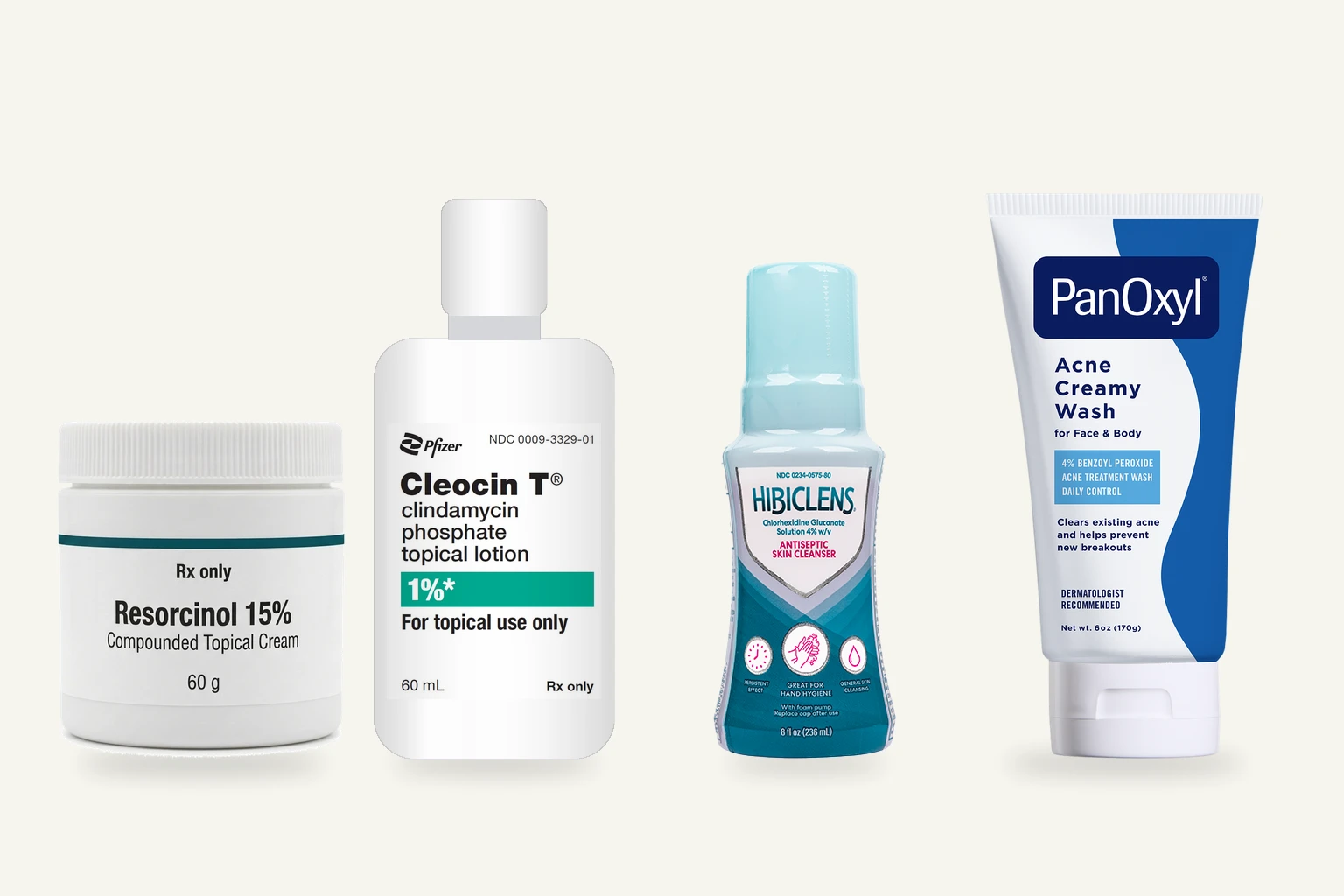
Left to right: illustrative compounded pharmacy jar (resorcinol 15% cream is prepared by licensed compounding pharmacies), Cleocin T (Pharmacia & Upjohn / Pfizer), Hibiclens (Molnlycke Health Care), and PanOxyl 4% (Crown Laboratories). Commercial products shown for identification. KindleeRx is not affiliated with these companies.
Topical Resorcinol 15% Versus Clindamycin 1% and Daily Washes for Hidradenitis Suppurativa

Chief Medical Officer
For mild-to-moderate hidradenitis suppurativa (HS), compounded topical resorcinol 15% cream is a leading non-antibiotic alternative to topical clindamycin 1%, helping unplug blocked hair follicles, shorten painful nodules, and avoid bacterial resistance (Molinelli 2022; Naik 2026). Topical clindamycin 1% still holds conditional backing in the October 2026 guidelines, and off-label topical ruxolitinib 1.5% cream now adds a third evidence-backed prescription option for milder flares without draining tunnels. Understanding how these topicals work alongside daily skin-fold habits helps keep Stage 1 and early Stage 2 HS calmer without overusing oral antibiotics.
In this article
How does topical resorcinol 15% compare with topical clindamycin 1% for hidradenitis suppurativa?
Topical clindamycin 1% was the original evidence-backed topical for HS after a 30-patient double-blind trial showed it outperformed placebo on pustules and patient ratings over 3 months (Clemmensen 1983) and a 46-patient trial found no major difference between topical clindamycin and oral tetracycline 500 mg twice daily (Jemec 1998). Its flaw shows up with repeated use: topical clindamycin targets surface bacteria without unplugging the blocked follicle, and bacteria adapt quickly. In a Johns Hopkins cross-sectional study of 239 HS patients, 63 in 100 patients using topical clindamycin grew clindamycin-resistant Staphylococcus aureus from lesions, versus 17 in 100 patients using no antibiotics (Fischer 2017).
Topical resorcinol 15% (1,3-dihydroxybenzene, prepared by a compounding pharmacy in the United States) takes a different route. It acts as a keratolytic peel, mild antiseptic, and local anti-inflammatory that breaks up keratin plugs at the mouth of the hair follicle. In an early Dutch series of 12 women with Stage 1 or 2 HS followed for at least a year, every patient reported less pain and shorter duration of painful nodules with self-applied 15% resorcinol (Boer 2010).
The largest direct comparison comes from an Italian 12-week retrospective study of 134 adults with mild-to-moderate HS (Hurley Stage 1 and Stage 2) comparing monotherapy with topical clindamycin 1% (73 patients) against topical resorcinol 15% cream (61 patients) (Molinelli 2022).
| Feature | Topical Resorcinol 15% Cream | Topical Clindamycin 1% | Topical Ruxolitinib 1.5% Cream (Opzelura) |
|---|---|---|---|
| October 2026 AAD/HSF guideline tier | Conditional recommendation for (Naik 2026) | Conditional recommendation for (Naik 2026) | Conditional recommendation for (Naik 2026) |
| Mechanism | Keratolytic follicle-unplugging peel plus local anti-inflammatory and antiseptic action | Topical lincosamide antibiotic targeting surface Gram-positive and anaerobic bacteria | Topical Janus kinase 1 and 2 anti-inflammatory inhibitor (off-label for HS) |
| Key clinical study results | 52 of 61 (85.3%) hit clinical response at week 12 in a retrospective study (Molinelli 2022); resorcinol 10% also beat clindamycin in a 60-patient randomized trial (Katoulis 2023) | 38 of 73 (52%) hit clinical response at week 12 in Molinelli 2022; beat placebo in a 30-patient trial (Clemmensen 1983) | In a 69-adult Phase 2 randomized trial (no draining tunnels), reduced lesion counts by 3.61 versus 2.42 on vehicle at week 16 with fewer flares (Porter 2026) |
| Antibiotic resistance risk | None | High: 63 in 100 grew resistant Staphylococcus aureus versus 17 in 100 off antibiotics (Fischer 2017) | None |
| Main side effects and limits | Peeling, mild burning/irritation, temporary brown skin staining; avoid large open wounds and pregnancy | Mild irritation (11 of 73 in Molinelli 2022); works best for superficial bumps, rarely deep tunnels; rare colitis warning on label (Cleocin T label) | Well tolerated in Phase 2 (zero severe drug-related events); carries class boxed warning on label; expensive without insurance (Opzelura label) |
Remember one critical nuance when reading Molinelli 2022: it was a retrospective chart review rather than a blinded randomized trial, so real-world differences in adherence and patient selection can amplify numbers. Even so, the 2023 prospective randomized trial of 60 Hurley Stage 1 patients confirmed that even a gentler 10% resorcinol cream outperformed topical clindamycin 1% lotion on lesion counts and quality of life through 24 weeks (Katoulis 2023).
Where does off-label topical ruxolitinib 1.5% cream fit in 2026?
Topical ruxolitinib 1.5% cream (Food and Drug Administration [FDA]-approved under the brand name Opzelura for eczema and nonsegmental vitiligo) earned a conditional recommendation for mild-to-moderate HS in the October 2026 joint guidelines (Naik 2026). That update follows the March 2026 Phase 2 randomized, double-blind, vehicle-controlled trial led by Martina Porter and colleagues in 69 adults with Hurley Stage 1 or Stage 2 HS (3 to 10 abscesses or nodules and no draining tunnels) (Porter 2026).
Applying 1.5% ruxolitinib cream twice daily for 16 weeks dropped active nodule and abscess counts by an average of 3.61 lesions, compared with 2.42 lesions on vehicle cream, with fewer flares and sustained control through week 32 on as-needed application (Porter 2026). No grade 3 or higher adverse events occurred during the blinded period. Practical caveats remain: it is still off-label for HS (making insurance coverage harder without a prior authorization), carries the FDA topical Janus kinase inhibitor boxed warning on its label (avoiding large body-surface areas above 20%), and was studied specifically in patients without draining tunnels (Opzelura label).
Which daily washes and region-based topicals do dermatologists use for hidradenitis suppurativa?
Almost every patient with HS asks which soap or wash to buy at the drugstore. Here is the honest clinical split between what dermatologists use in daily practice and what the October 2026 guideline graders found in formal trials:
- What the October 2026 guidelines concluded about washes: The 2019 North American guidelines noted that chlorhexidine, benzoyl peroxide, and zinc pyrithione washes were supported by expert opinion to lower surface bacterial load (Alikhan 2019 Part II). In October 2026, after applying strict randomized-evidence grading, the AAD and HSF panel classified chlorhexidine and benzoyl peroxide washes as insufficient evidence as standalone HS treatments (Naik 2026). That does not mean gentle antiseptic washes are harmful; it means washes are hygiene helpers, never a replacement for real medical therapy when nodules keep flaring.
- Why pairing benzoyl peroxide with topical clindamycin still makes sense: If you use topical clindamycin 1% lotion or gel, dermatologists routinely pair it with a brief benzoyl peroxide wash (4% to 5% in the shower, rinsed thoroughly so it doesn't bleach towels) to slow clindamycin-resistant Staphylococcus aureus buildup (Fischer 2017).
- The dermatologist "above the waist versus below the waist" pattern: Microbiome sequencing of clinically unaffected skinfolds in 60 HS patients confirmed that anaerobic bacteria increase significantly across HS folds, with a strong anatomic gradient heaviest in the gluteal cleft and groin compared with the underarms (Riverain-Gillet 2020). Informed by that regional bacterial difference, some dermatologists in everyday clinic practice pair topical clindamycin plus benzoyl peroxide wash above the waist (underarms and inframammary folds) while considering topical metronidazole (targeting anaerobic bacteria) below the waist (groin and buttocks). Patient surveys also note dilute bleach baths among commonly tried acute home remedies (Poondru 2023), typically diluted in dermatology practice as one-quarter to one-half cup of plain household 6% sodium hypochlorite bleach in a full 40-gallon bathtub for 5 to 10 minutes twice weekly and rinsed off afterward. Both below-the-waist topical metronidazole and dilute bleach baths are empirical clinic habits rather than formal October 2026 guideline recommendations.
- Zinc pyrithione wash (often sold as a mild anti-dandruff body wash) and chlorhexidine 4% wash remain popular gentle daily alternatives for sensitive groin skin that stings with benzoyl peroxide, keeping chlorhexidine strictly away from the eyes, ears, and mucous membranes.
What skin-fold drying and hair-removal habits reduce daily hidradenitis suppurativa friction?
Trapped sweat, skin-on-skin shear, and mechanical hair trauma trigger new follicular ruptures in HS-prone folds. Practical clinic habits borrowed from both HS patient care and intertrigo skin-fold drying protocols help protect calm skin between flares:
- Dry skin folds completely without harsh rubbing: Rough towel friction irritates tender nodules. Adapted from dermatology skin-fold drying practice for intertrigo, gently pat folds dry and finish with a hair dryer on the cool setting until the crease feels completely dry (the classic clinic test: dry enough that a facial tissue would not stick).
- Use soft, moisture-wicking barrier fabric: Smooth, breathable cotton or dedicated moisture-wicking fold liners placed under the breasts or in abdominal and groin creases cut both trapped sweat and skin-on-skin friction. Swap out tight synthetic leggings or chafing underwear seams.
- Skip close razor shaving and chemical hair removers: Razors nick plugged follicles and drive hairs back into irritated dermis, while chemical depilatory creams burn tender fold skin. Trim hair gently with clean electric clippers set slightly above the skin surface instead, or ask an in-person dermatologist about laser hair removal (conditionally recommended in the October 2026 guidelines) to reduce hair-follicle density permanently (Naik 2026).
- Pause irritating antiperspirants and heavy fragrances during flares: Switch to gentle, fragrance-free formulas or pause deodorant directly over open or acutely inflamed underarm nodules until skin calms down.
What peeling, staining, wound, and pregnancy cautions apply to resorcinol 15%?
Topical resorcinol 15% works like a controlled micro-peel, so knowing what is normal versus what means "stop and call" prevents surprises:
- Expected local reactions: In Molinelli 2022, among 61 patients using resorcinol 15% cream, 35 reported local peeling (desquamation), 25 noted temporary brown skin staining, and 21 had mild-to-moderate stinging or irritation, yet zero patients stopped treatment (Molinelli 2022). Brown discoloration fades after stopping; wear dark undergarments or protect light fabrics until the cream absorbs.
- How clinicians typically apply it: Most protocols apply a thin pea-sized dab once daily for maintenance on flare-prone intact skin and twice daily on an emerging tender nodule (Boer 2010). If peeling or soreness gets uncomfortable, stepping back to once daily or every other day usually restores comfort.
- Never spread resorcinol 15% over large open wounds or extensive ulcerated folds: Systemic toxicity from resorcinol is rare and linked mostly to high-concentration 40% to 50% peels or heavy absorption through large broken skin surfaces, so limit application to intact skin and small localized nodules (Molinelli 2022).
- Avoid during pregnancy and breastfeeding: Systemic absorption data in pregnancy remain limited, so dermatologists avoid topical resorcinol 15% during pregnancy and discuss pregnancy-safe alternatives instead.
- Watch for true allergic contact dermatitis: Resorcinol can occasionally trigger a spreading itchy, blistering allergic rash; if itching or rash spreads beyond the treated spot, wash it off and stop using it.
Important Information
This article is educational and is not medical advice. Topical resorcinol 15% cream is a compounded, off-label medication prepared by licensed United States compounding pharmacies under a prescriber's order; compounded medications are not approved or reviewed by the Food and Drug Administration for safety, effectiveness, or quality (FDA compounding guidance). Topical ruxolitinib 1.5% cream (Opzelura) and topical clindamycin 1% are also prescribed off-label for HS. KindleeRx is not affiliated with Incyte, Pharmacia & Upjohn (Pfizer), Molnlycke Health Care, Crown Laboratories, or any drug or cleanser manufacturer named in this article. Discuss pregnancy plans, open wounds, and skin sensitivities with a licensed clinician before starting any prescription topical.
Sources
- Molinelli E, Brisigotti V, Simonetti O, et al. Efficacy and safety of topical resorcinol 15% versus topical clindamycin 1% in the management of mild-to-moderate hidradenitis suppurativa: A retrospective study. Dermatologic Therapy 2022.
- Katoulis A, Efthymiou O, Liakou A, Pappa G, Kanelleas A, et al. Resorcinol 10% as a Promising Therapeutic Option for Mild Hidradenitis Suppurativa: A Prospective, Randomized, Open Study. Skin Appendage Disorders 2023.
- Boer J, Jemec GBE. Resorcinol peels as a possible self-treatment of painful nodules in hidradenitis suppurativa. Clinical and Experimental Dermatology 2010.
- Naik HB, Yeung H, Frazer-Green L, et al. Joint American Academy of Dermatology-Hidradenitis Suppurativa Foundation guidelines of care for the management of hidradenitis suppurativa. Journal of the American Academy of Dermatology 2026.
- Porter ML, et al. Efficacy and safety of ruxolitinib cream in patients with mild to moderate hidradenitis suppurativa: phase 2 randomized trial. Journal of the American Academy of Dermatology 2026.
- Fischer AH, Haskin A, Okoye GA. Patterns of antimicrobial resistance in lesions of hidradenitis suppurativa. Journal of the American Academy of Dermatology 2017.
- Clemmensen OJ. Topical treatment of hidradenitis suppurativa with clindamycin. International Journal of Dermatology 1983.
- Jemec GBE, Wendelboe P. Topical clindamycin versus systemic tetracycline in the treatment of hidradenitis suppurativa. Journal of the American Academy of Dermatology 1998.
- Riverain-Gillet É, Guet-Revillet H, Jais JP, Ungeheuer MN, et al. The Surface Microbiome of Clinically Unaffected Skinfolds in Hidradenitis Suppurativa. Journal of Investigative Dermatology 2020.
- Poondru S, Scott K, Riley JM. Patient perspectives of wound care management in hidradenitis suppurativa. Archives of Dermatological Research 2023.
- Alikhan A, Sayed C, Alavi A, et al. North American clinical management guidelines for hidradenitis suppurativa: Part II. Journal of the American Academy of Dermatology 2019.
- Incyte Corporation. OPZELURA (ruxolitinib) Cream Prescribing Information. DailyMed 2026.
- Pharmacia & Upjohn. CLEOCIN T (clindamycin phosphate) Topical Prescribing Information. DailyMed 2026.
- Food and Drug Administration. Understanding the Risks of Compounded Drugs.
Related Articles
Hidradenitis Suppurativa
Hibiclens, PanOxyl, Head & Shoulders, and Glycolic Acid for Hidradenitis Suppurativa: What Works and What Irritates
Nov 25, 2026 · 11 min read
Hidradenitis Suppurativa
Hidradenitis Suppurativa: The Complete 2026 Dermatologist Guide (Stages, Causes, and New Guidelines)
Nov 25, 2026 · 14 min read

Hidradenitis Suppurativa
Can Hidradenitis Suppurativa Be Treated Online? What Works Virtually, Costs Without Insurance, and When You Need an Office Visit
Nov 25, 2026 · 12 min read