
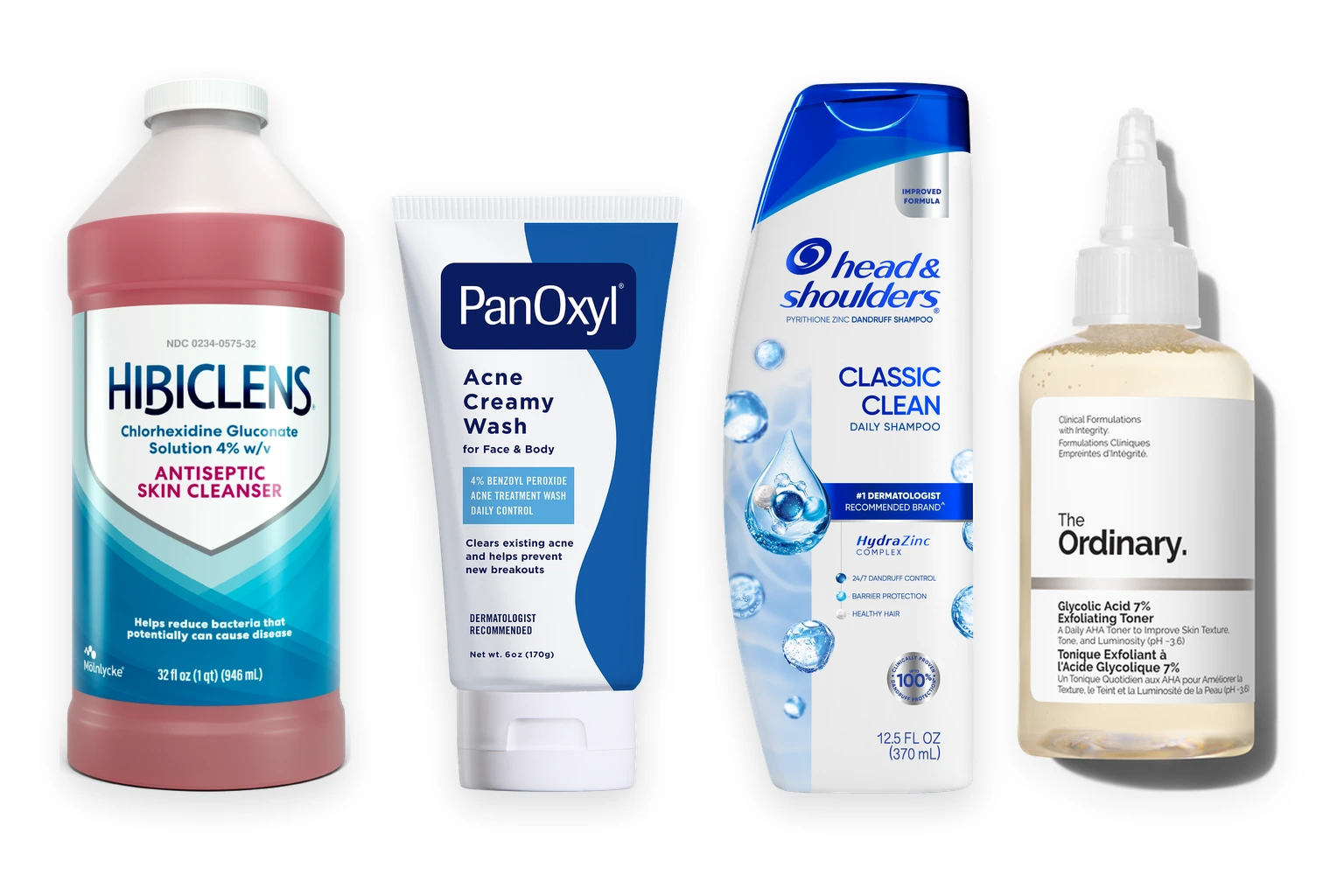
Images: Molnlycke Health Care (Hibiclens), Crown Laboratories (PanOxyl), Procter & Gamble (Head & Shoulders), and DECIEM (The Ordinary). Shown to identify the products. KindleeRx is not affiliated with these companies.
Hibiclens, PanOxyl, Head & Shoulders, and Glycolic Acid for Hidradenitis Suppurativa: What Works and What Irritates

Chief Medical Officer
Drugstore washes like Hibiclens, PanOxyl 4%, and pyrithione zinc shampoo (Head & Shoulders) can cut surface bacteria, reduce fold odor, and curb antibiotic resistance, but none of them replace prescription therapy when hidradenitis suppurativa (HS) nodules keep returning (Naik 2026). Walk into any online HS community and you will see dozens of competing shower routines stacking four cleansers, glycolic acid toner, and camphor ointment on top of raw skin. Knowing what each bottle does and where it causes chemical burns saves pain, money, and wasted months.
In this article
Can drugstore washes cure hidradenitis suppurativa on their own?
No over-the-counter (OTC) soap or body wash reaches deep inside a plugged, inflamed dermal hair follicle where HS nodules form. The 2019 North American clinical guidelines noted that chlorhexidine, benzoyl peroxide, and zinc pyrithione washes were supported by expert opinion to trim surface bacterial load (Alikhan 2019 Part II).
When the joint American Academy of Dermatology (AAD) and Hidradenitis Suppurativa Foundation (HSF) panel re-graded the randomized trial data in October 2026, they found insufficient evidence to recommend chlorhexidine or benzoyl peroxide washes as standalone HS therapies (Naik 2026). That update is freeing for patients who blame themselves when expensive washes fail to stop painful flares. Think of a gentle wash as daily fold hygiene and odor control, while prescription topicals (such as compounded resorcinol 15%, topical clindamycin 1%, or off-label topical ruxolitinib 1.5% cream) and targeted systemic medications carry the real anti-inflammatory load. Read our comparison of prescription topicals and washes.
How do Hibiclens, PanOxyl, and Head & Shoulders compare for daily shower care?
Each popular HS wash works differently, carries distinct irritation risks, and fits a specific zone of the body. Microbiome sequencing across 60 HS patients confirmed that skin-fold bacterial communities vary sharply by body region, with denser anaerobic bacteria in the groin and gluteal cleft than in the armpits (Riverain-Gillet 2020).
| Product (Active Ingredient) | Where It Helps Most | How to Use Safely | Key Cautions and Trade-Offs |
|---|---|---|---|
| Hibiclens Chlorhexidine gluconate 4% liquid | Broad surface antiseptic that binds briefly to outer skin to lower odor and surface bacteria on intact armpits, under-breast folds, and outer thighs (Alikhan 2019 Part II) | Lather gently with bare hands (no rough washcloths) on intact fold skin for 30 to 60 seconds, rinse thoroughly, and pat dry | Label warns not to use in the genital area, to keep out of eyes, ears, and mouth, and to avoid routine use on deep wounds; rare severe allergic reactions occur; daily overuse can dry folds (Hibiclens label) |
| PanOxyl Acne Creamy Wash Benzoyl peroxide 4% (gentler than 10% foaming wash) | Kills surface bacteria without inducing resistance; ideal shower partner if you apply prescription topical clindamycin 1% (Fischer 2017) | Apply a thin layer to intact armpits or chest folds for 1 to 2 minutes in the shower, then rinse completely and use white towels | Bleaches colored towels, bath mats, and underwear; 10% strength stings thin groin skin quickly, so most dermatologists start at 4% |
| Head & Shoulders Classic Clean Pyrithione zinc 1% shampoo used as fold wash | Mild antimicrobial and yeast-calming wash suited for sweaty under-breast folds, inner thighs, or skin irritated by Hibiclens or PanOxyl (Alikhan 2019 Part II) | Smooth gently over intact skin folds for 60 seconds during a warm shower and rinse well | Pick basic fragrance-light formulas over intense menthol variants, which burn sensitive groin or underarm skin |
| The Ordinary Glycolic Acid 7% Toner Alpha-hydroxy acid leave-on liquid | Cosmetic surface exfoliant popular online for smoothing follicular plugs, post-flare dark marks, and underarm odor on calm, unbroken skin | Test a small intact patch 2 nights per week after drying fully; stop immediately if stinging, peeling, or redness worsens | Zero published HS clinical trials; causes sharp chemical burning if applied over open, draining, or freshly shaved skin |
Is The Ordinary Glycolic Acid 7% toner safe for hidradenitis suppurativa skin folds?
Glycolic acid 7% became a viral HS forum favorite for a logical reason: HS begins with keratin plugs blocking hair-follicle openings, and dermatologists already rely on prescription keratolytic peels like compounded topical resorcinol 15% cream (which reached clinical response in 52 of 61 adults [85.3%] in a 12-week retrospective cohort) to unclog those follicular mouths (Molinelli 2022). Glycolic acid is a mild alpha-hydroxy acid that loosens surface dead skin cells and lowers skin-fold pH, which can also cut underarm odor.
Two critical caveats separate online hype from safe skin care:
- No clinical trial has tested glycolic acid 7% for HS: any benefit is cosmetic surface exfoliation on calm skin, not proven treatment of deep nodules or tunnels.
- Never put acidic toner on open sores or raw folds: thin armpit and groin skin absorbs leave-on acids rapidly, especially inside warm, occluded creases. Applying glycolic acid over a freshly drained opening, rubbed skin, or right after Hibiclens scrubbing commonly triggers painful irritant dermatitis that mimics a fresh flare. Limit testing to completely intact, quiet skin a few nights per week, and skip it entirely if you already use prescription resorcinol 15%.
What about Vicks VapoRub, drawing salves, and bleach baths during an acute flare?
Online forums frequently recommend Vicks VapoRub, black drawing salves (such as PRID or ichthammol), tea tree oil, witch hazel, Epsom salt soaks, and dilute bleach baths to "bring a boil to a head." In a United States cross-sectional survey of 302 adults with HS, warm compresses, Epsom salt baths, Vicks VapoRub, tea tree oil, witch hazel, and bleach baths ranked among the most widely tried acute home remedies (Poondru 2023).
Here is the plain clinical reality on each home remedy:
- Vicks VapoRub (camphor, menthol, eucalyptus oil): People report temporary numbing relief because menthol triggers cool-receptors on intact skin and thick petrolatum softens overlying dry skin. It does not treat deep HS inflammation, has zero controlled HS trial data, and causes intense stinging and contact allergy if smeared onto open, draining, or genital skin. Never apply camphor ointments to open wounds.
- Drawing salves (ichthammol or homeopathic salves): No evidence shows any salve "pulls" deep HS drainage safely to the surface. Occluding an inflamed fold with heavy tar-like salves often traps heat, irritates surrounding skin, and delays real medical relief like a gentle in-office steroid injection.
- Warm plain-water compresses: Far safer and better tolerated. Applying a clean, warm, damp washcloth for 10 to 15 minutes comforts tender unopened nodules without adding fragrance allergens or burns.
- Dilute bleach baths: Some dermatologists use gentle dilute bleach baths (one-quarter to one-half cup of plain unscented 6% household sodium hypochlorite bleach in a full 40-gallon bathtub for 5 to 10 minutes twice weekly, followed by a clean water rinse) empirically to lower surface bacterial burden, though in a 438-patient online pain survey respondents rated bleach baths lowest for direct pain relief (Fernandez 2022). Never use bleach directly on skin or over painful raw ulcerations.
How should you build a simple daily shower rotation without wrecking your skin barrier?
Stacking Hibiclens, PanOxyl 10%, glycolic acid, and scented body wash in the same week strips the skin barrier and provokes painful chafing flares. A calm, dermatologist-friendly routine stays remarkably simple:
- Pick one primary fold cleanser at a time: Choose PanOxyl 4% creamy wash if you use topical clindamycin 1% above the waist, Hibiclens 4% a few days a week on intact folds for odor and surface bacteria, or pyrithione zinc shampoo (Head & Shoulders Classic Clean) when skin feels raw or sensitive.
- Use bare hands, never loofahs or abrasive scrubs: Mechanical rubbing shears fragile hair follicles and seeds new flares. Wash gently with clean fingertips and lukewarm water.
- Dry folds completely without rubbing: Gently pat with a clean soft towel, then finish with a hair dryer on the cool setting until moisture disappears from the crease.
- Upgrade early when washes are not enough: If new painful lumps keep returning month after month despite clean daily habits, over-the-counter bottles have hit their ceiling. Pair this guide with our HS wound care and bandage guide and our online versus in-office HS care guide.
Important Information
This article is educational and is not personal medical advice. Over-the-counter cleansers, shampoos, cosmetic exfoliating toners, and camphor-menthol ointments are not approved by the Food and Drug Administration to treat or cure hidradenitis suppurativa. Always follow product label warnings, avoid using chlorhexidine gluconate in the genital area, eyes, ears, mouth, or routinely on deep wounds, and avoid acidic toners or menthol ointments on open or draining skin. KindleeRx is not affiliated with Molnlycke Health Care, Crown Laboratories, Procter & Gamble, DECIEM, or any brand named in this guide. Consult a licensed clinician for recurrent or worsening flares.
Sources
- Naik HB, Yeung H, Frazer-Green L, et al. Joint American Academy of Dermatology-Hidradenitis Suppurativa Foundation guidelines of care for the management of hidradenitis suppurativa. Journal of the American Academy of Dermatology 2026.
- Alikhan A, Sayed C, Alavi A, et al. North American clinical management guidelines for hidradenitis suppurativa: Part II. Journal of the American Academy of Dermatology 2019.
- Fischer AH, Haskin A, Okoye GA. Patterns of antimicrobial resistance in lesions of hidradenitis suppurativa. Journal of the American Academy of Dermatology 2017.
- Poondru S, Scott K, Riley JM. Patient perspectives of wound care management in hidradenitis suppurativa. Archives of Dermatological Research 2023.
- Fernandez JM, Thompson AM, Borgstrom M, Orenstein LAV, Hsiao JL, Shi VY. Pain management modalities for hidradenitis suppurativa: a patient survey. Journal of Dermatological Treatment 2022.
- Riverain-Gillet É, Guet-Revillet H, Jais JP, Ungeheuer MN, et al. The Surface Microbiome of Clinically Unaffected Skinfolds in Hidradenitis Suppurativa. Journal of Investigative Dermatology 2020.
- Molinelli E, Brisigotti V, Simonetti O, et al. Efficacy and safety of topical resorcinol 15% versus topical clindamycin 1% in the management of mild-to-moderate hidradenitis suppurativa: A retrospective study. Dermatologic Therapy 2022.
- Molnlycke Health Care US, LLC. HIBICLENS (chlorhexidine gluconate 4% solution) Drug Facts Label. DailyMed 2026.
Related Articles
Hidradenitis Suppurativa
Topical Resorcinol 15% Versus Clindamycin 1% and Daily Washes for Hidradenitis Suppurativa
Nov 25, 2026 · 14 min read
Hidradenitis Suppurativa
Hidradenitis Suppurativa Wound Care: Silicone Bandages, Hydrocolloids, Desitin 40% Zinc Oxide, Odor, and Everyday Comfort
Nov 25, 2026 · 10 min read
Hidradenitis Suppurativa
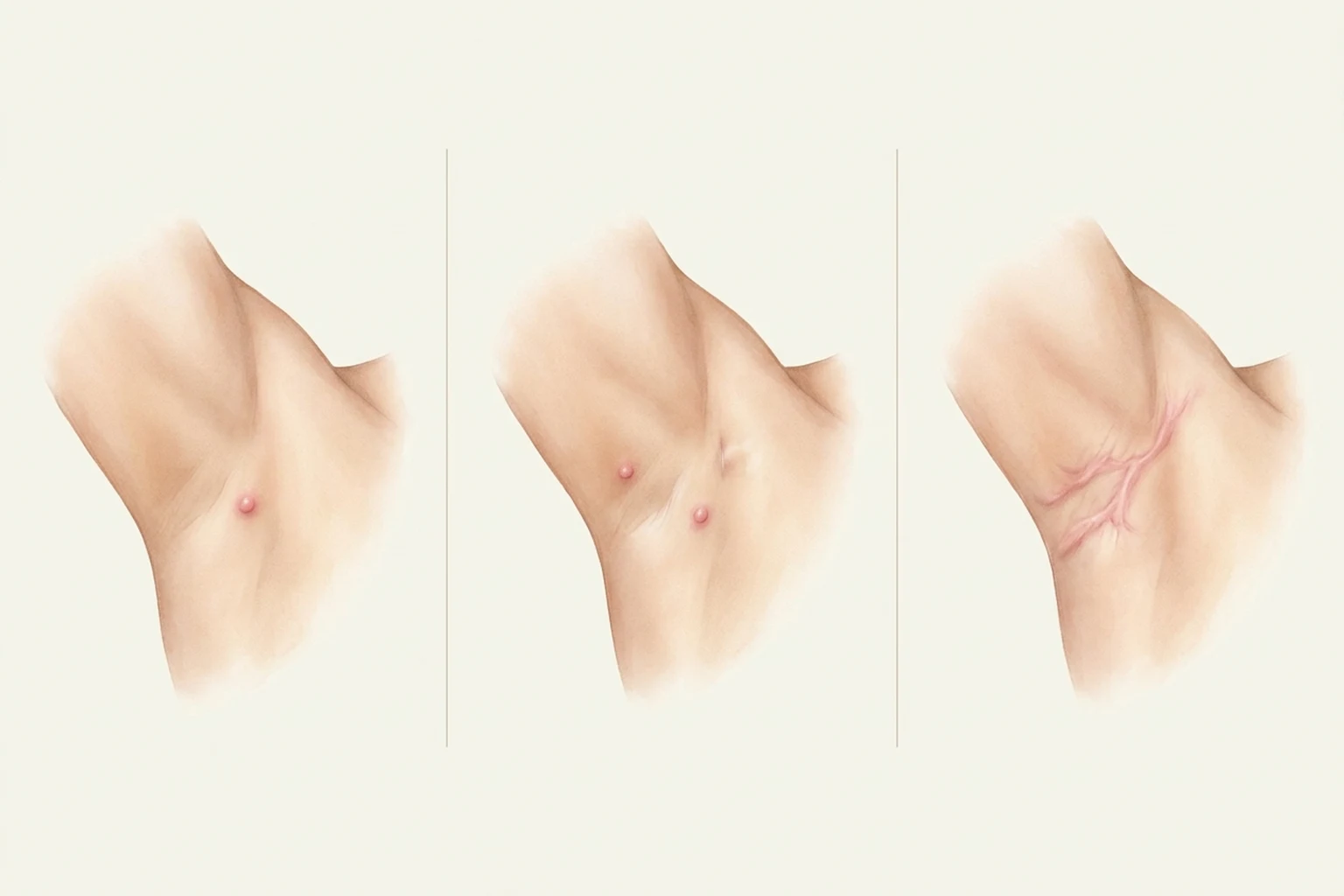
Hidradenitis Suppurativa: The Complete 2026 Dermatologist Guide (Stages, Causes, and New Guidelines)
Nov 25, 2026 · 14 min read