
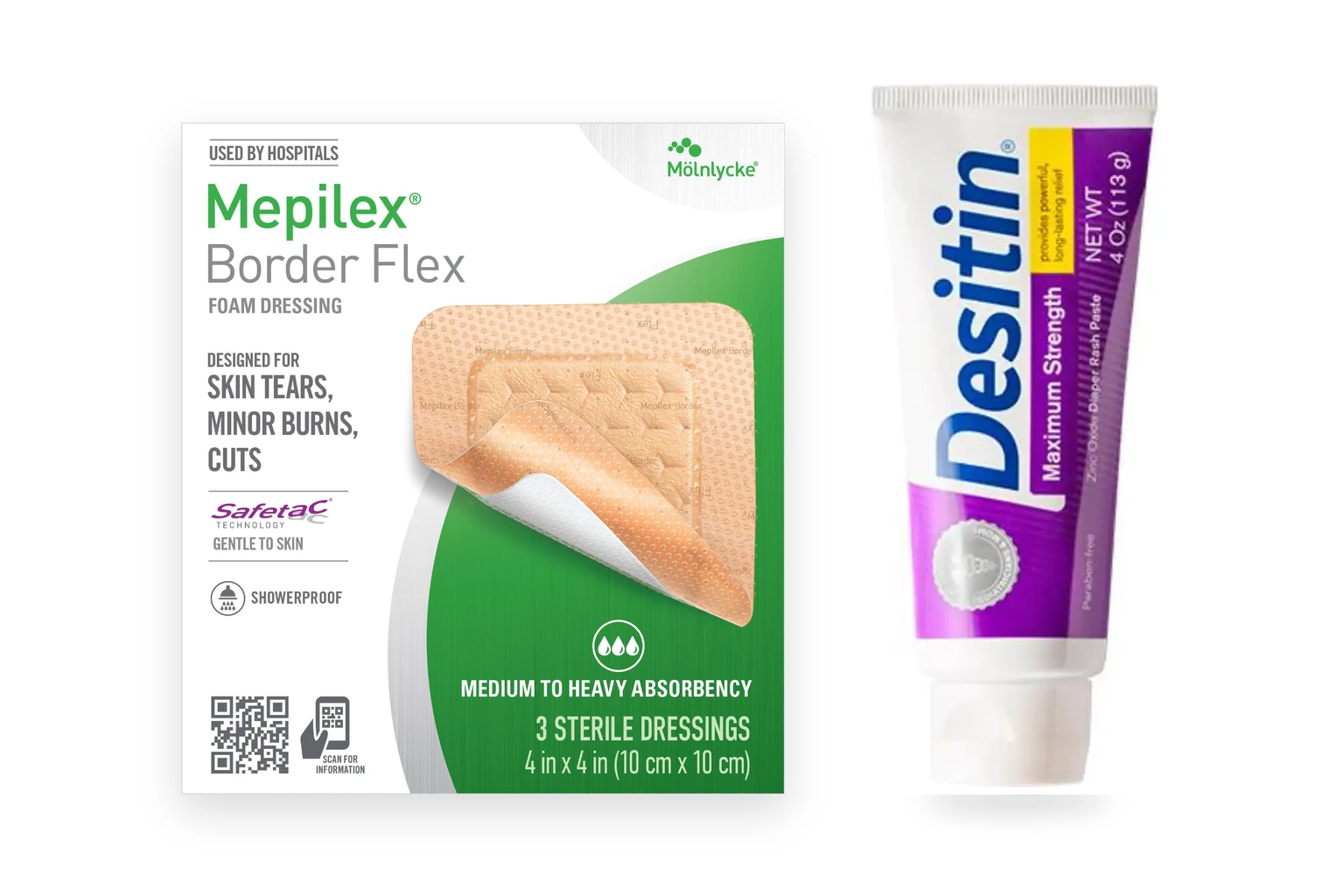
Images: Molnlycke Health Care (Mepilex Border Flex) and Kenvue (Desitin Maximum Strength). Shown to identify the products. KindleeRx is not affiliated with these companies.
Hidradenitis Suppurativa Wound Care: Silicone Bandages, Hydrocolloids, Desitin 40% Zinc Oxide, Odor, and Everyday Comfort

Chief Medical Officer
Effective hidradenitis suppurativa (HS) wound care matches dressing absorbency to drainage volume while keeping harsh acrylic glue off curved, moving skin folds (Swoboda 2025; Poondru 2023). Ask anyone living with draining armpit, groin, or under-breast flares what drains their energy fastest, and the answer is rarely a prescription bottle. Often it is finding a bandage that stays put while walking, absorbs fluid without leaking through clothes, and comes off at night without ripping raw skin.
In this article
Why do standard adhesive bandages fail in hidradenitis suppurativa folds?
Ordinary plastic drugstore bandages are engineered for flat forearms and dry scrapes, not curved, sweaty, hair-bearing folds that stretch hundreds of times a day. Standard acrylic adhesives pull away healthy top skin layers during frequent changes, creating painful medical adhesive-related skin injury (stripping, blistering, and raw borders) right next to an active flare.
In a United States online survey of 302 adults with HS, respondents frequently improvised with panty liners, menstrual pads, toilet paper, tissues, and ordinary gauze because clinic teams rarely taught practical fold-dressing setups (Poondru 2023). Nearly half of those answering about dermatologist care (48.8%, 103 respondents) reported that their dermatologist did not meet their wound-care needs. Tissues and toilet paper shed damp lint directly into open tracts, while dry woven cotton gauze sticks to drying drainage and tears fragile healing tissue on removal.
How do silicone foam dressings, non-stick gauze, and hydrocolloid patches compare?
The right dressing depends on how much fluid a flare produces and where it sits. International HS lesion-management best-practice guidance co-authored by wound-care specialists, surgeons, and HS dermatologists including Christopher Sayed emphasizes matching dressing absorbency to drainage, protecting surrounding skin from moisture damage, and choosing atraumatic borders that lift off comfortably (Swoboda 2025).
| Dressing Type | Best HS Use Case | Pros | Watch-Outs |
|---|---|---|---|
| Soft silicone-bordered foam (for example, Mepilex Border Flex) | Moderate-to-heavy draining nodules, armpits, groin, buttocks, and post-deroofing wounds | Flexes with curved folds, locks drainage away from skin, stays shower-resistant, and lifts off gently without tearing skin | Higher upfront box price unless bought in medical-supply multipacks or covered via durable medical equipment |
| Calcium alginate or hydrofiber pad + non-stick cover | Heavy weeping tracts and deeper open drainage spots | Turns liquid exudate into a soft gel that holds large fluid volume and slides out painlessly during changes | Needs a secondary cover (silicone border, paper tape, or snug cotton garment) to stay in place; skip on dry wounds |
| Non-stick pad (Telfa-style) + soft silicone tape or abdominal pad | Budget-friendly daily coverage for light-to-moderate flares | Inexpensive per dressing; glossy non-adherent film avoids ripping healing tissue when paired with a thin dab of plain petrolatum | Lower fluid capacity than foam; avoid cheap aggressive paper or cloth adhesive tapes on inflamed folds |
| Hydrocolloid bandage | Small, lightly weeping or closed friction-rubbed bumps on flatter skin | Smooth low-profile cushion that blocks clothing rub | Poor fit for heavy drainage or deep tunnels (fills fast, leaks odor, softens surrounding skin); never apply over suspected spreading cellulitis |
For curved spots where no adhesive holds cleanly (such as deep underarm hollows or inner groin creases), specialized seam-free HS wound-care garments (such as soft wrap-style underarm or groin pocket briefs) hold absorbent pads firmly in place with zero adhesive touching the skin. Even a smooth, clean, fragrance-free cotton liner tucked inside snug, seam-free boxer briefs can hold an absorbent pad cleanly on a budget without glue.
Does Desitin 40% zinc oxide paste help open hidradenitis suppurativa holes and chafed folds?
High-strength zinc oxide 40% barrier paste (such as Desitin Maximum Strength diaper rash paste) is one of the most talked-about pharmacy staples in HS communities, and dermatologists understand why it feels comforting.
- Where zinc oxide 40% paste works best: Spread thinly over intact skin surrounding a draining opening (the periwound border) and along chafed, damp skin folds. Zinc oxide creates a thick, breathable moisture shield that blocks alkaline wound fluid and sweat from burning nearby healthy skin, while cutting skin-on-skin friction.
- How to care for the open wound center itself: Keep deep open holes clean with lukewarm water or gentle sterile saline, then coat the raw base thinly with plain fragrance-free petroleum jelly (such as Vaseline) beneath a non-stick pad or silicone foam dressing. Avoid packing heavy opaque zinc paste deep inside a narrow draining tunnel, where it traps residue and makes clinicians' skin checks harder.
- How to remove thick paste gently: Never scrub dried zinc oxide off tender folds with soap and friction. Soften it first with a dab of plain mineral oil or petroleum jelly on a soft cloth, wipe gently, and rinse with lukewarm water.
How can you manage drainage odor, sweat, deodorant, and underwear safely?
Odor is one of the most emotionally exhausting parts of living with draining HS, yet patients rarely hear a reassuring, scientific explanation: HS odor does not mean you are unclean. Microbiome research across 60 HS patients showed that HS-prone folds carry elevated anaerobic bacteria (especially in the groin and gluteal areas), and anaerobic bacteria break down trapped protein-rich wound fluid into strong-smelling compounds (Riverain-Gillet 2020).
Practical daily adjustments lower odor and irritation together:
- Control drainage at the source first: Trapped stale fluid drives smell far more than fresh drainage. Swap damp dressings promptly, rinse folds gently after sweating, and dry thoroughly with a hair dryer on the cool setting.
- Choose deodorant carefully during underarm flares: Skip spray fragrances, baking-soda sticks (which raise skin pH and sting folds), and harsh essential oils over active bumps. Use mild, fragrance-free formulas only on intact skin around calm flares, and pause direct application over open weeping nodules until skin closes.
- Upgrade fabrics and underwear seams: Tight elastic leg bands sit directly across the inguinal crease, sawing into plugged hair follicles with every step. Switch to seamless, tagless, soft modal, bamboo, or breathable cotton boxer briefs or boyshorts whose leg hems sit comfortably below the groin crease.
- Treat recurring tunnels medically: If persistent foul-smelling drainage continues month after month from the same tunnel, washes and bandages are only managing symptoms. Pairing targeted medical therapy with in-office tunnel deroofing eliminates the mucus-lined pocket producing the drainage. See our clinic deroofing versus wide excision guide.
How can you reduce the monthly cost of hidradenitis suppurativa wound supplies?
Bandages add up rapidly when drainage lasts months. In the 2023 United States wound-care survey of 302 adults with HS, 135 respondents (nearly half) reported they could not afford the dressings they needed, with disproportionate cost strain among Black patients (Poondru 2023). Four strategies cut out-of-pocket costs dramatically:
- Ask your dermatologist for a written dressing prescription: Commercial insurance, Medicaid, and Medicare plans frequently cover silicone foam dressings, calcium alginate pads, and non-stick gauze through a durable medical equipment supplier when a clinician documents your HS diagnosis (L73.2), active draining wounds, and monthly dressing count.
- Use health savings or flexible spending accounts: Bandages, silicone foam dressings, gauze, medical tape, and zinc oxide ointment qualify as eligible medical expenses under standard United States tax-advantaged health accounts.
- Buy medical-grade dressings by the box from medical distributors, not small pharmacy 3-packs: Per-dressing costs for silicone foam borders and non-stick pads often drop by half or more when ordered in 10-count or 20-count clinical boxes online instead of single drugstore packets.
- Save expensive silicone foam for high-friction days: Use silicone foam borders for workdays, travel, and heavy drainage, while relying on low-cost non-stick pads tucked inside seamless cotton garments at home overnight.
Important Information
This guide is educational and is not personal medical advice. Wound-dressing selection should be tailored to drainage volume, allergy history, and infection status with a licensed clinician or wound-care specialist. Stop using any adhesive, cleanser, or barrier paste that causes worsening redness, blistering, or burning. KindleeRx is not affiliated with Molnlycke Health Care, Kenvue, or any dressing or skincare manufacturer named above. Seek prompt in-person evaluation for fever, rapidly spreading skin redness, severe pain, or non-healing ulcers.
Sources
- Poondru S, Scott K, Riley JM. Patient perspectives of wound care management in hidradenitis suppurativa. Archives of Dermatological Research 2023.
- Swoboda L, Chaffin AE, Horissian M, Kelso M, LeBlanc K, et al. Best practice in the management of hidradenitis suppurativa lesions. Journal of Wound Care 2025.
- Riverain-Gillet É, Guet-Revillet H, Jais JP, Ungeheuer MN, et al. The Surface Microbiome of Clinically Unaffected Skinfolds in Hidradenitis Suppurativa. Journal of Investigative Dermatology 2020.
Related Articles
Hidradenitis Suppurativa
Hibiclens, PanOxyl, Head & Shoulders, and Glycolic Acid for Hidradenitis Suppurativa: What Works and What Irritates
Nov 25, 2026 · 11 min read
Hidradenitis Suppurativa
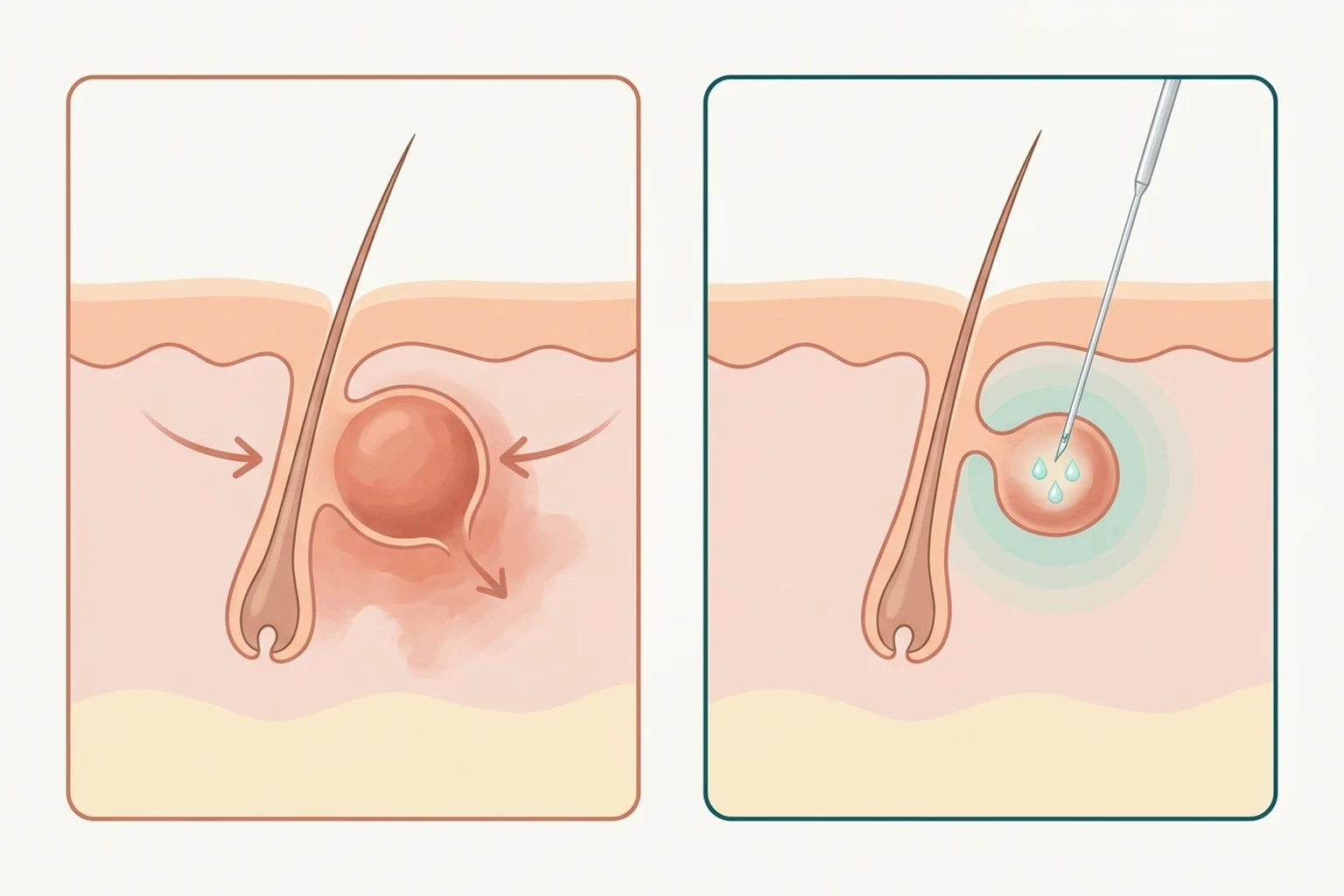
Should You Pop a Hidradenitis Suppurativa Boil? Steroid Shots, Urgent Care Lancing, and Safe Flare Relief
Nov 25, 2026 · 10 min read
Hidradenitis Suppurativa
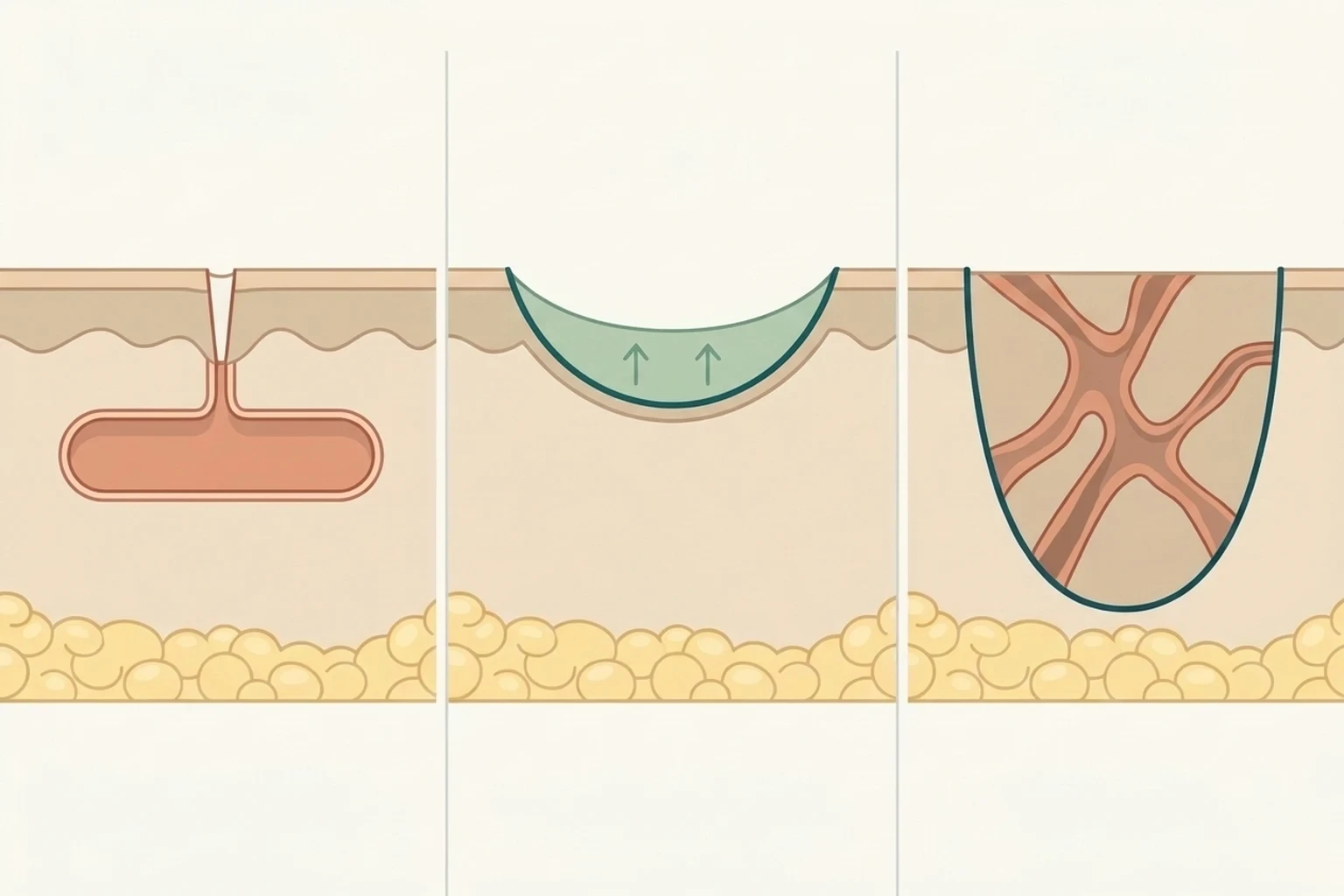
Hidradenitis Suppurativa Deroofing Versus Wide Excision Surgery: Recovery, Recurrence, and Weight-Denial Myths
Nov 25, 2026 · 10 min read