
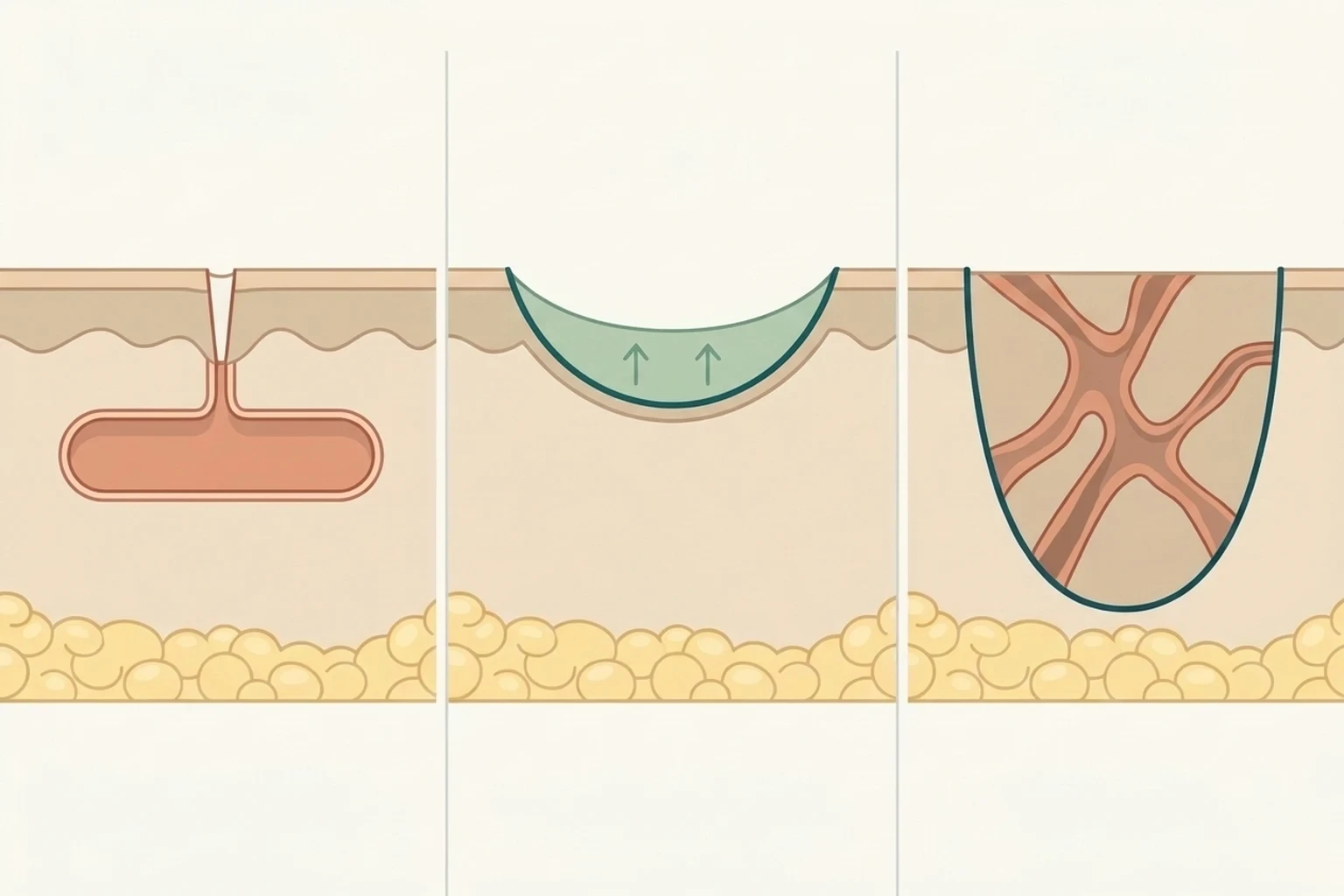
Artificial intelligence-generated image. Not an actual patient or treatment result.
Hidradenitis Suppurativa Deroofing Versus Wide Excision Surgery: Recovery, Recurrence, and Weight-Denial Myths

Chief Medical Officer
For hidradenitis suppurativa (HS) tunnels that drain repeatedly in the exact same spot, tissue-sparing clinic deroofing under local anesthesia removes the roof of the tract permanently with far less downtime than most patients fear, while wide excision tackles extensive interconnected Stage 3 scarring (Ravi 2022; Shams 2025 Procedures). Many people avoid surgical conversations for years because they picture a hospital operating room, skin grafts, and months in bed. Modern dermatologic HS surgery looks completely different for most patients.
In this article
Why do recurring hidradenitis suppurativa tunnels need surgery instead of more antibiotics?
Once a deep nodule forms a sinus tract (an epithelial-lined tunnel beneath the skin surface), medications can quiet the inflammation around that tunnel, but pills and biologics rarely erase an established scar tube completely. Skin cells lining the inside of the tunnel keep shedding keratin and trapping fluid, which is why the same spot swells, drains, flattens, and refills month after month.
Dermatologists combine medical therapy (to quiet whole-body inflammation and stop new areas from forming) with procedural removal (to eliminate old fixed tunnels permanently) (Shams 2025 Procedures). One practical clinical tip before any surgical visit: ask your clinician to map the exact recurring spot with you using a handheld mirror while you point to the flare that bothers you most, since quiet scars look smaller on exam day than they feel during an active flare.
What is clinic deroofing and how does it compare with wide excision?
Not all HS surgery means major hospital excision. Dermatologic surgeons match the procedure directly to whether you have isolated Stage 1 or Stage 2 tracts versus dense, matted Stage 3 plaques (Shams 2025 Procedures; Hamad 2020).
| Procedure | How It Works | Setting & Healing | Published Recurrence & Best Fit |
|---|---|---|---|
| Clinic deroofing (electrosurgical or scissor unroofing) | Under local numbing, the surgeon gently explores every tunnel branch with a blunt probe, removes only the "roof" of skin above the tract, and cleans away gelatinous tissue while preserving the healthy floor | Awake office visit; left open to heal flat from the bottom up (secondary intention) with simple petrolatum and non-stick dressings over several weeks | 17% lesion recurrence (15 of 88) over median 34 months in Dutch series (van der Zee 2010); ideal for fixed recurrent Stage 1 and Stage 2 nodules or tunnels |
| Local or regional excision | Removes an entire clustered patch of scarred skin and subcutaneous tunnels down to healthy fat | Office or outpatient surgery center; left open to heal by secondary intention or partially closed | In classic surgical follow-up, 42.8% recurred after limited regional excision versus 100% after simple drainage (Ritz 1998); fits stubborn localized plaques |
| Wide excision (with open healing, flap, or graft) | Removes an entire heavily scarred anatomic fold (such as an entire Stage 3 armpit, groin, or genital plaque) with clean surgical margins | Operating room; often coordinated with plastic, colorectal, or urologic reconstruction for complex genital or perineal areas (Hamad 2020) | Lowest local recurrence (27% in classic radical excision series; Ritz 1998), traded against longer wound healing |
Why do dermatologists usually leave deroofing wounds open without stitches? Sewing an inflamed, bacteria-colonized HS fold shut traps deep fluid, splits open frequently, and hides missed side-branches. Leaving a smooth saucer-shaped wound open lets fresh pink skin grow cleanly across from the edges and bottom, leaving a surprisingly flat, flexible scar that stretches comfortably as you move your arm or leg.
How painful is clinic hidradenitis suppurativa surgery recovery and how many workdays do people miss?
The most detailed real-world patient-experience data come from the University of North Carolina (UNC) HS specialty clinic under Christopher Sayed, published in JAMA Dermatology (Ravi 2022). Researchers evaluated 194 clinic-based deroofing and excision procedures across 78 patients ages 12 and older:
- Fast return to daily life: patients missed a median of 2 days of work or school (the middle half ranged from 1 to 7 days) and returned to normal activities at a median of 10 days (middle half ranged from 3 to 14 days).
- Less painful than an active HS flare: for 126 of 194 procedures (65%), patients reported that pain during a typical HS flare was worse than their surgical recovery pain.
- High satisfaction even when nearby skin still flares: patient-reported recurrence at or near the surgical site was 41% (79 of 194 procedures) in this single-center retrospective cohort, yet 148 of 194 procedures (76%) were rated very satisfied by patients because eliminating chronic painful tunnels brought substantial relief.
For postoperative care after open deroofing, keeping the healing base clean and moist with plain petroleum jelly and a gentle non-stick or silicone foam dressing keeps changes comfortable. Read our HS wound care and bandage guide.
Should high body mass index or smoking disqualify you from hidradenitis suppurativa surgery?
Thousands of patients on HS forums share the same devastating story: a general surgeon took one look at their weight chart or smoking history and refused to operate until they lost 50 pounds or quit smoking completely.
A landmark 2025 JAMA Dermatology review by Rayad Shams and Christopher Sayed audited 12 published HS surgical studies specifically testing whether obesity, diabetes, or smoking raised surgical complication rates (Shams 2025 Review):
- Smoking: zero studies evaluating smoking found increased HS surgical complication risks. (Quitting smoking still improves long-term HS inflammation and general health, so it remains worth supporting, but it should not automatically bar a patient from clinic deroofing.)
- Obesity and body mass index (BMI): only 3 of 10 studies reported modest links to complications (wound separation, delayed healing, or hospital readmission across debridement [deroofing or excision without flap or graft], flap reconstruction, or skin-graft techniques), while 7 of 10 studies found no increased risk.
- Diabetes: 1 of 5 studies reported higher hospital readmissions after debridement or flap reconstruction, making reasonable blood-sugar management sensible before major operating-room closures.
If a surgeon gives you a blanket BMI cutoff for a straightforward draining tunnel, seek a second opinion from a dermatologic surgeon listed in the Hidradenitis Suppurativa Foundation provider directory who performs awake office deroofing regularly.
Should you stop your biologic before hidradenitis suppurativa surgery?
Patients on Humira, Cosentyx, or Bimzelx frequently worry that stopping injections before surgery will trigger a massive flare, while non-specialist surgeons sometimes insist on holding biologics for weeks out of habit.
The October 20, 2026 joint American Academy of Dermatology (AAD) and Hidradenitis Suppurativa Foundation (HSF) guidelines specifically address perioperative care and issue a conditional recommendation to continue adalimumab through HS surgery rather than pausing therapy (Naik 2026). Keeping inflammation suppressed before and during surgery often shrinks the surgical footprint and reduces surrounding flare activity. Always confirm exact timing with both your dermatologist and your surgeon, especially if you take an oral Janus kinase (JAK) inhibitor or undergo complex multi-stage reconstruction. See our 2026 HS biologic ladder guide.
Important Information
This article is educational and is not surgical or personal medical advice. Surgical choices, anesthesia type, healing timelines, and perioperative medication timing depend on lesion anatomy, comorbidities, and individual medical evaluation. Discuss bleeding risks, infection signs, and wound-care plans directly with a qualified board-certified dermatologist or surgeon.
Sources
- Ravi S, Miles JA, Steele C, Christiansen MK, Sayed CJ. Patient Impressions and Outcomes After Clinic-Based Hidradenitis Suppurativa Surgery. JAMA Dermatology 2022.
- van der Zee HH, Prens EP, Boer J. Deroofing: a tissue-saving surgical technique for the treatment of mild to moderate hidradenitis suppurativa lesions. Journal of the American Academy of Dermatology 2010.
- Shams RB, Sayed CJ. Hidradenitis Suppurativa Surgery Complication Rates Among Patients With Obesity or Diabetes or Who Smoke: A Review. JAMA Dermatology 2025.
- Shams RB, Milanovic S, Sayed CJ. Procedural Interventions for Hidradenitis Suppurativa. Dermatologic Clinics 2025.
- Ritz JP, Runkel N, Haier J, Buhr HJ. Extent of surgery and recurrence rate of hidradenitis suppurativa. International Journal of Colorectal Disease 1998.
- Naik HB, Yeung H, Frazer-Green L, et al. Joint American Academy of Dermatology-Hidradenitis Suppurativa Foundation guidelines of care for the management of hidradenitis suppurativa. Journal of the American Academy of Dermatology 2026.
- Hamad J, McCormick BJ, Sayed CJ, Paci K, Overton M, et al. Multidisciplinary Update on Genital Hidradenitis Suppurativa: A Review. JAMA Surgery 2020.
- Hidradenitis Suppurativa Foundation. Provider Directory and Clinic Resources.
Related Articles
Hidradenitis Suppurativa
Should You Pop a Hidradenitis Suppurativa Boil? Steroid Shots, Urgent Care Lancing, and Safe Flare Relief
Nov 25, 2026 · 10 min read
Hidradenitis Suppurativa
Humira, Cosentyx, Bimzelx, and Rinvoq for Hidradenitis Suppurativa: The 2026 Targeted Therapy Ladder
Nov 25, 2026 · 16 min read
Hidradenitis Suppurativa
Hidradenitis Suppurativa Wound Care: Silicone Bandages, Hydrocolloids, Desitin 40% Zinc Oxide, Odor, and Everyday Comfort
Nov 25, 2026 · 10 min read