
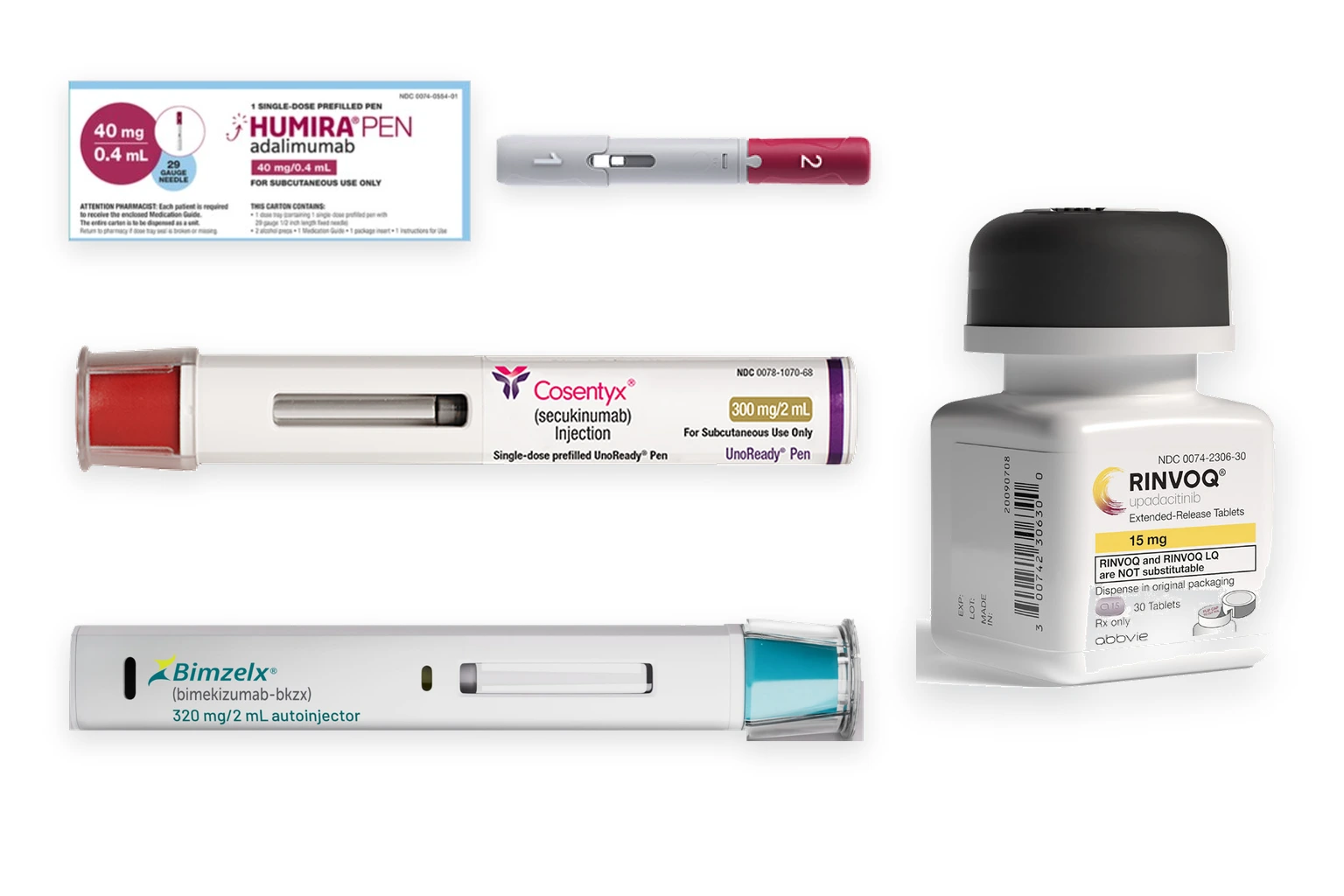
Images: AbbVie (Humira and Rinvoq; 15 mg bottle shown for identification), Novartis (Cosentyx), and UCB (Bimzelx). Shown to identify the products. KindleeRx is not affiliated with these companies.
Humira, Cosentyx, Bimzelx, and Rinvoq for Hidradenitis Suppurativa: The 2026 Targeted Therapy Ladder

Chief Medical Officer
Moderate-to-severe hidradenitis suppurativa (HS) no longer relies on a single injection: as of late 2026, three Food and Drug Administration (FDA)-approved biologics (Humira, Cosentyx, and Bimzelx) plus intravenous infliximab hold strong backing from the October 20, 2026 joint American Academy of Dermatology (AAD) and Hidradenitis Suppurativa Foundation (HSF) guidelines, with off-label oral Rinvoq conditionally recommended when biologics fall short or inflammatory conditions overlap (Naik 2026). Starting a targeted systemic medication earlier in Hurley Stage 2 and Stage 3 disease protects skin from irreversible tunneling and scarring far better than cycling through years of failing antibiotics.
In this article
Which biologics are Food and Drug Administration-approved and strongly recommended for hidradenitis suppurativa in 2026?
Four biologic therapies earned strong recommendations in the October 20, 2026 joint guidelines for moderate-to-severe HS, targeting two major inflammatory pathways: tumor necrosis factor alpha (TNF-alpha) and interleukin-17 (IL-17) (Naik 2026).
- Adalimumab (Humira and FDA-approved biosimilars): First-line TNF-alpha blocker approved for moderate-to-severe HS in patients ages 12 and older weighing 30 kg or more (weekly 40 mg maintenance dosing in adults) (Humira label). Adalimumab also holds the strongest perioperative surgical evidence, with October 2026 conditionally recommending continuing adalimumab through HS surgery rather than pausing injections (Naik 2026).
- Secukinumab (Cosentyx): Selective interleukin-17A (IL-17A) blocker approved for adults in October 2023 and expanded by the FDA on March 13, 2026 to adolescents ages 12 and older weighing 30 kg or more, making it the first pediatric IL-17 biologic for HS (adult dosing starts with 300 mg weekly loading doses at Weeks 0, 1, 2, 3, and 4, followed by 300 mg every 4 weeks with an option to step up to every 2 weeks) (Cosentyx label).
- Bimekizumab (Bimzelx): Dual IL-17A and interleukin-17F (IL-17F) blocker approved by the FDA on November 20, 2024 for adults with moderate-to-severe HS (320 mg every 2 weeks through week 16, then every 4 weeks) (Bimzelx label).
- Infliximab (Remicade and biosimilars): Intravenous TNF-alpha infusion prescribed off-label for severe HS, allowing weight-based dose adjustments for patients with higher body weight or aggressive draining tunnels (Grant 2010; Naik 2026).
How do Humira, Cosentyx, Bimzelx, infliximab, and Rinvoq compare in clinical trials?
No head-to-head trial has directly randomized Humira, Cosentyx, Bimzelx, infliximab, and Rinvoq against one another in HS. Each trial enrolled slightly different mixes of Hurley Stage 2 and Stage 3 patients and assessed the primary endpoint (Hidradenitis Suppurativa Clinical Response [HiSCR50]: at least a 50% drop in abscesses and inflammatory nodules with no rise in abscesses or draining tunnels) at week 12 or week 16.
| Therapy (Target) | 2026 FDA & Guideline Status | Key Trial Response (Plain Counts) | Practical Pros & Safety Notes |
|---|---|---|---|
| Adalimumab (Humira / biosimilars) TNF-alpha blocker | FDA-approved (ages 12+, 30 kg+); Strong 2026 recommendation (Naik 2026) | Week 12 HiSCR50: 42 in 100 (41.8%) versus 26 in 100 (26.0%) in PIONEER I (307 adults); 59 in 100 (58.9%) versus 28 in 100 (27.6%) in PIONEER II (326 adults) (Kimball 2016) | Longest safety track record; can be continued through HS surgery; treats coexisting Crohn disease; screen for tuberculosis and hepatitis; serious infection and lymphoma boxed warnings (Humira label) |
| Secukinumab (Cosentyx) IL-17A blocker | FDA-approved (adults; expanded March 13, 2026 to ages 12+, 30 kg+); Strong 2026 recommendation | Week 16 HiSCR50 (1,084 adults across 2 trials): SUNSHINE every-2-week 45 in 100 versus 34 in 100 placebo (every-4-week 42 in 100 did not separate reliably); SUNRISE every-2-week 42 in 100 and every-4-week 46 in 100 versus 31 in 100 placebo (Kimball 2023) | Less frequent maintenance injections (every 2 to 4 weeks after weekly loading) and low reported anti-drug antibody rate (under 1 in 100, subject to standard assay drug-interference limits); monitor closely for inflammatory bowel disease flares and mucocutaneous yeast infections (Cosentyx label) |
| Bimekizumab (Bimzelx) Dual IL-17A + IL-17F blocker | FDA-approved (adults 18+, November 20, 2024); Strong 2026 recommendation | Week 16 HiSCR50 (1,014 adults across 2 trials): BE HEARD I every-2-week 138 of 289 (48%) versus 21 of 72 (29%) placebo (every-4-week arm missed statistical separation); BE HEARD II every-2-week 151 of 291 (52%) and every-4-week 77 of 144 (54%) versus 24 of 74 (32%) placebo (Kimball 2024). In the 2-year open-label extension (446 adults reaching Year 2), 85 in 100 completers held HiSCR50 and 44 in 100 held HiSCR100 (100% abscess and inflammatory nodule clearance) (Sayed 2026) | Deep responses sustained through 2 years without rising overall adverse-event rates; higher rate of oral thrush (candidiasis) than selective IL-17A blockers; label also carries warnings for suicidal ideation screening, liver enzyme elevation, and inflammatory bowel disease (Bimzelx label) |
| Infliximab (Remicade) Intravenous TNF-alpha blocker | Off-label for HS; Strong 2026 recommendation (Naik 2026) | In a randomized crossover trial of 38 moderate-to-severe HS patients, significantly more infliximab patients hit at least 50% severity reduction at week 8 with pain and inflammatory-marker drops (Grant 2010) | Weight-based intravenous dosing helps severe heavy-burden HS; requires infusion-center visits; chimeric mouse-human antibody can trigger anti-drug antibodies and fading response over time (Remicade label) |
| Upadacitinib (Rinvoq) Oral JAK inhibitor | Off-label for HS; Conditional 2026 recommendation (Naik 2026) | Phase 2 randomized trial (47 on 30 mg daily, 21 on placebo): 38 in 100 (38.3%) reached week-12 HiSCR50 versus a 25 in 100 (25.0%) prespecified historical placebo benchmark (exploratory adjusted gap 14.7 percentage points versus in-trial placebo), sustained through week 40 (Ackerman 2025) | Once-daily pill that also treats coexisting eczema, psoriatic arthritis, or Crohn disease; carries FDA JAK boxed warnings (serious infections, higher all-cause mortality, blood clots, major cardiovascular events, malignancy) and requires baseline and follow-up lab monitoring (Rinvoq DailyMed label) |
Where does oral Rinvoq (upadacitinib) fit alongside hidradenitis suppurativa biologics in 2026?
Unlike Humira, Cosentyx, Bimzelx, and infliximab (which are injected or infused biologic antibodies targeting specific outside cytokines), Rinvoq (upadacitinib) is a once-daily oral Janus kinase (JAK) inhibitor that dampens multiple inflammatory signals inside immune cells at once. It belongs directly on the 2026 targeted therapy ladder rather than as an afterthought, with three clear facts separating it from the approved biologics:
- Current approval and Phase 3 status: As of late 2026, upadacitinib remains off-label for HS while earning a conditional recommendation in the October 20, 2026 joint guidelines (Naik 2026). AbbVie's global Phase 3 Step-Up HS trial (NCT05889182, target enrollment 1,328 adults and adolescents ages 12 and older who previously failed anti-TNF-alpha therapy) is active and no longer recruiting, with formal Phase 3 results still pending (Step-Up HS NCT05889182).
- Where dermatologists reach for oral Rinvoq: Phase 2 HS data studied 30 mg once daily, and specialists reach for upadacitinib primarily after patients fail or lose response to TNF-alpha and IL-17 biologics, or when one daily pill can simultaneously address HS plus an overlapping FDA-approved condition such as atopic dermatitis, psoriatic arthritis, ulcerative colitis, Crohn disease, or nonsegmental vitiligo (approved November 23, 2026), keeping in mind that FDA-approved dosing depends on diagnosis (for example, 15 mg once daily for psoriatic arthritis and nonsegmental vitiligo, versus 15 mg or 30 mg maintenance in atopic dermatitis or inflammatory bowel disease) (Ackerman 2025; AbbVie Rinvoq Prescribing Information, November 2026).
- Monitoring and safety trade-offs: Because oral JAK inhibitors carry FDA boxed warnings for serious infections, higher all-cause mortality, blood clots (thrombosis), major adverse cardiovascular events, and malignancy, the prescribing label directs baseline checks for tuberculosis, viral hepatitis, complete blood counts, liver enzymes, and pregnancy status when applicable before starting, followed by lipid testing approximately 12 weeks after initiation and periodic lab monitoring thereafter (AbbVie Rinvoq Prescribing Information, November 2026).
Which biologics and pills do the October 2026 guidelines advise avoiding?
One of the biggest practical upgrades in the October 20, 2026 guidelines is spelling out what not to waste months trying (Naik 2026). Many patients and non-specialist clinics assume that any blockbuster psoriasis biologic will automatically clear HS. Clinical trials proved otherwise.
The October 2026 joint panel issued conditional recommendations against using the following agents as primary HS therapy:
- Etanercept (Enbrel): Even though it blocks TNF-alpha like Humira, etanercept failed to outperform placebo in HS clinical trials.
- Interleukin-23 biologics (guselkumab [Tremfya] and risankizumab [Skyrizi]): Both are powerhouse psoriasis therapies, yet dedicated Phase 2 HS trials failed to meet their primary endpoints.
- Older conventional immunosuppressants (methotrexate and azathioprine): Both carry substantial toxicity without reliable primary HS efficacy (though a specialist may occasionally pair low-dose methotrexate with infliximab strictly to reduce anti-drug antibodies).
- Oral retinoids (isotretinoin and acitretin): Calling HS "acne inversa" misleads patients into asking for Accutane; October 2026 recommends against both oral retinoids as standalone HS therapy.
- Complement blockers vilobelimab and avacopan: Conditionally recommended against based on current evidence.
How do dermatologists handle biologic failure, paradoxical rashes, and switching?
Even the best biologic leaves roughly half of moderate-to-severe HS patients short of complete clearing at week 16. Experienced dermatologists anticipate three real-world situations instead of declaring defeat:
- Switching classes when primary or secondary failure hits: Real-world durability matters too. In a 2026 three-center academic cohort of 135 adults starting adalimumab as their first biologic (co-authored by University of North Carolina [UNC] HS specialist Christopher Sayed and colleagues), advancing to Hurley Stage 3 was independently linked to shorter treatment durability, reinforcing why delaying targeted care until extensive scarring sets in makes disease harder to hold long term (Young 2026). If Humira never gains traction after 12 to 16 weeks (or fades after a year as drug levels dip), switching pathways to an IL-17 blocker (Cosentyx or Bimzelx) or to weight-based intravenous infliximab is now standard. In complex patients juggling overlapping autoimmune conditions (for example, HS alongside psoriatic arthritis, pyoderma gangrenosum, or inflammatory bowel disease), oral upadacitinib 30 mg daily has emerged as a top dermatologist-preferred JAK option because one daily pill calms multiple inflammatory pathways simultaneously (Ackerman 2025). See also our 2026 HS pipeline and refractory care guide covering oral povorcitinib, golimumab, and dual targeted therapy.
- Spotting paradoxical psoriasis on biologics: Blocking TNF-alpha can paradoxically trigger new plaque or palmar-plantar psoriasis. In a clinical database of 83 HS patients on adalimumab, 10 of 83 (12%) developed paradoxical psoriasis after a median of 7 months, and switching to an IL-17 blocker (secukinumab in 8 of 10) cleared or improved the rash while keeping HS controlled in most cases (Tsiogka 2023). Rare paradoxical scalp psoriasis can also appear on secukinumab in dermatology practice, prompting careful re-evaluation of the rash and biologic class.
- Screening for inflammatory bowel disease before choosing IL-17 blockers: Patients with HS carry a higher baseline rate of Crohn disease and ulcerative colitis. Since IL-17 inhibitors (Cosentyx and Bimzelx) can provoke or worsen inflammatory bowel disease, clinicians screen for chronic diarrhea, rectal bleeding, or unexplained weight loss and prefer a TNF-alpha blocker (Humira or infliximab) or upadacitinib when bowel disease is suspected (Cosentyx label).
Why are placebo response rates so high in hidradenitis suppurativa clinical trials?
Patients reading Phase 3 drug charts often wonder why roughly 3 in 10 people taking saltwater placebo injections hit the 50% lesion-reduction mark in PIONEER, SUNSHINE, SUNRISE, and BE HEARD (Kimball 2016; Kimball 2023; Kimball 2024).
HS naturally waxes and wanes. Patients tend to enroll in a clinical trial right at the crest of a miserable flare, and several painful nodules naturally drain and soften over the next 12 to 16 weeks ("regression to the mean"). Trial protocols also supply daily antiseptic washes, wound guidance, and frequent specialist visits to everyone, including the placebo group (Garg 2024). Judging any HS biologic means looking at how far the drug beats placebo (roughly 11 to 31 percentage points across statistically significant Phase 3 arms) and how steadily it holds flare control through weeks 48 to 52, not judging a single raw percentage in isolation.
How can you appeal a hidradenitis suppurativa biologic step-therapy denial?
Insurance plans routinely deny first-time prescriptions for Humira biosimilars, Cosentyx, Bimzelx, or off-label Rinvoq on the first pass, demanding months of additional oral antibiotics or drugs the patient already tried years ago. Two tools dramatically raise approval odds:
- Cite the October 20, 2026 AAD and HSF step-therapy policy directly: The guidelines state plainly that mandatory step therapy lacks evidence of clinical benefit in HS and causes harmful delays that allow permanent scarring (Naik 2026).
- Ask your dermatologist to use pre-built HSF appeal templates: The Hidradenitis Suppurativa Foundation Clinician Resources Hub provides drug-specific prior authorization and appeal letter templates pairing your diagnosis code (L73.2), Hurley stage, documented past antibiotics and topicals, emergency-room or lancing history, and daily pain impact.
Important Information
This article summarizes published clinical trials, FDA prescribing labels, and the October 20, 2026 joint American Academy of Dermatology and Hidradenitis Suppurativa Foundation guidelines for educational purposes only and is not personal medical advice. Adalimumab, secukinumab, and bimekizumab are FDA-approved for moderate-to-severe HS; infliximab and upadacitinib are prescribed off-label for HS in the United States. All systemic biologics and JAK inhibitors carry serious infection warnings and medication-specific safety screenings detailed on their official FDA labels. KindleeRx is not affiliated with or endorsed by AbbVie, Novartis, UCB, Janssen, Amgen, or any pharmaceutical company named in this guide. Always make systemic therapy decisions with a qualified licensed dermatologist.
Sources
- Naik HB, Yeung H, Frazer-Green L, et al. Joint American Academy of Dermatology-Hidradenitis Suppurativa Foundation guidelines of care for the management of hidradenitis suppurativa. Journal of the American Academy of Dermatology 2026.
- Kimball AB, Okun MM, Williams DA, et al. Two Phase 3 Trials of Adalimumab for Hidradenitis Suppurativa (PIONEER I and II). New England Journal of Medicine 2016.
- Kimball AB, Jemec GBE, Alavi A, et al. Secukinumab in moderate-to-severe hidradenitis suppurativa (SUNSHINE and SUNRISE): week 16 and week 52 results. The Lancet 2023.
- Kimball AB, Jemec GBE, Sayed CJ, et al. Efficacy and safety of bimekizumab in patients with moderate-to-severe hidradenitis suppurativa (BE HEARD I and II). The Lancet 2024.
- Sayed CJ, Kirby B, Garg A, Naik HB, Kimball AB, et al. Bimekizumab demonstrated a favorable safety profile and high levels of efficacy with up to 2 years of treatment in patients with moderate to severe hidradenitis suppurativa. Journal of the American Academy of Dermatology 2026.
- Young AT, Pannu A, Velaoras A, Leyson R, Shams RB, et al. Predictors of adalimumab durability in hidradenitis suppurativa: a multicenter cohort study. Journal of Dermatological Treatment 2026.
- Grant A, Gonzalez T, Montgomery MO, et al. Infliximab therapy for patients with moderate to severe hidradenitis suppurativa: randomized placebo-controlled crossover trial. Journal of the American Academy of Dermatology 2010.
- Ackerman LS, Schlosser BJ, Zhan T, et al. Improvements in moderate-to-severe hidradenitis suppurativa with upadacitinib: phase 2 randomized placebo-controlled study. Journal of the American Academy of Dermatology 2025.
- AbbVie. Step-Up HS: Phase 3 Study of Oral Upadacitinib in Adult and Adolescent Participants With Moderate to Severe Hidradenitis Suppurativa Who Have Failed Anti-TNF Therapy (NCT05889182). ClinicalTrials.gov.
- Tsiogka A, Liakou AI, Agiasofitou E, Gregoriou S, Stratigos A, et al. Adalimumab-Induced Paradoxical Psoriasis Treated with Biologics Targeting the IL-17/IL-23 Axis in Patients with Hidradenitis Suppurativa. Dermatology 2023.
- Garg A, Mastacouris N, Ingram JR, Strunk A. Addressing high placebo response rates in randomized clinical trials for hidradenitis suppurativa. British Journal of Dermatology 2024.
- Hidradenitis Suppurativa Foundation. Clinician Resources Hub and Appeal Templates.
- AbbVie Inc. HUMIRA (adalimumab) Prescribing Information. DailyMed 2026.
- Novartis Pharmaceuticals. COSENTYX (secukinumab) Prescribing Information. DailyMed 2026.
- UCB Inc. BIMZELX (bimekizumab-bkzx) Prescribing Information. DailyMed 2026.
- AbbVie Inc. RINVOQ (upadacitinib) Prescribing Information. DailyMed 2026.
- AbbVie Inc. RINVOQ (upadacitinib) Full Prescribing Information (Revised November 2026, including nonsegmental vitiligo approval).
- Janssen Biotech. REMICADE (infliximab) Prescribing Information. DailyMed 2026.
Related Articles
Hidradenitis Suppurativa
New Hidradenitis Suppurativa Treatments in 2026 and Beyond: Povorcitinib Phase 3 Trials, 2-Year Biologics, and Dual Targeted Therapy
Nov 25, 2026 · 11 min read
Hidradenitis Suppurativa
Hidradenitis Suppurativa: The Complete 2026 Dermatologist Guide (Stages, Causes, and New Guidelines)
Nov 25, 2026 · 14 min read
Hidradenitis Suppurativa
Hidradenitis Suppurativa Deroofing Versus Wide Excision Surgery: Recovery, Recurrence, and Weight-Denial Myths
Nov 25, 2026 · 10 min read