
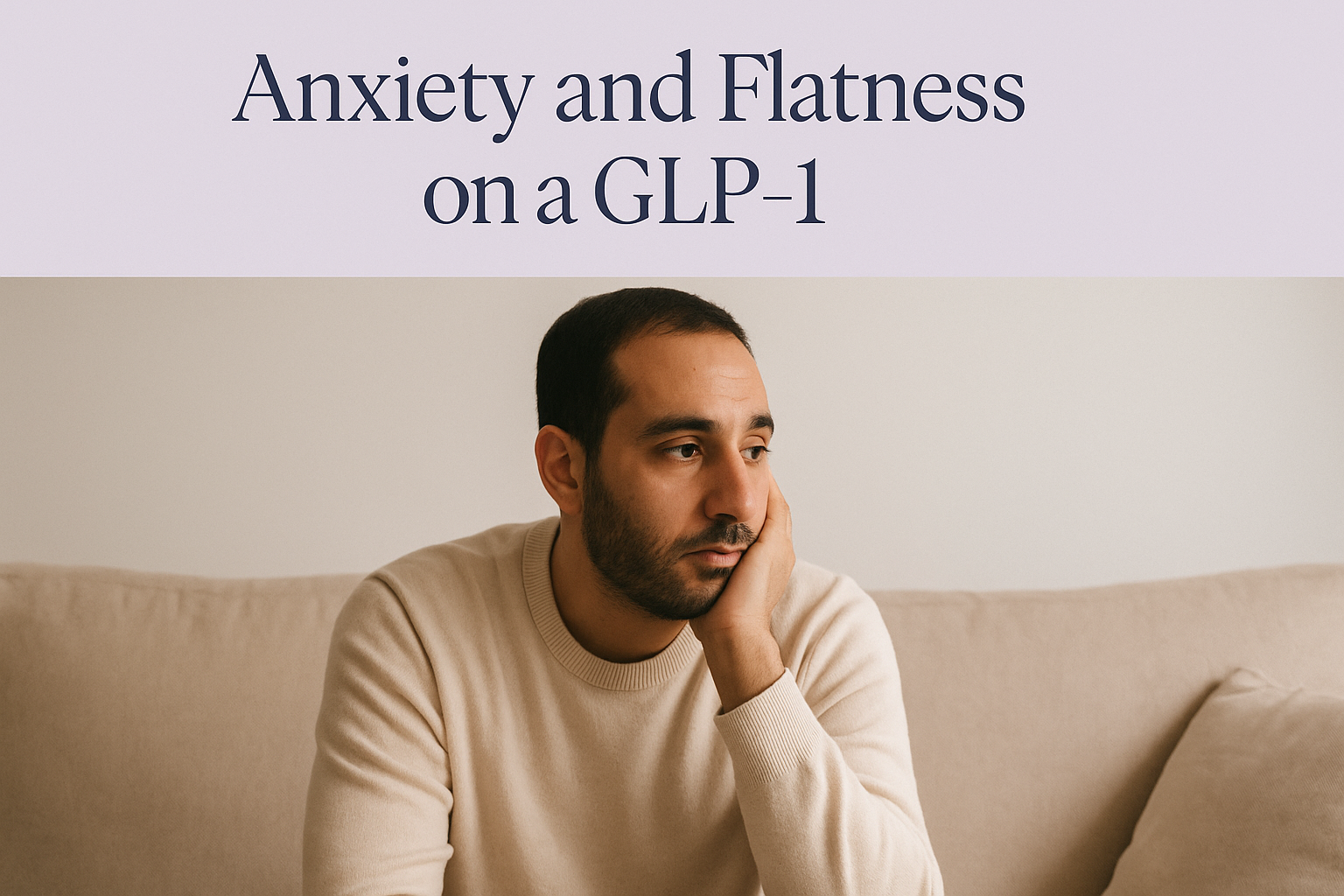
The patients who come to me saying they do not like how they feel on Wegovy or Zepbound are not usually describing nausea. They are describing something harder to name. Less interest in things they used to enjoy. A low-grade flatness. A creeping anxiety that did not exist before the medication. Sometimes a sense that they are watching their own life rather than participating in it.
GLP-1 Skin + WeightMay 18, 2026 · 10 min read
Anxiety, Flatness, and Not Feeling Like Yourself on a GLP-1: What's Happening and What to Do

Dr. Brandon Kirsch, MD, FAAD
Chief Medical Officer
This is real. Anxiety appears on the FDA semaglutide label. The flatness pattern is reported clinically and discussed in the GLP-1 neuropsychiatric literature, even though the label does not name it directly. It is not in your head. It also has a clinical explanation and a few reasonable paths forward.
Here is the conversation I would have with you.
What's Actually Happening in the Brain
GLP-1 receptors are not just in the gut. They are also expressed in several brain regions, including the ventral tegmental area and the nucleus accumbens. Those are the structures that make up what neuroscientists call the brain's reward circuit. When dopamine is released in this circuit, it produces the feeling of "wanting" and reward associated with food, alcohol, drugs, and other cues that the brain has learned predict pleasure or relief.
When you activate GLP-1 receptors with semaglutide or tirzepatide, the medication appears to dampen dopamine signaling in this reward circuit. For most patients, what they notice is that the constant pull toward food gets quieter. They call it food noise relief. They feel relief.
For a subset of patients, that dampening effect spreads past food. The same circuit that handled food cravings also handles a lot of other "wanting" signals (the pull to do things you enjoy, the small daily pulses of reward from work, hobbies, and social contact). When that circuit gets globally quieter, some patients describe it as feeling flat, anhedonic, or vaguely anxious. The reward that used to come from a small accomplishment or a favorite meal feels diluted.
This is not most patients. Most patients experience the food-noise quieting as freeing, not flattening. But it is enough patients that anxiety shows up on the FDA label, and it is worth taking seriously when it shows up in your life.
Why This Matters for the Conversation with Your Prescriber
This is the most important thing to take away from this article. When you call your prescriber, do not lead with "the medication is not working for me." Lead with "the issue is mood, not GI." Those are two different conversations and they lead to two different plans.
If you tell a busy clinician that you do not like how you feel on Wegovy, the default interpretation is GI side effects, and the default plan is to wait it out or adjust the dose. That is the wrong plan for what you are actually describing. The right plan starts with naming the symptom clearly. "I feel emotionally flat," or "I am more anxious than I used to be," or "I am not interested in things I used to enjoy." Those words tell a clinician where to look.
A good prescriber will take this seriously. A platform without licensed clinician access may have no way to escalate this concern.
Three Reasonable Options
Once the issue is named, there are three reasonable directions to consider, and the choice depends on how severe the symptoms are, how much the weight management itself matters to you, and what your medical history is.
Hold the current dose for an extra few weeks. Some patients adapt over time. A meaningful subset of patients who experience the flatness or mild anxiety find that staying at the current dose for an additional 2 to 4 weeks lets the brain recalibrate. The reward circuit gradually adjusts to the new dopamine baseline, and the mood symptoms quiet down. The trade-off is that you are choosing to stay in a less-comfortable state for a few weeks in exchange for not abandoning the medication entirely. For mild symptoms, this is a reasonable first move.
Switch to a different GLP-1. Semaglutide and tirzepatide are not the same drug. Tirzepatide is a dual GIP/GLP-1 agonist, which means it activates a slightly different receptor profile. Some patients who feel flat on one agent tolerate the other better. This is a clinical observation, not a guaranteed outcome, and it is not perfectly predictable in advance. The switch is worth considering if the symptoms are persistent and bothersome.
Stop the medication. For some patients, the mood symptoms are severe enough or matter enough relative to the weight goals that stopping is the right call. This is not failure. GLP-1 medications are a tool. Stopping is not failure. Weight management takes years, and other tools exist.
When to Stop Today
Most mood symptoms on a GLP-1 are mild and adaptable. A small subset are not. The threshold for stopping the medication today, before any other conversation, is when you experience any of the following.
New or worsening suicidal thoughts. New or significantly worsening depression that interferes with your ability to function at work, in relationships, or in basic daily activities. New panic attacks. Significant agitation. Any thoughts of harming yourself or others.
These warrant stopping the medication and getting urgent mental health support, not waiting for the next prescriber visit. The standard channels apply: your primary care provider, an established mental health clinician, or in an emergency the 988 Suicide and Crisis Lifeline or your local emergency room. The FDA and the European Medicines Agency have both reviewed reports of suicidal ideation on GLP-1 medications, and neither found a causal link. After a large FDA meta-analysis of 91 placebo-controlled trials (more than 100,000 patients) showed no increased risk, the FDA had the precautionary suicidal-behavior-and-ideation language removed from the Wegovy and other GLP-1 labels in early 2026. That does not erase the experience of patients who report new psychiatric symptoms, which still warrants a real evaluation.
Why a Dermatology-Led Program Should Take This Seriously
One thing many GLP-1-only platforms miss is that the patient with the mood side effect is the same patient who might also be experiencing telogen effluvium, facial volume loss, and the visible weight changes that affect self-image. The mood symptoms do not happen alone. They happen alongside other things that are also changing, including the caloric deficit, sleep disruption, and the body-image shift of rapid weight loss, all of which can contribute to mood changes on their own.
A dermatology program is set up to look at the skin, scalp, and mood changes together. Our side effects piece covers the rest of the side effect spectrum, and our piece on body dysmorphia after rapid weight loss covers a related and underdiscussed dimension of how patients feel about themselves during the transition.
Bottom Line
Anxiety, flatness, and anhedonia on a GLP-1 are real, biologically plausible, and clinically reported. Anxiety is on the label; flatness is reported clinically. The first move is naming the symptom precisely with your prescriber. The three reasonable options are holding the dose, switching agents, or stopping. Severe symptoms (new suicidality, worsening depression, panic attacks) warrant stopping the medication today and getting mental health support. If the medication is not working for you, that is a reason to change the plan.
Important Information
Compounded medications are prepared by accredited US compounding pharmacies under a licensed prescriber and are not FDA-approved drug products in the way that brand-name medications such as Wegovy, Ozempic, Mounjaro, and Zepbound are. GLP-1 medications carry possible side effects including nausea, fatigue, mood changes, anxiety, gallbladder issues, pancreatitis risk, and temporary hair shedding. New or worsening psychiatric symptoms warrant prompt medical evaluation. The 988 Suicide and Crisis Lifeline is available 24/7 in the United States. GLP-1 therapy requires evaluation and prescription by a licensed clinician. This article is educational and is not medical advice.
Sources
- US Food and Drug Administration labeling for semaglutide (Wegovy, Ozempic) and tirzepatide (Zepbound, Mounjaro).
- US Food and Drug Administration. FDA evaluating reports of suicidal thoughts or actions in patients taking a certain type of medicines approved for type 2 diabetes and obesity. 2023. Updated 2026: an FDA review of 91 placebo-controlled trials found no causal association, and the suicidal behavior and ideation language was removed from GLP-1 labeling (including Wegovy) in early 2026.
- Eren-Yazicioglu CY, et al. Can GLP-1 be a target for reward system related disorders? A qualitative synthesis and systematic review. Front Behav Neurosci. 2021;14:614884.
- Wilding JPH, et al. Once-weekly semaglutide in adults with overweight or obesity. N Engl J Med. 2021;384(11):989-1002.
- Jastreboff AM, et al. Tirzepatide once weekly for the treatment of obesity. N Engl J Med. 2022;387(3):205-216.
Related Articles

→
GLP-1 Skin + Weight
The Side of Weight Loss Nobody Warns You About: Your Dermatologist Should
May 18, 2026 · 11 min read

→
GLP-1 Skin + Weight
Why Alcohol Tastes Different on a GLP-1: The Dopamine Reward Pathway Explained
May 18, 2026 · 9 min read

→
GLP-1 Skin + Weight
Five Questions to Ask Before Starting a GLP-1, Especially If You Have Psoriasis or HS
May 18, 2026 · 11 min read