
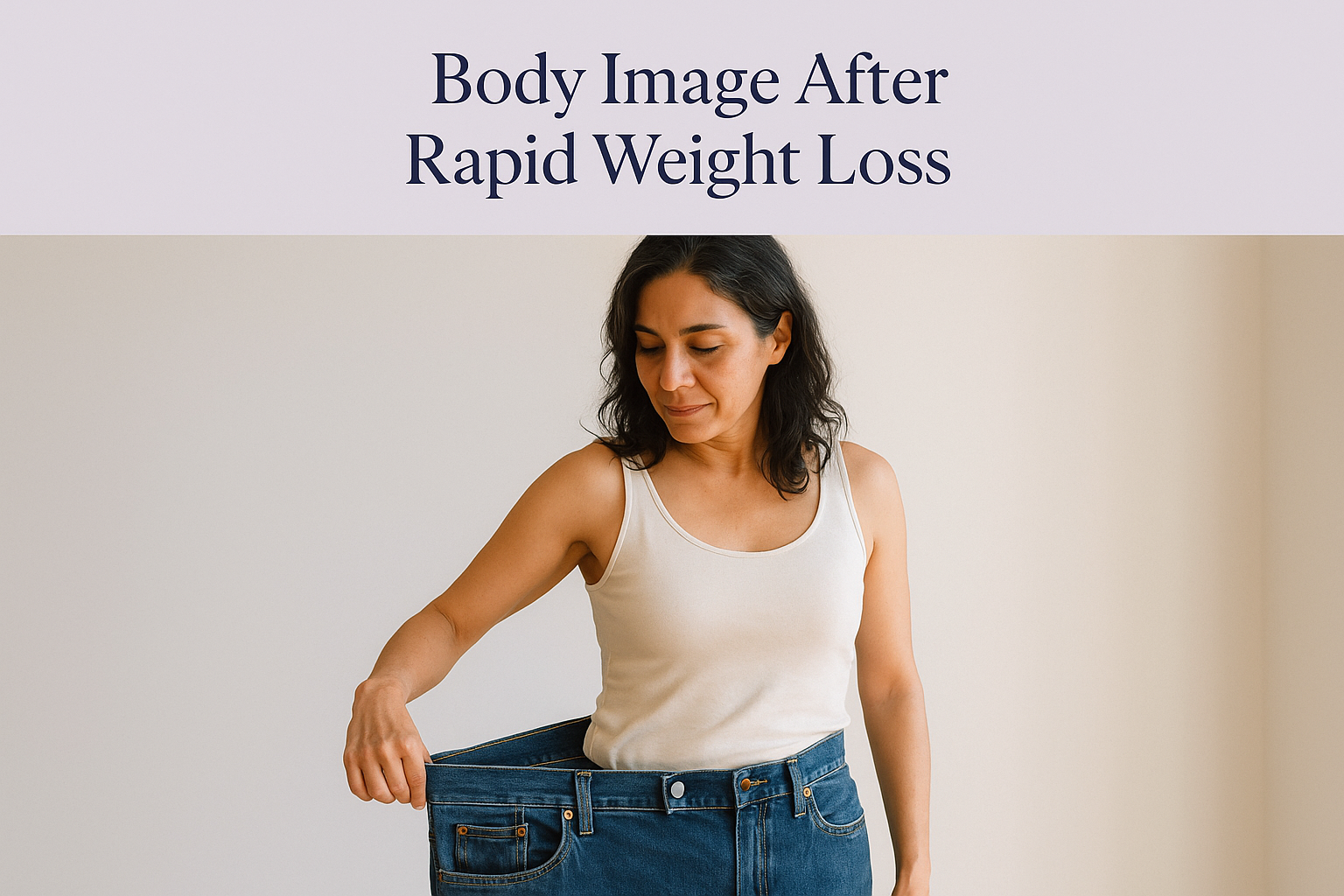
A patient told me recently: "The smaller I get, the bigger I feel." She had lost 40 pounds on tirzepatide over six months. The mirror was showing her one thing. Her body, the way she experienced it in space, was telling her something different. Her old clothes hung off her. Her wedding ring was loose. The scale showed steady progress. And somehow she felt physically larger than when she had started.
GLP-1 Skin + WeightMay 18, 2026 · 10 min read
The Smaller You Get, the Bigger You Feel: The Body Image Lag After Rapid GLP-1 Weight Loss

Dr. Brandon Kirsch, MD, FAAD
Chief Medical Officer
This is real. It is underdiscussed. The patients who do not talk about it are usually the ones still in it. Here is the version of this conversation I would have if you were sitting across from me.
The Body Schema Lag
Your brain maintains an internal model of your body in space. Neuroscientists call it the body schema. It tells you, without your having to think about it, how wide your shoulders are, how much room you take up walking through a doorway, where your feet are when you sit down. The body schema gets built through years of physical experience and updates slowly. It is not based on the number on the scale or the size of your clothes. It is based on the cumulative physical data your brain has accumulated about being in your body.
When you lose weight quickly, the body schema does not update at the same pace. The scale changes weekly. The mirror changes monthly. The body schema can take many months to catch up. In the meantime, your felt size lags your actual size. You walk into a doorway and brace as if you are wider than you are. You sit in a chair and pull in your elbows. You see a photo of yourself and the body in the photo does not match the body you experience yourself living in.
GLP-1 medications produce some of the fastest sustained weight loss medicine has ever delivered. The body schema lag is a predictable consequence. It is not a sign that something is wrong with you. It is the inevitable mismatch between scale data updating in weeks and body-mapping data updating in months.
What Helps
Three concrete moves help close the gap faster than waiting alone does.
Take a weekly photo in the same outfit and the same spot. Same lighting, same pose, same neutral wall behind you. Your visual memory is short and noisy. A reliable weekly archive gives your brain hard visual evidence to update against. Patients who do this consistently for two or three months find that the body schema catches up faster than it does for patients who avoid mirrors and photos entirely.
The reason to do it weekly rather than daily is that weekly differences are visible. Daily differences are too small to detect, which makes the exercise feel discouraging rather than calibrating.
Buy one or two items that actually fit your current body. This is harder than it sounds. The instinct, especially in active weight loss, is to keep wearing old clothes (which are now loose) because new clothes feel like a commitment to a number that might still change. The problem is that wearing the loose old clothes keeps the old schema in place. The body in the loose shirt feels like the body the shirt was bought for, even when it is not.
One well-fitting pair of pants. One well-fitting top. That is enough to recalibrate. You do not need a whole new wardrobe. You need clothes that confront your brain with the actual current size of your body.
Verbal recalibration helps too. Tell people about the weight loss. Not in a humble-brag way. In a "this is real and I am still adjusting to it" way. The verbal acknowledgment by the people around you (and your own verbal acknowledgment to them) helps the schema update, because the brain registers what is socially confirmed as more real than what is privately experienced.
When This Tips Into Something That Needs More Help
For most patients, the body schema lag is uncomfortable but resolves over a few months as the brain catches up. For some patients, it tips into territory that warrants more than weekly photos.
The threshold I use is this. The body image lag I have been describing is a normal, temporary adjustment: it is uncomfortable, but it fades as the brain catches up. What it is not is body dysmorphic disorder (BDD), which is a distinct clinical condition. If the dissonance is leading to avoidance of photographs, of mirrors, of changing clothes in front of a partner, of intimacy, or of social situations where your body will be seen, the issue has moved past normal adjustment toward that clinical territory. The same is true if seeing yourself produces significant distress, intrusive thoughts about how you look, repetitive mirror-checking or grooming, or a fixed sense that you are still "fat" despite scale data that says otherwise. That pattern warrants a clinical evaluation, not just weekly photos.
These are not failures of willpower or vanity. They are clinical patterns that respond to clinical care. A few sessions with a therapist who has experience with body image issues, eating disorders, or post-weight-loss adjustment can make a meaningful difference. Cognitive behavioral therapy approaches in particular have good evidence for the specific cluster of thoughts and behaviors that tend to accompany body image distress.
If you are looking for resources, the National Eating Disorders Association (NEDA) has a screening tool and clinician finder online. For acute distress, the Crisis Text Line (text "NEDA" to 741741) or the 988 Suicide and Crisis Lifeline are appropriate. Most major academic medical centers have body image and eating disorders clinics with experience in post-weight-loss adjustment. Your primary care provider can also refer.
Why a Dermatology-Led Program Should Care About This
The patient experiencing body schema lag after rapid GLP-1 weight loss is often the same patient experiencing visible facial volume loss, hair shedding, and changes in how clothes fit. The schema lag does not happen in isolation. It happens alongside other things the patient is processing simultaneously.
A GLP-1-only program is not set up to have this conversation. The default response, when a patient brings up body image, tends to be a referral or a redirection. Both are sometimes appropriate, but a clinician-led program should be willing to engage all of it (the dermatologic side effects, the mood symptoms, the body image transition) and to coordinate with mental health resources when the situation calls for it.
Our side effects piece covers the physical changes side. Our anxiety and flatness article covers the mood side. This piece covers the body image side. They are connected.
What I Tell My Own Patients
The frame I use is this. Your body is changing faster than your brain is built to map. The mismatch is uncomfortable. It is also normal, expected, and temporary. The brain catches up. It just takes longer than the scale does.
If you can be patient with the gap, take photos for calibration, and buy a few clothes that fit your current body, the schema will close most of the way within three to six months. If the gap is producing real distress or driving avoidance behaviors, ask for help from a therapist who knows this terrain. You are not vain. You are recalibrating.
Bottom Line
The smaller you get, the bigger you feel is a real phenomenon with a real neurological explanation. The body schema updates more slowly than the scale, and rapid GLP-1 loss outpaces it by months. Weekly photos in the same setup, one or two well-fitting items of clothing, and verbal acknowledgment from people around you all help the schema catch up. If the dissonance is producing avoidance or significant distress, a therapist with body image experience can help. The gap closes. It just takes longer than the weight loss does.
Important Information
Compounded medications are prepared by accredited US compounding pharmacies under a licensed prescriber and are not FDA-approved drug products in the way that brand-name medications such as Wegovy, Ozempic, Mounjaro, and Zepbound are. Body image distress that is significant or interferes with daily functioning warrants professional evaluation. National Eating Disorders Association (NEDA) screening and resources are available at nationaleatingdisorders.org. For acute distress, text "NEDA" to 741741 (Crisis Text Line) or call 988 (Suicide and Crisis Lifeline). GLP-1 medications carry possible side effects including nausea, fatigue, mood changes, gallbladder issues, pancreatitis risk, and temporary hair shedding. GLP-1 therapy requires evaluation and prescription by a licensed clinician. This article is educational and is not medical advice.
Sources
- Longo MR, Haggard P. An implicit body representation underlying human position sense. Proc Natl Acad Sci. 2010;107(26):11727-11732.
- Cash TF, Smolak L (editors). Body Image: A Handbook of Science, Practice, and Prevention. 2nd ed. Guilford Press.
- Cuzzolaro M, Fassino S (editors). Body Image, Eating, and Weight: A Guide to Assessment, Treatment, and Prevention. Springer.
- STEP-1: Wilding JPH, et al. Once-weekly semaglutide in adults with overweight or obesity. N Engl J Med. 2021;384(11):989-1002.
- SURMOUNT-1: Jastreboff AM, et al. Tirzepatide once weekly for the treatment of obesity. N Engl J Med. 2022;387(3):205-216.
Related Articles

→
GLP-1 Skin + Weight
Anxiety, Flatness, and Not Feeling Like Yourself on a GLP-1: What's Happening and What to Do
May 18, 2026 · 10 min read

→
GLP-1 Skin + Weight
The Side of Weight Loss Nobody Warns You About: Your Dermatologist Should
May 18, 2026 · 11 min read

→
GLP-1 Skin + Weight
Food Noise Coming Back on a GLP-1: Why It Happens (and Why It Is Not the Dose)
May 18, 2026 · 10 min read