
One of the more surprising findings from the GLP-1 era is how many patients report a meaningful drop in their interest in alcohol. Patients who used to drink three or four drinks a night, or who used to plan their weeks around a Friday wine routine, describe losing interest in alcohol within weeks of starting semaglutide or tirzepatide. They are not white-knuckling sobriety. They are not in a 12-step program. The pull just got quieter, and then it was gone.
GLP-1 Skin + WeightMay 18, 2026 · 9 min read
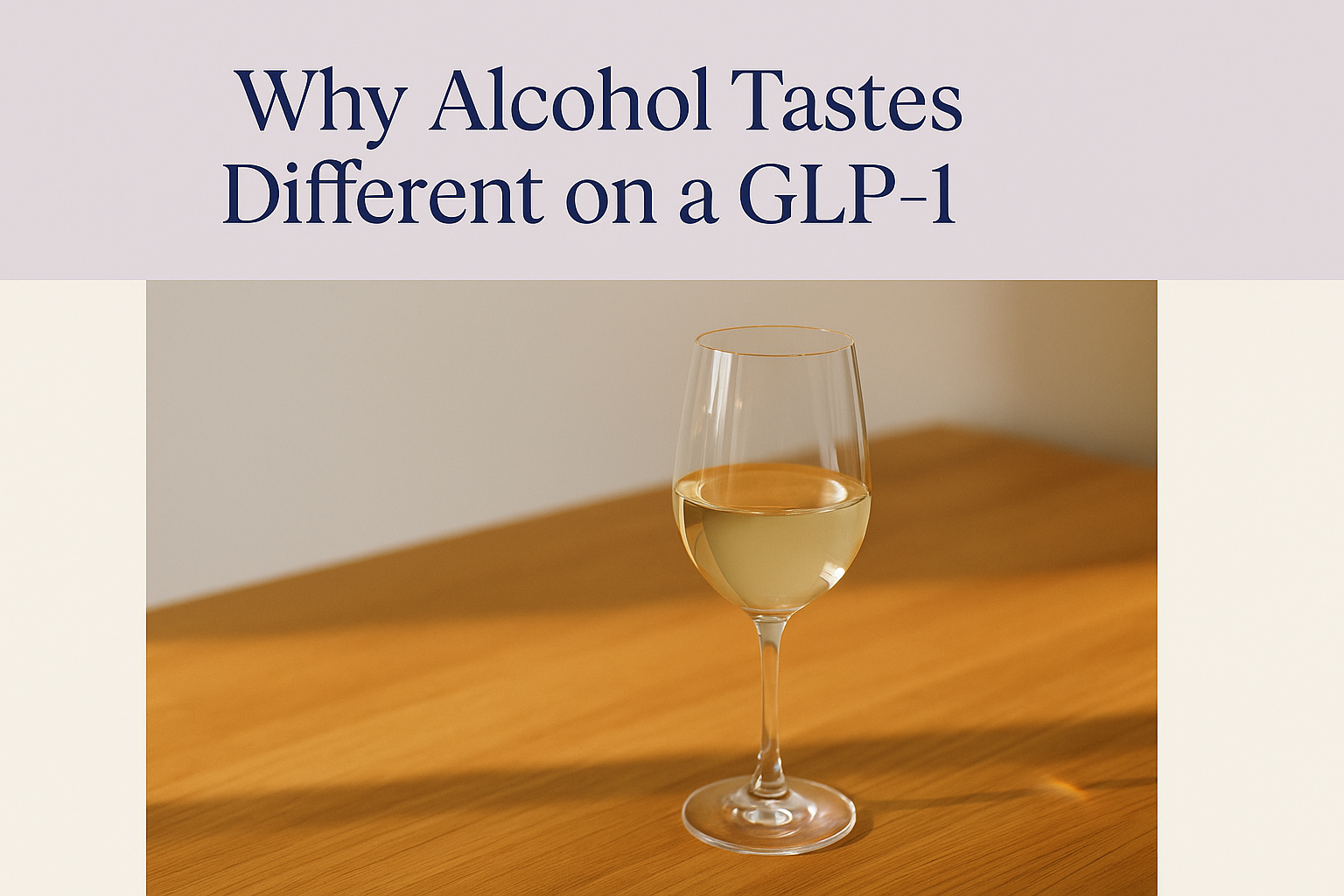
Why Alcohol Tastes Different on a GLP-1: The Dopamine Reward Pathway Explained

Dr. Brandon Kirsch, MD, FAAD
Chief Medical Officer
This is real, mechanistically explained, and the subject of multiple ongoing clinical trials. Here is what is happening.
The Reward Pathway Mechanism
GLP-1 receptors are not just in the gut. They are also expressed in several brain regions involved in reward processing, including the ventral tegmental area and the nucleus accumbens. These structures form what neuroscientists call the brain's reward circuit. When dopamine is released in this circuit, it produces the felt experience of "wanting" and reward associated with food, alcohol, drugs, gambling, social reinforcement, and other learned cues.
When you activate GLP-1 receptors with semaglutide or tirzepatide, the medication dampens dopamine release in this reward circuit. For most patients, the most noticeable consequence is that the constant pull toward food gets quieter. The chatter about what to eat next, the urge to snack, the compulsive interest in food cues, all get softer.
What is less appreciated is that the same dopamine signal that responded to food cues also responded to alcohol cues. When you drink, the reward your brain experiences is mediated through the same circuit. Dampening the circuit dampens both responses. The pour, the first sip, the buzz, all register as less rewarding than they did before.
Two Distinct Things Are Happening
When patients describe losing interest in alcohol on a GLP-1, two distinct mechanisms are at play, and it is worth understanding them separately.
The drink itself feels less rewarding. When you do drink, the reward your brain registers is muted. The buzz is less buzzy. The first-sip pleasure is duller. The flavor matters less. Patients describe this as "I drank, but it just was not worth it." The drinking can still happen, but the reinforcement that normally drives repeat drinking is diminished.
The wanting itself gets quieter. This is the more striking and underdiscussed effect. Even before any drink is poured, the pull toward alcohol decreases. The 5 PM thought of "what wine would go with dinner" does not show up. The Friday-night anticipation of the first drink fades. The ritual and the planning that used to accompany drinking lose their pull.
The second piece is the one most patients describe as transformative. It is not that they had to resist drinking and succeeded. It is that the desire itself was no longer there to resist.
This dual mechanism (muted reward when you drink, and reduced wanting before you drink) is what makes GLP-1 medications interesting to researchers studying alcohol use disorder. Most existing treatments for AUD work on one side or the other. GLP-1 medications appear to work on both.
What the Research Is Showing
Phase II and III clinical trials are now underway for GLP-1 receptor agonists in alcohol use disorder. The early data is positive enough that the field is taking it seriously. A 2024 review (Klausen et al., Eur J Pharmacol) walked through preclinical and small clinical signals of reduced alcohol consumption and craving with semaglutide and related agents. Preclinical work in rats (Aranas et al., eBioMedicine 2023) showed semaglutide reduced alcohol intake and relapse-like drinking, providing the mechanistic basis the human trials are now testing. Phase II readouts for semaglutide in alcohol use disorder began in 2024 and 2025, and Phase III programs are scaling up. A full Phase III readout is likely 2 to 3 years out.
This is not yet an FDA-approved indication for either medication. Patients getting prescribed semaglutide or tirzepatide for weight management are reporting the alcohol effect as an emergent finding, not as an indication-driven outcome. That said, the consistency of the reports across patients, plus the mechanistic plausibility, plus the early trial data, has shifted the conversation. Multiple addiction medicine specialists I know are watching this space closely.
For patients with a history of alcohol use that has been hard to address, the conversation with a prescriber about whether GLP-1 therapy might help is reasonable. The decision should weigh the eligibility criteria for the medication (you still need to meet BMI or comorbidity thresholds), the side effect profile, and the broader alcohol use disorder treatment context. GLP-1 medications are not a replacement for established AUD care. They may be a useful addition for some patients.
What If You Were a Heavy Drinker
Patients who used to drink heavily before starting a GLP-1 should know two things going in.
First, the effect is real and rapid. Many patients notice the decreased interest in alcohol within the first two to four weeks of therapy. The drop can be substantial, and it can feel destabilizing if your social life or self-image is built around drinking.
Second, if your drinking has been heavy and prolonged, abruptly stopping can produce withdrawal symptoms (tremor, sweating, anxiety, in severe cases seizures or delirium tremens). The GLP-1 does not cause withdrawal directly, but if it reduces your drinking so quickly that your body goes into withdrawal, you can end up in a dangerous state. Patients with daily heavy alcohol use should have a medical conversation with their primary care provider or an addiction medicine clinician before starting a GLP-1, both about the eligibility for the medication and about the safe taper if drinking was previously heavy.
A Note on the Mood Side
The same reward-circuit mechanism that produces the alcohol effect also accounts for some of the mood symptoms a subset of patients experience on GLP-1 therapy. Anxiety, low-grade flatness, and reduced interest in things you used to enjoy are mechanistically related to what is happening with the alcohol response. Our piece on anxiety and flatness on a GLP-1 walks through that side of the picture in more depth.
Most patients experience the reward dampening as freeing (less food noise, less alcohol pull, easier abstinence from things that were not serving them). A subset experiences it as flattening. The same mechanism, different felt experience, depending on the individual.
A good weight management program addresses this kind of broader picture, not just weight loss. For more on the brain mechanisms of these medications, see how GLP-1 medications work.
Bottom Line
The reduced alcohol interest on GLP-1 medications is real, mechanistically explained, and increasingly studied. GLP-1 receptors on the brain's reward circuit dampen dopamine release in response to alcohol cues, which produces both a muted reward from drinking and a reduced wanting before drinking. Phase II and III trials for alcohol use disorder are underway. For patients with a history of heavy drinking, the rapid interest drop can be destabilizing and warrants medical conversation before starting. For most patients, the alcohol effect is one of the unexpected upsides of GLP-1 therapy.
Important Information
Compounded medications are prepared by accredited US compounding pharmacies under a licensed prescriber and are not FDA-approved drug products in the way that brand-name medications such as Wegovy, Ozempic, Mounjaro, and Zepbound are. GLP-1 medications are not FDA-approved for the treatment of alcohol use disorder. Use for alcohol-related effects in patients prescribed for weight management is emergent and not an indication-driven outcome. Patients with active alcohol use disorder or heavy drinking patterns should consult primary care or addiction medicine before starting a GLP-1. GLP-1 therapy requires evaluation and prescription by a licensed clinician. This article is educational and is not medical advice.
Sources
- Klausen MK, et al. The role of GLP-1 in alcohol use disorder: emerging evidence. Eur J Pharmacol. 2024;962:176153.
- Eren-Yazicioglu CY, et al. Can GLP-1 be a target for reward system related disorders? A qualitative synthesis and systematic review. Front Behav Neurosci. 2021;14:614884.
- Aranäs C, et al. Semaglutide reduces alcohol intake and relapse-like drinking in rats. eBioMedicine. 2023;93:104642.
- US National Institute on Alcohol Abuse and Alcoholism. Treatment for Alcohol Problems. NIH Publication.
- Drucker DJ. Mechanisms of action and therapeutic application of glucagon-like peptide-1. Cell Metab. 2018;27(4):740-756.
Related Articles
→
GLP-1 Skin + Weight
Anxiety, Flatness, and Not Feeling Like Yourself on a GLP-1: What's Happening and What to Do
May 18, 2026 · 10 min read
→
GLP-1 Skin + Weight
Food Noise Coming Back on a GLP-1: Why It Happens (and Why It Is Not the Dose)
May 18, 2026 · 10 min read
→
GLP-1 Skin + Weight
How GLP-1 Medications Work: The Science Behind Semaglutide and Tirzepatide
Mar 21, 2026 · 7 min read