
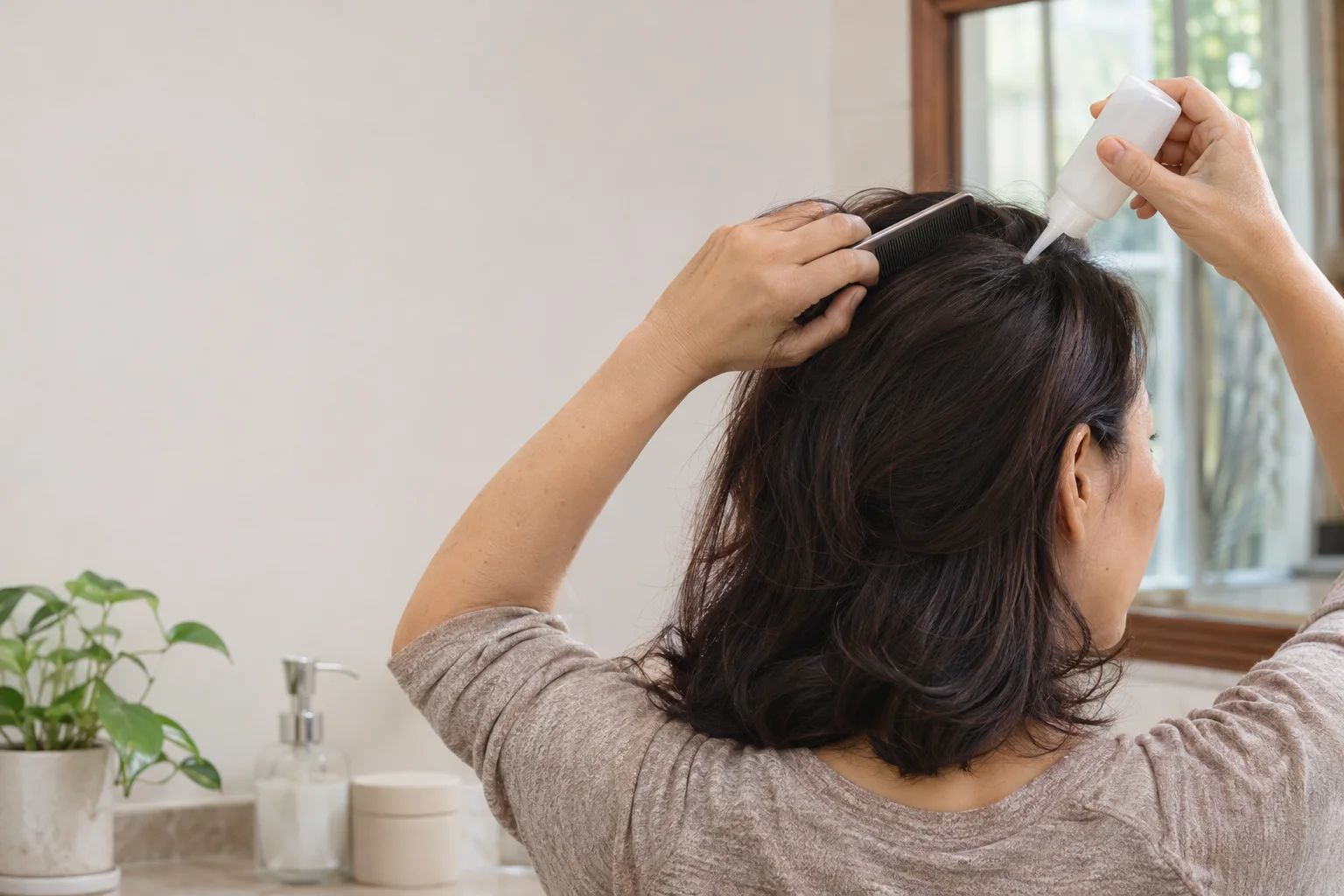
AI-generated illustration. Not an actual patient or treatment result.
Scalp Psoriasis Treatment: What Works, From Shampoos to Prescriptions

Chief Medical Officer
The most effective single treatment for scalp psoriasis is a topical steroid, in a shampoo, foam or solution made for hair-bearing skin. In the label trial of clobetasol 0.05% foam, 39 of 62 users (63%) reached treatment success after 2 weeks, compared with 1 of 31 (3%) on vehicle foam (clobetasol foam label). Steroid-free roflumilast foam is the main alternative, and drugstore tar or salicylic acid shampoos help with scale and itch. About half of people with plaque psoriasis get it on the scalp, according to the American Academy of Dermatology (AAD) (AAD).
In this article
What is the most effective treatment for scalp psoriasis?
A topical steroid is the most effective single treatment. A Cochrane review of 59 trials with 11,561 people found steroids cleared scalp psoriasis more often than vitamin D analogs: in 4 trials of 4 to 8 weeks (2,180 people) that measured full clearing, about 29 in 100 fully cleared with a steroid versus about 16 in 100 with a vitamin D analog (Schlager 2016). Moderate, high and very high potency steroids worked about equally. Adding calcipotriene, a vitamin D analog, to a steroid helped only a little (about 35 in 100 fully cleared versus 29 in 100 on the steroid alone), and the authors judged a generic steroid alone acceptable for short-term use. In the Taclonex label trial, calcipotriene plus betamethasone suspension left 70.0% clear or almost clear at 8 weeks, compared with 63.1% on betamethasone alone and 36.7% on calcipotriene alone (Taclonex label). For a flare, my first choice is a short course of clobetasol in a scalp form.
Which shampoos help scalp psoriasis?
Over-the-counter (OTC) coal tar and salicylic acid shampoos control symptoms, and prescription clobetasol shampoo treats the disease. Under the Food and Drug Administration (FDA) monograph, only two ingredients may be sold without a prescription for psoriasis: coal tar 0.5% to 5% and salicylic acid 1.8% to 3% (21 CFR 358.710). Their labels may only claim to relieve itching, redness, flaking and scaling, and say to use them at least twice a week. Clobetasol 0.05% shampoo, left on a dry scalp for 15 minutes once daily, rated clear or minimal in 42.1% and 28.3% of users after 4 weeks, vs 2.1% and 10.2% on vehicle (clobetasol shampoo label). In 162 people, it beat a 1% tar blend shampoo on every efficacy measure (Griffiths 2006). Ketoconazole shampoo is not proven for psoriasis: the only controlled trial I could find used ketoconazole tablets and was stopped early over possible drug toxicity (Farr 1985).
How do you soften and remove thick scalp scale?
Soften the scale with salicylic acid, then lift it gently rather than picking or scrubbing. The National Psoriasis Foundation (NPF) says salicylic acid softens plaques and removes scale (NPF), and the AAD says it can soften thick, stubborn scalp patches (AAD). The OTC strength is 1.8% to 3% (21 CFR 358.710). The AAD also warns that rubbing, scrubbing and scratching can make scalp psoriasis worse. Once the scale is thinner, the medicine has to reach skin: part the hair and apply the product directly to each plaque, as the roflumilast foam instructions describe (Zoryve foam label). Here is what I tell patients: soften first, treat second.
How long can you use a steroid on your scalp?
Clobetasol: 2 weeks for the solution and foam, 4 weeks for the shampoo (adults only). Calcipotriene plus betamethasone suspension: up to 8 weeks. Clobetasol scalp solution is limited to 2 consecutive weeks and 50 mL per week (clobetasol solution label), and clobetasol foam to 2 weeks and 50 g per week (clobetasol foam label). Clobetasol shampoo allows 4 consecutive weeks in adults only; 5 of 12 adolescents (42%) developed adrenal suppression on it (clobetasol shampoo label). Calcipotriene plus betamethasone suspension may be used up to 8 weeks, up to 100 g per week in adults (Taclonex label). After clearing, twice-weekly clobetasol shampoo delayed relapse to a median 141 days vs 30.5 days on vehicle, a schedule outside the label (Poulin 2010).
What are the steroid-free options for the scalp?
Roflumilast 0.3% foam (Zoryve), a phosphodiesterase-4 (PDE4) inhibitor, is the steroid-free scalp option I reach for first. It is approved for scalp and body psoriasis from age 12, once daily (Zoryve foam label). In two 8-week trials, 66.4% vs 27.8% and 56.7% vs 11.0% on vehicle reached a clear or almost clear scalp with at least a 2-grade gain. Scalp itch eased slightly more than on vehicle within 24 hours (0.44 vs 0.09 points on a 10-point scale). Among people who started with itch of 4 or more, 25.2% vs 8.0% had a 4-point drop at week 2 (Gooderham 2025). Calcipotriene 0.005% scalp solution alone left about 31% cleared or almost cleared after 8 weeks (calcipotriene scalp solution label), and it burned more often than clobetasol shampoo head to head (Reygagne 2005). The foam's propellants are flammable, so avoid fire, flame and smoking during and right after applying it (Zoryve foam label).
Does scalp psoriasis cause hair loss?
Rarely, and the loss is temporary. The NPF states that severe scalp psoriasis can, in rare cases, cause temporary hair loss (NPF). The AAD warns that scratching and scrubbing can make scalp psoriasis worse, so treat the itch (AAD). If you also use prescription ketoconazole 2% shampoo, its label reports more than normal hair shedding in under 1% of 264 trial patients (ketoconazole shampoo label).
Is it scalp psoriasis or seborrheic dermatitis?
It can be either one, or both at once. The NPF describes scalp psoriasis as powdery with a silvery sheen and seborrheic dermatitis as yellowish and greasy (NPF), and the AAD notes a person can have both conditions, sometimes needing a biopsy to sort out (AAD). The difference changes the plan. In a Cochrane review, ketoconazole 2% fully cleared seborrheic dermatitis in about 50 in 100 people at 4 weeks, versus about 28 in 100 on a placebo (Okokon 2015), while psoriasis responds best to the steroids above. Roflumilast foam is labeled for both, for seborrheic dermatitis from age 9 (Zoryve foam label). If plaques show up elsewhere too, my eczema vs psoriasis guide shows how to tell the rashes apart.
How does KindleeRx treat psoriasis?
Through the KindleeRx psoriasis treatment program, licensed clinicians (physician assistants and nurse practitioners working under a board-certified dermatologist's protocols) review each case online and reply in under 5 hours on average. For mild to moderate psoriasis, when a clinician decides it is appropriate, they may prescribe the Calming Cream, a compounded cream with roflumilast 0.2% and calamine 5% used once daily. It is a cream, and the scalp results above come from branded Zoryve foam, so none of them describe it. A prescription is never guaranteed; if treatment is not prescribed, the refund is full, including the consultation fee. If weight is part of your picture, read how GLP-1 medications relate to psoriasis.
Important Information
The KindleeRx Calming Cream is a compounded prescription medication containing roflumilast 0.2% and calamine 5%, prepared by a licensed US compounding pharmacy under a licensed prescriber. It is not Zoryve, it is not a generic of Zoryve, and it is not an FDA-approved drug product. Compounded medications are not reviewed by the FDA for safety, effectiveness, or quality. KindleeRx is not affiliated with Arcutis or Zoryve. Published trial data for branded roflumilast (Zoryve) reflect the branded product and the branded concentrations studied in those trials, not this compounded formula. Eligibility is determined by a licensed clinician after reviewing your information. Not all patients qualify. This article is educational and is not medical advice.
Sources
- Merola JF, et al. Prevalence of psoriasis phenotypes among men and women in the USA. Clinical and Experimental Dermatology 2016.
- Schlager JG, et al. Topical treatments for scalp psoriasis. Cochrane Database of Systematic Reviews 2016.
- Glenmark. Clobetasol propionate foam 0.05% prescribing information. DailyMed 2026.
- Padagis. Clobetasol propionate shampoo 0.05% prescribing information. DailyMed 2026.
- Fougera. Clobetasol propionate topical solution 0.05% prescribing information. DailyMed 2026.
- LEO Pharma. Taclonex (calcipotriene and betamethasone dipropionate) topical suspension prescribing information. DailyMed 2021.
- Perfero Pharma. Pellix (calcipotriene) scalp solution 0.005% prescribing information. DailyMed 2026.
- Arcutis Biotherapeutics. ZORYVE (roflumilast) topical foam prescribing information and Instructions for Use, revised June 2026. DailyMed.
- Gooderham MJ, et al. ARRECTOR trial of roflumilast foam 0.3% in scalp and body psoriasis. JAMA Dermatology 2025.
- US Code of Federal Regulations. 21 CFR Part 358, Subpart H: drug products for the control of dandruff, seborrheic dermatitis, and psoriasis. eCFR.
- Griffiths CE, et al. Clobetasol propionate shampoo vs tar blend shampoo in scalp psoriasis. Journal of Dermatological Treatment 2006.
- Reygagne P, et al. Clobetasol propionate shampoo vs calcipotriol solution in scalp psoriasis. Journal of Dermatological Treatment 2005.
- Poulin Y, et al. Twice-weekly clobetasol propionate shampoo to maintain scalp psoriasis remission. Journal of Dermatological Treatment 2010.
- Farr PM, et al. Placebo-controlled trial of oral ketoconazole in psoriasis. Lancet 1985.
- Padagis. Ketoconazole shampoo 2% prescribing information. DailyMed 2026.
- Okokon EO, et al. Topical antifungals for seborrhoeic dermatitis. Cochrane Database of Systematic Reviews 2015.
- National Psoriasis Foundation. Scalp psoriasis.
- American Academy of Dermatology. Scalp psoriasis: shampoos, scale softeners, and other treatments.
- American Academy of Dermatology. Seborrheic dermatitis: diagnosis and treatment. 2024.
Related Articles
Psoriasis
GLP-1 for Psoriasis: How Weight Loss Can Improve Skin Clearance
May 17, 2026 · 13 min read
Psoriasis
When Weight Is Part of the Psoriasis Story: The Conversation That Often Gets Missed
May 18, 2026 · 10 min read
Eczema
Eczema vs. Psoriasis: The 5-Minute Guide to Getting the Right Diagnosis
Feb 15, 2026 · 13 min read