

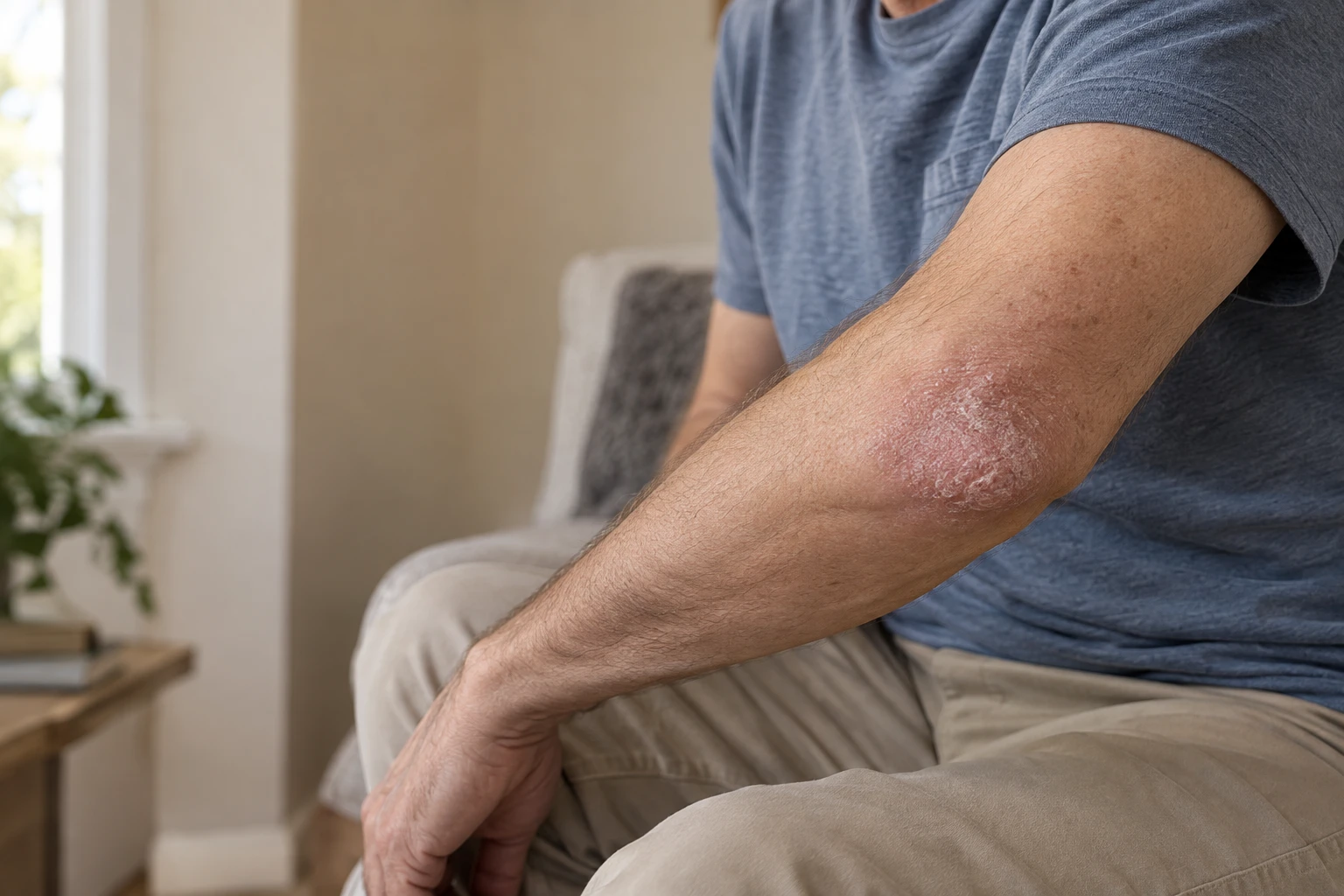
AI-generated illustration. Not an actual patient or treatment result.
Inverse and Genital Psoriasis: Which Creams Are Safe for Skin Folds?

Chief Medical Officer
The safest creams for skin folds and genitals are a short course of a low-potency steroid, followed by a steroid-free cream such as roflumilast, tacrolimus or pimecrolimus for longer care. Roflumilast 0.3% cream is approved by the Food and Drug Administration (FDA) for psoriasis including skin folds, and in its two trials 71.5% and 67.5% of patients with fold psoriasis reached clear or almost clear at 8 weeks, vs 13.8% and 17.4% on vehicle (Zoryve cream label). Super-potent steroids such as clobetasol are labeled to stay off the groin and armpits.
In this article
What is inverse psoriasis?
Inverse psoriasis is psoriasis in the body's skin folds. A National Psoriasis Foundation (NPF) consensus lists the folds involved: armpits, groin and genitals, under the breasts, between the buttocks, around the anus, belly folds and behind the ears (Khosravi 2017). In three U.S. cohorts, 21% to 30% of people with psoriasis reported it (Merola 2016). A systematic review of 14 studies describes fold skin as sensitive, thin and naturally occluded, which is why treatment differs from elbows and knees (Reynolds 2020). If you are unsure the rash is psoriasis at all, my eczema vs psoriasis guide covers the differences.
How common is genital psoriasis?
Common, and often missed. In a French study of 776 people seen for psoriasis elsewhere on the body, 335 (43.2%) had genital involvement, yet only 40% of those 335 had ever had their genitals examined (Larsabal 2019). Itching was the main symptom, and genital psoriasis was linked to worse quality of life and sexual health. A Chinese hospital study of 7032 people found genital involvement in 12.00% (Lu 2025); the two studies used different settings and definitions. In the roflumilast cream trials, 13% to 18% of patients had genital psoriasis at the start (Lebwohl 2022). If you have psoriasis anywhere and itching in the groin, say so at your visit.
Which creams are safe for skin folds and the genital area?
Lower-potency steroids for short courses, then steroid-free creams. In 2009 the NPF Medical Board recommended low- to mid-potency steroids for 2 to 4 weeks, and calcipotriene, pimecrolimus or tacrolimus for long-term care (Kalb 2009); its 2017 update keeps low-potency steroids for short-term use (Khosravi 2017). The American Academy of Dermatology (AAD) pathway suggests lower-potency steroids for up to 4 weeks, or off-label tacrolimus 0.1% for up to 8 weeks or pimecrolimus for 4 to 8 weeks (AAD pathway). Tacrolimus 0.1% ointment cleared or almost cleared face or fold psoriasis in 65.2% vs 31.5% on vehicle (Lebwohl 2004). Roflumilast 0.3% cream is labeled for folds from age 2 (Zoryve cream label). My plan: a mild steroid to calm a flare, then a steroid-free cream to keep it calm.
How do the skin-fold treatments compare?
These results come from different trials with different endpoints and lengths, so they cannot be compared head to head.
| Treatment | Result in skin-fold psoriasis | Status for psoriasis |
|---|---|---|
| Roflumilast 0.3% cream (Zoryve) | 71.5% and 67.5% clear or almost clear vs 13.8% and 17.4% on vehicle, 8 weeks | Approved, skin folds included, age 2 and up |
| Tacrolimus 0.1% ointment | 65.2% vs 31.5% clear or almost clear (face or folds), 8 weeks | Off-label; boxed warning |
| Pimecrolimus 1% cream | 54% vs 21% clear or almost clear at week 2; 71% at week 8 | Off-label; boxed warning |
| Betamethasone valerate 0.1% (mid-potency steroid) | 86.4% drop in severity score vs 21.1% on vehicle, 4 weeks | Short courses only |
| Calcipotriol 0.005% | 62.4% drop in severity score, 4 weeks | Can irritate surrounding skin |
| Tapinarof 1% cream (Vtama) | 24 of 29 (83%) clear or almost clear, 12 weeks, open label, no vehicle group | Approved for plaque psoriasis in adults |
Sources for the table: Zoryve cream label, Lebwohl 2004, Gribetz 2004, Kreuter 2006, NCT05680740 and the Vtama label. In the 4-week head-to-head trial, pimecrolimus was the weakest active cream, with a 39.7% drop (Kreuter 2006).
Why are strong steroids risky in skin folds?
Fold skin thins more easily, and the fold itself traps the medicine. Steroid labels warn that the face, groin and armpits are more prone to steroid-induced skin thinning (clobetasol solution label). Occlusion raises absorption: the clobetasol label notes that 96 hours under occlusion markedly increases hydrocortisone penetration, and it bars clobetasol from the groin, armpits and occlusive dressings (clobetasol label). Fold skin is naturally occluded (Reynolds 2020). In 12 volunteers, twice-daily clobetasol thinned the test skin by about 15% in 16 days (Lubach 1995), and medium-to-high potency steroids measurably thinned skin from day 8 (Queille-Roussel 2001). I keep super-potent steroids out of folds.
Does Zoryve work for inverse psoriasis?
Yes. Zoryve (roflumilast 0.3% cream), a phosphodiesterase-4 (PDE4) inhibitor, is FDA-approved for plaque psoriasis including intertriginous areas, meaning skin folds, from age 2 (Zoryve cream label). Among patients with fold psoriasis, 71.5% vs 13.8% (DERMIS-1) and 67.5% vs 17.4% (DERMIS-2) reached clear or almost clear at 8 weeks; this subgroup was about 22% and 19% of patients. Across both trials (all body sites), application-site pain was 1.0% vs 0.3% on vehicle. The manufacturer lists skin folds and external genital areas such as the groin as use sites (Zoryve application page), and both the label and the site say not to use it in the eyes, mouth or vagina. It is contraindicated with moderate or severe liver impairment (Zoryve cream label).
What should you avoid putting on skin folds and genitals?
Avoid super-potent steroids, leave-on coal tar and any strong steroid under a dressing. Over-the-counter coal tar creams, ointments and lotions must carry a warning against use in the genital area or groin unless a doctor advises it (21 CFR 358.750). Calcipotriene can irritate both plaques and the normal skin around them (calcipotriene cream label). Tacrolimus and pimecrolimus carry a boxed warning that long-term safety is not established, with rare reports of skin cancer and lymphoma (pimecrolimus label). Roflumilast is not for use in the eyes, mouth or vagina, and while breastfeeding it should not go on the nipple or areola (Zoryve cream label).
How does KindleeRx treat psoriasis?
Through the KindleeRx psoriasis treatment program, licensed clinicians (physician assistants and nurse practitioners working under a board-certified dermatologist's protocols) review each case online and reply in under 5 hours on average. For mild to moderate psoriasis, when a clinician decides it is appropriate, they may prescribe the Calming Cream, a compounded cream with roflumilast 0.2% and calamine 5% used once daily. The skin-fold results above belong to branded Zoryve and do not describe it. A prescription is never guaranteed; if treatment is not prescribed, the refund is full, including the consultation fee. If weight is part of your picture, read how GLP-1 medications relate to psoriasis.
Important Information
The KindleeRx Calming Cream is a compounded prescription medication containing roflumilast 0.2% and calamine 5%, prepared by a licensed US compounding pharmacy under a licensed prescriber. It is not Zoryve, it is not a generic of Zoryve, and it is not an FDA-approved drug product. Compounded medications are not reviewed by the FDA for safety, effectiveness, or quality. KindleeRx is not affiliated with Arcutis or Zoryve. Published trial data for branded roflumilast (Zoryve) reflect the branded product and the branded concentrations studied in those trials, not this compounded formula. Eligibility is determined by a licensed clinician after reviewing your information. Not all patients qualify. This article is educational and is not medical advice.
Sources
- Merola JF, et al. Prevalence of psoriasis phenotypes among men and women in the USA. Clinical and Experimental Dermatology 2016.
- Larsabal M, et al. GENIPSO: genital involvement in psoriasis. British Journal of Dermatology 2019.
- Lu L, et al. Hard-to-treat areas in psoriasis: a multicenter study in China. BMC Immunology 2025.
- Khosravi H, et al. Treatment of inverse/intertriginous psoriasis: updated guidelines from the Medical Board of the National Psoriasis Foundation. Journal of Drugs in Dermatology 2017.
- Kalb RE, et al. Treatment of intertriginous psoriasis: from the Medical Board of the National Psoriasis Foundation. Journal of the American Academy of Dermatology 2009.
- Reynolds KA, et al. Treatment of intertriginous psoriasis: a systematic review. Journal of Dermatological Treatment 2020.
- American Academy of Dermatology. Management of adult psoriasis with topicals: clinical pathway, May 2023 update.
- Arcutis Biotherapeutics. ZORYVE (roflumilast) cream prescribing information and Patient Information, revised June 2026. DailyMed.
- Arcutis Biotherapeutics. Applying ZORYVE cream. zoryve.com, 2026.
- Lebwohl MG, et al. DERMIS-1 and DERMIS-2 trials of roflumilast cream 0.3% in plaque psoriasis. JAMA 2022.
- Lebwohl M, et al. Tacrolimus ointment for facial and intertriginous psoriasis. Journal of the American Academy of Dermatology 2004.
- Gribetz C, et al. Pimecrolimus cream 1% in inverse psoriasis. Journal of the American Academy of Dermatology 2004.
- Kreuter A, et al. Pimecrolimus, calcipotriol, betamethasone and vehicle in intertriginous psoriasis. Archives of Dermatology 2006.
- ClinicalTrials.gov. NCT05680740: tapinarof cream 1% in intertriginous plaque psoriasis, posted results.
- Organon. Vtama (tapinarof) cream prescribing information. DailyMed 2025.
- Fougera. Clobetasol propionate topical solution 0.05% prescribing information. DailyMed 2026.
- Cosette. Clobetasol propionate ointment 0.05% prescribing information. DailyMed 2023.
- Lubach D, et al. Skin thinning with clobetasol propionate in volunteers. Dermatology 1995.
- Queille-Roussel C, et al. Skin atrophy with topical steroids vs pimecrolimus cream. British Journal of Dermatology 2001.
- Glenmark. Calcipotriene cream 0.005% prescribing information. DailyMed 2026.
- Glenmark. Pimecrolimus cream 1% prescribing information. DailyMed 2025.
- US Code of Federal Regulations. 21 CFR Part 358, Subpart H: drug products for the control of dandruff, seborrheic dermatitis, and psoriasis. eCFR.
Related Articles
Psoriasis
GLP-1 for Psoriasis: How Weight Loss Can Improve Skin Clearance
May 17, 2026 · 13 min read

Psoriasis
When Weight Is Part of the Psoriasis Story: The Conversation That Often Gets Missed
May 18, 2026 · 10 min read
Eczema
Eczema vs. Psoriasis: The 5-Minute Guide to Getting the Right Diagnosis
Feb 15, 2026 · 13 min read