
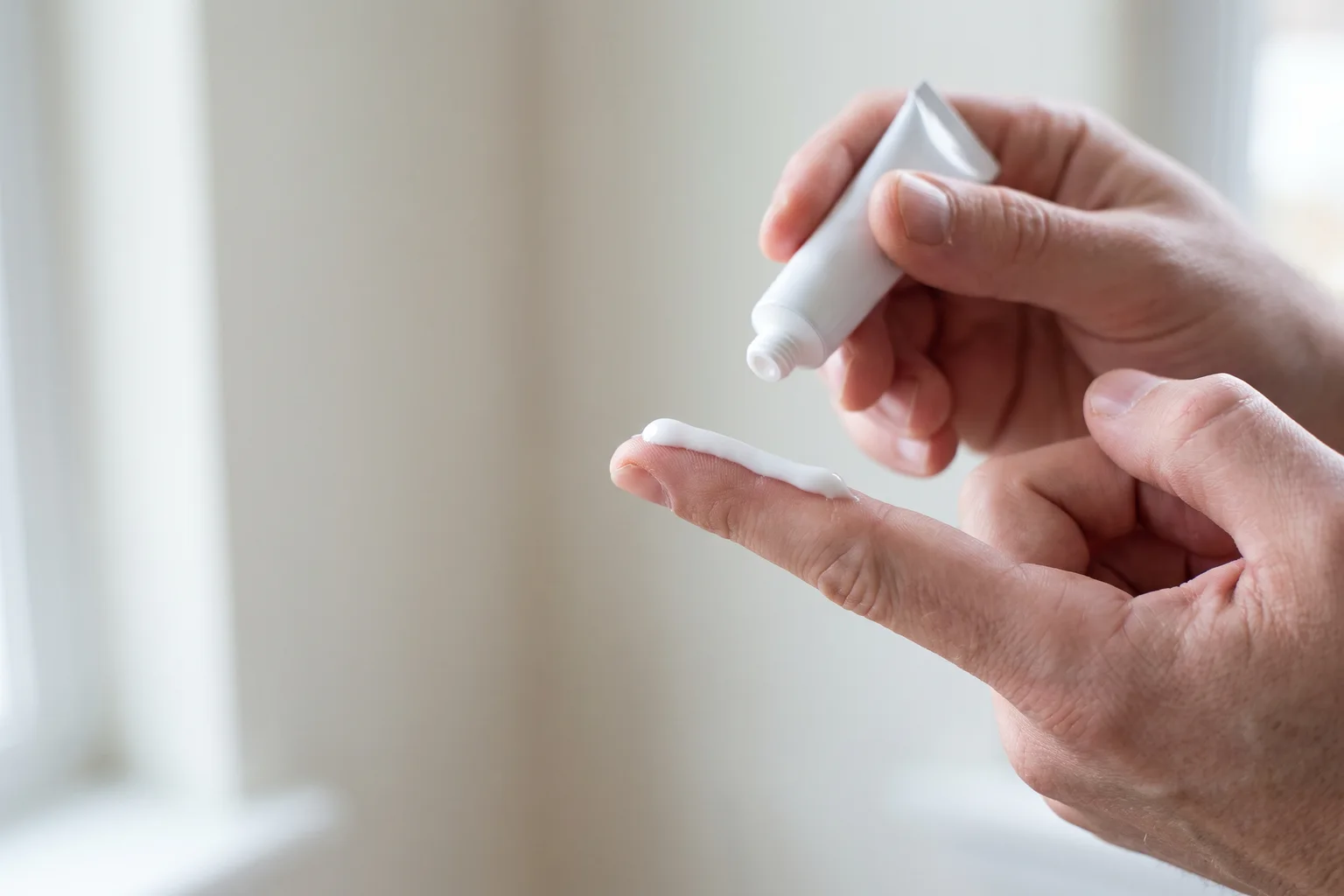
AI-generated illustration. Not an actual patient or treatment result.
How Long Can You Safely Use Clobetasol?

Chief Medical Officer
Use clobetasol for 2 weeks at a time and no more than 50 g a week, unless your product is the shampoo (4 weeks) or the lotion or spray, which allow 2 more weeks only on small areas of plaque psoriasis that have not cleared. The 2-week cap on the cream and ointment exists because clobetasol has suppressed the hypothalamic-pituitary-adrenal (HPA) axis, the body's own steroid system, at doses as low as 2 g per day (clobetasol ointment label). After a burst, I step patients down to a few days a week or to a non-steroid.
In this article
How long can you use clobetasol?
Two consecutive weeks for the cream, ointment, gel, scalp solution and foams. The ointment label says treatment beyond 2 consecutive weeks is not recommended and use under age 12 is not recommended (clobetasol ointment label). The scalp solution carries the same 2-week limit (clobetasol solution label). The shampoo allows 4 weeks in adults (clobetasol shampoo label).
Longer use happens in practice. The American Academy of Dermatology (AAD) suggests super-potent (class 1) steroids such as clobetasol for up to 4 weeks on thick, chronic plaques (AAD topical pathway). Its guideline adds that topical steroids in general can be used beyond 12 weeks under careful physician supervision (AAD guideline summary).
Which clobetasol products allow 4 weeks?
Three do: the shampoo, and the spray and lotion on small areas of plaque psoriasis. Every form caps use at 50 g (or 50 mL) a week.
| Clobetasol 0.05% form | Longest labeled course | Weekly maximum | Age |
|---|---|---|---|
| Cream, ointment | 2 weeks | 50 g | 12 and older |
| Scalp solution | 2 weeks | 50 mL | 12 and older |
| Scalp foam | 2 weeks | 50 g (21 capfuls) | 12 and older |
| Emulsion foam | 2 weeks | 50 g | 12 and older |
| Lotion | 2 weeks, plus 2 more for plaques under 10% of the body | 50 g | 18 and older |
| Spray | 4 weeks (past 2 weeks, small areas only) | 50 g (59 mL) | 18 and older |
| Shampoo | 4 weeks | 50 g | 18 and older |
Sources: the ointment, solution, scalp foam, emulsion foam, lotion, spray and shampoo labels on DailyMed. The spray also caps each application at 26 sprays.
How much clobetasol is too much?
More than 50 g a week is too much on every label, and the risk climbs with the area you cover. In label studies, adrenal suppression appeared in 5 of 13 people (38%) who put the scalp foam on at least 20% of their skin for 14 days (clobetasol foam label), in 6 of 37 (16.2%) treating at least 30% of their skin with the emulsion foam (emulsion foam label), and in 8 of 10 psoriasis patients after 4 weeks of the lotion (clobetasol lotion label).
To measure, use the fingertip unit: ointment squeezed from fingertip to the first crease covers about 286 square centimeters, and one adult hand takes about 1.2 units (Long 1991). I tell patients to treat only active plaques, never the whole body.
Where should you not use clobetasol?
Not on the face, groin or armpits, not for rosacea or perioral dermatitis, and not under bandages or plastic wrap. That is the label's list (clobetasol ointment label). Labels warn that the face, groin and armpits thin more easily than other skin after steroid use (clobetasol solution label). Skin folds are thin and naturally covered, which works like a dressing (Reynolds 2020), and the clobetasol label notes that 96 hours of occlusion markedly increased hydrocortisone penetration (clobetasol ointment label). The scalp solution must not be used on a scalp with a primary infection (clobetasol solution label).
What happens if you use clobetasol too long?
The skin thins first, and with heavy use the adrenal system can be suppressed. In emulsion foam trials of 821 people, application-site atrophy (thinning) occurred in 1.9% (emulsion foam label). In 24 healthy volunteers, twice-daily clobetasol cream thinned skin on ultrasound over 6 weeks (Korting 1992). Thinning reached a plateau within about 2 weeks in another volunteer study (Lubach 1992). One small study found no change: 10 volunteers using once-daily foam for 4 weeks (Lacarrubba 2009).
The label also lists spider veins (telangiectasia) among its less frequent reactions (clobetasol ointment label).
Is skin thinning from clobetasol permanent?
Usually not, if you stop early. In a 41-day volunteer study, skin thickness normalized within 2 weeks after clobetasol was stopped (Lubach 1992). In a second study of 12 volunteers, 16 days of twice-daily use thinned skin about 15%; afterward, one application every 5th or 7th day kept the skin about as thin, every 10th day brought thickness near normal and every 14th day kept it normal (Lubach 1995). Those were healthy volunteers studied for weeks, not years. The shampoo label still warns that some local reactions may be irreversible (clobetasol shampoo label). Thinning you can see needs an in-person exam.
Can you use clobetasol a few days a week for maintenance?
Yes, after the skin clears, but the best safety data come from the rinse-off shampoo. Twice-weekly clobetasol shampoo on the scalp stretched the median time to relapse to 141 days vs 30.5 days on a placebo shampoo, with no more thinning or adrenal suppression than placebo (Poulin 2010). That schedule is outside the shampoo label, which stops at 4 consecutive weeks (clobetasol shampoo label). In 90 cleared patients, a once-weekly pulse of a super-potent steroid (3 doses 12 hours apart) kept 60% of the active group controlled for 6 months, while 80% on placebo flared (Katz 1991). Twice-weekly calcipotriene plus betamethasone foam added 41 days in remission over a year (Lebwohl 2021, PSO-LONG). Leave-on clobetasol is different. In volunteers, applying it every third day thinned skin as much as daily use (Lubach 1992), and every 5th or 7th day still kept skin thinned (Lubach 1995). Long-term use of a leave-on clobetasol should follow a prescriber's plan.
What can you use when you need a break from clobetasol?
A non-steroid, either alone or paired with weekend steroid use. The AAD pathway suggests a vitamin D analog twice daily on weekdays with a high-potency steroid twice daily on weekends, and a vitamin D analog alone for up to 52 weeks when psoriasis does not involve the face or scalp (AAD topical pathway).
Two newer non-steroid creams also work. Roflumilast 0.3% cream (Zoryve), a phosphodiesterase-4 (PDE4) inhibitor, has no maximum treatment length on its label and reached clear or almost clear with a 2-grade gain in 41.5% vs 5.8% and 36.7% vs 7.1% on vehicle at week 8 (Zoryve cream label). Tapinarof 1% (Vtama) reached the same endpoint in 35.4% vs 6.0% and 40.2% vs 6.3% at week 12 (Lebwohl 2021, PSOARING trials), with folliculitis in 20% vs 1% (Vtama label). For skin folds, off-label tacrolimus 0.1% ointment cleared or almost cleared 65.2% vs 31.5% on vehicle at 8 weeks (Lebwohl 2004). The same steroid rules apply to eczema; see topical steroids for eczema, and if you are unsure which disease you have, read eczema vs psoriasis.
How does KindleeRx treat psoriasis?
KindleeRx is a telehealth service, and its psoriasis treatment program is run by licensed clinicians (physician assistants and nurse practitioners working under a board-certified dermatologist's protocols). They review each case online and prescribe only when appropriate, and clinicians reply in under 5 hours on average. A prescription is never guaranteed and not everyone qualifies. If treatment is not prescribed, the refund is full, including the consultation fee.
Sources
- Clobetasol Propionate Ointment USP 0.05% prescribing information (Cosette). DailyMed. 2023.
- Clobetasol Propionate Topical Solution 0.05% prescribing information (Fougera). DailyMed. 2026.
- Clobetasol Propionate Foam 0.05% prescribing information (Glenmark). DailyMed. 2026.
- Clobetasol Propionate Emulsion Foam 0.05% prescribing information (Glenmark). DailyMed. 2026.
- Clobetasol Propionate Lotion 0.05% prescribing information (Lupin). DailyMed. 2025.
- Clobetasol Propionate Spray 0.05% prescribing information (Zydus). DailyMed. 2026.
- Clobetasol Propionate Shampoo 0.05% prescribing information (Padagis). DailyMed. 2026.
- American Academy of Dermatology. Management of Adult Psoriasis with Topicals, clinical pathway. 2023.
- American Academy of Dermatology. Psoriasis clinical guideline summary.
- Long CC, Finlay AY. The finger-tip unit, a new practical measure. Clin Exp Dermatol. 1991.
- Reynolds KA, et al. Treatments for inverse psoriasis: a systematic review. J Dermatolog Treat. 2020.
- Korting HC, et al. 0.25% prednicarbate cream and the corresponding vehicle induce less skin atrophy than 0.1% betamethasone-17-valerate cream and 0.05% clobetasol-17-propionate cream. Eur J Clin Pharmacol. 1992.
- Lubach D, et al. Steroid-induced dermal thinning: discontinuous application of clobetasol-17-propionate ointment. Dermatology. 1992.
- Lubach D, et al. Skin atrophy induced by initial continuous topical application of clobetasol followed by intermittent application. Dermatology. 1995.
- Lacarrubba F, et al. Ultrasound evaluation of clobetasol propionate 0.05% foam application in psoriatic and healthy skin: a pilot study. Dermatol Ther. 2009.
- Poulin Y, et al. Clobetasol propionate shampoo 0.05% is efficacious and safe for long-term control of moderate scalp psoriasis. J Dermatolog Treat. 2010.
- Katz HI, et al. Intermittent corticosteroid maintenance treatment of psoriasis: a double-blind multicenter trial of augmented betamethasone dipropionate ointment in a pulse dose treatment regimen. Dermatologica. 1991.
- Lebwohl M, et al. Twice-weekly topical calcipotriene/betamethasone dipropionate foam as proactive management of plaque psoriasis (PSO-LONG trial). J Am Acad Dermatol. 2021.
- Zoryve (roflumilast) cream prescribing information. Arcutis Biotherapeutics. DailyMed. 2026.
- Lebwohl MG, et al. Phase 3 trials of tapinarof cream for plaque psoriasis. N Engl J Med. 2021.
- Vtama (tapinarof) cream prescribing information. DailyMed. 2025.
- Lebwohl M, et al. Tacrolimus ointment is effective for facial and intertriginous psoriasis. J Am Acad Dermatol. 2004.
Related Articles
Eczema
Topical Steroids for Eczema: Benefits, Safety, and the Rise of Steroid-Free Options
Mar 2, 2026 · 13 min read
Psoriasis
GLP-1 for Psoriasis: How Weight Loss Can Improve Skin Clearance
May 17, 2026 · 13 min read
Psoriasis
When Weight Is Part of the Psoriasis Story: The Conversation That Often Gets Missed
May 18, 2026 · 10 min read