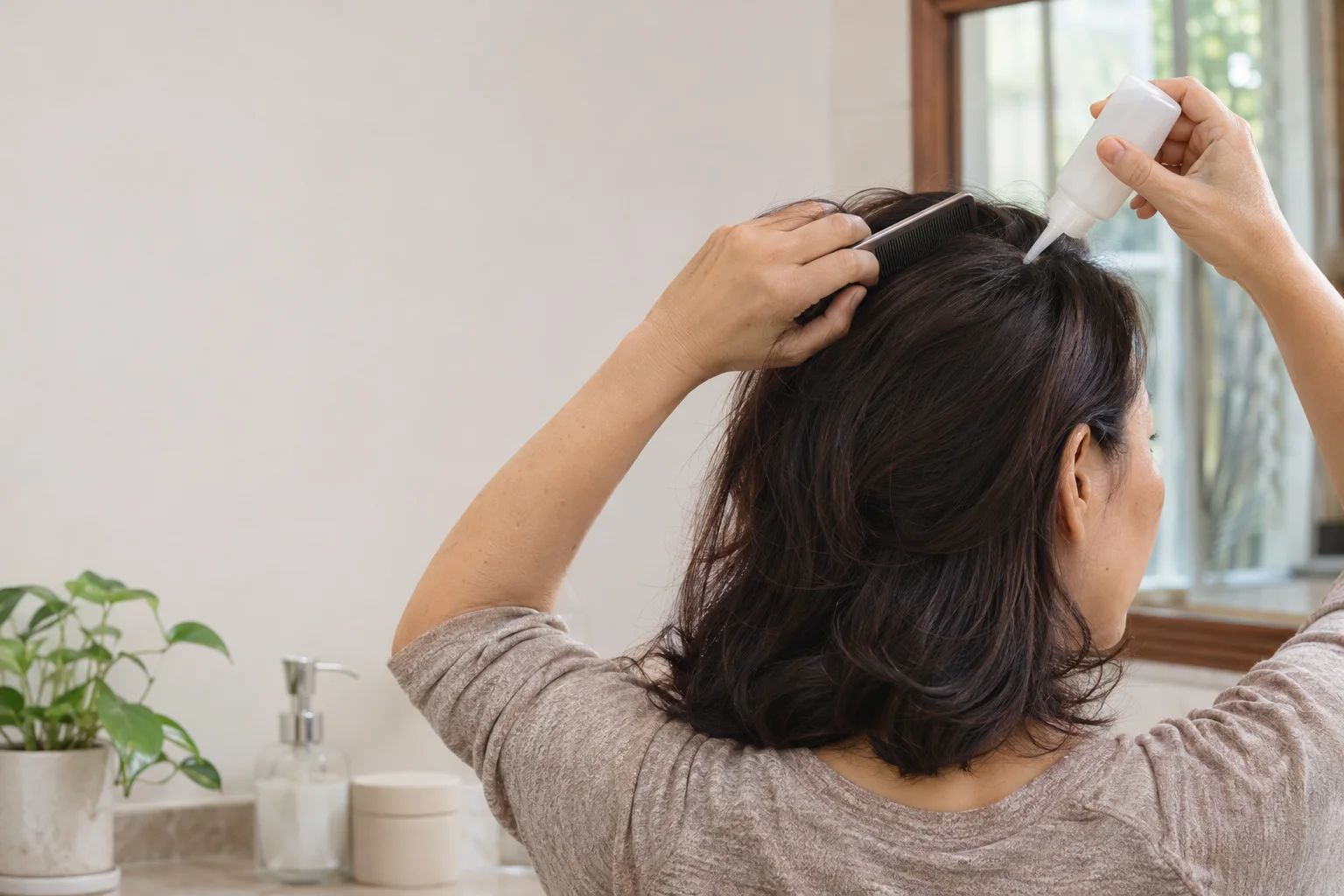
AI-generated illustration. Not an actual patient or treatment result.
Psoriasis on the Face and Ears: Which Prescription Creams Are Safe on Thin Skin?

Chief Medical Officer
Treat psoriasis on the face and outer ears with short bursts of a low-potency steroid followed by steroid-free daily maintenance such as topical roflumilast or off-label tacrolimus, never with the potent body steroids used on elbows or knees. Facial and eyelid skin is far thinner and absorbs topical medicine rapidly, turning strong body creams into a recipe for permanent skin thinning, broken capillaries, and rebound redness.
In this article
How common is psoriasis on the face and ears?
More common than most patients expect, and strongly tied to scalp flares. Clinical reviews report facial psoriasis in about 20% of patients with chronic plaque psoriasis (and up to 49% in broader survey estimates), while ear involvement occurs in about 18% of all psoriasis patients at some point (Dopytalska 2018; Farber 1992).
Among patients who have facial psoriasis, lesions cluster in predictable zones: 76% on the upper forehead, 52% on the lower forehead, 46% around the ears (periauricular skin), 39% on the ears themselves, and 39% on the cheeks (Dopytalska 2018). Most patients with facial psoriasis also carry scalp plaques, and facial involvement is linked with higher overall skin severity and a much higher rate of the Koebner phenomenon, where scratching or picking creates brand-new plaques (70.2% compared with 29.8% in patients without facial psoriasis) (Dopytalska 2018).
Why are strong psoriasis steroids dangerous on the face and ears?
Thin skin lets potent steroids soak in at a fraction of the dose that elbow plaques require. FDA prescribing labels explicitly warn against using clobetasol ointment or calcipotriene plus betamethasone foam (Enstilar) on the face (clobetasol ointment label; Enstilar label). Repeated potent steroid use on facial skin causes:
- Skin thinning (atrophy) and spider veins (telangiectasia): Fragile, translucent skin that bruises easily and stays persistently flushed.
- Steroid-induced acne and perioral dermatitis: Red bumps around the mouth, nose, or eyelids that flare sharply when the cream is stopped.
- Eye complications: Chronic topical steroid exposure around the eyelids can raise eye pressure and increase the risk of glaucoma and cataracts (Enstilar label).
I see this mistake in clinic every week: someone dabs their elbow clobetasol tube onto a stubborn patch beside the nose or behind the ear because it worked so quickly on their arm. It flattens the spot in two days, then traps the skin in a cycle of thinning and rebound redness.
Which prescription creams are safe for facial and outer-ear psoriasis?
The American Academy of Dermatology (AAD) topical clinical pathway directs clinicians to lower-potency steroids for short courses (up to 4 weeks) or steroid-free calcineurin inhibitors on facial and sensitive skin (AAD pathway), and modern steroid-free creams have widened our maintenance toolbox dramatically.
| Prescription option | Steroid? | Key clinical evidence | Practical face and ear notes |
|---|---|---|---|
| Low-potency steroids (desonide 0.02% to 0.05%, hydrocortisone 2.5%) | Yes (mild) | Recommended by AAD pathway for short flare control up to 4 weeks | Fast redness relief; limit duration, avoid direct eyelid rims, then step down to steroid-free care |
| Roflumilast 0.3% cream (Zoryve, phosphodiesterase-4 [PDE4] inhibitor) | No | Overall week-8 success 41.5% vs 5.8% and 36.7% vs 7.1%; thin skin folds 71.5% vs 13.8% and 67.5% vs 17.4% (Zoryve label) | Once daily; FDA-approved ages 2+; only 1.0% site pain; no skin thinning; not for moderate or severe liver impairment |
| Tacrolimus 0.1% ointment / pimecrolimus 1% cream (calcineurin inhibitors) | No | Tacrolimus 0.1% cleared or almost cleared face or fold psoriasis in 65.2% vs 31.5% at 8 weeks (Lebwohl 2004) | Off-label for psoriasis; FDA boxed warning (Protopic label; Elidel label); frequent early stinging or warmth; keep out of eyes |
| Tapinarof 1% cream (Vtama) | No | Adult plaque psoriasis week-12 success 36% vs 6% and 40% vs 6% (Vtama label) | Once daily, steroid-free, no site cap; watch for folliculitis (20%) or contact dermatitis (7%) |
If your plaques also involve the groin, armpits, or under-breast creases, the same thin-skin principles apply; see our inverse and genital psoriasis guide.
How do you safely handle psoriasis inside or behind the ears?
Ear psoriasis usually sits in two distinct places: the crease behind the ear (often an extension of scalp psoriasis) and the outer cup or entrance of the ear canal. Treat them gently:
- Stop picking and scraping: Picking scale off the ear bowl triggers the Koebner response and makes the plaque thicker and redder within days (Farber 1992). Soften dry flakes in a lukewarm shower with gentle, fragrance-free cleanser instead.
- Keep medications on the outer ear only: Apply a tiny smear of a clinician-approved mild steroid or steroid-free cream to the crease behind the ear and outer cartilage using a clean fingertip. Never push creams, ointments, or cotton swabs down into the ear canal, where trapped buildup can block sound or breed infection.
- Control the scalp too: Treating hairline and behind-the-ear plaques rarely holds unless you calm scalp plaques at the same time; see our scalp psoriasis treatment guide.
Is it facial psoriasis or seborrheic dermatitis?
The two conditions overlap so closely around the hairline, eyebrows, nasal creases, and ears that dermatologists call the middle ground sebopsoriasis (Dopytalska 2018). Classic facial psoriasis forms sharper pink-to-red plaques with thicker dry scale and often accompanies plaques on the scalp, elbows, knees, or pitted nails. Seborrheic dermatitis tends to show softer borders with greasy yellow-white flaking driven by normal skin yeast (Malassezia). Read our seborrheic dermatitis face and scalp guide if greasy flaking in the eyebrows and beard area is your main symptom.
How does KindleeRx treat facial and outer-ear psoriasis?
Through the KindleeRx Psoriasis Regimen, licensed clinicians (physician assistants and nurse practitioners working under a board-certified dermatologist's protocols) review clear photos of your face, hairline, and outer ears and reply in under 5 hours on average. If appropriate, your clinician selects two prescriptions from 11 listed formulas (6 containing a steroid, 5 steroid-free), often pairing short-term facial flare control such as Soothing Facial Cream (desonide 0.02%, salicylic acid 3%, sulfacetamide and sulfur 3%) with daily steroid-free Calming Daily Cream (roflumilast 0.2% and calamine 5%) or Scalp Relief Solution when the hairline is involved.
Automatic refills are $149 for the first 90-day order, then $149 every 90 days before coupons (including the $20 consultation fee, free shipping, and 90 days of unlimited clinician messaging); a one-time purchase is $181.25 before coupons. Prescriptions are never guaranteed, and if treatment isn't appropriate you receive a full refund including the consultation fee.
Important Information
KindleeRx offers compounded prescription medications prepared by licensed United States compounding pharmacies under a licensed prescriber's order. Compounded medications aren't FDA-approved and aren't reviewed by the FDA for safety, effectiveness, or quality (FDA compounding guidance). KindleeRx's Calming Daily Cream (roflumilast 0.2% and calamine 5%) isn't Zoryve, isn't a generic of Zoryve (no FDA-approved generic of Zoryve exists), and KindleeRx isn't affiliated with Arcutis Biotherapeutics, Organon, LEO Pharma, or Bausch Health. Published trial results for Zoryve, Vtama, Enstilar, and tacrolimus reflect those studied products only, not KindleeRx's compounded formulations. Tacrolimus and pimecrolimus are off-label for psoriasis. Eligibility is determined by a licensed clinician after reviewing your health history and photos. Not all patients qualify. Individual results vary. This article is educational and isn't medical advice.
Sources
- Dopytalska K, et al. Psoriasis in Special Localizations. Reumatologia 2018.
- Farber EM. Ear Psoriasis. Cutis 1992.
- Lebwohl M, et al. Tacrolimus Ointment Is Effective for Facial and Intertriginous Psoriasis. Journal of the American Academy of Dermatology 2004.
- LEO Pharma. Protopic (tacrolimus) Ointment Prescribing Information. Drugs@FDA 2022.
- Bausch Health. Elidel (pimecrolimus) Cream Prescribing Information. Drugs@FDA 2014.
- Arcutis Biotherapeutics. ZORYVE (roflumilast) Cream Prescribing Information, revised June 2026. DailyMed.
- Organon. VTAMA (tapinarof) Cream Prescribing Information, revised May 2025. DailyMed.
- Cosette. Clobetasol Propionate Ointment 0.05% Prescribing Information. DailyMed 2023.
- LEO Pharma. Enstilar (calcipotriene and betamethasone dipropionate) Foam Prescribing Information, revised April 2022. DailyMed.
- American Academy of Dermatology. Management of Adult Psoriasis With Topicals: Clinical Pathway, May 2023 Update.
- Food and Drug Administration. Understanding the Risks of Compounded Drugs.