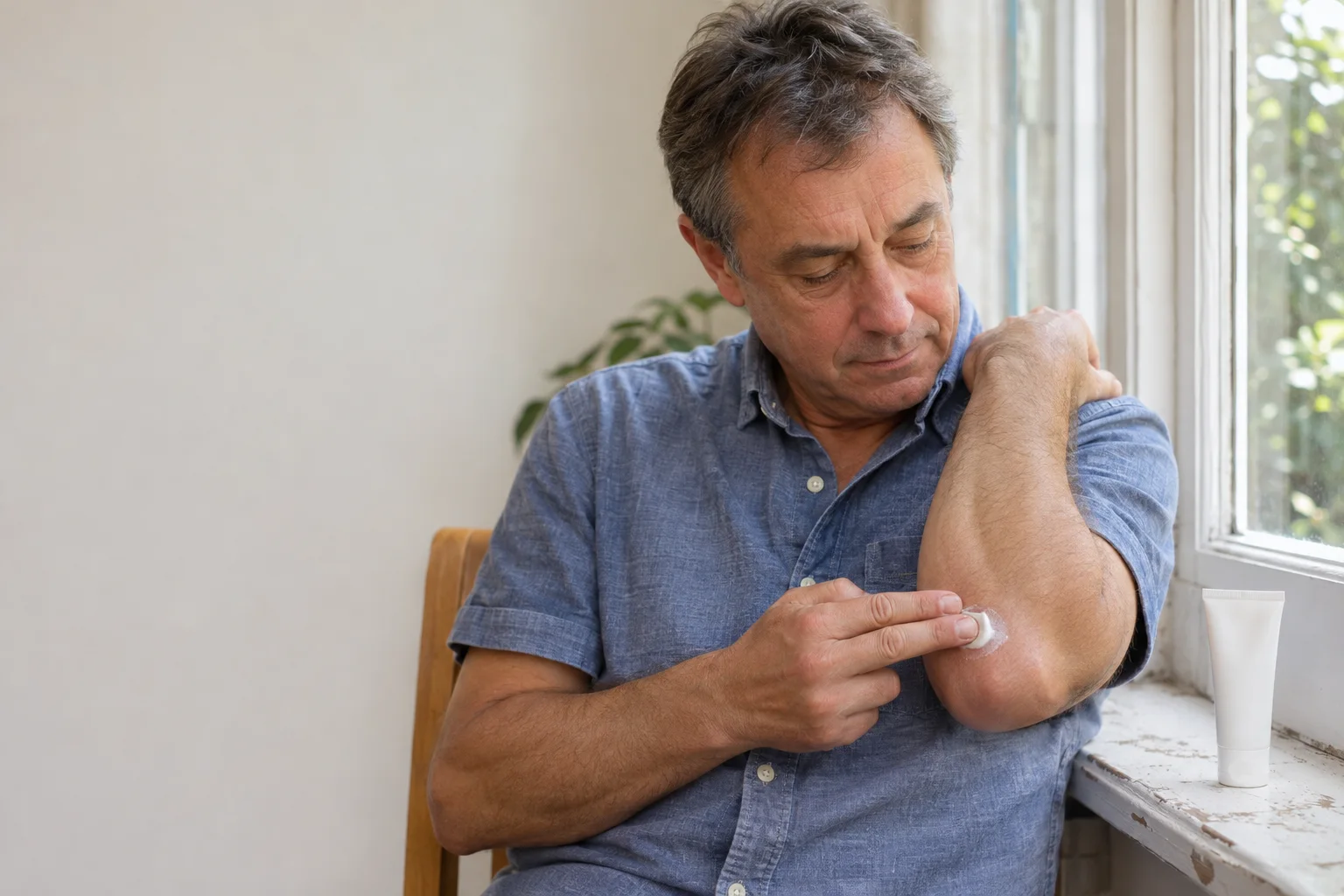
AI-generated illustration. Not an actual patient or treatment result.
Best Online Psoriasis Treatment: How Telehealth Options Compare

Chief Medical Officer
The best online psoriasis treatment pairs dermatologist-designed protocols with body-site-specific prescriptions (thick body plaques, scalp, face, and skin folds) and ongoing clinician messaging. In a 12-month randomized equivalence trial of 296 adults across California and Colorado, asynchronous online dermatology delivered the same plaque and body-area clearing as in-person dermatology visits (Armstrong 2018). Localized plaque, scalp, and skin-fold psoriasis can often be managed with prescription topicals or selected oral therapy when you match the formula to the skin site. Over-the-counter drugstore products are legally limited to coal tar (0.5% to 5%) and salicylic acid (1.8% to 3%) for symptom control alone (Title 21 of the Code of Federal Regulations, Part 358).
In this article
KindleeRx publishes this guide and offers one of the online care models compared in this guide. We didn't test competing telehealth services head to head; all clinical figures come from peer-reviewed studies and FDA prescribing labels.
Does online psoriasis treatment work as well as an in-person dermatologist?
Yes, for adult psoriasis managed with prescription medications, randomized clinical evidence shows online dermatology matches in-person clinic care. The Patient-Centered Outcomes Research Institute Psoriasis Teledermatology Trial randomized 296 adults (148 online, 148 in person; mean age 49 years) for 12 months. Patients in the online arm uploaded photos and history asynchronously and received assessments, education, and prescriptions from dermatologists online. At 12 months, differences between arms landed within the trial's prespecified equivalence margins and were negligible: 0.27 points on self-administered PASI and 0.05 percentage points on BSA, while patient-rated global improvement slightly favored the online group (Armstrong 2018).
Access matters just as much as clinical accuracy. In a 2025 University of Rochester study of 839 urgent-care dermatology referrals, 56.5% of patients never completed an in-person dermatology visit. Among those who completed a visit, urgent-care diagnoses agreed with dermatologists only 29.1% of the time. When five dermatologists reviewed a subset of 40 referrals, they judged only 20% (8 of 40) of urgent-care treatment plans appropriate, while rating 92.5% (37 of 40) manageable through clinician-to-dermatologist electronic consultation and only 5.0% (2 of 40) needing an urgent in-person exam (Rahman 2025). For localized plaques, I would rather get a patient on the right prescription this week than let them wait months for a brief office slot.
How do online psoriasis treatment options compare?
Patients searching for online psoriasis care generally choose among four options. Each trades off prescription variety, speed, insurance paperwork, and follow-up access.
| Care model | How visits work | Typical prescriptions | Follow-up and pricing | Best fit |
|---|---|---|---|---|
| KindleeRx Psoriasis Regimen (regimen details) | 5-minute online intake with skin photos; licensed clinician reviews under a board-certified dermatologist's protocols; replies in under 5 hours on average | Two clinician-chosen prescriptions, if appropriate, from 11 listed compounded and prescription formulas (6 with steroids, 5 steroid-free), spanning thick plaques, scalp, face, skin folds, and oral roflumilast, shipped free | $149 first 90-day order, then $149 every 90 days with automatic refills (before coupons), including the $20 consult and 90 days unlimited messaging; $181.25 one-time (before coupons); cancel anytime; no insurance needed | Patients with mild-to-moderate body, scalp, or skin-fold plaques wanting paired rescue and maintenance therapy without prior authorizations (44 states plus Washington, D.C.) |
| General urgent-care or primary telehealth | Brief video or form visit with a primary-care or urgent-care clinician | Single generic steroid cream or ointment sent to a retail pharmacy | Visit copay or cash visit fee plus local pharmacy fill; new visit fee for adjustments | Straightforward refills of a known generic steroid for localized elbow or knee plaques |
| Insurance-billed online dermatology clinic | Photo or video visit with a dermatologist or dermatology clinician | Generic steroids, vitamin D analogs, and FDA-approved branded topicals (Enstilar, Zoryve, Vtama) or oral systemics via prior authorization | Specialist copay or deductible plus pharmacy copays; branded drugs depend on insurance formulary approval | Insured patients specifically targeting FDA-approved branded foams, creams, or systemic prescriptions through their health plan |
| In-person dermatologist visit | Full skin, scalp, nail, and joint exam; lab screening or biopsy when needed | All topicals plus injectable biologics (interleukin-17, interleukin-23, and tumor necrosis factor blockers), oral systemics, and office phototherapy | Specialist copay or cash visit plus labs and specialty pharmacy coordination; wait times often stretch weeks | Moderate-to-severe widespread psoriasis, joint pain (psoriatic arthritis), severe nail disease, or biologic therapy |
Which prescription psoriasis treatments can clinicians prescribe online?
Online dermatology clinicians prescribe across four main topical and oral groups, depending on plaque thickness, body site, and total area covered. Trial rates below come from separate vehicle- or placebo-controlled trials with different endpoints and durations (most topical trials requiring clear or almost clear skin plus at least a 2-grade improvement), so they aren't head-to-head comparisons.
| Treatment | Steroid | Published trial result (drug vs vehicle/placebo) | Key safety or label limits | Primary source |
|---|---|---|---|---|
| Calcipotriene + betamethasone foam (Enstilar) | Yes | Clear or almost clear at 4 weeks: 53.3% vs 4.8%; twice-weekly maintenance (outside label dosing) extended median time to relapse to 56 vs 30 days | Max 60 g every 4 days; avoid face, groin, and armpits; 2 of 21 adults had adrenal suppression in a 52-week label sub-study | Enstilar label; Lebwohl 2021 (PSO-LONG) |
| Clobetasol 0.05% (super-potent class 1 steroid) | Yes | Scalp foam clear or almost clear at 2 weeks: 39 of 62 (63%) vs 1 of 31 (3%) | Cream/ointment limited to 2 consecutive weeks and 50 g/week; never on face, groin, or armpits | Clobetasol foam label; Clobetasol ointment label |
| Roflumilast 0.3% cream (Zoryve, phosphodiesterase-4 (PDE4) inhibitor) | No | Clear or almost clear at 8 weeks: 41.5% vs 5.8% and 36.7% vs 7.1% overall; 71.5% vs 13.8% and 67.5% vs 17.4% in skin folds | Ages 2+; once daily; no boxed warning or BSA cap; not with moderate or severe liver impairment; diarrhea 3.1% vs 0%, application-site pain 1.0% vs 0.3% | Lebwohl 2022; Zoryve cream label |
| Roflumilast 0.3% foam (Zoryve foam, scalp and body) | No | Scalp clear or almost clear at 8 weeks: 66.4% vs 27.8% and 56.7% vs 11.0% across two 8-week trials (one phase 3, one phase 2b) | Ages 12+; once daily; flammable propellant; not with moderate or severe liver impairment; headache 3.1% vs 1.2%, diarrhea 2.5% vs 1.6% | Gooderham 2025; Zoryve foam label |
| Tapinarof 1% cream (Vtama) | No | Clear or almost clear at 12 weeks: 35.4% vs 6.0% and 40.2% vs 6.3%; median 114 days before worsening after stopping | Adults only; once daily; folliculitis in 20% vs 1%, contact dermatitis 7% vs 1% | Lebwohl 2021 (PSOARING); Vtama label |
| Oral roflumilast 500 mcg daily (off-label systemic PDE4 pill) | No | At least 75% plaque reduction at 12 weeks: 8 of 23 (35%) vs 0 of 23 (0%) on placebo; 10 of 23 (44%) at 24 weeks during open-label extension | FDA-approved for severe chronic obstructive pulmonary disease, off-label for psoriasis; not with moderate or severe liver impairment; transient stomach upset, weight loss, headache, insomnia; screen for depression or suicidal thoughts | Gyldenløve 2023; Daliresp label |
For a detailed cream-by-cream breakdown including coal tar and vitamin D analogs, read our guide to the best creams for psoriasis.
Why does body location decide which online psoriasis prescription you get?
Psoriasis doesn't respond to one universal tube. I match the vehicle to the body site before I look at brand names: foams and liquid solutions for the scalp, steroid-free creams for the face and folds, and short potent courses for thick elbow or knee plaques. Skin thickness and drug absorption vary dramatically across those areas.
- Thick elbow, knee, and trunk plaques: Need higher-potency topical steroids (limited to short bursts, such as 2 consecutive weeks for clobetasol ointment, per our clobetasol safety guide), coal tar and salicylic acid combinations to break down thick scale, topical retinoids (tazarotene, contraindicated in pregnancy), or steroid-plus-vitamin D regimens.
- Scalp psoriasis: Reported by 45% to 56% of patients in three United States cohorts (Merola 2016). Thick ointments mat hair and fail because patients stop using them; liquid solutions, foams, and medicated shampoos penetrate hair-bearing skin cleanly. See what works for scalp psoriasis.
- Face and skin folds (inverse psoriasis): Skin-fold psoriasis (armpits, groin, under the breasts, and other creases) was reported by 21% to 30% of people with psoriasis in three United States cohorts (Merola 2016). Facial and fold skin is thin, and natural folds trap moisture and raise steroid absorption, making super-potent steroids off-limits. I rely on short low-potency facial steroids or steroid-free creams such as topical roflumilast or calcineurin inhibitors (off-label for psoriasis); see inverse and genital psoriasis options.
- Nails: Pitted, crumbling, or lifting nails rarely clear with creams alone, and nail dystrophy is an important warning sign. In a cohort of 1,593 psoriasis patients, those with nail dystrophy were almost 3 times as likely to develop psoriatic arthritis, yet only 5.1% of the whole group developed psoriatic arthritis within 20 years (Wilson 2009). A 464-patient prospective cohort found 2.7 new psoriatic arthritis cases per 100 psoriasis patients each year (Eder 2016). Read what works for nail psoriasis.
What does online psoriasis treatment cost?
Online psoriasis pricing splits into three tiers depending on whether you buy generic topicals, branded pharmaceuticals, or a bundled cash-pay regimen.
- Generic steroid prescriptions via cash telehealth: You pay a separate visit fee (or insurance specialist copay) plus your retail pharmacy fill. A second medication or dosage change usually means another paid visit.
- Branded non-steroid creams without insurance: Branded roflumilast cream (Zoryve) commonly lists at $950 to $1,263 cash per tube (GoodRx, 2026; cash prices vary by pharmacy and region) before insurance or savings-card reductions.
- KindleeRx Psoriasis Regimen (bundled cash-pay): $149 for the first 90-day order with automatic refills, then $149 every 90 days (before coupons). That includes two prescriptions, if prescribed, the $20 consultation fee, free shipping, and 90 days of unlimited clinician messaging. A one-time purchase is $181.25 before coupons. Automatic refills can be canceled anytime, and an itemized receipt is available in the patient portal for health savings account or flexible spending account (HSA/FSA) reimbursement, depending on your plan's rules.
How does KindleeRx's online psoriasis treatment work?
Through the KindleeRx Psoriasis Regimen, you complete a 5-minute online assessment and upload clear photos of your plaques. Licensed clinicians (physician assistants and nurse practitioners working under a board-certified dermatologist's protocols) evaluate your photos and health history and reply in under 5 hours on average.
If treatment is appropriate, your clinician picks two complementary prescriptions from 11 listed compounded and prescription formulations (6 containing a steroid, 5 steroid-free). For thick body plaques, options include Plaque Rescue Ointment (coal tar solution 8%, salicylic acid 6%, clobetasol 0.05%) and Plaque Precision Cream (tazarotene 0.1%). For daily steroid-free control or specific body sites, options include Calming Daily Cream (roflumilast 0.2% and calamine 5%, also available standalone as The Calming Cream), Scalp Relief Solution, Soothing Facial Cream, Ease the Itch Lotion, lower-leg care, wet-wrap kits, and Systemic Calm Tablets (oral roflumilast 500 mcg) for widespread involvement.
Service is available in 44 states plus Washington, D.C. (excluding Arkansas, Kansas, Maryland, Mississippi, Nebraska, and West Virginia). Prescriptions are never guaranteed. If a clinician determines treatment isn't appropriate, you receive a full refund including the $20 consultation fee. Orders also carry a 90-day satisfaction refund guarantee (including the $20 consultation fee, after clinician review of follow-up photos).
When do you need an in-person dermatologist for psoriasis?
Online care cuts the wait for mild-to-moderate plaque, scalp, and skin-fold psoriasis. When joints ache or plaques cover too much skin for creams to keep pace, I recommend an in-person dermatologist who can start targeted biologics that protect both skin and joints.
Important Information
KindleeRx offers compounded prescription medications prepared by licensed United States compounding pharmacies under a licensed prescriber's order. Compounded medications aren't approved by the FDA and aren't reviewed by the FDA for safety, effectiveness, or quality (FDA compounding guidance). KindleeRx's Calming Daily Cream (roflumilast 0.2% and calamine 5%) isn't Zoryve, isn't a generic of Zoryve (no FDA-approved generic of Zoryve exists), and KindleeRx isn't affiliated with Arcutis Biotherapeutics, Organon, LEO Pharma, or AstraZeneca. Published clinical trial data for branded products (Zoryve, Enstilar, Vtama) and oral roflumilast describe those studied products and strengths only, not KindleeRx's compounded formulations. Oral roflumilast is FDA-approved for severe chronic obstructive pulmonary disease (Daliresp label); its use in psoriasis is off-label. A licensed clinician determines whether treatment is appropriate after reviewing your health history and photos. Not all patients qualify. Individual results vary. This article is educational and isn't medical advice.
Sources
- Armstrong AW, et al. Effectiveness of Online vs In-Person Care for Adults With Psoriasis: A Randomized Clinical Trial. JAMA Network Open 2018.
- Rahman SM, et al. Identifying Care Gaps and Referral Patterns in Acute Dermatology at Urgent Care Centers. Archives of Dermatological Research 2025.
- Merola JF, et al. Prevalence of Psoriasis Phenotypes Among Men and Women in the USA. Clinical and Experimental Dermatology 2016.
- Alinaghi F, et al. Prevalence of Psoriatic Arthritis in Patients With Psoriasis: A Systematic Review and Meta-Analysis of 266 Studies. Journal of the American Academy of Dermatology 2019.
- Wilson FC, et al. Incidence and Clinical Predictors of Psoriatic Arthritis in Patients With Psoriasis: A Population-Based Study. Arthritis & Rheumatism 2009.
- Eder L, et al. The Incidence and Risk Factors for Psoriatic Arthritis in Patients With Psoriasis: A Prospective Cohort Study. Arthritis & Rheumatism 2016.
- LEO Pharma. Enstilar (calcipotriene and betamethasone dipropionate) Foam Prescribing Information. DailyMed 2022.
- Lebwohl M, et al. PSO-LONG: Long-Term Proactive Management of Plaque Psoriasis With Calcipotriene/Betamethasone Foam. Journal of the American Academy of Dermatology 2021.
- Glenmark. Clobetasol Propionate Foam 0.05% Prescribing Information. DailyMed 2026.
- Cosette. Clobetasol Propionate Ointment 0.05% Prescribing Information. DailyMed 2023.
- Lebwohl MG, et al. DERMIS-1 and DERMIS-2 Trials of Roflumilast Cream 0.3% in Plaque Psoriasis. JAMA 2022.
- Arcutis Biotherapeutics. ZORYVE (roflumilast) Cream Prescribing Information, revised June 2026. DailyMed.
- Gooderham MJ, et al. ARRECTOR Trial of Roflumilast Foam 0.3% for Scalp and Body Psoriasis. JAMA Dermatology 2025.
- Arcutis Biotherapeutics. ZORYVE (roflumilast) Foam Prescribing Information, revised June 2026. DailyMed.
- Lebwohl MG, et al. Phase 3 Trials of Tapinarof Cream 1% for Plaque Psoriasis (PSOARING 1 and 2). New England Journal of Medicine 2021.
- Organon. VTAMA (tapinarof) Cream Prescribing Information, revised May 2025. DailyMed.
- Gyldenløve M, et al. Efficacy and Safety of Oral Roflumilast for Moderate-to-Severe Psoriasis (PSORRO): A Randomized Controlled Trial. The Lancet Regional Health - Europe 2023.
- AstraZeneca. DALIRESP (roflumilast) Tablets Prescribing Information, revised March 2020. DailyMed.
- United States Code of Federal Regulations. Title 21, Part 358, Subpart H: Drug Products for the Control of Dandruff, Seborrheic Dermatitis, and Psoriasis. Electronic Code of Federal Regulations.
- GoodRx. Zoryve Retail Cash Pricing (2026).
- Food and Drug Administration. Understanding the Risks of Compounded Drugs.