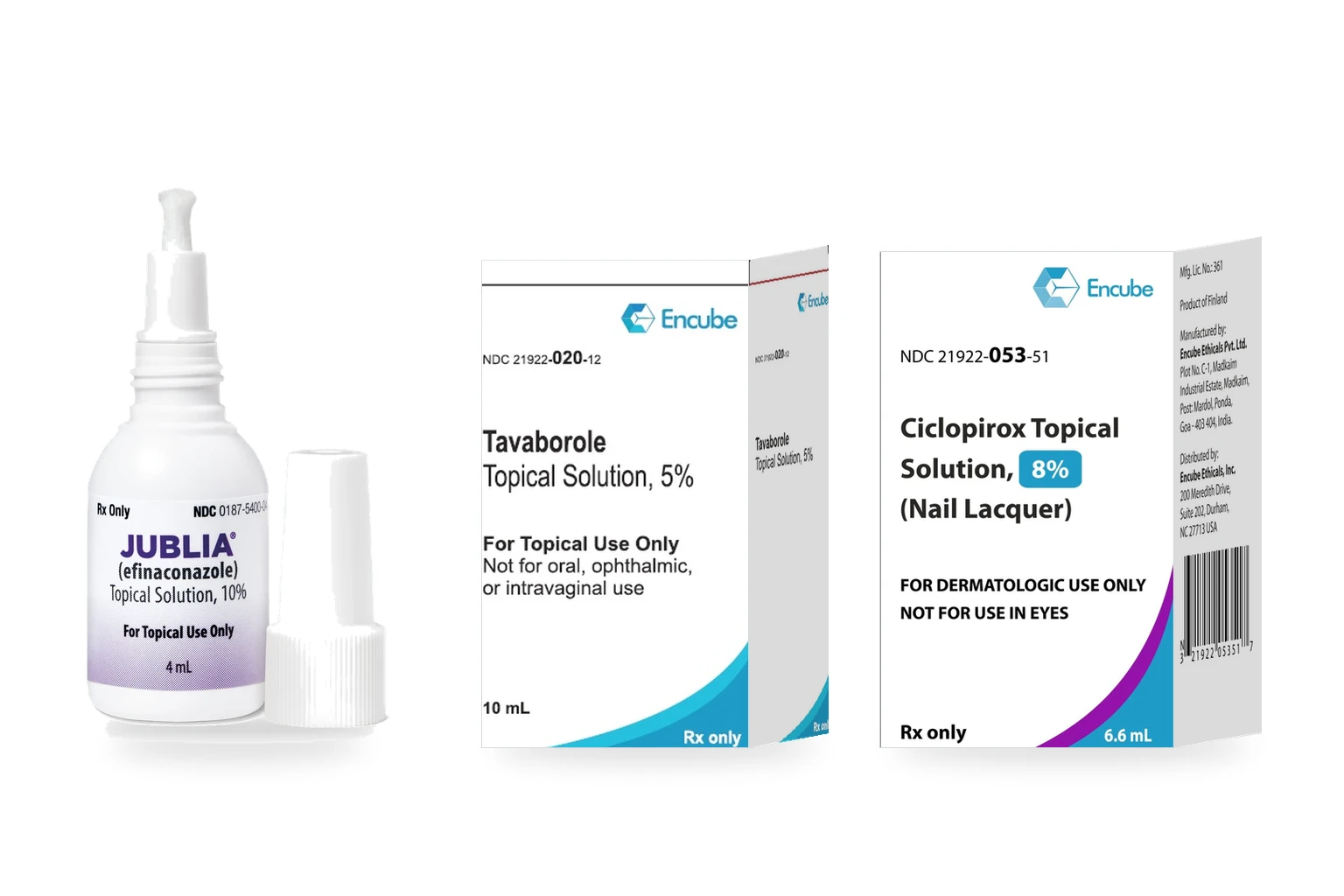
Product images shown for identification. Jublia (Bausch Health) and Encube Ethicals products are trademarks of their respective owners. KindleeRx is not affiliated with or endorsed by these companies.
Toenail Fungus in Children and Teens: Why Topicals Work Better and Household Screening Matters

Chief Medical Officer
Finding a thick, yellow toenail on your child or teenager is stressful, yet pediatric toenail fungus follows very different rules than adult nail fungus: it is much rarer, far easier to confuse with non-fungal nail conditions, and significantly more responsive to prescription topical drops (Gupta 2022; Gupta 2025).
In this article
How common is toenail fungus in children and teenagers, and why is lab testing essential?
A 2025 global epidemiological review reported that culture-confirmed pediatric toenail onychomycosis affects only 0.33% of children worldwide (rising in higher-risk subgroups such as children with Down syndrome or weakened immunity) (Gupta 2025).
Many look-alike conditions occur far more often in kids and teens, including:
- Congenital malalignment of the great toenail (sideways-angled thickened big toenail from early childhood) (Cedirian 2024)
- Cleat, soccer, and tight-shoe trauma
- Post-viral onychomadesis (nail shedding weeks after hand-foot-and-mouth disease)
- Nail psoriasis or twenty-nail dystrophy
Pediatric dermatologists strongly recommend confirming fungus on a painless nail clipping (mycology exam) before starting months of medication (Gupta 2022).
Why do topical antifungals work so much better in kids than in adults?
Adult toenails are thick and slow-growing, taking 12 to 18 months to replace completely. Children's toenails are thinner, more permeable, and grow out much faster, giving prescription topical solutions a real advantage without exposing a growing child to unnecessary systemic pills (Gupta 2022; Gupta 2024).
In a multicenter, open-label Phase 4 trial (without a vehicle control arm) of 62 children and adolescents (ages 6 to 16) with culture-positive toenail fungus applying efinaconazole 10% topical solution once daily for 48 weeks, 65% achieved mycologic cure and 40% achieved complete clear-nail cure at Week 52, with low plasma absorption and zero dropouts from side effects (ingrown toenail was the only treatment-related adverse event) (Gupta 2020).
Which topical and oral antifungals are used for pediatric nail fungus?
| Pediatric therapy | FDA pediatric approval | Clinical role |
|---|---|---|
| Efinaconazole 10% solution (Jublia) | Approved ages 6 and older (Gupta 2022) | First-line topical for mild-to-moderate pediatric toenail fungus; 40% complete cure in Phase 4 trial (Gupta 2020) |
| Tavaborole 5% solution (Kerydin) | Approved ages 6 and older (Gupta 2022) | Once-daily FDA-approved pediatric topical alternative with minimal systemic exposure |
| Ciclopirox 8% lacquer | Approved ages 12 and older (Gupta 2022) | Low-cost generic topical option for teens with mild involvement |
| Oral terbinafine, itraconazole, or fluconazole | Off-label under age 18 (weight-based dosing) (Gupta 2022) | Reserved by pediatric specialists for severe, matrix-involving, or topical-refractory cases; pediatric laser/device efficacy data remain lacking |
Compare adult dosing strategies in our guide to oral versus topical toenail fungus treatment.
Why must parents and household members get checked at the same time?
Children rarely develop toenail fungus in a vacuum. Dermatology guidelines emphasize checking parents, grandparents, and siblings for athlete's foot (tinea pedis) and fungal toenails whenever a child tests positive (Gupta 2022; Gupta 2025). Shared showers, bathmats, carpets, and nail clippers pass dermatophytes right back to a healing child.
Simple household habits that break the cycle:
- Treat any parent's or adult caregiver's athlete's foot and fungal toenails concurrently.
- Give each family member separate nail clippers and clean shared shower floors weekly.
- Wash bathmats hot and have everyone wear shower sandals in shared locker rooms or pools. Review our full guides on whether toenail fungus is contagious and how to prevent nail fungus.
Who treats pediatric nail fungus, and how can KindleeRx help affected adults in the home?
KindleeRx treats adults ages 18 and older only and does not evaluate or prescribe for children or teenagers. If your child or teen has a suspicious toenail, book an in-person appointment with a pediatrician or board-certified pediatric dermatologist for nail-clipping confirmation and pediatric-approved care.
If you or another adult (18+) in the household also has thick, yellow fungal toenails that could keep re-exposing your family, licensed clinicians (physician assistants and nurse practitioners working under a board-certified dermatologist's protocols) review your photos and history through the KindleeRx Nail Regimen and reply in under 5 hours on average. When clinically appropriate for eligible adults, the 90-day program pairs 21 terbinafine 250 mg pills (off-label pulse schedule) with a 30 mL compounded topical nail solution (itraconazole 1%, terbinafine 3%, urea 20%, tea tree oil 6.6%, and dimethyl sulfoxide [DMSO]) for $99 on the first automatic-refill order, then $99 every 90 days before coupons (including the $20 consultation fee, free shipping, and 90 days of clinician messaging), or $118.75 one-time before coupons. Before prescribing oral terbinafine, your clinician may ask for copies of your earlier liver blood test results, or ask your primary care provider to order a test. Available in 44 states plus Washington, D.C. (excluding Arkansas, Kansas, Maryland, Mississippi, Nebraska, and West Virginia), with a full refund including the consultation fee if treatment is not prescribed.
Important Information
KindleeRx's topical nail solution (itraconazole 1%, terbinafine 3%, urea 20%, tea tree oil 6.6%, and DMSO) is a compounded prescription medication prepared by a licensed United States compounding pharmacy under a prescriber's order. Compounded medications are not approved by the Food and Drug Administration (FDA) and are not reviewed by the FDA for safety, effectiveness, or quality (FDA compounding guidance). Oral terbinafine pulse dosing (21 pills over 3 months) is an off-label schedule. KindleeRx treats adults ages 18 and older only and does not diagnose or treat pediatric or adolescent patients. Jublia is a registered trademark of Bausch Health Companies Inc. or its affiliates and Kerydin is a trademark of Anacor Pharmaceuticals, Inc.; KindleeRx is not affiliated with or endorsed by either manufacturer. Eligibility is determined by a licensed clinician after reviewing your medical history and photos. Not all patients qualify. Individual results vary. This article is educational and is not medical advice.
Sources
- Gupta AK, Taylor D. Pediatric Dermatophyte Onychomycosis: A Review. International Journal of Dermatology 2025.
- Gupta AK, Venkataraman M, Shear NH, Piguet V. Onychomycosis in Children: Review on Treatment and Management Strategies. Journal of Dermatological Treatment 2022.
- Gupta AK, Venkataraman M, Shear NH, Piguet V. Labeled Use of Efinaconazole Topical Solution 10% in Treating Onychomycosis in Children and a Review of the Management of Pediatric Onychomycosis. Dermatologic Therapy 2020.
- Gupta AK, Mann A, Polla Ravi S, Wang T, Cooper EA. Efinaconazole 10% Solution: A Comprehensive Review of Its Use in the Treatment of Onychomycosis. Expert Opinion on Pharmacotherapy 2024.
- Cedirian S, Alessandrini A, Starace MVR. Pediatric Nail Disorders. Skin Appendage Disorders 2024.
- Food and Drug Administration. Understanding the Risks of Compounded Drugs.