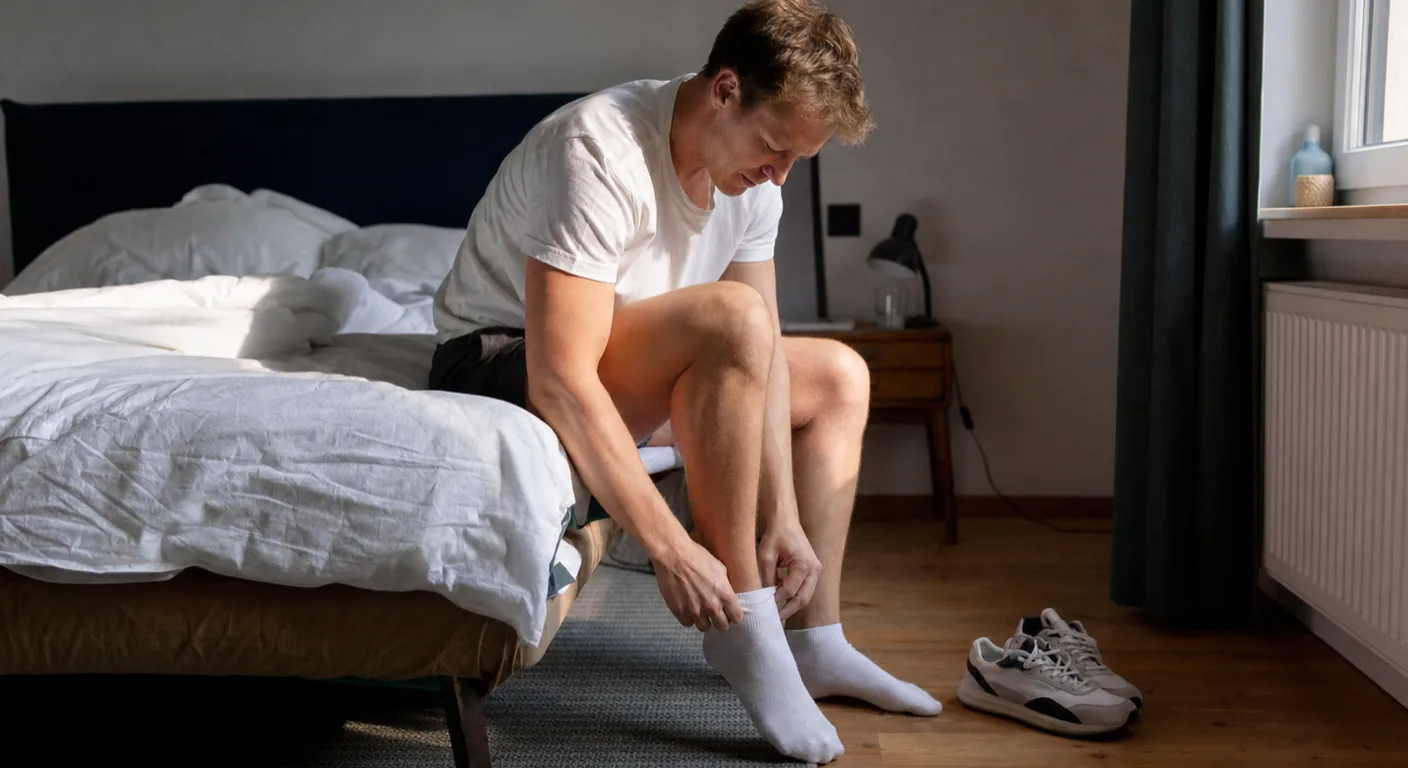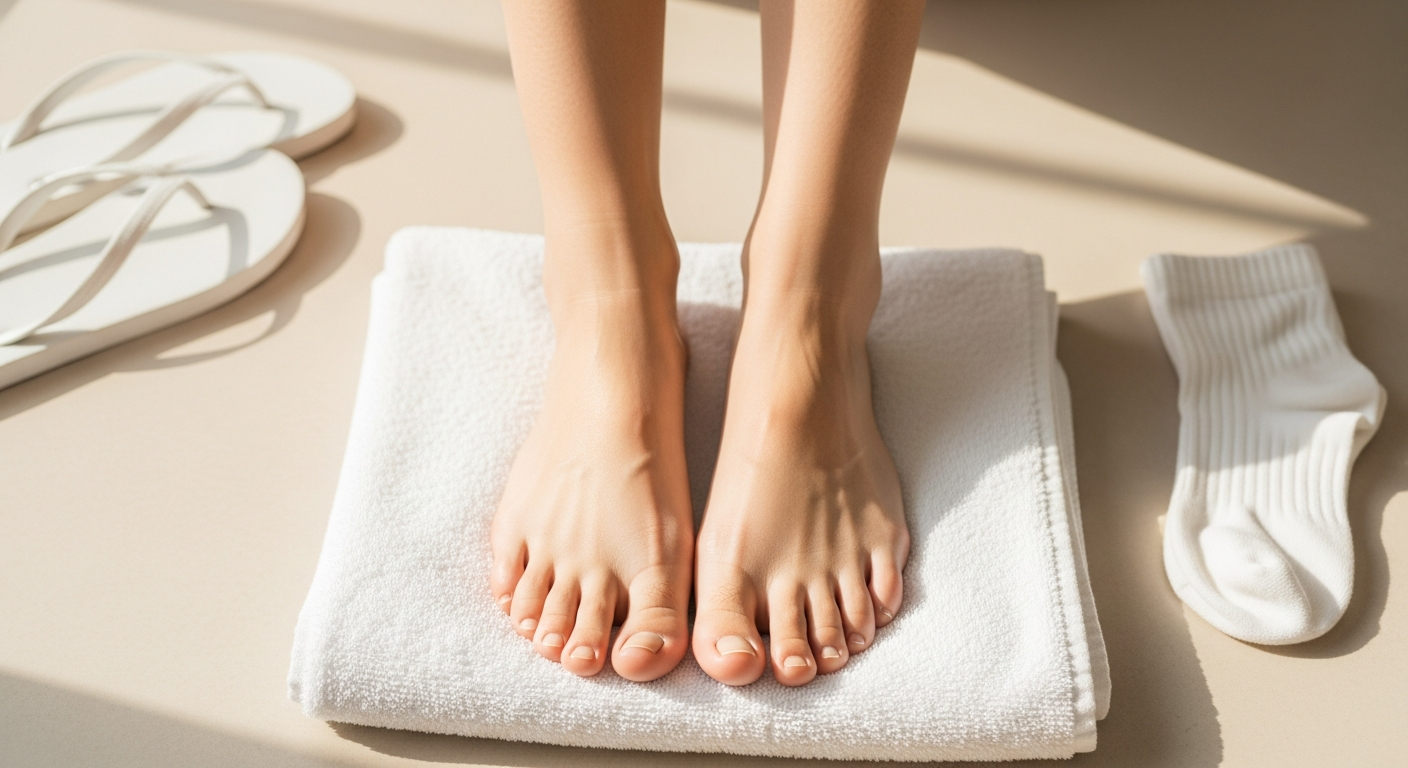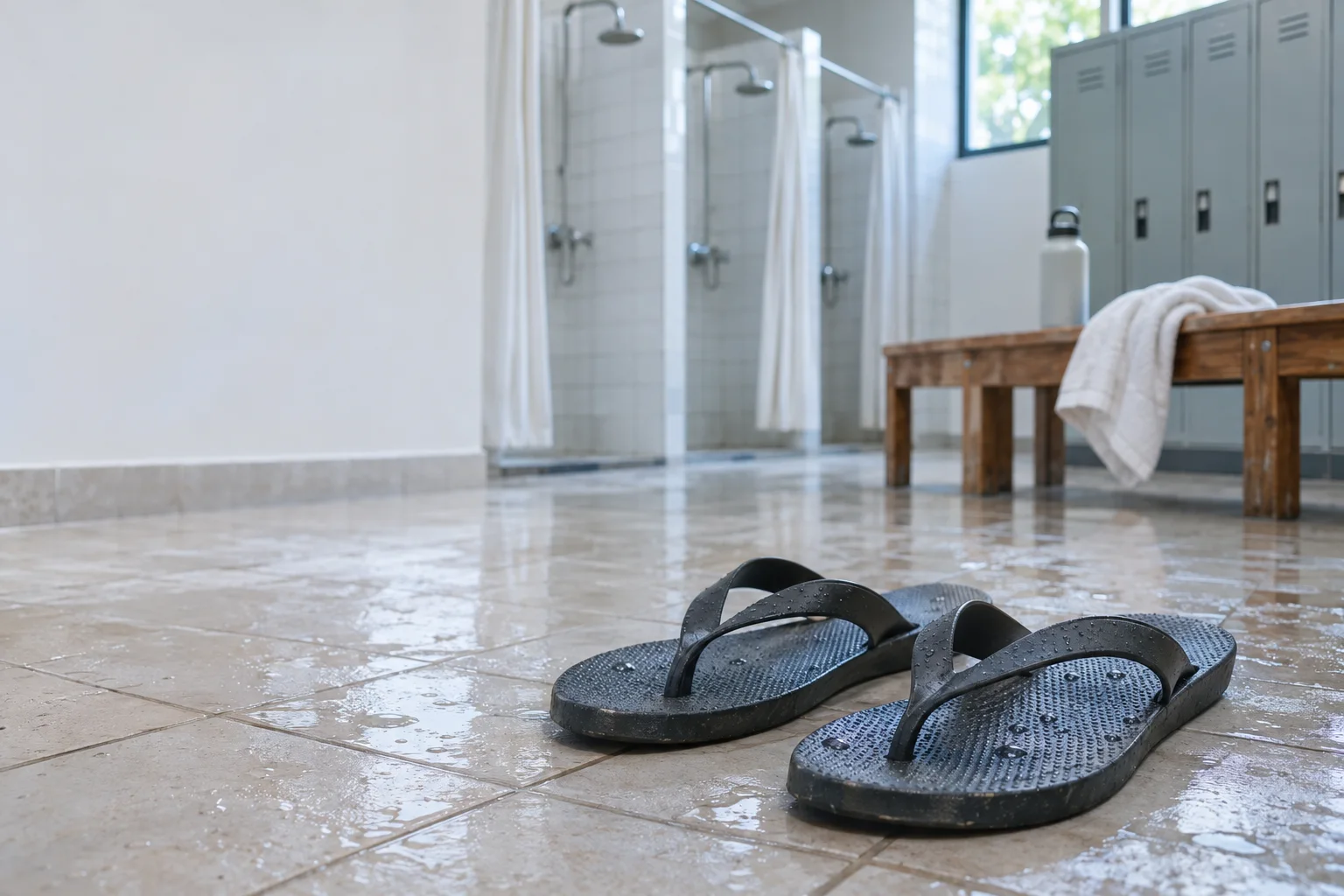
AI-generated illustration. Not an actual patient or treatment result.
Is Toenail Fungus Contagious?

Chief Medical Officer
Yes, toenail fungus is contagious, mostly through bare feet on damp floors, shared shoes, towels and clippers, and close contact at home. The AAD says it is common for people who live together to pick up the fungus from each other (AAD). Hot laundry, shower sandals and treating everyone in the home cut the main routes.
In this article
Can toenail fungus spread from person to person?
Yes, toenail fungus spreads between people, most often inside a household. In a US study of 50 households with a dermatophyte infection, 18 had more than one infected member, and genetic typing of Trichophyton rubrum showed the same strain passed between members in 8 homes (Ghannoum 2013). Spread was tied to having athlete's foot and nail fungus together, and to scaling soles or discolored nails. In 550 people with diabetes, a family history of nail fungus was a significant predictor of having it (Gupta 1998). The AAD lists touching an infected person, walking barefoot on contaminated floors and sharing items as the routes (AAD).
Can you catch toenail fungus from a shower, pool or gym floor?
Yes. The AAD says walking barefoot on a pool deck, in a locker room or in a public shower can pick up the fungi that cause nail fungus (AAD). At 10 indoor pools, dermatophytes grew from 13 of 593 environmental samples, 10 of them from dressing-room floors (Rafiei 2010). In 7 Dutch pool facilities, dermatophytes turned up only on floors, and fungal counts peaked where barefoot visitors walk between rooms (Ekowati 2018). The AAD's advice covers gyms and pools alike: wear shoes, flip-flops or shower sandals in locker rooms, gyms, spas, shared showers and on pool decks (AAD).
Can toenail fungus spread to other nails, your skin or your hands?
Yes. In 2,761 Polish patients with toenail fungus, 42.8% had a fungal skin infection elsewhere: athlete's foot in 33.8%, fingernail fungus in 7.4%, groin infection in 4.2% and hand infection in 1.6% (Szepietowski 2006). Hands usually catch it from the feet. In 80 people with infection of both feet and one hand, the hand infection usually came second and appeared on the hand used to scratch the feet or pick the toenails (Daniel 1997). Don't pick at infected nails with your fingers, wash your hands after touching your feet, and treat athlete's foot at the same time as the nails.
Can you get toenail fungus from a pedicure?
You can, through shared tools or foot baths that are not cleaned between clients. The AAD names nail-grooming tools as a place the fungi live and advises checking that a salon sanitizes its tools and foot baths (AAD causes; AAD prevention tips). In a lab study, Trichophyton rubrum deliberately added to nail polish top coat survived 60 days in two of three brands, though not in colored polish or base coat (Klafke 2018). There are no published numbers I can give you on how often salon pedicures pass on nail fungus. Bring your own clippers and file, and skip the shared top coat.
Does washing socks kill toenail fungus?
Washing at 60 °C (140 °F) removes it; cooler washes and dryer heat do not reliably kill it. In 81 socks from people with athlete's foot, 36% of cultures still grew fungus after a 40 °C (104 °F) wash, including T. rubrum in 4, while 6% grew fungus after 60 °C, all of it Aspergillus mold (Amichai 2013). A textile lab recovered T. rubrum after a 30 °C wash, and about 10% of fungal material moved to clean items stored in the same basket (Hammer 2011). Machine drying, freezing at minus 20 °C for up to a week and 90 minutes of 60 °C dry heat all failed to kill spores (Akhoundi 2022). Wash socks and towels on the hottest cycle the fabric allows, ideally 60 °C.
How do you protect the people in your home?
Treat everyone in the home who has nail fungus or athlete's foot, and stop sharing the items that carry it. That is the AAD's first household advice (AAD). Then:
- Never share nail clippers, towels or shoes, and disinfect clippers after each use with a 5-minute soak in 1 tablespoon of bleach per cup of water (AAD).
- Wash socks, towels and bath mats at 60 °C, and keep worn socks apart from clean laundry.
- Disinfect or throw away shoes worn before treatment, and give shoes 24 hours to dry. Swabs found fungus in the footwear of most nail fungus patients tested, and ozone gas cleared it (Gupta 2013); an ultraviolet-C (UV-C) shoe sanitizer cut fungal growth in a lab shoe model (Ghannoum 2012).
- Wear sandals in a shared shower until everyone is treated.
Who is most likely to catch toenail fungus?
Risk is higher with older age, long-term vein disease in the legs, a kidney transplant, human immunodeficiency virus (HIV) and diabetes. Population studies in Europe and North America put toenail fungus at 4.3% of people (Sigurgeirsson 2014). In Canada it was four times as common after age 60 (Gupta 2016). A 2024 review of 108 studies found it about 3 to 6 times as common in people with chronic venous disease, a kidney transplant, HIV or diabetes, and in older people, as in the general population (Gupta 2024). Children rarely get it; pediatric studies report 0% to 7.66% (Vestergaard-Jensen 2022), and an AAD nail specialist says a child with nail fungus likely has a parent who has it too (AAD).
How does KindleeRx treat toenail fungus?
Treating the infected person removes the source for everyone else. KindleeRx offers a 90-day prescription nail program that pairs oral terbinafine (250 mg once daily for one week each month, 21 tablets over 3 months, a pulse schedule that differs from the label's 12 weeks of daily dosing) with a 30 mL compounded topical solution containing itraconazole 1%, terbinafine 3%, urea 20% and tea tree oil 6.6%, when appropriate. Compounded medications are not FDA-approved. Licensed clinicians (physician assistants and nurse practitioners working under a board-certified dermatologist's protocols) review each case and reply in under 5 hours on average. Not everyone qualifies; if nothing is prescribed, the refund is full, including the consultation fee. Individual results vary.
For daily habits, read how to prevent nail fungus, and after treatment, read how to stop toenail fungus coming back. The complete guide to toenail fungus covers diagnosis and treatment.
Sources
- American Academy of Dermatology. Nail fungus: Causes. 2025.
- American Academy of Dermatology. 11 tips to prevent nail fungus. 2026.
- Ghannoum MA et al. Cutis 2013;91(5):237-45.
- Gupta AK et al. Br J Dermatol 1998.
- Rafiei A, Amirrajab N. Iran J Public Health 2010.
- Ekowati Y et al. Int J Hyg Environ Health 2018.
- Szepietowski JC et al. Arch Dermatol 2006.
- Daniel CR 3rd et al. Int J Dermatol 1997.
- Klafke GB et al. An Bras Dermatol 2018.
- Amichai B et al. Int J Dermatol 2013.
- Hammer TR et al. Mycopathologia 2011.
- Akhoundi M et al. J Fungi 2022.
- Gupta AK, Brintnell WC. J Cutan Med Surg 2013.
- Ghannoum MA et al. J Am Podiatr Med Assoc 2012.
- NHS. Fungal nail infection. 2024.
- Sigurgeirsson B, Baran R. J Eur Acad Dermatol Venereol 2014.
- Gupta AK et al. J Eur Acad Dermatol Venereol 2016.
- Gupta AK et al. Mycoses 2024.
- Vestergaard-Jensen S et al. Pediatr Dermatol 2022.