Editorial image created with artificial intelligence using Dr. Brandon Kirsch's likeness. Illustrative scene.
A Dermatologist Ranks Every Toenail Fungus Treatment (From Home Remedies to Combination Therapy)

Chief Medical Officer
Most people treat toenail fungus backward, spending months and hundreds of dollars on surface oils and drugstore drops before ever reaching a medicine that gets beneath the nail plate. As a board-certified dermatologist, I see the same pattern every week in clinic: thick, yellowed nails that sat untouched through bottles of tea tree oil, medicated polishes, and expensive laser packages.
In this article
The biology is simple. Nail fungus (onychomycosis) lives inside the nail bed and underside of the hard keratin plate. Any treatment that sits only on the top surface fights an uphill battle against a thick physical shield. Below is how I rank every major toenail fungus category from weakest to strongest based on published randomized clinical trials.
KindleeRx publishes this ranking and offers a prescription nail program. We did not run head-to-head trials comparing outside brands; every cure count below comes from peer-reviewed medical studies and Food and Drug Administration (FDA) prescribing labels.
| Rank | Treatment category | Published trial evidence (plain counts) | My verdict |
|---|---|---|---|
| Tier 5 | Home remedies and drugstore drops | No large randomized trials proving nail cure; athlete's-foot creams treat skin, not the nail bed | Skip for established thick toenails |
| Tier 4 | In-office 1064-nm nail lasers | About 33 in 100 vs 20 in 100 negative culture at 3 months; no clearance difference at 12 months (Hollmig 2014) | High out-of-pocket cost for weak long-term proof |
| Tier 3 | Prescription topical solutions alone (ciclopirox, tavaborole, efinaconazole) | Fungus-free lab test in 31 to 55 in 100; completely clear nail in 7 to 18 in 100 at 52 weeks (Elewski 2013; Elewski 2015; Gupta 2000) | Reasonable for mild outer-edge fungus or when pills are unsafe |
| Tier 2 | Oral prescription terbinafine alone | Outperformed oral azoles across 48 trials (10,200 adults) with similar side-effect risk (Kreijkamp-Kaspers 2017) | Strongest single-drug foundation for moderate-to-severe nails |
| Tier 1 | Combination oral terbinafine plus prescription topical solution | About 59 in 100 combined clinical and mycological success at 18 months vs 45 in 100 on oral pills alone (Baran 2007) | Best practical strategy for stubborn or multi-nail infections |
Why do drugstore nail fungus drops and home remedies rank last?
Over-the-counter drops, vinegar soaks, essential oils, and mentholated rubs sit on top of the nail plate while the infection stays protected underneath. Nonprescription antifungal creams sold for athlete's foot are formulated for soft skin and carry FDA labels stating they are not effective on the scalp or nails (American Academy of Dermatology (AAD) nail fungus guide).
Wait times push millions of people into that trap. In a national United States survey of 4,156 responding adults, about 10 in 100 reported a fungal nail infection, roughly 61 in 100 with a superficial fungal infection diagnosed the condition themselves, and about 56 in 100 used over-the-counter antifungals (Benedict 2022). Some nonprescription paints bleach or thin the top layer briefly so the nail looks slightly brighter for a few weeks, yet the deeper nail bed stays infected. If you want a deeper look at shelf products, read our evidence review of over-the-counter toenail fungus products.
Do in-office laser treatments actually cure toenail fungus?
No convincing randomized trial proves that in-office lasers reliably cure toenail fungus over the long term. The FDA clears nail lasers only for temporary increase in clear nail growth, which is a cosmetic clearance standard rather than proof of fungal cure (Hollmig 2014).
In a randomized controlled trial at Stanford evaluating two sessions of 1064-nm neodymium:yttrium-aluminum-garnet (Nd:YAG) laser spaced two weeks apart versus no treatment across 27 patients (125 infected nails), about 33 in 100 laser patients had a negative culture at 3 months versus 20 in 100 untreated controls, a gap no better than chance. By 12 months, proximal clear nail growth showed no meaningful difference between laser and untreated nails (0.24 mm versus 0.15 mm) (Hollmig 2014). When clinics charge hundreds to over a thousand dollars cash per series for those odds, I steer patients toward prescription medication first. See our full laser toenail fungus evidence breakdown.
How do prescription nail lacquers and solutions compare?
Prescription topical solutions earn Tier 3 because they penetrate better than drugstore liquids and avoid systemic drug interactions, though they require 48 weeks of daily painting and work best on mild, outer-edge infections covering less than half the nail.
- Ciclopirox 8% lacquer: Across the two pivotal United States vehicle-controlled trials, about 34 in 100 patients achieved mycological cure versus 10 in 100 on placebo, and the FDA label recommends regular professional nail debridement alongside daily application (Gupta 2000; Gupta 2000b).
- Tavaborole 5% solution (Kerydin): In two phase 3 trials applying drops once daily for 48 weeks, about 31 to 36 in 100 reached negative mycology versus 7 to 12 in 100 on inactive base, while complete cure (totally clear nail plus negative lab tests) occurred in about 7 in 100 and 9 in 100 at week 52 (Elewski 2015).
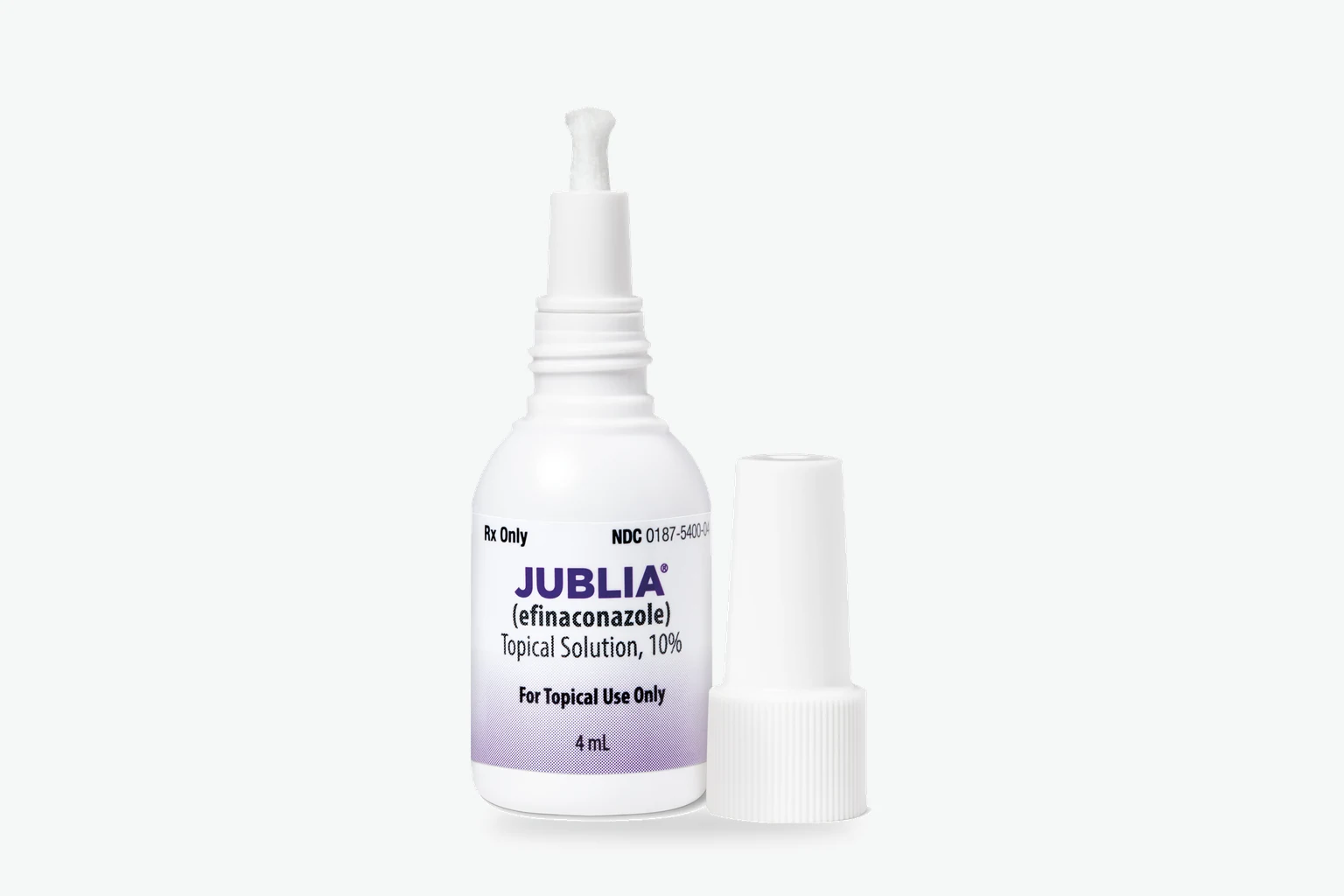
- Efinaconazole 10% solution (Jublia): Across two phase 3 trials (1,655 patients combined), once-daily use for 48 weeks achieved mycological cure in about 55 in 100 (study 1) and 53 in 100 (study 2), with complete clear-nail cure in about 18 in 100 and 15 in 100 versus 3 in 100 and 6 in 100 on inactive solution (Elewski 2013). Cash retail prices for branded Jublia can run high without commercial insurance coverage.
For patients who cannot take oral antifungals due to liver disease or interacting medications, a prescription topical is a sensible tool. For thick, long-standing big toenails, painting the surface alone tests almost anyone's patience.
Why does oral terbinafine outperform topical drops alone?
Oral terbinafine reaches the nail matrix and nail bed directly through the bloodstream, building antifungal concentrations inside the growing nail tissue where fungus hides.
In the landmark Cochrane systematic review pooling 48 randomized trials (10,200 participants), oral terbinafine beat placebo for both clinical and mycological cure with high-certainty evidence, and beat oral azole antifungals (such as itraconazole and fluconazole) for both clinical and mycological cure without raising overall adverse-event risk (Kreijkamp-Kaspers 2017). A meta-analysis comparing continuous daily dosing against intermittent pulse dosing across nine studies found continuous therapy produced higher lab-test fungal clearance, while some intermittent pulse regimens (such as two 4-week-on, 4-week-off pulses) achieved comparable complete clear-nail cure with fewer total tablets (Gupta 2013).
Safety screening matters before starting pills. Oral terbinafine must not be used in people with chronic or active liver disease, and clinicians review current prescriptions for interactions (Terbinafine label). At KindleeRx, clinicians never order liver tests; if your medical history raises a question, a clinician may ask for prior results or ask your primary care provider to check before prescribing.
Why does combination oral plus topical therapy rank first for stubborn nails?
Attacking the fungus from inside through the bloodstream while coating the nail plate from outside covers both sides of a thick nail. In a multicenter randomized trial of 249 adults with stubborn toenail fungus reaching the nail base (matrix), adding amorolfine 5% topical antifungal nail lacquer (not sold in the United States) to oral terbinafine raised combined clinical and mycological success at 18 months to about 59 in 100 (59.2%) compared with 45 in 100 (45.0%) on oral terbinafine alone (Baran 2007). Both regimens were well tolerated, and the combination lowered cost per cured patient.
That two-sided logic is why I designed the KindleeRx Nail Regimen. After a 5-minute online intake and nail photos, a licensed clinician reviews your health history, medications, and photos (replying in under 5 hours on average). In some cases a clinician may ask for a nail fungus test if the diagnosis is uncertain, though testing is not required to start. When appropriate, your clinician prescribes:
- 21 oral terbinafine 250 mg tablets on a three-month pulse schedule (one week on, three weeks off) to treat the infection from the inside.
- 30 mL compounded topical nail solution combining itraconazole 1%, terbinafine 3%, urea 20% (to soften thick keratin), tea tree oil 6.6%, and dimethyl sulfoxide (DMSO) to penetrate from the outside.
- 90 days of unlimited clinician messaging and free shipping (usual delivery 5 to 7 days total).
Automatic refills are $99 for the first 90-day order and $99 every 90 days (before coupons), including the $20 consultation fee; a one-time order is $118.75 before coupons. You can cancel automatic refills anytime with one click. Service covers 44 states plus Washington, D.C. (excluding Arkansas, Kansas, Maryland, Mississippi, Nebraska, and West Virginia). If a clinician determines treatment is not appropriate, you receive a full refund including the $20 consultation fee, and orders carry a 90-day satisfaction refund guarantee after clinician review of follow-up photos.
Be patient with nail growth. Even after fungus clears, a big toenail takes 9 to 12 months or longer to grow out completely, so a 90-day supply starts the recovery process rather than producing an overnight clear nail (AAD nail fungus guide). Ready to check your fit? Take our quick 3-tap nail fungus check or explore full Nail Regimen details.
Important Information
KindleeRx offers telemedicine consultations with licensed clinicians who decide whether prescription treatment is appropriate after reviewing your health history and photos. No prescription is guaranteed. KindleeRx's topical nail solution (itraconazole 1%, terbinafine 3%, urea 20%, tea tree oil 6.6%, and DMSO) is a compounded medication prepared by a licensed United States compounding pharmacy. Compounded medications are not approved by the FDA and are not reviewed by the FDA for safety, effectiveness, or quality (FDA compounding guidance). Published trial rates for branded or reference antifungals (Jublia, Kerydin, ciclopirox, amorolfine, and continuous oral terbinafine) reflect those studied drugs and regimens only, not KindleeRx's specific compounded topical or pulse combination. Oral terbinafine must not be used in chronic or active liver disease. Individual results vary. This guide is educational and is not personal medical advice.
Sources
- Benedict K, et al. High Frequency of Self-Diagnosis and Self-Treatment in a Nationally Representative Survey About Superficial Fungal Infections. Journal of Fungi 2022.
- Hollmig ST, et al. Lack of Efficacy With 1064-nm Neodymium:Yttrium-Aluminum-Garnet Laser for the Treatment of Onychomycosis: A Randomized, Controlled Trial. Journal of the American Academy of Dermatology 2014.
- Gupta AK, et al. Ciclopirox 8% Nail Lacquer in the Treatment of Onychomycosis of the Toenails in the United States. Journal of the American Podiatric Medical Association 2000.
- Gupta AK, et al. Ciclopirox Nail Lacquer and Podiatric Practice. Journal of the American Podiatric Medical Association 2000.
- Elewski BE, et al. Efinaconazole 10% Solution in the Treatment of Toenail Onychomycosis: Two Phase III Multicenter, Randomized, Double-Blind Studies. Journal of the American Academy of Dermatology 2013.
- Elewski BE, et al. Efficacy and Safety of Tavaborole Topical Solution, 5%, for Treatment of Toenail Onychomycosis: Results From 2 Randomized Phase-III Studies. Journal of the American Academy of Dermatology 2015.
- Kreijkamp-Kaspers S, et al. Oral Antifungal Medication for Toenail Onychomycosis (CD010031). Cochrane Database of Systematic Reviews 2017.
- Gupta AK, et al. Terbinafine in the Treatment of Dermatophyte Toenail Onychomycosis: A Meta-Analysis of Efficacy for Continuous and Intermittent Regimens. Journal of the European Academy of Dermatology and Venereology 2013.
- Baran R, et al. A Multicentre, Randomized, Controlled Study of the Efficacy, Safety and Cost-Effectiveness of Combination Therapy With Amorolfine Nail Lacquer and Oral Terbinafine Compared With Oral Terbinafine Alone. British Journal of Dermatology 2007.
- DailyMed. Terbinafine Hydrochloride Tablets 250 mg Prescribing Information.
- American Academy of Dermatology. Nail Fungus: Diagnosis and Treatment.
- Food and Drug Administration. Understanding the Risks of Compounded Drugs.