
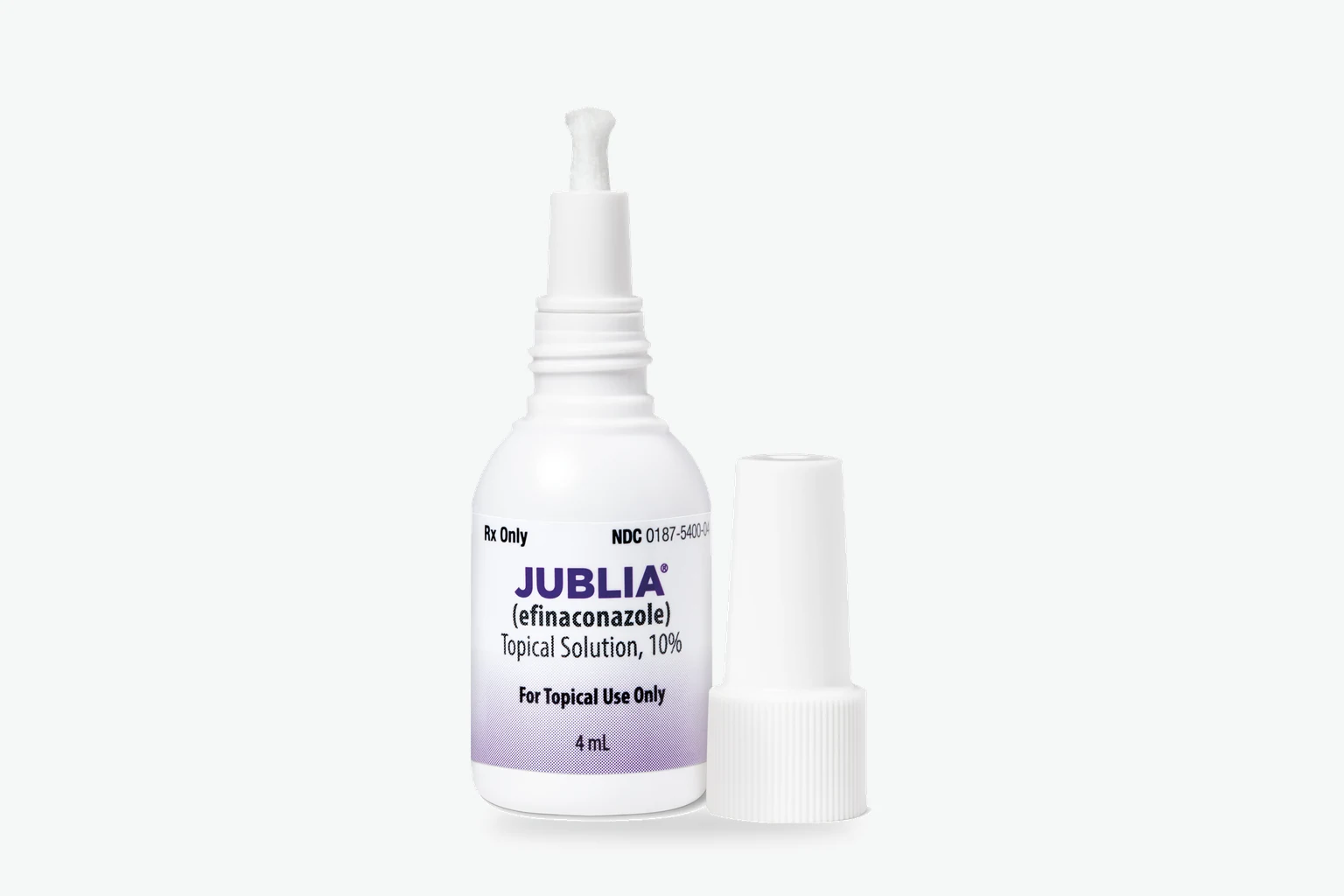
Image: Bausch Health, maker of Jublia. Shown to identify the product. KindleeRx is not affiliated with Bausch Health.
Does Jublia Work? Cure Rates, Timeline and How to Apply It

Chief Medical Officer
Yes, Jublia works better than its inactive solution, but it gives a completely clear, fungus-free toenail to about 1 in 6 adults after a year. In its two phase 3 trials, complete cure at week 52 was 17.8% (117 of 656) and 15.2% (88 of 580), versus 3.3% and 5.5% on vehicle, after 48 weeks of once-daily use (Jublia label). I reach for it when pills are off the table or the infection is mild.
In this article
How well does Jublia work?
Jublia clears the nail completely in roughly 15% to 18% of adults and clears the fungus on testing in about half. Complete cure means 0% of the nail affected plus negative potassium hydroxide (KOH) and culture tests. On that strict endpoint, Jublia reached 17.8% and 15.2% at week 52 (Jublia label). Allowing up to 5% of the nail to stay affected, the rates were 26.4% and 23.4%, versus 7.0% and 7.5% on vehicle. Mycologic cure was 55.2% and 53.4% (Elewski 2013), versus 16.8% and 16.9% on vehicle (Jublia label). A 2020 Cochrane review pooled 3 trials with 1,716 people and rated this evidence high quality: about 17 in 100 people on Jublia reached complete cure, versus about 5 in 100 on vehicle (Foley 2020). The trials enrolled adults with 20% to 50% of the nail involved.
How long does Jublia take to work?
The labeled course is 48 weeks of daily use, and the trials judged results at week 52. The trial authors wrote that 52 weeks may be too brief to judge a clinical cure (Elewski 2013). Toenails grow about 1.62 mm a month in healthy young adults (Yaemsiri 2010), so a damaged big toenail takes many months to grow out. Longer use kept helping in one open-label study of 101 patients: in the group treated for 24 months, effective cure (fungus-free with 10% or less of the nail affected) rose from 13.2% at 12 months to 22.6% at 24 months (Gupta 2024). That goes beyond the label. A review notes older patients may need more than 48 weeks (Gupta 2021). I judge progress by the clear band growing in at the base.
How do you apply Jublia correctly?
Apply it once a day, every day, for 48 weeks, to clean, dry toenails. The label and Instructions for Use give these steps (Jublia label):
- Wait at least 10 minutes after showering, bathing or washing.
- Use the built-in flow-through brush. Do not press or rub it hard against the nail.
- Cover the whole nail, the skin folds around it, the nail bed, the skin under the tip and the underside of the nail.
- Apply a second coat on the big toenail.
- Let it dry completely before socks or bedding touch it, then wash your hands.
The solution is flammable, so keep it away from heat and flame. The effect of nail polish on Jublia has not been evaluated.
Who gets the best results with Jublia?
In pooled trial data, women and people with nails 33% or less involved had higher complete cure, and treating coexisting athlete's foot was linked to higher cure; children did well in an uncontrolled study. Pooled across both trials, complete cure was 18.5% versus 4.7% on vehicle, and rates were higher in women and in nails 33% or less involved (Gupta 2014). A second pooled analysis found starting severity did not predict outcome within the 20% to 50% range (Elewski 2018). Treating coexisting athlete's foot raised complete cure to 29.4% from 16.1% (Markinson 2015). In 112 people with diabetes, complete cure was 13.0% versus 18.8% without diabetes, a difference that was not significant (Vlahovic 2014). Children aged 6 to 16 reached 40.0% complete cure in an uncontrolled study (Eichenfield 2020).
Can you use Jublia with terbinafine pills?
Yes, nothing on the label rules it out. The label says Jublia neither inhibits nor induces the liver's cytochrome P450 (CYP450) drug-processing enzymes at treatment levels, and it lists no contraindications (Jublia label). The evidence for the pairing is thin. In 12 Japanese patients who had little response after more than 20 weeks of terbinafine 125 mg daily, switching to Jublia after the pills (with terbinafine still in the nail) gave an effective rate of 66.7% and a cure rate of 16.7% over about 28 weeks (Noguchi 2021). The research for this article found no randomized trial of the two together. Terbinafine pills alone produced a clear, fungus-free nail in 38% at week 48 in their label trial (terbinafine label). For thick nails or several infected toes, I start with a pill plus a topical; I explain why in oral vs topical toenail fungus treatment.
Does Jublia work on fingernails?
It may, but fingernails are outside the label. Jublia is indicated for toenail onychomycosis caused by Trichophyton rubrum and Trichophyton mentagrophytes, and its patient information calls it a medicine for toenails (Jublia label). The only series found is from one Japanese clinic: in 10 patients treated for fingernail disease, the affected area fell from 82.7% to 17.6% of the nail, and 80.0% improved (Noguchi 2018). There was no control group, and improvement is not cure. Fingernails grow about twice as fast as toenails (3.47 versus 1.62 mm a month), so a treated fingernail grows out in less time (Yaemsiri 2010).
What are Jublia's side effects?
Side effects stay at the nail and are uncommon. In 1,227 treated adults, the reactions more common than with vehicle were ingrown toenail (2.3% versus 0.7%), application site dermatitis (2.2% versus 0.2%), blisters (1.6% versus 0%) and pain (1.1% versus 0.2%) (Jublia label). Counting every health problem during the trials, colds included, Cochrane found slightly more on Jublia: about 66 in 100 people versus 60 in 100 on vehicle, though most were probably unrelated to the treatment (Foley 2020). The label covers patients 6 years and older.
Is Jublia or pills plus a topical the better choice?
Jublia suits mild infections and people who cannot take pills. For thicker or multiple nails, I prefer oral terbinafine plus a topical. No head-to-head study has compared the efficacy of the KindleeRx regimen with Jublia. Jublia's price and generic status are covered in what Jublia costs.
KindleeRx offers a 90-day prescription nail program: oral terbinafine 250 mg once daily for one week each month (21 tablets over 3 months) plus a 30 mL compounded solution of itraconazole 1%, terbinafine 3%, urea 20% and tea tree oil 6.6%, prescribed together when appropriate. The Food and Drug Administration (FDA) label schedule for terbinafine is 250 mg daily for 12 weeks, and compounded medications are not FDA-approved. Licensed clinicians (physician assistants and nurse practitioners working under a board-certified dermatologist's protocols) review each case and reply in under 5 hours on average. Before prescribing oral terbinafine, your clinician may ask for copies of your earlier liver blood test results, or ask your primary care provider to order a test. Not everyone qualifies; if treatment is not prescribed, the refund is full, including the consultation fee. Individual results vary. For every option, start with the complete guide to toenail fungus.
Sources
- Bausch Health. JUBLIA (efinaconazole) topical solution 10% prescribing information, Instructions for Use and Patient Information. DailyMed 2025.
- Elewski BE, et al. Efinaconazole 10% solution in the treatment of toenail onychomycosis: Two phase III multicenter, randomized, double-blind studies. J Am Acad Dermatol 2013.
- Foley K, et al. Topical and device-based treatments for fungal infections of the toenails. Cochrane Database Syst Rev 2020.
- Yaemsiri S, et al. Growth rate of human fingernails and toenails in healthy American young adults. J Eur Acad Dermatol Venereol 2010.
- Gupta AK, Cooper EA. Extended Use of Topical Efinaconazole Remains Safe and Can Provide Continuing Benefits for Dermatophyte Toenail Onychomycosis. J Fungi (Basel) 2024.
- Gupta AK, et al. One size does not fit all: the need for individualized treatment based on factors that may affect the therapeutic outcome of efinaconazole 10% solution for the treatment of toenail onychomycosis. Int J Dermatol 2021.
- Gupta AK, et al. The efficacy and safety of efinaconazole 10% solution for treatment of mild to moderate onychomycosis: a pooled analysis of two phase 3 randomized trials. J Drugs Dermatol 2014.
- Elewski BE, Cantrell W, Lin T. Is Severity of Disease a Prognostic Factor for Cure Following Treatment of Onychomycosis? J Drugs Dermatol 2018.
- Markinson B, Caldwell B. Efinaconazole Topical Solution, 10% Efficacy in Patients with Onychomycosis and Coexisting Tinea Pedis. J Am Podiatr Med Assoc 2015.
- Vlahovic TC, Joseph WS. Efinaconazole topical, 10% for the treatment of toenail onychomycosis in patients with diabetes. J Drugs Dermatol 2014.
- Eichenfield LF, et al. Safety, Pharmacokinetics, and Efficacy of Efinaconazole 10% Topical Solution for Onychomycosis Treatment in Pediatric Patients. J Drugs Dermatol 2020.
- Noguchi H, et al. Topical efinaconazole: A sequential combination therapy with oral terbinafine for refractory tinea unguium. J Dermatol 2021.
- Noguchi H, et al. Topical efinaconazole: A promising therapeutic medication for tinea unguium. J Dermatol 2018.
- Aurobindo. Terbinafine tablets prescribing information. DailyMed.
- NHS. Fungal nail infection. 2024.
Related Articles

Nail Care
Jublia vs. KindleeRx: compare cost and included care
Sep 15, 2026 · 6 min read
Nail Care
How Long Does Toenail Fungus Take to Clear? The Treatment and Regrowth Timeline
Jul 19, 2026 · 5 min read
Nail Care
Oral vs Topical for Toenail Fungus, and Why the Combination Wins
Jul 19, 2026 · 9 min read