
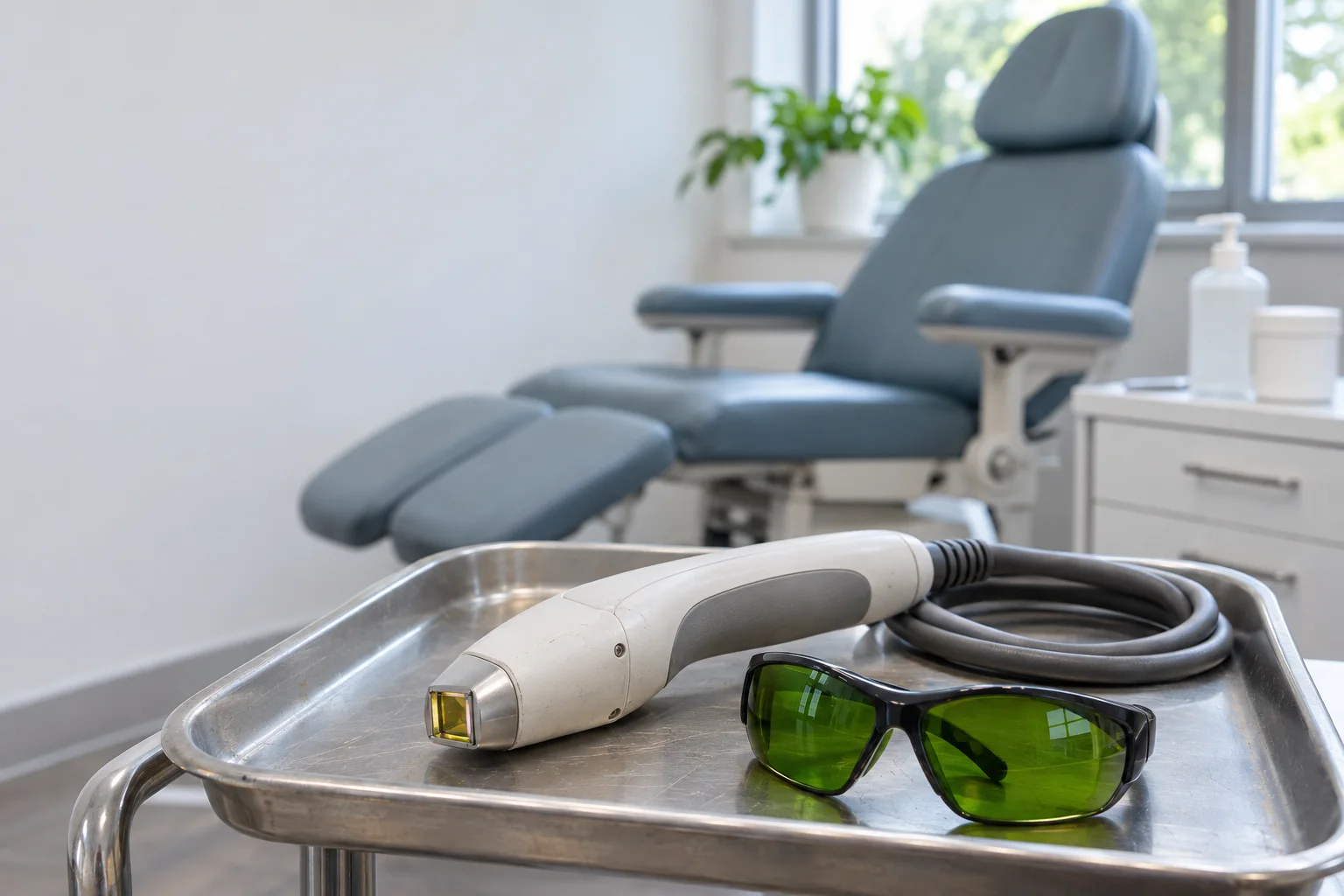
AI-generated illustration. Not an actual patient or treatment result.
Is Laser Treatment for Toenail Fungus Worth It?

Chief Medical Officer
Laser treatment for toenail fungus is not worth it for most people: controlled trials show no reliable cure, and you pay out of pocket for several sessions. Three randomized trials of the 1064-nm neodymium-doped yttrium aluminum garnet (Nd:YAG) laser found no cure benefit over sham or no treatment (Hollmig 2014; Karsai 2017; Sabbah 2019). The British Association of Dermatologists (BAD) says laser has not shown consistent, reliable benefits (BAD leaflet 2026).
In this article
Does laser treatment cure toenail fungus?
No, not in the trials that compared it against sham or no treatment. In a double-blind trial of 51 patients given three Nd:YAG sessions at weeks 0, 12 and 24, complete cure of the big toenail at week 52 was 0% with laser versus 7.7% with sham, and negative cultures were 33% versus 50% (Sabbah 2019).
The other controlled trials agree:
- 27 patients, 2 sessions: negative culture at 3 months in 33% versus 20% (not significant), with no difference in clear nail growth at 12 months (Hollmig 2014).
- 20 patients, 4 sessions: no one in either group was free of fungus at 12 months (Karsai 2017).
- 64 people with diabetes, 4 sessions: no difference in combined clinical and laboratory cure at 1 year (Nijenhuis-Rosien 2019).
Pooling two trials (85 people), the Cochrane review estimated fungal cure at 52 weeks in about 31 in 100 with laser and 30 in 100 without, on low-quality evidence (Foley 2020).
What is laser treatment actually FDA-cleared to do?
Make the nail look clearer for a while. Nail lasers fall under FDA product code PDZ, a Class 2 device defined as being for the temporary increase of clear nail in patients with onychomycosis (FDA product code PDZ). FDA guidance states that every marketed nail-fungus device has been cleared for visual improvement, and that this wording does not mean the treatment eliminates the infection (FDA guidance 2016).
openFDA lists 19 clearances under this code, from the PinPointe FootLaser in October 2010 to a device cleared in March 2026 (FDA 510(k) record K093547). Clearance is not approval. The American Academy of Dermatology (AAD) puts it plainly: no laser is FDA-approved to treat the infection (AAD).
Why do some laser studies report high success rates?
Most report mycological cure from uncontrolled studies. A 2019 meta-analysis of 22 prospective trials (755 people, 18 of them without a control group) found pooled mycological cure of 70.4% but complete cure of only 7.2% (Yeung 2019). Another pooled 35 studies (1,723 patients) at 63.0% mycological cure (Ma 2019).
A complete cure, a clear nail plus negative tests, is the result patients want. Uncontrolled numbers have no comparison group, and the controlled trials above found no such benefit.
How does laser compare with pills and prescription topicals?
Laser alone trails both. The figures below come from different trials, so compare them loosely.
| Treatment | Complete cure | Source |
|---|---|---|
| Nd:YAG laser, 3 sessions | 0% at week 52 (sham 7.7%) | Sabbah 2019 |
| Laser, pooled prospective trials | 7.2% | Yeung 2019 |
| Terbinafine 250 mg daily, 12 weeks | 38% at week 48 | Label |
| Terbinafine 250 mg daily, 3 months | 40.5% of target toenails at 18 months | Warshaw 2005 |
| Efinaconazole 10% (Jublia), 48 weeks | 15.2% to 17.8% at week 52 (vehicle 3.3% to 5.5%) | Label |
Laser may help as an add-on. A 2022 meta-analysis of 12 randomized trials (869 patients) found laser plus a topical antifungal reached complete cure about 6 times as often as the topical alone (Zhang 2022). In a 3-arm trial of 53 patients, oral terbinafine plus laser cleared nails more often than either alone through week 24, though that is too early to judge final cure (Xu 2014). I cover pills and topicals in oral vs topical toenail fungus treatment.
How much does laser treatment cost, and does insurance cover it?
A 2022 review puts the average at $400 to $1,200 per session, with multiple sessions spread over as long as 19 months, and says insurance usually does not cover it (Falotico 2022). The AAD says insurers consider laser a cosmetic treatment (AAD). In the UK, the National Health Service does not fund it (BAD leaflet 2026). The controlled trials used 2 to 4 sessions.
Who might still consider laser?
Someone who cannot take antifungal pills, has tried a prescription topical, and is willing to pay for a cosmetic improvement. Even then, I would pair it with a topical antifungal, a combination where randomized data show a gain (Zhang 2022). Whatever you choose, judge it by clear new nail growing in from the base; the BAD says toenail infections may take 12 to 18 months to clear (BAD leaflet 2026). The timeline is laid out in how long toenail fungus takes to clear.
What does KindleeRx offer instead?
The KindleeRx nail program is a 90-day program of oral terbinafine plus a compounded topical solution, prescribed together when appropriate. The tablet part is 250 mg once daily for one week each month, 21 tablets over 3 months, which differs from the FDA-labeled 12 weeks of daily tablets, and compounded medications are not FDA-approved. Licensed clinicians (physician assistants and nurse practitioners working under a board-certified dermatologist's protocols) review each case online, and clinicians reply in under 5 hours on average. Not everyone qualifies; if no treatment is prescribed, the refund is full, including the consultation fee. For every option, start with the complete toenail fungus guide.
Sources
- US Food and Drug Administration. Medical devices and clinical trial design for the treatment or improvement in the appearance of fungally-infected nails. 2016.
- US Food and Drug Administration. Product classification: product code PDZ.
- US Food and Drug Administration. 510(k) premarket notification K093547, PinPointe FootLaser. 2010.
- Sabbah L, et al. A randomized, double-blind, controlled trial evaluating the efficacy of Nd:YAG 1064 nm short-pulse laser compared with placebo in the treatment of toenail onychomycosis. J Cutan Med Surg 2019.
- Hollmig ST, et al. Lack of efficacy with 1064-nm neodymium:yttrium-aluminum-garnet laser for the treatment of onychomycosis: a randomized, controlled trial. J Am Acad Dermatol 2014.
- Karsai S, et al. Treating onychomycosis with the short-pulsed 1064-nm-Nd:YAG laser: results of a prospective randomized controlled trial. J Eur Acad Dermatol Venereol 2017.
- Nijenhuis-Rosien L, et al. Laser therapy for onychomycosis in patients with diabetes at risk for foot ulcers (LASER-1). J Eur Acad Dermatol Venereol 2019.
- Foley K, et al. Topical and device-based treatments for fungal infections of the toenails. Cochrane Database Syst Rev 2020.
- Yeung K, et al. Efficacy of laser treatment for onychomycotic nails: a systematic review and meta-analysis of prospective clinical trials. Lasers Med Sci 2019.
- Ma W, et al. Laser treatment for onychomycosis: a systematic review and meta-analysis. Medicine (Baltimore) 2019.
- Zhang J, et al. Efficacy of laser therapy combined with topical antifungal agents for onychomycosis: a systematic review and meta-analysis of randomised controlled trials. Lasers Med Sci 2022.
- Xu Y, et al. Combined oral terbinafine and long-pulsed 1,064-nm Nd:YAG laser treatment is more effective for onychomycosis than either treatment alone. Dermatol Surg 2014.
- Falotico JM, Lipner SR. Updated perspectives on the diagnosis and management of onychomycosis. Clin Cosmet Investig Dermatol 2022.
- Warshaw EM, et al. Pulse versus continuous terbinafine for onychomycosis: a randomized, double-blind, controlled trial. J Am Acad Dermatol 2005.
- Aurobindo Pharma. Terbinafine Tablets USP prescribing information. DailyMed 2024.
- Bausch Health. JUBLIA (efinaconazole) topical solution 10% prescribing information. DailyMed 2025.
- American Academy of Dermatology. Nail fungus: diagnosis and treatment. 2025.
- British Association of Dermatologists. Fungal nail infections: patient information leaflet. 2026.
Related Articles
Nail Care
Oral vs Topical for Toenail Fungus, and Why the Combination Wins
Jul 19, 2026 · 9 min read
Nail Care
How Long Does Toenail Fungus Take to Clear? The Treatment and Regrowth Timeline
Jul 19, 2026 · 5 min read

Nail Care
Best online toenail fungus treatment: Which option fits you?
Sep 15, 2026 · 7 min read