

Editorial image created with artificial intelligence. Illustrative scene; not an actual patient or clinician.
A Dermatologist Ranks Every Prescription Eczema Treatment (From Creams to Biologics)

Chief Medical Officer
Eczema fails most often when a patient tries to manage every flare and every body site with a single tube. Thick, cracked skin on the knuckles needs a completely different strength and vehicle than delicate redness around the eyelids or neck, and calming a flare is only half the job if you have nothing gentle ready to keep skin quiet afterward.
In this article
As a board-certified dermatologist, I rank eczema treatments by how reliably they control both today's flare and next month's relapse without creating avoidable side effects or insurance bottlenecks.
KindleeRx publishes this ranking and provides one of the online prescription eczema programs compared in this guide. Clinical figures come from peer-reviewed trials and Food and Drug Administration (FDA) labels; we did not test outside services head to head.
| Rank | Eczema approach | Key clinical trial evidence (plain counts) | Best role |
|---|---|---|---|
| Tier 5 | Drugstore hydrocortisone 1%, topical antihistamines, antibiotic ointments | American Academy of Dermatology (AAD) 2023 guidelines conditionally recommend against routine topical antimicrobials, antiseptics, and antihistamines (Sidbury 2023) | Keep bland moisturizers; skip medicated shelf creams for real flares |
| Tier 4 | One generic topical steroid prescribed alone | Potent steroids cleared about 70 in 100 vs 39 in 100 on mild steroids; relapse hits about 58 in 100 without maintenance (Lax 2022) | Short single-site flare only; incomplete long-term plan |
| Tier 3 | Single steroid-free prescription cream (roflumilast, tapinarof, ruxolitinib, crisaborole, tacrolimus) | Clear or almost clear in about 29 to 54 in 100 across separate vehicle trials (Simpson 2024; Papp 2021; Silverberg 2024) | Ideal for mild flares, face, eyelids, folds, and steroid-free daily care |
| Tier 2 | In-person biologics (dupilumab) and oral Janus kinase (JAK) inhibitors | Dupilumab SOLO 1/2: about 36 to 38 in 100 clear or almost clear at week 16 vs 8 to 10 in 100 placebo (Simpson 2016) | Essential escalation for severe widespread eczema failing topicals |
| Tier 1 | Paired two-prescription plan (body-site flare control plus maintenance or itch-cycle relief) | Proactive maintenance cut relapse from 58 in 100 to 25 in 100 (Lax 2022); online dermatology matched office visits across 456 patients (Armstrong 2026a) | Best practical daily engine for mild-to-moderate adult eczema |
Why do over-the-counter eczema tubes stall on active flares?
Plain fragrance-free ointments and barrier creams belong in every eczema routine, and the 2023 American Academy of Dermatology adult topical guidelines give moisturizers a strong recommendation (Sidbury 2023). Active moderate flares are another story. Over-the-counter 1% hydrocortisone is too weak for thick body or hand plaques, while the same guidelines conditionally recommend against routine topical antimicrobials, antiseptics, and topical antihistamines for eczema because they rarely help and can trigger allergic contact reactions (Sidbury 2023).
Yet many people stay stuck in the pharmacy aisle for months waiting for an appointment. In a 2026 clinic survey of 464 dermatology patients, about 55 in 100 waited more than three months, roughly 39 in 100 saw symptoms worsen while waiting, and about 66 in 100 used over-the-counter or herbal remedies to bridge the gap (Rivera 2026).
How do single-tube topical steroids rank, and what is the real thinning risk?
Topical corticosteroids remain fast, dependable flare controllers, and the 2022 Cochrane review of 104 randomized trials (8,443 participants) clarified two facts that surprise many patients:
- Potency and frequency: Moderate steroids beat mild steroids (about 52 in 100 versus 34 in 100 treatment success), potent steroids beat mild steroids by an even wider margin (about 70 in 100 versus 39 in 100), and once-daily application of potent steroids worked just as well as twice-daily use (Lax 2022).
- Actual skin-thinning counts: Across 22 short flare trials (typically 1 to 5 weeks), abnormal skin thinning appeared in only 26 of 2,266 participants (about 1 in 100), and 22 of those 26 occurred with potent or very potent steroids (Lax 2022).
The flaw with a single steroid tube is what happens in week three. Patients stop the tube abruptly, skin flares right back (about 58 in 100 relapsed without proactive maintenance in the Cochrane analysis), or patients keep smearing a strong body steroid onto thin facial or fold skin where it does not belong.
Where do standalone steroid-free creams fit in eczema care?
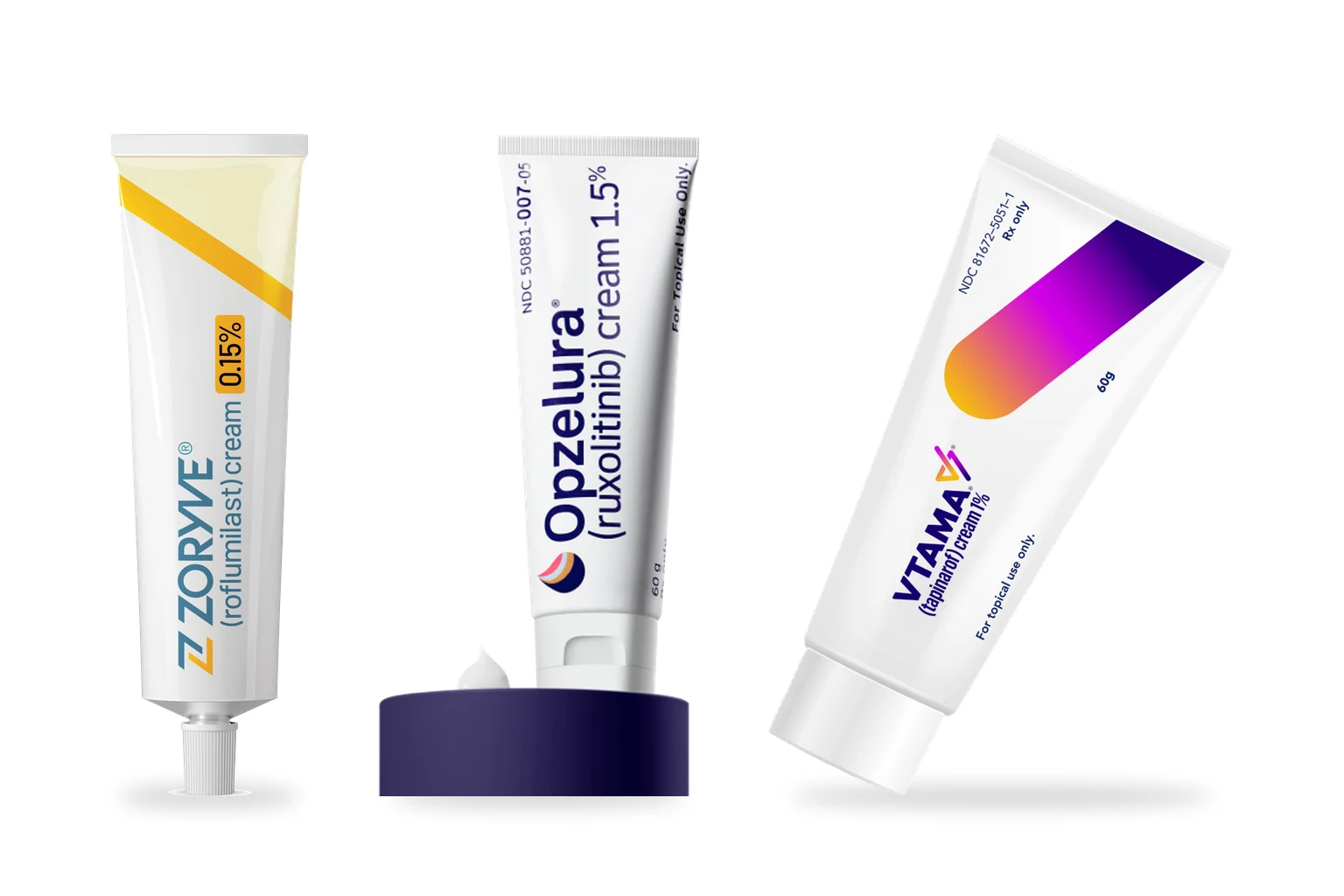
Modern steroid-free prescription creams are a major leap forward for facial, eyelid, neck, and skin-fold eczema and for patients who prefer to skip steroids altogether. In a 291-trial Cochrane network analysis (45,846 people), potent steroids, tacrolimus 0.1%, and ruxolitinib 1.5% ranked near the top for short-term clearing (Lax 2024), while once-daily roflumilast 0.15% (Simpson 2024) and tapinarof 1% (Silverberg 2024) provide non-steroidal daily control without an FDA boxed warning.
A single gentle steroid-free tube (such as The Calming Cream) works well for mild-to-moderate sensitive-skin flares. For thick, cracked hands, weeping flares, or severe nighttime itching across multiple zones, pairing a fast flare controller or targeted anti-itch lotion with daily maintenance gets patients comfortable far faster. Read our full steroid-free cream ranking to compare each non-steroid option closely.
When are injectable biologics and oral Janus kinase (JAK) pills the right tier?
When eczema covers a large share of the body, ruins sleep night after night, or keeps breaking through well-matched prescription topicals, systemic in-person therapy is the right answer. In the phase 3 SOLO 1 and SOLO 2 trials (1,379 adults inadequately controlled by topicals), injectable dupilumab cleared or nearly cleared about 38 in 100 (SOLO 1) and 36 in 100 (SOLO 2) at week 16 versus 10 in 100 and 8 in 100 on placebo (Simpson 2016).
Biologics and oral JAK inhibitors require in-person dermatology exams, insurance prior authorizations, and lab monitoring for JAK pills, so they sit in Tier 2 for severe disease rather than first-line mild-to-moderate flares.
Why does a paired two-prescription plan rank first for mild-to-moderate adult eczema?
In day-to-day dermatology, the highest-value plan matches two complementary prescriptions to what eczema actually does: one medication quiets active inflammation or breaks the nighttime itch-scratch cycle, while the second keeps skin calm on delicate areas or between flares. Paired with asynchronous online dermatology (proven equivalent to in-person clinic care across 456 patients in two 12-month randomized trials, Armstrong 2026a; Armstrong 2015), patients get fast adjustments whenever a flare moves.
That is the architecture behind the KindleeRx Eczema Regimen:
- Two clinician-selected prescriptions in one plan: Licensed clinicians evaluate your 5-minute online intake and skin photos (replying in under 5 hours on average) and select two prescriptions, if appropriate, from 11 listed compounded and prescription formulas (6 containing a steroid and 5 steroid-free; steroid-free options are available).
- Body-site precision: Options span Calming Daily Cream (steroid-free roflumilast 0.2% plus calamine 5%), Ease the Itch Lotion (steroid-free doxepin 1%, pramoxine 1%, menthol 1%, colloidal oatmeal 1%), Soothing Facial Cream, scalp solutions, thick-plaque ointment, wet-wrap kits, lower-leg formulas, and off-label oral roflumilast 500 mcg tablets for widespread disease when appropriate.
- Transparent 90-day pricing: Automatic refills are $149 for the first 90-day order and $149 every 90 days (before coupons), including the $20 consultation fee, free shipping (usual delivery 5 to 7 days total), and 90 days of unlimited clinician messaging. A one-time order is $181.25 before coupons. Cancel automatic refills anytime with one click.
Service is available in 44 states plus Washington, D.C. (excluding Arkansas, Kansas, Maryland, Mississippi, Nebraska, and West Virginia). If a clinician determines treatment is not appropriate, you receive a full refund including the $20 consultation fee, plus a 90-day satisfaction refund guarantee after clinician review of follow-up photos. Ready to see how a paired plan fits your skin? Take our 3-tap eczema check or review full Eczema Regimen details.
Important Information
KindleeRx offers compounded prescription medications prepared by licensed United States compounding pharmacies under a licensed prescriber's order. Compounded medications are not approved by the FDA and are not reviewed by the FDA for safety, effectiveness, or quality (FDA compounding guidance). KindleeRx's Calming Daily Cream (roflumilast 0.2% and calamine 5%) is not Zoryve, is not a generic of Zoryve (no FDA-approved generic exists), and KindleeRx is not affiliated with Arcutis Biotherapeutics, Incyte, Organon, Pfizer, Sanofi, Regeneron, or LEO Pharma. Published clinical trial numbers describe those studied branded or reference medications only, not KindleeRx's compounded formulas. Oral roflumilast is FDA-approved for severe chronic obstructive pulmonary disease (Daliresp label); its use in eczema is off-label, it is contraindicated in moderate or severe liver impairment, and it carries warnings for mood changes (including depression or suicidal thoughts), weight loss, and stomach upset. Tazarotene is strictly contraindicated in pregnancy. A licensed clinician decides whether treatment is appropriate after reviewing your history and photos. Not all patients qualify. Individual results vary. This article is educational and is not personal medical advice.
Sources
- Rivera J, et al. Dermatology Appointments as an Indicator of Systemic Healthcare Issues. Cureus 2026.
- Sidbury R, et al. Guidelines of Care for the Management of Atopic Dermatitis in Adults With Topical Therapies. Journal of the American Academy of Dermatology 2023.
- Lax SJ, Harvey J, et al. Strategies for Using Topical Corticosteroids in Children and Adults With Eczema (CD013356). Cochrane Database of Systematic Reviews 2022.
- Lax SJ, et al. Topical Anti-Inflammatory Treatments for Eczema: Network Meta-Analysis (CD015064). Cochrane Database of Systematic Reviews 2024.
- Simpson EL, et al. INTEGUMENT-1 and INTEGUMENT-2 Trials of Roflumilast Cream 0.15% in Atopic Dermatitis. JAMA Dermatology 2024.
- Papp K, et al. TRuE-AD1 and TRuE-AD2 Trials of Ruxolitinib Cream in Atopic Dermatitis. Journal of the American Academy of Dermatology 2021.
- Silverberg JI, et al. ADORING 1 and ADORING 2 Trials of Tapinarof Cream 1% in Atopic Dermatitis. Journal of the American Academy of Dermatology 2024.
- Simpson EL, et al. Two Phase 3 Trials of Dupilumab Versus Placebo in Atopic Dermatitis (SOLO 1 and SOLO 2). New England Journal of Medicine 2016.
- Armstrong AW, et al. Online vs In-Person Care for Atopic Dermatitis: A Randomized Clinical Trial. JAMA Dermatology 2026.
- Armstrong AW, et al. Patient-Centered, Direct-Access Online Care for Management of Atopic Dermatitis: A Randomized Clinical Trial. JAMA Dermatology 2015.
- AstraZeneca. DALIRESP (roflumilast) Tablets Prescribing Information. DailyMed.
- Food and Drug Administration. Understanding the Risks of Compounded Drugs.
Related Articles

Eczema
Best Online Eczema Treatment: How Telehealth Options Compare
Nov 22, 2026 · 17 min read
Eczema
Topical Steroids for Eczema: Benefits, Safety, and the Rise of Steroid-Free Options
Mar 2, 2026 · 14 min read
Eczema
Zoryve vs Opzelura vs Vtama vs Eucrisa: Non-Steroid Eczema Creams Compared
Nov 19, 2026 · 13 min read