
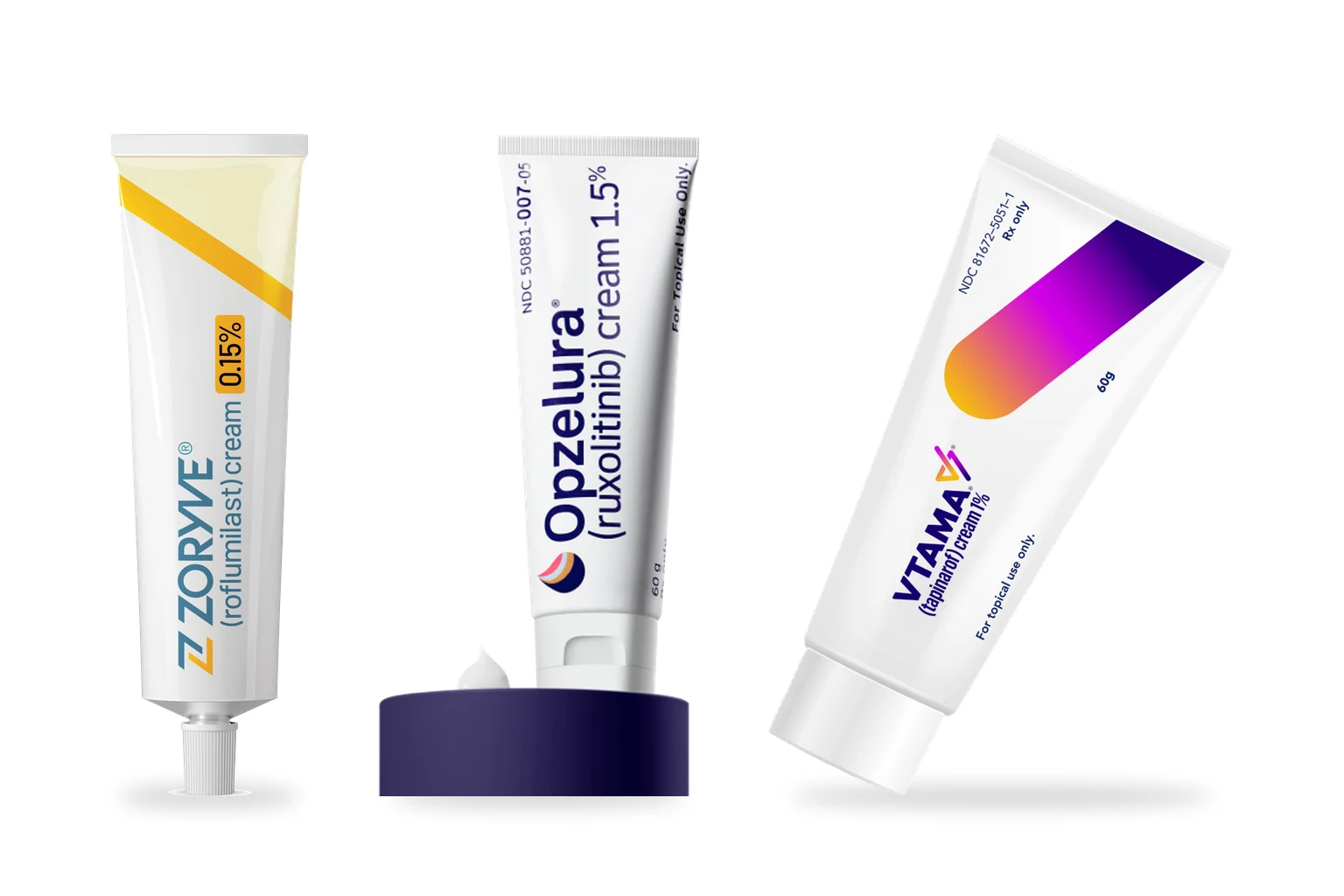
Images: Arcutis Biotherapeutics (Zoryve), Incyte (Opzelura) and Organon (Vtama). Shown to identify the products. KindleeRx is not affiliated with these companies.
Zoryve vs Opzelura vs Vtama vs Eucrisa: Non-Steroid Eczema Creams Compared

Chief Medical Officer
No single non-steroid eczema cream wins every category: Opzelura and tacrolimus 0.1% clear the most skin, while Zoryve, Vtama and Eucrisa carry no boxed warning. In a 2024 Cochrane network meta-analysis of 291 trials and 45,846 people, ruxolitinib, tacrolimus 0.1% and potent steroids ranked among the most effective topical treatments, and phosphodiesterase-4 (PDE4) inhibitors among the least (Lax 2024). All six creams beat their own base cream in their pivotal trials. I choose by body site, age, how much skin is involved and how much burning a person can tolerate.
In this article
Which non-steroid eczema cream works best?
Ruxolitinib 1.5% (Opzelura) and tacrolimus 0.1% (Protopic) work best on the published rankings. The 2024 Cochrane review placed ruxolitinib 1.5% and tacrolimus 0.1% near the top for clear or almost clear skin, and listed crisaborole 2%, pimecrolimus 1%, roflumilast 0.15% and tacrolimus 0.03% among the least effective; tapinarof 1% ranked low in 3 of 5 analyses (Lax 2024). Treatment lasted a median of 21 days, and 89% of trials carried a high risk of bias. The evidence review behind the 2023 US allergy guideline (219 trials) put pimecrolimus among the most effective and crisaborole in the middle (Chu 2023). My order: Opzelura for a short course on a limited area when other prescription creams have not worked, tacrolimus for the face and folds, and Zoryve or Vtama when a large area needs a once-daily cream with no area cap.
How do Zoryve, Opzelura, Vtama, Eucrisa and tacrolimus differ?
They differ in drug class, approved ages, how often you apply them and whether they carry a boxed warning. The trial percentages below come from separate trials with different patients, endpoints and time points, so they cannot be compared head to head.
| Cream | Label: who and how often | Boxed warning | Pivotal trials, drug vs base | Burning or skin reaction, drug vs base | References |
|---|---|---|---|---|---|
| Zoryve 0.15% (roflumilast, PDE4 inhibitor) | Mild to moderate eczema, age 6 and up (0.05% for ages 2 to 5); once daily | No | Clear or almost clear at week 4: 32.0% vs 15.2% and 28.9% vs 12.0% | Application site pain 1.5% vs 0.7% | Zoryve label |
| Opzelura 1.5% (ruxolitinib, Janus kinase inhibitor) | Mild to moderate, age 2 and up, not immunocompromised, when other prescription creams fail or are not advisable; twice daily, up to 20% of the body | Yes | Clear or almost clear at week 8, ages 12 and up: 53.8% vs 15.1% and 51.3% vs 7.6% | Under 1% (ages 12 and up); 5% vs 2% (ages 2 to 11) | Papp 2021; Opzelura label |
| Vtama 1% (tapinarof) | Eczema, age 2 and up (trials enrolled moderate to severe); once daily | No | Clear or almost clear at week 8: 45.4% vs 13.9% and 46.4% vs 18.0% | Site reactions 3.5% vs 3.3%; folliculitis 9% vs 1% | Silverberg 2024; Vtama label |
| Eucrisa 2% (crisaborole, PDE4 inhibitor) | Mild to moderate, age 3 months and up; twice daily | No | Clear or almost clear at day 29: 32.8% vs 25.4% and 31.4% vs 18.0% | Burning or stinging 4% vs 1% | Paller 2016; Eucrisa label |
| Protopic 0.03% and 0.1% (tacrolimus, calcineurin inhibitor) | Moderate to severe, second line; either strength for adults; only 0.03% for ages 2 to 15; twice daily | Yes | 90% or more improvement at 12 weeks, adults: 27.5% (0.03%) and 36.8% (0.1%) vs 6.6% | Burning 46% (0.03%) and 58% (0.1%) vs 26%, adults | Hanifin 2001; Protopic label |
| Elidel 1% (pimecrolimus, calcineurin inhibitor) | Mild to moderate, age 2 and up, second line; twice daily | Yes | Clear or almost clear at 6 weeks, ages 2 to 17: 35% vs 18% | Burning 10.4% vs 12.5% in children at 6 weeks; 8% to 26% across trials | Elidel label |
Opzelura, Protopic and Elidel are labeled for short-term, non-continuous use (Opzelura label; Protopic label; Elidel label). Zoryve and Vtama go on once a day with no limit on body area (Zoryve cream label; Vtama label). That difference decides most of my choices.
Which non-steroid creams carry a boxed warning?
Opzelura, Protopic and Elidel carry boxed warnings; Zoryve, Vtama and Eucrisa do not. The Opzelura box covers serious infections, death, cancer, major heart events and blood clots, drawn largely from a study of an oral Janus kinase (JAK) pill in people 50 and older with rheumatoid arthritis; it also states that cancers were reported in Opzelura users and blood clots occurred in its trials (Opzelura label). The Protopic and Elidel box says long-term safety is not established and that rare skin cancers and lymphomas were reported, with no causal link proven (Elidel label). The Zoryve cream label has no boxed warning and no warnings section (Zoryve cream label). Opzelura is also capped at one 60 g tube a week from age 12.
Which one burns or stings the most?
Tacrolimus burns the most. In the 12-week Protopic trials, 46% of adults on 0.03% and 58% on 0.1% reported skin burning, against 26% on the base ointment; burning was most common in the first few days, and with 0.1% an episode lasted a median of 15 minutes (Protopic label). Eucrisa caused burning or stinging in 4% vs 1% (Eucrisa label), and the Cochrane review ranked tacrolimus and crisaborole most likely to cause application-site reactions (Lax 2024). Zoryve 0.15% caused application site pain in 1.5% vs 0.7% (Zoryve cream label), and none of 34 patients who had quit Eucrisa for stinging, burning or poor tolerability had a site reaction on Zoryve (Simpson 2024). Vtama's site reactions matched its base cream (3.5% vs 3.3%); its issue is folliculitis, bumps at hair follicles, in 9% vs 1% (Vtama label).
Are topical steroids or tacrolimus better for eczema?
Tacrolimus 0.1% works about as well as a mid-strength steroid and does not thin the skin, but it burns more. In a 3-week trial of 570 adults, tacrolimus 0.1% matched hydrocortisone butyrate 0.1%, while tacrolimus 0.03% did worse (Reitamo 2002). A Cochrane review of 20 trials found tacrolimus 0.1% better than low-potency steroids, about equal to moderate and potent ones, with no evidence of skin thinning; in a 6-month trial (972 people), about 52 in 100 on tacrolimus 0.1% reported burning versus 14 in 100 on hydrocortisone (Cury Martins 2015). In 265 children with a severe flare, the steroid methylprednisolone aceponate cleared skin as often as tacrolimus 0.03% and did better on itch and sleep (Bieber 2007). Skin thinning showed up in 8 of 2,068 people on steroid creams and none of 2,060 on calcineurin creams (Axon 2021). I use a steroid to stop a body flare and tacrolimus on thin skin; see how to use topical steroids safely.
Which non-steroid cream is best for the face and eyelids?
Tacrolimus and pimecrolimus are my first choices for the face and eyelids, though both labels make them second line, for when other prescription creams fail or are not advisable, and Zoryve is a once-daily alternative. The American Academy of Dermatology (AAD) guideline says these calcineurin inhibitors carry no risk of skin thinning and are especially useful on the face and skin folds; in a trial it cites, 45% cleared eyelid eczema on pimecrolimus vs 19% on the base cream (Eichenfield 2014). In 568 adults with facial eczema, tacrolimus 0.1% helped 93% vs 88% on the steroid fluticasone at 21 days, with more burning (Doss 2009). For children under 12, the UK's National Institute for Health and Care Excellence (NICE) names pimecrolimus a second-line choice for the face and neck (NICE 2025). About 42% of patients in the Zoryve eczema trials had facial eczema and 21% eyelid eczema (Simpson 2024). Its label bars use in the eye (Zoryve cream label).
Do tacrolimus and pimecrolimus cause cancer?
The best evidence shows no measurable increase in cancer. A 2023 meta-analysis of 110 studies and 3.4 million patients found 4.70 cancers per 1,000 people exposed to tacrolimus or pimecrolimus vs 4.56 per 1,000 unexposed (Devasenapathy 2023). Mean follow-up was 11 months, so decades of use remain less certain. The boxed warning stays on both labels, which tell users to avoid continuous long-term use and to treat only affected skin (Protopic label). In a 5-year study of 2,418 infants, more than 85% reached treatment success both on pimecrolimus (with short steroid courses for flares) and on steroids alone, side effects were similar, and the pimecrolimus group needed 7 vs 178 steroid days (Sigurgeirsson 2015). Those infants were younger than the US label's minimum age of 2. I prescribe both for the face and folds, applied only where the rash is.
How does KindleeRx treat eczema without a steroid?
The KindleeRx Calming Cream is a compounded prescription cream with roflumilast 0.2% and calamine 5%, applied once daily for mild to moderate eczema or psoriasis when a clinician decides it is appropriate. It is not Zoryve, and the Zoryve trial numbers above belong to Zoryve alone. Licensed clinicians (physician assistants and nurse practitioners working under a board-certified dermatologist's protocols) review each case online and reply in under 5 hours on average. A prescription is never guaranteed, and if treatment is not prescribed, the refund is full, including the consultation fee. To see where non-steroid creams fit, read when over-the-counter care is enough and the complete eczema guide.
Important Information
The KindleeRx Calming Cream is a compounded prescription medication containing roflumilast 0.2% and calamine 5%, prepared by a licensed US compounding pharmacy under a licensed prescriber. It is not Zoryve, it is not a generic of Zoryve, and it is not an FDA-approved drug product. Compounded medications are not reviewed by the FDA for safety, effectiveness, or quality. KindleeRx is not affiliated with Arcutis or Zoryve. Published trial data for branded roflumilast (Zoryve) reflect the branded product and the branded concentrations studied in those trials, not this compounded formula. Eligibility is determined by a licensed clinician after reviewing your information. Not all patients qualify. This article is educational and is not medical advice.
Sources
- Lax SJ, et al. Cochrane Database of Systematic Reviews 2024 (network meta-analysis of topical anti-inflammatory eczema treatments, CD015064).
- Chu DK, et al. Journal of Allergy and Clinical Immunology 2023 (evidence review of topical treatments for the 2023 US allergy guideline).
- Arcutis Biotherapeutics. ZORYVE (roflumilast) cream prescribing information, revised June 2026. DailyMed.
- Simpson EL, et al. JAMA Dermatology 2024 (INTEGUMENT-1 and INTEGUMENT-2 trials of roflumilast cream 0.15%).
- Incyte. OPZELURA (ruxolitinib) cream prescribing information, revised June 2026. DailyMed.
- Papp K, et al. Journal of the American Academy of Dermatology 2021 (TRuE-AD1 and TRuE-AD2 trials of ruxolitinib cream).
- Organon. VTAMA (tapinarof) cream prescribing information, revised May 2025. DailyMed.
- Silverberg JI, et al. Journal of the American Academy of Dermatology 2024 (ADORING 1 and ADORING 2 trials of tapinarof cream).
- Pfizer. EUCRISA (crisaborole) ointment prescribing information. DailyMed.
- Paller AS, et al. Journal of the American Academy of Dermatology 2016 (pivotal trials AD-301 and AD-302 of crisaborole ointment).
- LEO Pharma. Protopic (tacrolimus) ointment prescribing information. Drugs@FDA.
- Hanifin JM, et al. Journal of the American Academy of Dermatology 2001 (12-week trials of tacrolimus ointment in adults).
- Bausch Health. ELIDEL (pimecrolimus) cream prescribing information, 2014. Drugs@FDA.
- Reitamo S, et al. Journal of Allergy and Clinical Immunology 2002 (tacrolimus ointment vs hydrocortisone butyrate in adults).
- Cury Martins J, et al. Cochrane Database of Systematic Reviews 2015 (review of topical tacrolimus, CD009864).
- Bieber T, et al. Allergy 2007 (methylprednisolone aceponate vs tacrolimus 0.03% in children with severe flares).
- Axon E, et al. Safety of topical corticosteroids in atopic eczema: an umbrella review. BMJ Open 2021.
- Eichenfield LF, et al. Guidelines of care for the management of atopic dermatitis, section 2. Journal of the American Academy of Dermatology 2014.
- Doss N, et al. British Journal of Dermatology 2009 (tacrolimus 0.1% vs fluticasone for facial eczema in adults).
- National Institute for Health and Care Excellence. Atopic eczema in under 12s: diagnosis and management (CG57), updated 2025.
- Devasenapathy N, et al. Lancet Child and Adolescent Health 2023 (meta-analysis of cancer risk with tacrolimus and pimecrolimus).
- Sigurgeirsson B, et al. Pediatrics 2015 (5-year study of pimecrolimus vs topical steroids in infants).
Related Articles
Eczema
Topical Steroids for Eczema: Benefits, Safety, and the Rise of Steroid-Free Options
Mar 2, 2026 · 13 min read
Eczema
Over-the-Counter vs Prescription Eczema Treatments: What Should I Use, and When?
Mar 5, 2026 · 10 min read
Eczema
Facial and Eyelid Eczema: Your Complete Guide to Treating Sensitive Skin Safely
Mar 12, 2026 · 9 min read