

AI-generated illustration. Not an actual patient or treatment result.
Best Online Eczema Treatment: How Telehealth Options Compare

Chief Medical Officer
The best online eczema treatment pairs asynchronous dermatology photo review, prescription choices matched to each body area, and rapid follow-up when a flare shifts. Two 12-month randomized clinical trials covering 456 patients with atopic dermatitis showed online dermatology care achieved the same skin-severity improvements as traditional office visits (Armstrong 2026a; Armstrong 2015), and the 300-patient 2026 trial also showed equivalent quality-of-life gains (Armstrong 2026b). Mild-to-moderate flares rarely require a waiting room: they need the right prescription strength matched to the right body site, plus a clear maintenance plan once redness settles.
In this article
KindleeRx publishes this guide and offers one of the online care models compared in this guide. We didn't test other telehealth platforms head to head; every clinical figure comes from peer-reviewed studies and FDA prescribing labels.
Does online eczema treatment work as well as an in-person dermatologist?
Yes, for diagnosed mild-to-moderate eczema managed with prescription topicals and follow-up adjustments, randomized clinical trials show online dermatology matches in-person visits. In a 12-month pragmatic randomized equivalence trial across eight California clinics published in August 2026, 300 children and adults (mean age 34.6 years) were assigned to asynchronous online dermatology (149 people) or in-person clinic care (151 people). Both groups reached equivalent 12-month improvements on the Eczema Area and Severity Index, the Patient-Oriented Eczema Measure (POEM), and validated investigator global scores (Armstrong 2026a). A companion report from the same trial found equivalent Dermatology Life Quality Index improvements and shorter baseline wait times for evaluation in the online group (Armstrong 2026b).
Those 2026 results confirm an earlier 12-month randomized trial of 156 children and adults with atopic dermatitis. After an initial in-person visit, about 38 in 100 patients (38.4%) in the direct-access online group achieved clear or nearly clear skin at 12 months versus about 44 in 100 (43.6%) in the in-person group, landing within the trial's 10% equivalence margin. Symptom drops on the POEM scale were nearly identical too: -5.1 points online vs -4.86 points in clinic (Armstrong 2015).
The bigger clinical risk is getting stuck without dermatology-focused care. In a 2025 University of Rochester study of 839 urgent-care dermatology referrals, 56.5% of referred patients never completed an in-person dermatology visit. Among patients who did complete a visit, urgent-care diagnoses matched dermatologists only 29.1% of the time. Five dermatologists then reviewed a subset of 40 referrals: they rated only 20% (8 of 40) of urgent-care treatment plans appropriate, judged 92.5% (37 of 40) manageable via clinician-to-dermatologist e-consult, and found only 5.0% (2 of 40) needed an urgent in-person exam (Rahman 2025). That gap is why I favor dermatology-led online care over waiting months for a routine clinic slot.
How do online eczema treatment options compare?
Online eczema care falls into four distinct models. Choosing the right one depends on whether you want bundled cash-pay prescriptions shipped to your door, insurance-billed branded drugs at a local pharmacy, or in-person procedures.
| Care model | How visits work | Typical prescriptions | Follow-up and pricing | Best fit |
|---|---|---|---|---|
| KindleeRx Eczema Regimen (regimen details) | 5-minute online intake with skin photos; licensed clinician reviews under a board-certified dermatologist's protocols; replies in under 5 hours on average | Two clinician-chosen prescriptions, if appropriate, from 11 listed compounded and prescription formulas (6 with steroids, 5 steroid-free), shipped free | $149 first 90-day order, then $149 every 90 days with automatic refills (before coupons), including the $20 consult and 90 days unlimited messaging; $181.25 one-time (before coupons); cancel anytime; no insurance needed | Patients needing paired flare-control and maintenance prescriptions without insurance hurdles or office waits (44 states plus Washington, D.C.) |
| General urgent-care or primary telehealth | Short video or form visit with a primary-care or urgent-care clinician | Standard generic topical steroids (such as triamcinolone or hydrocortisone) sent to a local pharmacy | Separate visit copay or cash visit fee plus local pharmacy drug cost; follow-up usually requires a new paid visit | A simple single-site flare when you already know what generic steroid works |
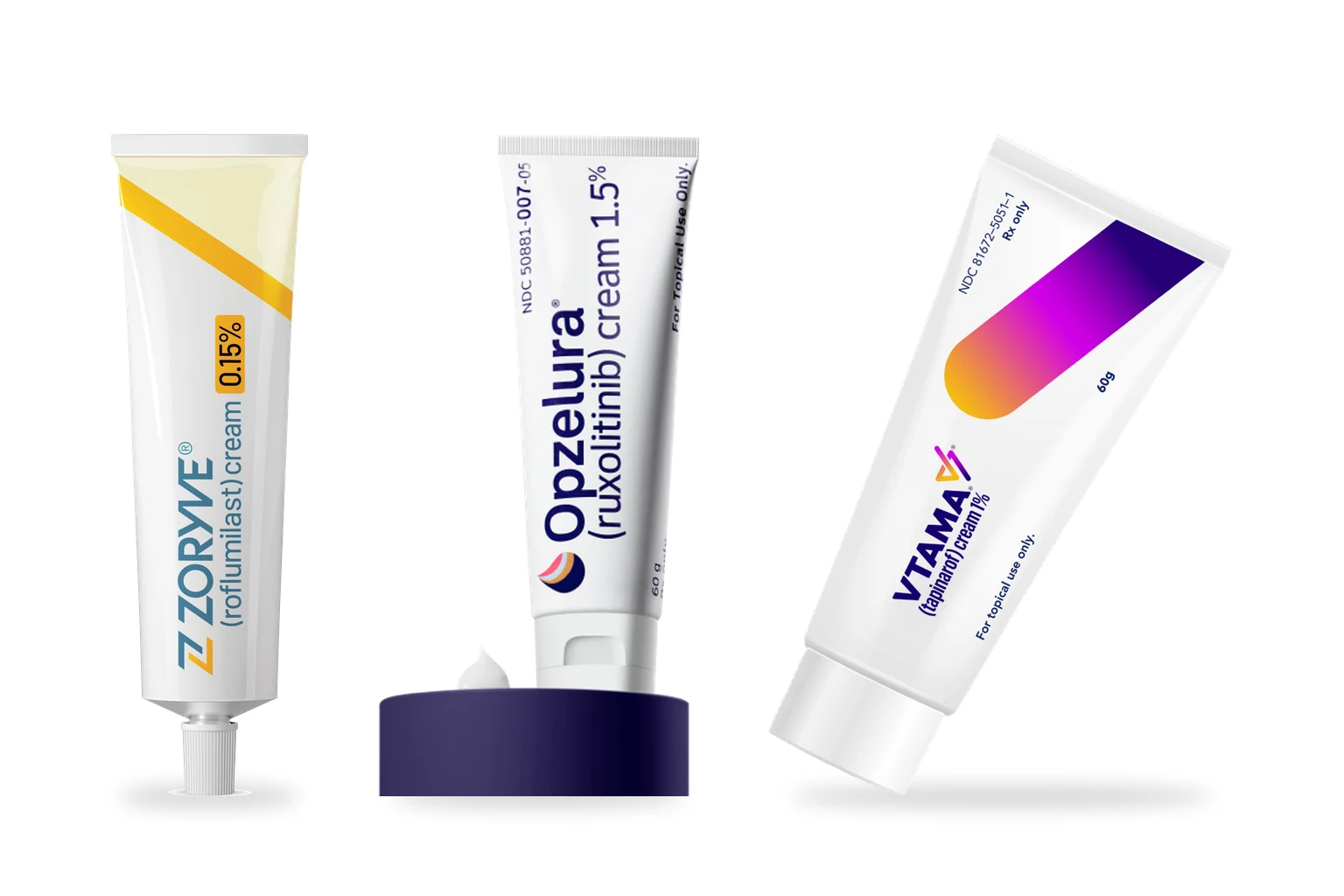
| Insurance-billed online dermatology clinic | Asynchronous photo visit or video visit with a dermatologist or dermatology clinician | Generic steroids, calcineurin inhibitors, and FDA-approved branded topicals (Zoryve, Opzelura, Vtama, Eucrisa) via prior authorization | Specialist copay or deductible plus pharmacy copays; branded creams require insurance approval or manufacturer savings cards | Patients with commercial insurance who specifically want FDA-approved branded creams or pediatric care covered under their plan |
| In-person dermatologist visit | Full skin exam, dermoscopy, patch testing, cultures, or skin biopsy | All topicals plus biologic injections (such as dupilumab), oral Janus kinase (JAK) inhibitors, and office phototherapy | Specialist copay or cash office fee plus separate lab, biopsy, and pharmacy costs; wait times often run weeks | Severe widespread eczema, unclear diagnosis, suspected contact allergy, skin infection, or biologic and oral JAK therapy |
Look closely at follow-up access before you pick a platform. Eczema rarely stays static for 90 days. A thick, cracked hand plaque needs a different potency and base than redness on the eyelids, and a plan that cuts off clinician messaging after day one leaves you guessing when the rash shifts.
Which prescription eczema medications can clinicians prescribe online?
The 2023 American Academy of Dermatology adult topical guideline issued strong recommendations for moisturizers, topical corticosteroids, topical calcineurin inhibitors (tacrolimus and pimecrolimus), topical phosphodiesterase-4 (PDE4) inhibitors, and topical JAK inhibitors (Sidbury 2023).
No single cream fits every body site. In a 2024 Cochrane network analysis of 291 trials covering 45,846 people, potent topical steroids, tacrolimus 0.1%, and ruxolitinib 1.5% ranked among the highest for short-term clearing, while PDE4 inhibitors ranked lower on average clearing (Lax 2024) and avoid steroid skin thinning and FDA boxed warnings (Zoryve label; Eucrisa label). The drug-specific clearing rates below come from separate vehicle-controlled trials (most requiring clear or almost clear skin plus at least a 2-grade improvement), so numbers can't be compared head to head.
| Medication class / example | Steroid | Published trial clearing (drug vs base) | Main safety or label limit | Primary source |
|---|---|---|---|---|
| Topical steroids (mild desonide to super-potent clobetasol) | Yes | Potent steroids ranked among the top clearing options in 291-trial Cochrane review; skin thinning occurred in 26 of 2,266 participants (about 1 in 100) across 22 short flare trials | Super-potent clobetasol limited to 2 consecutive weeks and 50 g/week; keep high-potency steroids off face, eyelids, groin, and armpits | Lax 2024; Lax 2022; Clobetasol label |
| Ruxolitinib 1.5% cream (Opzelura, topical JAK inhibitor) | No | Clear or almost clear at week 8 (ages 12+): 53.8% vs 15.1% and 51.3% vs 7.6% | FDA boxed warning (serious infections, death, cancer, major heart events, blood clots); approved ages 2+ (non-immunocompromised, second-line); max 20% body surface area (BSA) and 60 g/week at age 12+ (60 g per 2 weeks for ages 2 to 11); short-term non-continuous use | Papp 2021; Opzelura label |
| Tapinarof 1% cream (Vtama, aryl hydrocarbon receptor agonist) | No | Clear or almost clear at week 8 (ages 2+): 45.4% vs 13.9% and 46.4% vs 18.0% | No boxed warning or BSA cap; once daily; hair-follicle bumps (folliculitis) in 9% vs 1% | Silverberg 2024; Vtama label |
| Roflumilast 0.15% cream (Zoryve, topical PDE4 inhibitor) | No | Clear or almost clear at week 4 (ages 6+): 32.0% vs 15.2% and 28.9% vs 12.0%; average itch scores improved more than base cream from 24 hours | No boxed warning or BSA cap; once daily; not with moderate or severe liver impairment; application-site pain 1.5% vs 0.7% | Simpson 2024; Zoryve label |
| Crisaborole 2% ointment (Eucrisa, topical PDE4 inhibitor) | No | Clear or almost clear at day 29 (ages 2+): 32.8% vs 25.4% and 31.4% vs 18.0% | No boxed warning; approved from age 3 months; burning or stinging in 4% vs 1% | Paller 2016; Eucrisa label |
| Tacrolimus 0.1% ointment (Protopic, calcineurin inhibitor) | No | 90%+ improvement at 12 weeks in adults: 36.8% vs 6.6% | FDA boxed warning; burning in 58% of adults vs 26% on base ointment; second-line non-continuous use | Hanifin 2001; Protopic label |
In my practice, I match the medicine to the body site, the amount of skin involved, and how much stinging a person can tolerate. For a deeper look at every non-steroid option, read our comparison of Zoryve, Opzelura, Vtama, Eucrisa, and tacrolimus or our guide on when over-the-counter care is no longer enough.
Are topical steroids safe, or should you choose a steroid-free eczema cream?
Used on the right body site for the right duration, topical steroids have a low rate of skin thinning. Across 22 short-term flare trials (typically 1 to 5 weeks) pooled in a 2022 Cochrane review, abnormal skin thinning appeared in 26 of 2,266 participants (about 1 in 100), and 22 of those 26 cases came from potent or very potent steroids (Lax 2022). Over 6 months to 5 years across four randomized trials comparing steroids against calcineurin inhibitors, skin thinning occurred in 8 of 2,068 steroid users (7 on potent steroids) versus 0 of 2,060 on calcineurin inhibitors (Axon 2021).
I don't treat this choice as all-or-nothing. On thick body or hand flares, a short burst of an appropriately matched steroid calms inflammation fast. On thin skin (face, eyelids, neck, and skin folds) or for ongoing maintenance between flares, I reach for steroid-free options to avoid thinning risk altogether. Read our full guide to safe topical steroid use and facial and eyelid eczema care for body-site rules.
What does online eczema treatment cost with and without insurance?
Online eczema costs depend on whether your prescription is a generic tube filled at a local pharmacy, a branded pharmaceutical cream, or a bundled cash-pay regimen.
- Generic topical steroids through retail pharmacies: You pay a separate telehealth visit fee (or insurance specialist copay) plus your local pharmacy's generic tube cost. Follow-up changes usually require another billed visit.
- Branded non-steroid creams without insurance: Branded roflumilast cream (Zoryve) commonly runs $950 to $1,263 per tube at retail cash prices (GoodRx, 2026; cash prices vary by pharmacy and region), though commercial insurance and manufacturer savings cards can lower out-of-pocket costs after prior authorization.
- KindleeRx two-prescription cash-pay regimen: $149 for the first 90-day order with automatic refills, then $149 every 90 days (before coupons). That total covers two prescriptions, if prescribed, the $20 consultation fee, free shipping, and 90 days of unlimited clinician messaging. A one-time purchase is $181.25 before coupons. You can cancel automatic refills anytime, and an itemized receipt is available in the patient portal for health savings account or flexible spending account (HSA/FSA) reimbursement, depending on your plan's rules.
How does KindleeRx's online eczema treatment work?
Through the KindleeRx Eczema Regimen, you complete a 5-minute online intake and upload skin photos. Licensed clinicians (physician assistants and nurse practitioners working under a board-certified dermatologist's protocols) review your history and photos and reply in under 5 hours on average.
If treatment is appropriate, your clinician selects two prescription medications from 11 listed compounded and prescription formulations (6 containing a steroid, 5 steroid-free), pairing active flare control with daily maintenance or body-site care. Steroid-free daily options include Calming Daily Cream (compounded roflumilast 0.2% with calamine 5%, also offered standalone as The Calming Cream) and Ease the Itch Lotion (doxepin 1%, pramoxine 1%, menthol 1%, colloidal oatmeal 1%). Targeted and severe-flare options include Soothing Facial Cream (salicylic acid 3%, desonide 0.02%, sulfacetamide and sulfur 3%), scalp solution, thick-plaque ointment, wet-wrap kits, lower-leg care, and oral roflumilast 500 mcg tablets for widespread involvement.
Service is available in 44 states plus Washington, D.C. (excluding Arkansas, Kansas, Maryland, Mississippi, Nebraska, and West Virginia). No prescription is ever guaranteed. If a clinician determines treatment isn't appropriate, you receive a full refund including the $20 consultation fee. Every order also carries a 90-day satisfaction refund guarantee (including the $20 consultation fee, after clinician review of follow-up photos).
When is online eczema treatment not enough?
Online dermatology works best when the diagnosis is clear and topical or selected oral prescription management fits your severity. When a rash behaves strangely, spreads fast, or looks infected, I want you in an exam room so a clinician can swab, biopsy, or patch-test your skin directly. For background on types and triggers, see our complete eczema guide.
Important Information
KindleeRx offers compounded prescription medications prepared by licensed United States compounding pharmacies under a licensed prescriber's order. Compounded medications aren't approved by the FDA and aren't reviewed by the FDA for safety, effectiveness, or quality (FDA compounding guidance). KindleeRx's Calming Daily Cream (roflumilast 0.2% and calamine 5%) isn't Zoryve, isn't a generic of Zoryve (no FDA-approved generic of Zoryve exists), and KindleeRx isn't affiliated with Arcutis Biotherapeutics, Incyte, Organon, Pfizer, LEO Pharma, or AstraZeneca. Published clinical trial numbers for branded products (Zoryve, Opzelura, Vtama, Eucrisa, Protopic) reflect those branded drugs and studied strengths only, not KindleeRx's compounded formulations. Oral roflumilast is FDA-approved for severe chronic obstructive pulmonary disease (Daliresp label); its use in eczema is off-label. Oral roflumilast must not be used with moderate or severe liver impairment and carries FDA warnings for mood changes (including depression or suicidal thoughts), weight loss, and stomach upset. A licensed clinician determines whether treatment is appropriate after reviewing your health history and photos. Not all patients qualify. Individual results vary. This article is educational and isn't medical advice.
Sources
- Armstrong AW, et al. Online vs In-Person Care for Atopic Dermatitis: A Randomized Clinical Trial. JAMA Dermatology 2026.
- Armstrong AW, et al. Impact of Online Versus In-Person Management of Atopic Dermatitis on Quality of Life and Access to Care: A Randomized Controlled Trial. Journal of Investigative Dermatology 2026.
- Armstrong AW, et al. Patient-Centered, Direct-Access Online Care for Management of Atopic Dermatitis: A Randomized Clinical Trial. JAMA Dermatology 2015.
- Rahman SM, et al. Identifying Care Gaps and Referral Patterns in Acute Dermatology at Urgent Care Centers. Archives of Dermatological Research 2025.
- Sidbury R, et al. Guidelines of Care for the Management of Atopic Dermatitis in Adults With Topical Therapies. Journal of the American Academy of Dermatology 2023.
- Lax SJ, et al. Topical Anti-Inflammatory Treatments for Eczema: Network Meta-Analysis (CD015064). Cochrane Database of Systematic Reviews 2024.
- Lax SJ, Harvey J, et al. Strategies for Using Topical Corticosteroids in Children and Adults With Eczema (CD013356). Cochrane Database of Systematic Reviews 2022.
- Axon E, et al. Safety of Topical Corticosteroids in Atopic Eczema: An Umbrella Review. BMJ Open 2021.
- Cosette. Clobetasol Propionate Ointment 0.05% Prescribing Information. DailyMed 2023.
- Simpson EL, et al. INTEGUMENT-1 and INTEGUMENT-2 Trials of Roflumilast Cream 0.15% in Atopic Dermatitis. JAMA Dermatology 2024.
- Papp K, et al. TRuE-AD1 and TRuE-AD2 Trials of Ruxolitinib Cream in Atopic Dermatitis. Journal of the American Academy of Dermatology 2021.
- Silverberg JI, et al. ADORING 1 and ADORING 2 Trials of Tapinarof Cream 1% in Atopic Dermatitis. Journal of the American Academy of Dermatology 2024.
- Paller AS, et al. Efficacy and Safety of Crisaborole Ointment in Atopic Dermatitis (AD-301 and AD-302). Journal of the American Academy of Dermatology 2016.
- Hanifin JM, et al. Tacrolimus Ointment for the Treatment of Atopic Dermatitis in Adult Patients: Part I, Efficacy. Journal of the American Academy of Dermatology 2001.
- Arcutis Biotherapeutics. ZORYVE (roflumilast) Cream Prescribing Information, revised June 2026. DailyMed.
- Incyte. OPZELURA (ruxolitinib) Cream Prescribing Information, revised June 2026. DailyMed.
- Organon. VTAMA (tapinarof) Cream Prescribing Information, revised May 2025. DailyMed.
- Pfizer. EUCRISA (crisaborole) Ointment Prescribing Information. DailyMed.
- LEO Pharma. Protopic (tacrolimus) Ointment Prescribing Information. Drugs@FDA.
- AstraZeneca. DALIRESP (roflumilast) Tablets Prescribing Information, revised March 2020. DailyMed.
- GoodRx. Zoryve Retail Cash Pricing (2026).
- Food and Drug Administration. Understanding the Risks of Compounded Drugs.
Related Articles
Eczema
Zoryve vs Opzelura vs Vtama vs Eucrisa: Non-Steroid Eczema Creams Compared
Nov 19, 2026 · 13 min read
Eczema
Over-the-Counter vs Prescription Eczema Treatments: What Should I Use, and When?
Mar 5, 2026 · 10 min read
Eczema
Topical Steroids for Eczema: Benefits, Safety, and the Rise of Steroid-Free Options
Mar 2, 2026 · 13 min read