

Editorial image created with artificial intelligence using Dr. Brandon Kirsch's likeness. Illustrative scene.
A Dermatologist Ranks Every Steroid-Free Cream for Eczema and Psoriasis

Chief Medical Officer
A great steroid-free cream has to do more than skip steroids: it has to work on thin skin, feel calm going on, avoid strict body-area ceilings, and stay affordable enough that you actually use it every day. In my dermatology clinic, I watch patients abandon steroid-free prescriptions for two predictable reasons: either the tube stings every time it touches raw skin, or the pharmacy quotes a four-figure cash price after insurance rejects the claim.
In this article
Below is how I rank every major steroid-free topical option for eczema and psoriasis, grounded in published vehicle-controlled trials and FDA prescribing labels. Each drug was tested in separate trials with different durations and populations, so trial counts cannot be compared head to head.
KindleeRx publishes this ranking and offers a compounded roflumilast-based cream. All branded clinical trial figures describe those FDA-approved branded drugs and studied strengths only, not KindleeRx's compounded formula.
| Rank | Steroid-free option | Published trial clearing (drug vs base) | Main tradeoff |
|---|---|---|---|
| Tier 5 | Drugstore barrier creams, colloidal oatmeal, petrolatum | Strongly recommended daily foundation (Sidbury 2023); does not block immune inflammation alone | Essential partner, rarely clears active moderate flares alone |
| Tier 4 | Crisaborole 2% ointment (Eucrisa), a phosphodiesterase-4 (PDE4) inhibitor | Eczema day 29: about 33 in 100 vs 25 in 100, and 31 in 100 vs 18 in 100 (Paller 2016) | Twice-daily greasy ointment; stinging in about 4 in 100; eczema only |
| Tier 3 | Tacrolimus 0.1% ointment (Protopic), a calcineurin inhibitor | Adult eczema 90%+ improvement at 12 weeks: about 37 in 100 vs 7 in 100 (Hanifin 2001) | FDA boxed warning; burning in about 58 in 100 adults; off-label in psoriasis |
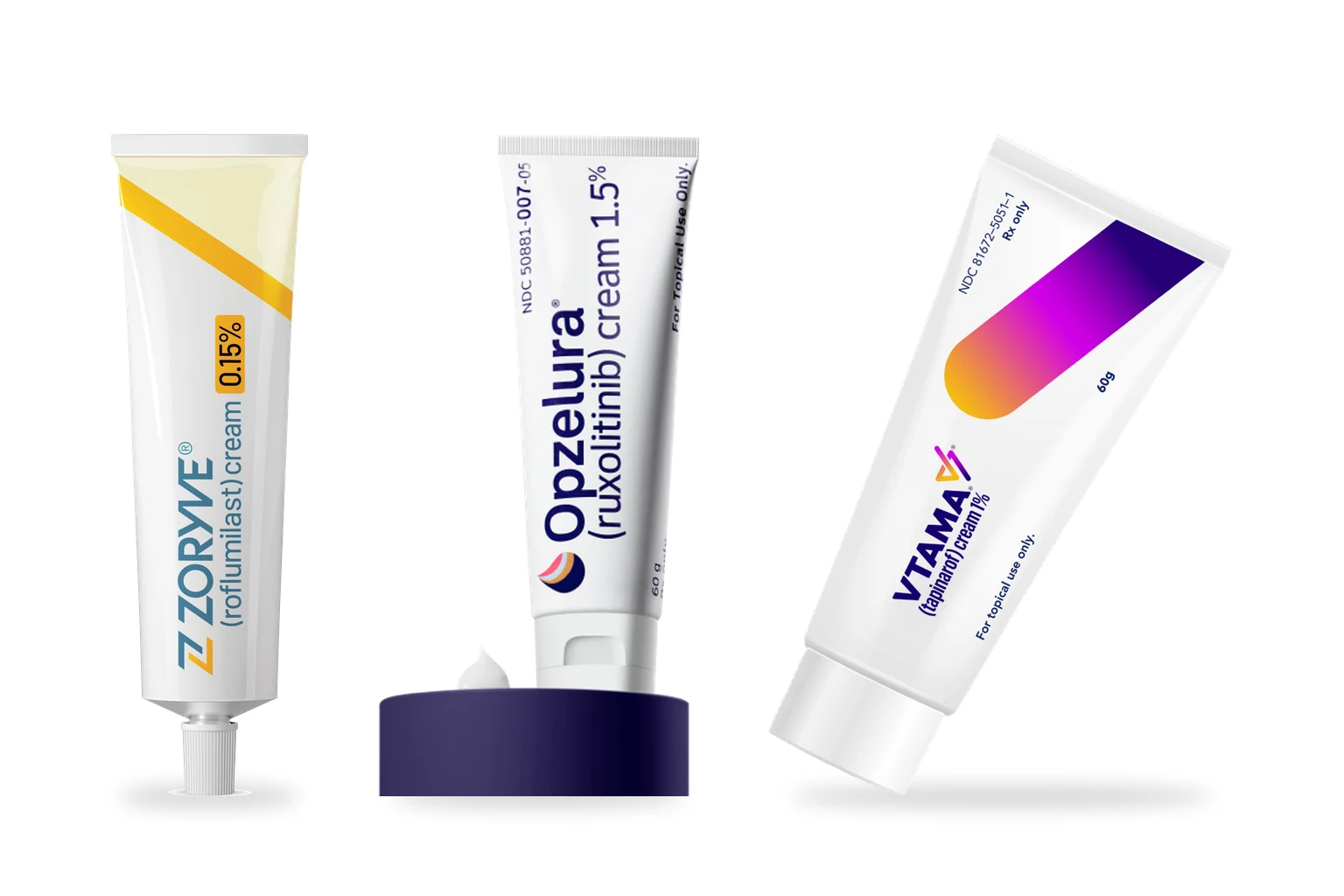
| Tier 2B | Tapinarof 1% cream (Vtama), an aryl hydrocarbon receptor (AhR) agonist | Eczema week 8: about 45 to 46 in 100 vs 14 to 18 in 100 (Silverberg 2024); psoriasis week 12: 35 to 40 in 100 vs 6 in 100 (Lebwohl 2021) | Hair-follicle bumps (folliculitis) in about 9 in 100 (eczema) to 20 in 100 (psoriasis) |
| Tier 2A | Ruxolitinib 1.5% cream (Opzelura), a topical Janus kinase (JAK) inhibitor | Eczema week 8: about 54 in 100 vs 15 in 100, and 51 in 100 vs 8 in 100; rapid itch drop within 12 hours (Papp 2021) | FDA boxed warning; 20% body-area and 60 g/week cap (ages 12+); short-term non-continuous use; eczema only |
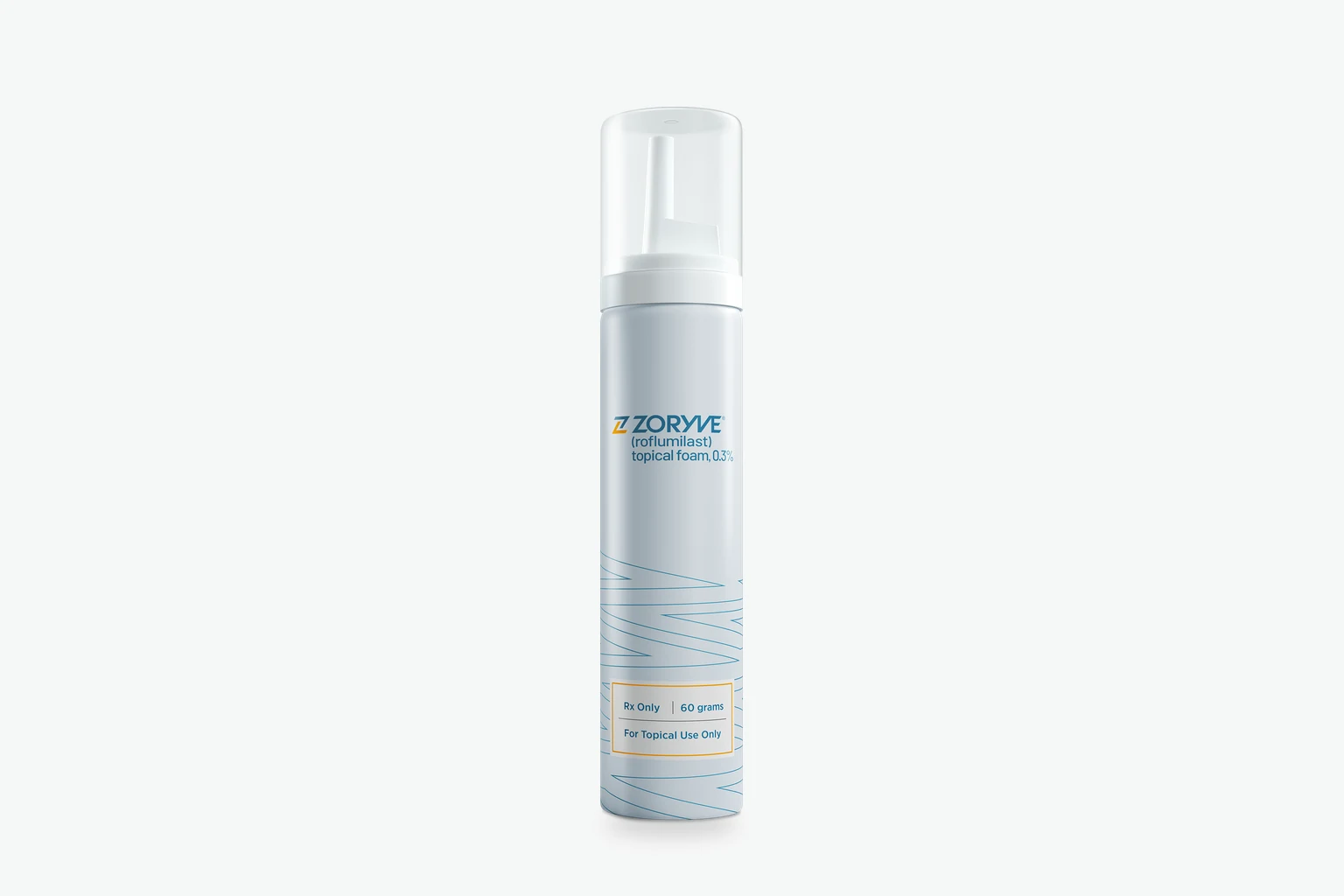
| Tier 1 | Topical roflumilast cream, a PDE4 inhibitor (branded Zoryve 0.15% and 0.3%) | Psoriasis week 8 (0.3%): 42 in 100 and 38 in 100 overall, 71 in 100 and 68 in 100 in skin folds (Lebwohl 2022); eczema week 4 (0.15%): 32 in 100 and 29 in 100 (Simpson 2024) | No FDA boxed warning or body-area cap; once daily; not for moderate or severe liver impairment; high branded cash price |
Why do plain moisturizers support steroid-free prescriptions without replacing them?
Plain fragrance-free moisturizers, ceramides, petrolatum, and colloidal oatmeal repair cracks in the outer skin barrier and lock in water, earning a strong recommendation from the American Academy of Dermatology (Sidbury 2023). Watch out for drugstore 1% hydrocortisone tubes marketed as gentle itch relief: hydrocortisone is still a mild topical steroid, not a steroid-free cream.
When immune cells are actively driving redness, stinging, and thick scale, plain moisturizer alone cannot switch off that inflammatory signal. Even so, I strongly encourage pairing daily moisturizer with any prescription steroid-free cream, including a moisturizer sandwich (bland moisturizer before and after roflumilast cream) whenever skin feels dry or reactive. See our moisturizer layering guide for practical timing.
How do older non-steroid ointments (crisaborole and tacrolimus) rank today?
Crisaborole 2% ointment (Eucrisa) and tacrolimus 0.1% ointment (Protopic) proved that steroid-free eczema care was possible, yet both show their age compared with newer creams.
- Crisaborole 2% ointment (Tier 4): Across two 28-day trials, about 33 in 100 versus 25 in 100 (AD-301) and 31 in 100 versus 18 in 100 (AD-302) achieved clear or almost clear skin (Paller 2016). It carries no FDA boxed warning and is approved down to 3 months of age (Eucrisa label), though twice-daily greasy ointment texture and application stinging (4 in 100 versus 1 in 100) limit adult adherence.
- Tacrolimus 0.1% ointment (Tier 3): In adult atopic dermatitis trials, about 37 in 100 reached 90% or greater improvement at 12 weeks versus 7 in 100 on base ointment (Hanifin 2001), and across long-term trials lasting up to 5 years, calcineurin inhibitors caused 0 cases of skin thinning in 2,060 participants (Axon 2021). Still, burning occurs in roughly 58 in 100 adults on tacrolimus 0.1% versus 26 in 100 on base ointment, and the FDA label carries a boxed warning restricting it to second-line non-continuous use (Protopic label).
Where do ruxolitinib (Opzelura) and tapinarof (Vtama) shine and fall short?
Both newer non-steroid creams deliver impressive clearing rates, and both come with specific clinical tradeoffs that keep them just behind roflumilast for everyday unrestricted use.
Ruxolitinib 1.5% cream (Tier 2A) is a topical JAK inhibitor. In the phase 3 TRuE-AD1 and TRuE-AD2 eczema trials (1,249 patients aged 12 and older), about 54 in 100 and 51 in 100 reached clear or almost clear skin at week 8 versus 15 in 100 and 8 in 100 on base cream, with noticeable itch reduction inside 12 hours (Papp 2021). The tradeoff is on the label: Opzelura carries the JAK-class FDA boxed warning (serious infections, death, cancer, major heart events, and blood clots), is capped at 20% body surface area (up to 60 g per week for ages 12 and older, or 60 g per 2 weeks for ages 2 to 11), is labeled for short-term non-continuous second-line use, and is not approved for psoriasis (Opzelura label).
Tapinarof 1% cream (Tier 2B) works through the aryl hydrocarbon receptor and treats both eczema and plaque psoriasis once daily without a boxed warning or body-area cap (Vtama label). In the ADORING 1 and 2 eczema trials (813 patients aged 2 and older), about 45 in 100 and 46 in 100 reached clear or almost clear skin at week 8 versus 14 in 100 and 18 in 100 on base (Silverberg 2024). In the PSOARING 1 and 2 psoriasis trials (1,025 adults), about 35 in 100 and 40 in 100 cleared at week 12 versus 6 in 100 on base (Lebwohl 2021). Its main practical snag is folliculitis (red hair-follicle bumps), appearing in roughly 9 in 100 eczema patients and 20 in 100 psoriasis patients versus 1 in 100 on base cream (Vtama label).
Why does topical roflumilast rank first as an everyday steroid-free all-rounder?
Topical roflumilast is a high-potency PDE4 inhibitor that combines once-daily simplicity, strong skin-fold performance, broad body-area freedom, and very low stinging across both eczema and plaque psoriasis.
- Psoriasis trials (DERMIS-1 and DERMIS-2, 881 participants, roflumilast 0.3% cream): At week 8, about 42 in 100 and 38 in 100 reached clear or almost clear skin overall versus 6 in 100 and 7 in 100 on base cream. In delicate skin folds (armpits, groin, under the breasts), success climbed to about 71 in 100 and 68 in 100 versus 14 in 100 and 19 in 100 on base, while meaningful itch relief reached about 68 in 100 and 69 in 100 (Lebwohl 2022).
- Eczema trials (INTEGUMENT-1 and INTEGUMENT-2, 1,337 participants aged 6+, roflumilast 0.15% cream): At week 4, about 32 in 100 and 29 in 100 reached clear or almost clear skin versus 15 in 100 and 12 in 100 on base, while 75% Eczema Area and Severity Index improvement (EASI-75) occurred in about 43 in 100 and 42 in 100. Investigators recorded no application-site irritation in at least 95 in 100 roflumilast users (Simpson 2024).
- Label profile: Once-daily cream, no FDA boxed warning, no body-area percentage cap, and safe for face and skin folds; contraindicated only in moderate-to-severe liver impairment (Zoryve label).
How does KindleeRx make roflumilast cream accessible without a four-figure retail pharmacy bill?
The biggest obstacle to topical roflumilast is not clinical performance; it is access. Without commercial insurance approval or manufacturer savings cards, branded Zoryve cream commonly lists at $950 to $1,263 cash for a 60 g tube (GoodRx, 2026).
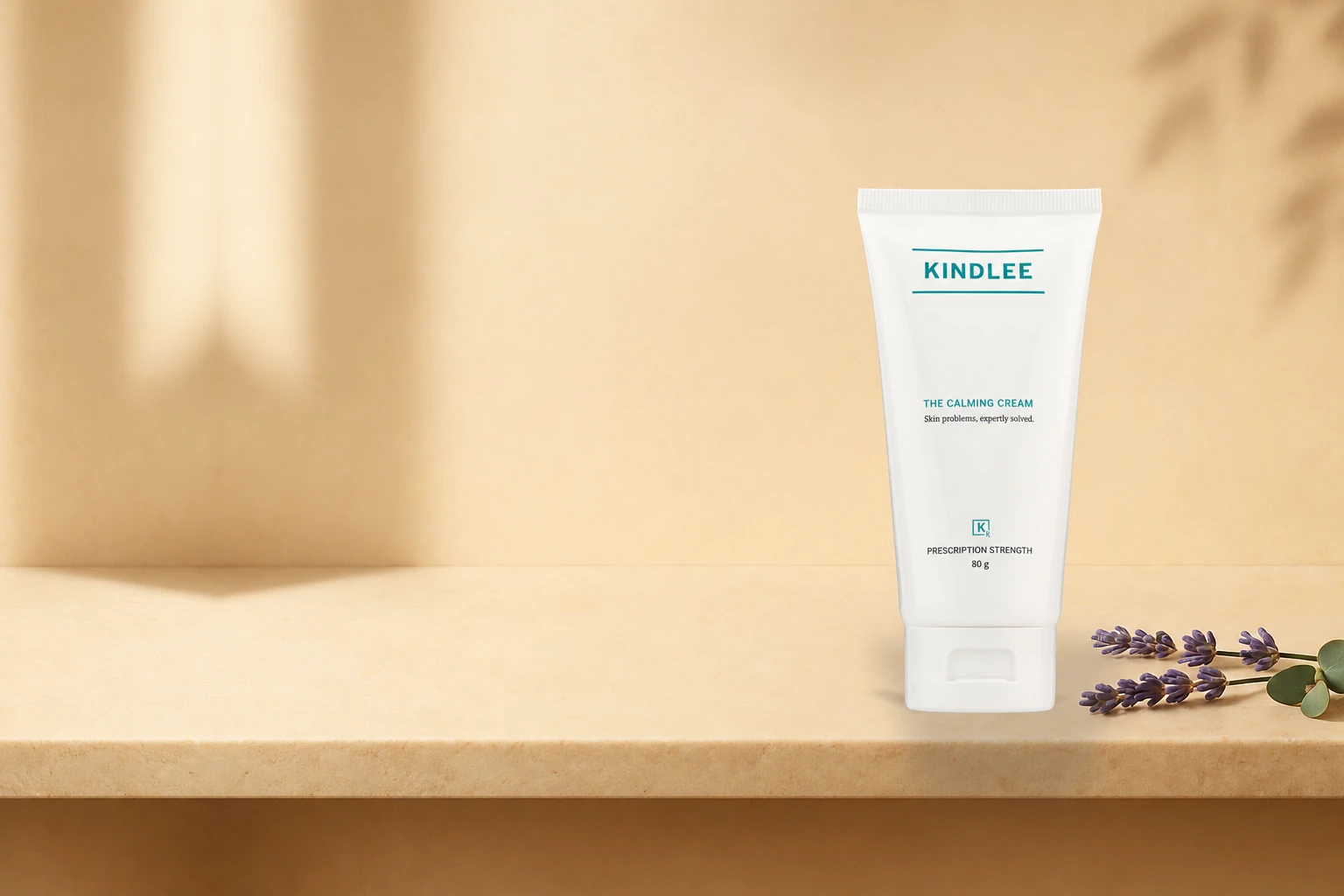
That price wall is why I designed The Calming Cream at KindleeRx: a single, once-daily, steroid-free 80 g compounded prescription tube combining roflumilast 0.2% with calamine 5% for added soothing comfort on sensitive skin, including the face and skin folds when directed by your clinician.
- Transparent pricing: Automatic refills are $70 for the first 90-day order and $70 every 90 days (before coupons), including the $20 consultation fee, free shipping, and 90 days of clinician messaging. A one-time order is $80 before coupons. Cancel automatic refills anytime with one click.
- Fast clinical review: Licensed clinicians review your 5-minute intake and photos and reply in under 5 hours on average, with usual delivery in 5 to 7 days total across 44 states plus Washington, D.C. (excluding Arkansas, Kansas, Maryland, Mississippi, Nebraska, and West Virginia).
- Zero-risk decision: Full refund including the $20 consultation fee if treatment is not prescribed, plus a 90-day satisfaction refund guarantee after clinician review of follow-up photos.
If you have severe widespread flares, thick body plaques, or scalp disease needing two targeted medicines, our two-prescription Eczema Regimen or Psoriasis Regimen may be a stronger match. Not sure where to start? Take our quick 3-tap Calming Cream check or view full Calming Cream details.
Important Information
KindleeRx offers compounded prescription medications prepared by licensed United States compounding pharmacies under a licensed prescriber's order. Compounded medications are not approved by the FDA and are not reviewed by the FDA for safety, effectiveness, or quality (FDA compounding guidance). KindleeRx's Calming Cream (roflumilast 0.2% and calamine 5%) is not Zoryve, is not a generic of Zoryve (no FDA-approved generic of Zoryve exists), and KindleeRx is not affiliated with Arcutis Biotherapeutics, Incyte, Organon, Pfizer, or LEO Pharma. Published clinical trial figures for Zoryve, Opzelura, Vtama, Eucrisa, and Protopic describe those FDA-approved branded drugs and studied strengths only, not KindleeRx's compounded formulation. Topical roflumilast should not be used in moderate-to-severe liver impairment. A licensed clinician determines whether treatment is appropriate after reviewing your health history and photos. Not all patients qualify. Individual results vary. This guide is educational and is not personal medical advice.
Sources
- Sidbury R, et al. Guidelines of Care for the Management of Atopic Dermatitis in Adults With Topical Therapies. Journal of the American Academy of Dermatology 2023.
- Axon E, et al. Safety of Topical Corticosteroids in Atopic Eczema: An Umbrella Review. BMJ Open 2021.
- Lebwohl MG, et al. Effect of Roflumilast Cream vs Vehicle Cream on Chronic Plaque Psoriasis: The DERMIS-1 and DERMIS-2 Randomized Clinical Trials. JAMA 2022.
- Simpson EL, et al. Roflumilast Cream, 0.15%, for Atopic Dermatitis in Adults and Children: INTEGUMENT-1 and INTEGUMENT-2 Randomized Clinical Trials. JAMA Dermatology 2024.
- Papp K, et al. Efficacy and Safety of Ruxolitinib Cream for the Treatment of Atopic Dermatitis: TRuE-AD1 and TRuE-AD2. Journal of the American Academy of Dermatology 2021.
- Silverberg JI, et al. Tapinarof Cream 1% Once Daily in Atopic Dermatitis: ADORING 1 and 2. Journal of the American Academy of Dermatology 2024.
- Lebwohl MG, et al. Phase 3 Trials of Tapinarof Cream for Plaque Psoriasis (PSOARING 1 and 2). New England Journal of Medicine 2021.
- Paller AS, et al. Efficacy and Safety of Crisaborole Ointment in Atopic Dermatitis (AD-301 and AD-302). Journal of the American Academy of Dermatology 2016.
- Hanifin JM, et al. Tacrolimus Ointment for the Treatment of Atopic Dermatitis in Adult Patients: Part I, Efficacy. Journal of the American Academy of Dermatology 2001.
- Arcutis Biotherapeutics. ZORYVE (roflumilast) Cream Prescribing Information. DailyMed.
- Incyte. OPZELURA (ruxolitinib) Cream Prescribing Information. DailyMed.
- Organon. VTAMA (tapinarof) Cream Prescribing Information. DailyMed.
- Pfizer. EUCRISA (crisaborole) Ointment Prescribing Information. DailyMed.
- LEO Pharma. Protopic (tacrolimus) Ointment Prescribing Information. Drugs@FDA.
- GoodRx. Zoryve Retail Cash Pricing (2026).
- Food and Drug Administration. Understanding the Risks of Compounded Drugs.
Related Articles
Eczema
Zoryve vs Opzelura vs Vtama vs Eucrisa: Non-Steroid Eczema Creams Compared
Nov 19, 2026 · 13 min read
Eczema
I Got Tired of Watching Patients Walk Away From a $900 Cream. So I Built a $70 One.
Jun 13, 2026 · 8 min read
Eczema
Is Zoryve a Steroid? Where You Can Use It and Long-Term Safety
Nov 19, 2026 · 9 min read