
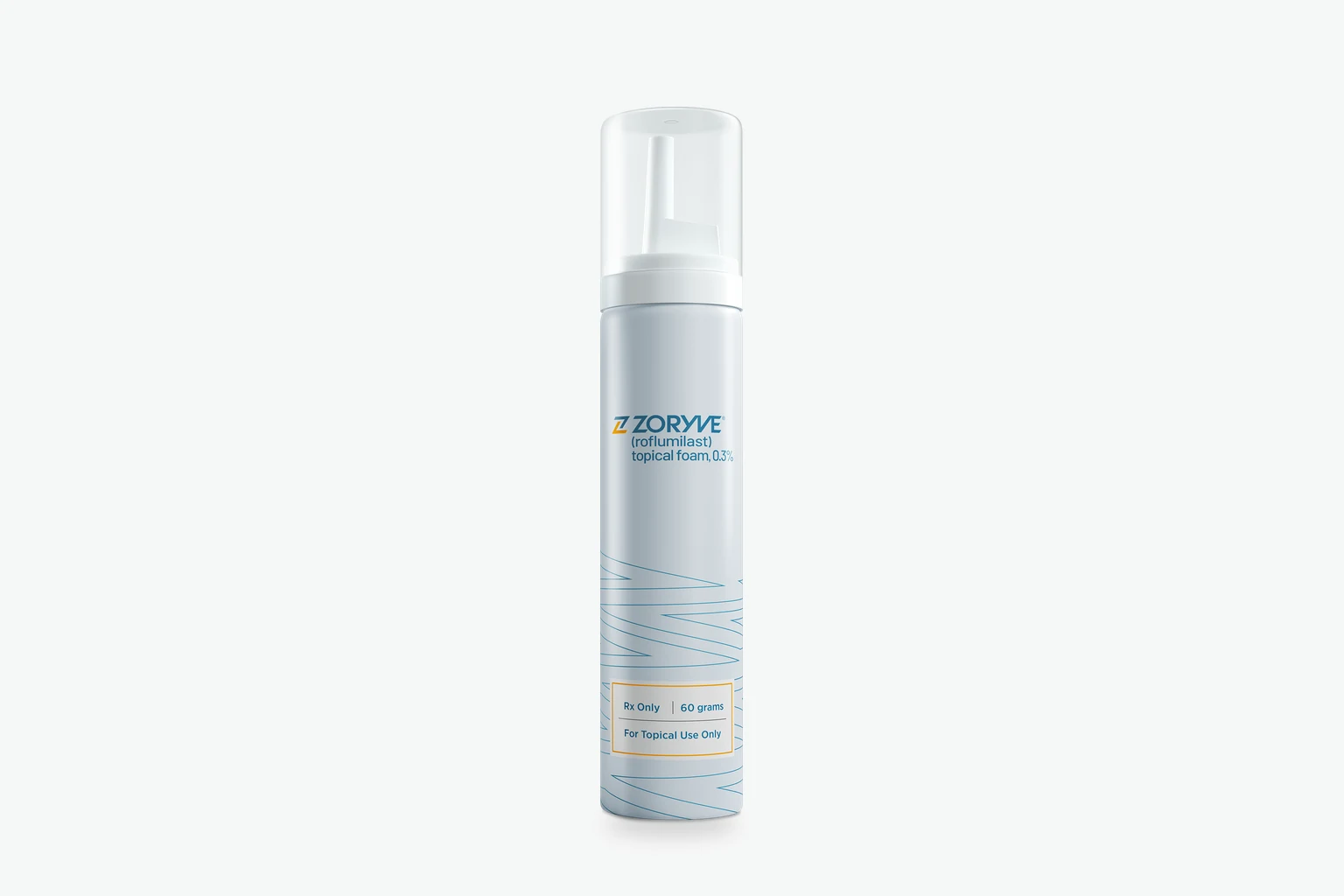
Image: Arcutis Biotherapeutics, maker of Zoryve. Shown to identify the product. KindleeRx is not affiliated with Arcutis Biotherapeutics.
Is Zoryve a Steroid? Where You Can Use It and Long-Term Safety

Chief Medical Officer
No, Zoryve is not a steroid. Its active ingredient, roflumilast, is a phosphodiesterase-4 (PDE4) inhibitor, and its ingredient list contains no corticosteroid (Zoryve cream label). The label approves the 0.3% cream for psoriasis in skin folds from age 2, sets no maximum treatment length, and reports that 644 people who kept using it for up to 64 weeks had a side effect profile consistent with the 8-week trials.
In this article
Is Zoryve a steroid?
No. The Zoryve cream label classifies roflumilast as a PDE4 inhibitor, and the phase 3 eczema report calls the 0.15% cream "nonsteroidal" (Zoryve cream label; Simpson 2024). Blocking PDE4 lets a signaling molecule called cyclic adenosine monophosphate (cyclic AMP) build up inside cells; the label says the exact way this calms skin is not well defined. The cream base is water, white petrolatum, isopropyl palmitate, emulsifiers, solvents and two paraben preservatives. Roflumilast was first approved in the U.S. in 2011 (Zoryve cream label); an oral form is approved for chronic obstructive pulmonary disease (COPD), and the cream was approved for plaque psoriasis on July 29, 2022 (Lebwohl 2022). Zoryve comes as cream 0.3% (psoriasis), cream 0.15% and 0.05% (eczema), and foam 0.3%. My short answer to patients: it belongs to a different drug class, so the steroid rules about short courses and rest weeks do not come from its label.
Can you use Zoryve on your face and eyelids?
Yes on facial and eyelid skin, never in the eye. The label bars use in the eyes, mouth or vagina; the manufacturer lists the face and eyelids as use sites (Zoryve cream label; Arcutis). In the eczema trials, 42% of patients had facial and 21% eyelid eczema, and at each visit more than 95% of roflumilast-treated patients had no signs of irritation (Simpson 2024). The American Academy of Dermatology guideline urges caution with steroid strength on the face and says limiting steroid use around the eyes may be prudent, though a link to glaucoma is not clear (Eichenfield 2014). For eyelid eczema, I start with a non-steroid. See my guide to facial and eyelid eczema.
Can you use Zoryve in skin folds and on the genitals?
Yes for skin folds and external genital skin, and no inside the vagina. Zoryve cream 0.3% is labeled for plaque psoriasis "including intertriginous areas" (skin folds) in patients 2 and older (Zoryve cream label). Among trial patients with fold psoriasis, 71.5% vs 13.8% (DERMIS-1) and 67.5% vs 17.4% (DERMIS-2) had clear or almost clear fold skin with at least a 2-grade improvement at week 8. At baseline, 13% to 18% of DERMIS patients had genital psoriasis (Lebwohl 2022), and the manufacturer lists the groin and other external genital skin as use sites. Steroid labels point the other way: a fluocinonide 0.05% cream label warns that thinning can occur on folds or the face even with short-term use (fluocinonide label), and the UK National Institute for Health and Care Excellence (NICE) limits moderate or potent steroids in children's armpits and groin to 7 to 14 days (NICE CG57).
Does Zoryve thin the skin like a steroid?
No skin thinning is listed for Zoryve. Neither the cream nor the foam label mentions skin atrophy, stretch marks or visible blood vessels; the only "atrophy" refers to the testes of male rats given oral roflumilast (Zoryve cream label; Zoryve foam label). Over 52 weeks of daily 0.3% cream in 332 adults, at least 97% had no irritation and 3.6% had treatment-related side effects, none serious (Stein Gold 2024). No trial in my sources measured skin thickness on Zoryve.
Steroid thinning is real but uncommon in trials. Flare-treatment trials recorded 26 cases among 2,266 participants (1%), 16 of them on very potent steroids (Lax 2022). In trials of 6 months to 5 years, a review counted thinning in 8 of 2,068 on steroid creams (7 on potent ones), and none of 2,060 on calcineurin-inhibitor creams (Axon 2021). Stronger steroids, occlusion, thin skin and older age raise the risk (Eichenfield 2014). Safe steroid use is covered in topical steroids for eczema.
Is Zoryve safe for long-term use?
Yes, as far as the data reach: about 15 months. In 644 people aged 6 and older who continued Zoryve cream 0.3% for up to 64 weeks, the label says the side effect profile was consistent with the 8-week trials; an eczema extension of 1,219 people aged 2 and older was also consistent (Zoryve cream label). Over 52 weeks in 332 adults with psoriasis, 3.9% stopped for side effects, no loss of effect was seen, and about 45% were clear or almost clear at week 52 (Stein Gold 2024). In the 52-week eczema extension (657 patients aged 6 and older), 4.7% had treatment-related side effects (Simpson 2026). In the 8-week psoriasis trials, the most common side effects were diarrhea (3.1% vs 0%) and headache (2.4% vs 1.0%) (Zoryve cream label). The label sets no time limit. My advice: daily use for months is reasonable, and use past about 15 months goes beyond what has been studied.
Who should not use Zoryve?
People with moderate to severe liver impairment (Child-Pugh B or C) should not use it; that is the only contraindication in either label (Zoryve cream label). The label also flags:
- Pregnancy: human data are too limited to judge risk; avoid Zoryve during labor and delivery.
- Breastfeeding: use the smallest area for the shortest time, never on the nipple or areola.
- Other medicines: pills that block the enzyme cytochrome P450 3A4 (CYP3A4), such as erythromycin, and birth control pills with gestodene and ethinyl estradiol may raise roflumilast levels.
- Age: safety below age 2 is not established.
- Parabens: the cream contains methylparaben and propylparaben, and a 2026 report described paraben allergy to it in 2 patients (Waldal 2026).
How does KindleeRx treat eczema and psoriasis without a steroid?
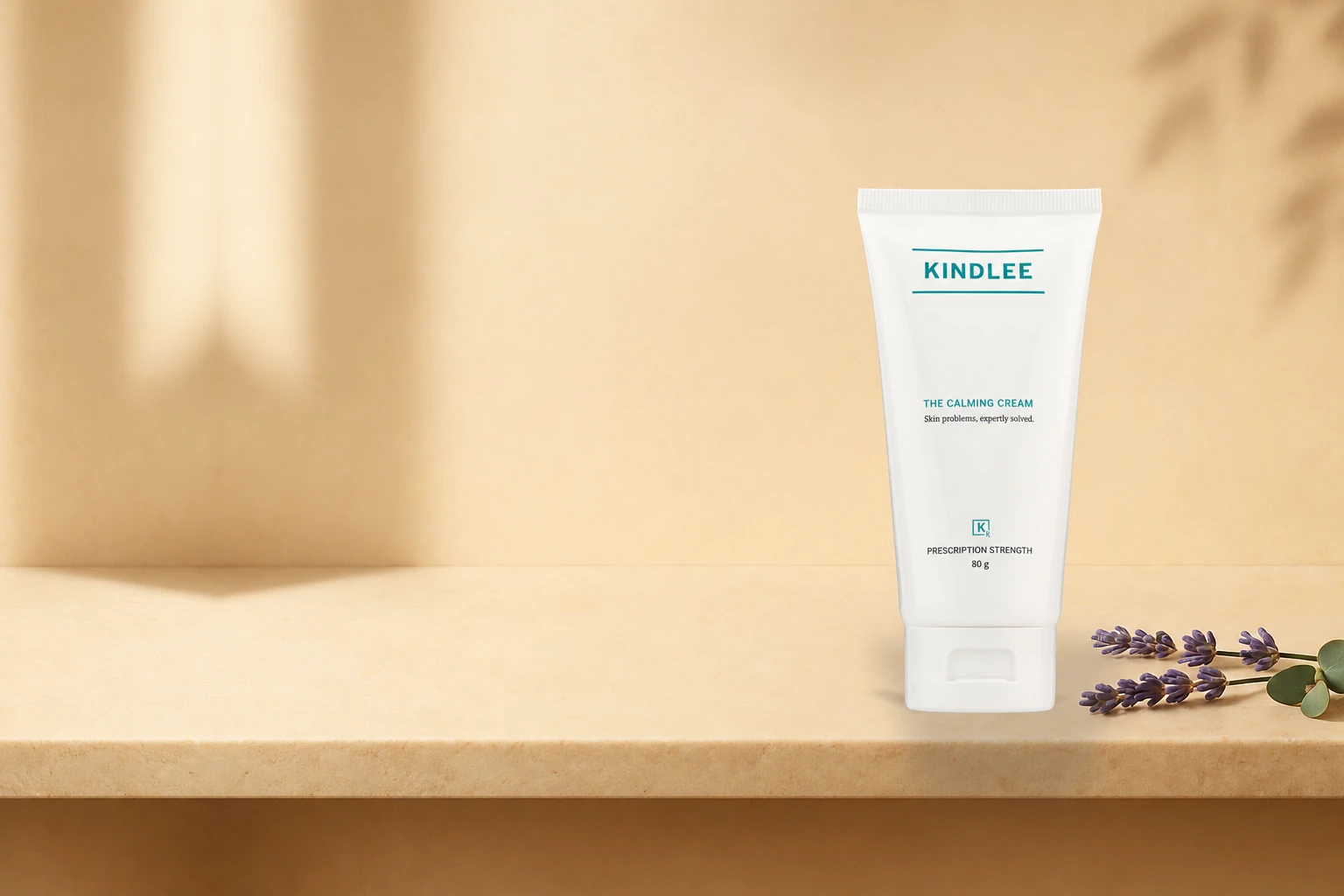
KindleeRx offers the Calming Cream, a compounded prescription cream with roflumilast 0.2% and calamine 5%, applied once daily for mild to moderate eczema or psoriasis when a clinician decides it is appropriate. It is not Zoryve, and the Zoryve trial numbers above describe Zoryve only. Licensed clinicians (physician assistants and nurse practitioners working under a board-certified dermatologist's protocols) review each case online and reply in under 5 hours on average. A prescription is never guaranteed; if treatment is not prescribed, the refund is full, including the consultation fee. For the wider picture of eczema care, start with eczema basics to breakthroughs.
Important Information
The KindleeRx Calming Cream is a compounded prescription medication containing roflumilast 0.2% and calamine 5%, prepared by a licensed US compounding pharmacy under a licensed prescriber. It is not Zoryve, it is not a generic of Zoryve, and it is not an FDA-approved drug product. Compounded medications are not reviewed by the FDA for safety, effectiveness, or quality. KindleeRx is not affiliated with Arcutis or Zoryve. Published trial data for branded roflumilast (Zoryve) reflect the branded product and the branded concentrations studied in those trials, not this compounded formula. Eligibility is determined by a licensed clinician after reviewing your information. Not all patients qualify. This article is educational and is not medical advice.
Sources
- Arcutis Biotherapeutics. ZORYVE (roflumilast) cream prescribing information and Patient Information, revised 6/2026. DailyMed.
- Arcutis Biotherapeutics. ZORYVE (roflumilast) topical foam prescribing information, revised 6/2026. DailyMed.
- Arcutis Biotherapeutics. Applying ZORYVE cream. zoryve.com, 2026.
- Simpson EL et al. Roflumilast cream, 0.15%, for atopic dermatitis in adults and children: INTEGUMENT-1 and INTEGUMENT-2 randomized clinical trials. JAMA Dermatology 2024.
- Lebwohl MG et al. Effect of roflumilast cream vs vehicle cream on chronic plaque psoriasis: the DERMIS-1 and DERMIS-2 randomized clinical trials. JAMA 2022.
- Stein Gold L et al. Long-term safety and effectiveness of roflumilast cream 0.3% in adults with chronic plaque psoriasis: a 52-week, phase 2, open-label trial. Journal of the American Academy of Dermatology 2024.
- Simpson EL et al. Long-term safety and efficacy with roflumilast cream 0.15% in patients aged 6 years and older with atopic dermatitis: a phase 3 open-label extension trial. Dermatitis 2026.
- Waldal GL et al. Allergic contact dermatitis to parabens associated with topical roflumilast cream: a case series of 2 patients. Dermatitis 2026.
- Eichenfield LF et al. Guidelines of care for the management of atopic dermatitis: section 2. Journal of the American Academy of Dermatology 2014.
- Lax SJ, Harvey J et al. Strategies for using topical corticosteroids in children and adults with eczema. Cochrane Database of Systematic Reviews 2022.
- Axon E et al. Safety of topical corticosteroids in atopic eczema: an umbrella review. BMJ Open 2021.
- Garrott HM, Walland MJ. Glaucoma from topical corticosteroids to the eyelids. Clinical and Experimental Ophthalmology 2004.
- Amneal Pharmaceuticals. Fluocinonide cream USP 0.05% label. DailyMed.
- National Institute for Health and Care Excellence. Atopic eczema in under 12s: diagnosis and management (CG57), updated 2025.
Related Articles
Eczema
Facial and Eyelid Eczema: Your Complete Guide to Treating Sensitive Skin Safely
Mar 12, 2026 · 9 min read

Eczema
Topical Steroids for Eczema: Benefits, Safety, and the Rise of Steroid-Free Options
Mar 2, 2026 · 13 min read
Eczema
I Got Tired of Watching Patients Walk Away From a $900 Cream. So I Built a $70 One.
Jun 13, 2026 · 8 min read