Week two on semaglutide or tirzepatide is when the appetite suppression is at its loudest and the willingness to eat is at its lowest. Most patients tell me a version of "I know I am supposed to eat, but nothing sounds good and everything I try sits in my stomach like cement." This is real. The advice "make sure you eat enough" is true and unhelpful. Here is what actually works.
GLP-1 Skin + WeightMay 18, 2026 · 10 min read
What to Eat When You Are Not Hungry on a GLP-1

Dr. Brandon Kirsch, MD, FAAD
Chief Medical Officer
The frame I give patients for the first few weeks is to eat by the clock, not by hunger. Hunger signals are unreliable on a starter dose. A schedule (three small meals plus one or two protein snacks at fixed times) keeps the daily totals on track even when nothing sounds appealing.
Cold and Bland Beats Warm and Seasoned
When the GI system is slowed and the appetite is muted, two things change about how food tastes. Strong smells (warm cooking, seasoning, sauces) become more aversive. Texture matters more. Food that sat on the stomach fine before now feels heavy and lingering.
The practical fix is to pivot toward cold, bland, high-protein options that bypass the smell aversion and that the slowed stomach can handle. The specific foods I recommend at this stage:
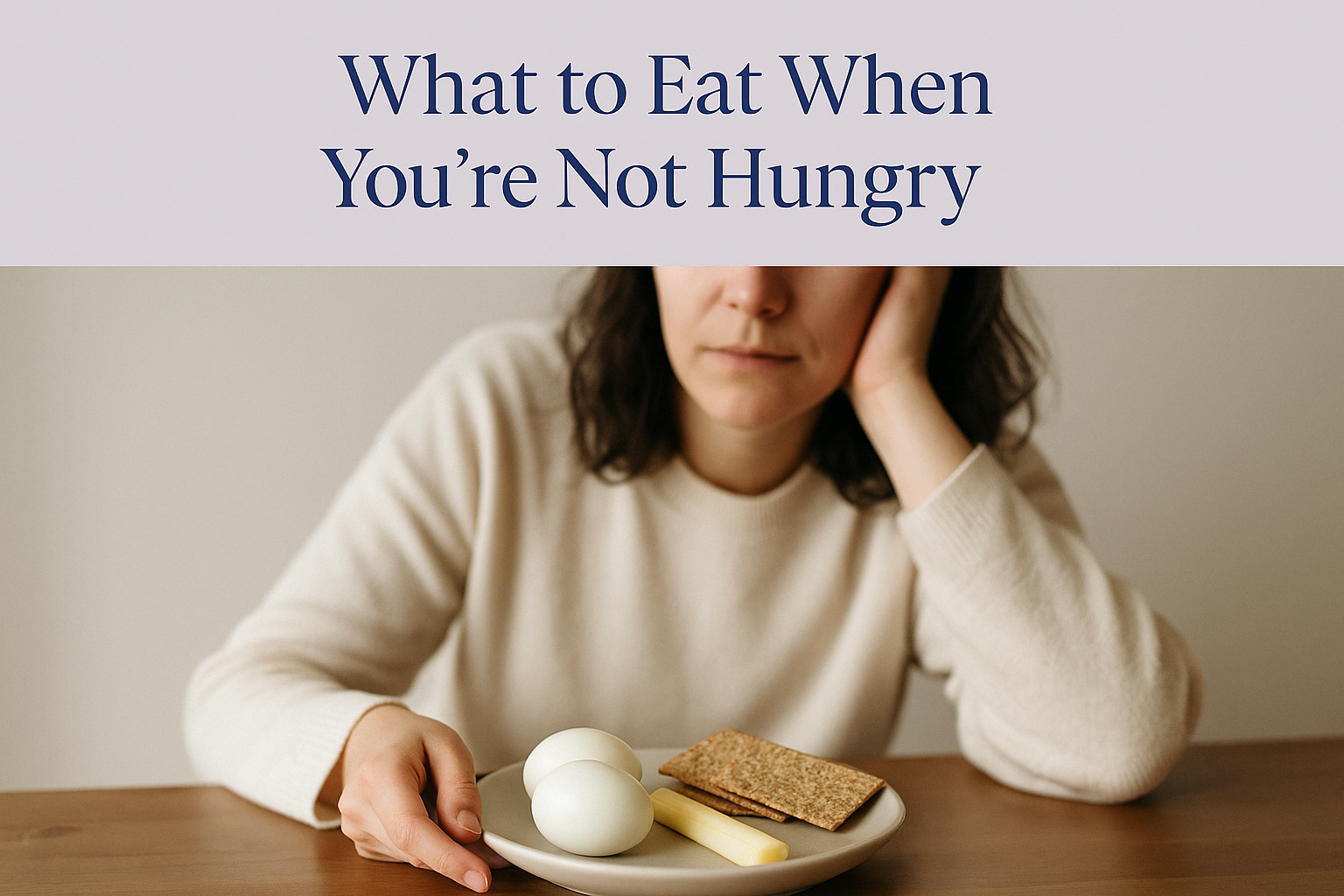
Greek yogurt with berries. Cottage cheese plain or with fruit. Hard-boiled eggs. Plain rotisserie chicken cubed and refrigerated. Beef jerky or turkey jerky. Edamame (steamed and salted, eaten cold or at room temperature). String cheese. Deli turkey or chicken. A protein shake made with whey or pea protein.
None of these are exciting. That is the point. They are easy to eat when nothing sounds appealing, they deliver real protein per bite, and most of them require no cooking, which matters when the smell of cooking is the first thing turning you off food.
The Daily Numbers to Hit
Even when appetite is suppressed, the daily targets do not change much. Patients who hit them stay out of the fatigue and hair-shedding spiral. Patients who let the numbers slide because they are not hungry tend to pay for it at week six.
For week two on a starter dose of semaglutide or tirzepatide, the floor I want patients hitting:
Protein at 60 to 80 grams per day during the first couple of weeks. This is a temporary floor for the early weeks while nausea is loudest, not a long-term target. Once tolerance improves, push toward 1.2 to 1.6 grams of protein per kilogram of body weight per day, which for most patients in active GLP-1 weight loss lands in the 90 to 140 gram range.
Water at 2 to 3 liters per day. Spread it across the day. Sip rather than gulp, especially around meals. Drinking large volumes with food makes nausea worse.
Sodium at 2,000 to 3,000 mg per day. Most patients lose sodium aggressively during rapid weight loss and feel better adding it back. An electrolyte packet (LMNT, Pedialyte, Liquid IV) once or twice a day is the easiest way to hit this without paying attention to it. Patients with hypertension, heart failure, or kidney disease should clear an electrolyte plan with their prescriber rather than assuming the 2,000 to 3,000 mg target applies to them.
One piece of fruit per day, mostly for the vitamins and the fiber, not the calories. A handful of berries, a clementine, half a banana.
A serving of fiber from vegetables, beans, or whole grains. Constipation is a common GLP-1 side effect and fiber helps prevent it before it starts.
The Thing Nobody Mentions
Most GLP-1 advice stops at the food and water targets. There is one more piece that matters as much for your one-year outcome and that almost no one talks about at week two.
Start lifting weights twice a week.
The reason has nothing to do with looking strong and everything to do with what GLP-1 weight loss does to body composition. The medication reduces appetite, you eat less, and you lose weight. The weight you lose is a mix of fat and muscle. The fat loss is the goal. The muscle loss is the cost.
Muscle does two things you care about. It supports your metabolism (more muscle means a higher resting metabolic rate, which means you regain less when you eventually stop the medication or plateau), and it supports the structural framework of your body (posture, joint health, the way clothes fit, the way the face and body look as the weight comes off).
Patients who lift weights twice a week during GLP-1 therapy preserve substantially more muscle than patients who do not. The protocol does not need to be elaborate. Two sessions a week, 30 to 45 minutes each, focused on compound lifts (squats, deadlifts, presses, rows, or their machine equivalents at a gym). Bodyweight movements (push-ups, lunges, planks, step-ups) and light dumbbell work also count when they are progressive (the load goes up over time).
The muscle you build (or preserve) during the active loss phase pays dividends for the next 6 to 12 months and beyond. The cost is two hours a week.
A Realistic Day at Week Two
What this looks like in practice:
Morning: Greek yogurt with berries (20 g protein) and an electrolyte packet (LMNT or similar) mixed in 16 oz of water.
Late morning: Two hard-boiled eggs (12 g protein) and a clementine.
Midday: A turkey and cheese roll-up (deli turkey, string cheese) and another 16 oz of water.
Afternoon: A protein shake made with whey or pea protein in unsweetened almond milk (20 g protein).
Evening: Cold rotisserie chicken cubed over plain edamame and cucumber (25 g protein).
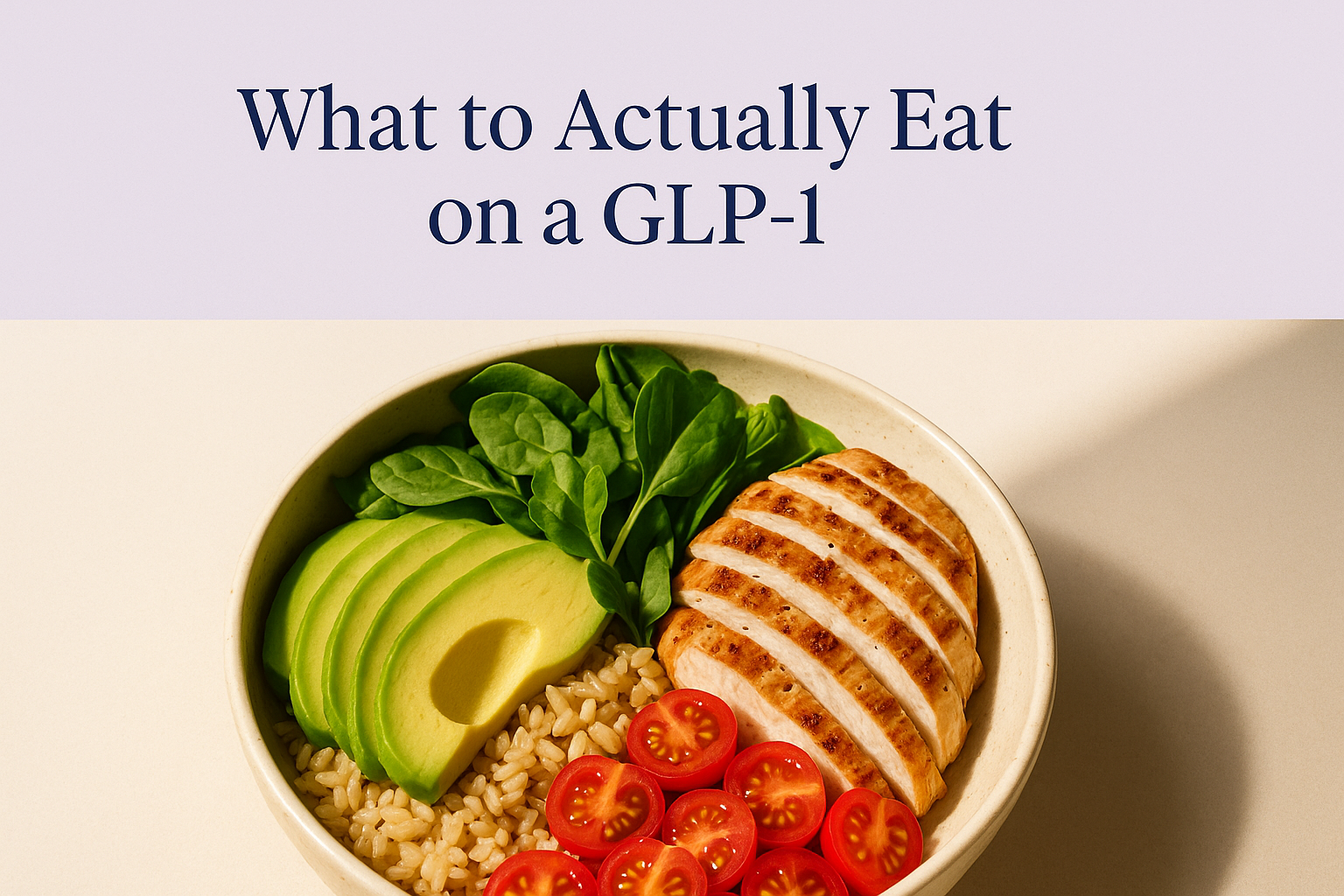
Total protein: roughly 80 grams. Water: 60 to 80 ounces depending on top-ups. Sodium: handled by the electrolyte packet plus the deli turkey and cheese. No cooking required. Most of it can be assembled in 30 seconds from the fridge.
This is not glamorous and not a diet plan I would publish in a wellness magazine. It is what works when nothing sounds appealing and you still have to feed your body protein.
When to Worry
A few patterns are not "low appetite" and need different attention.
If you cannot keep water down for more than 12 hours, that is dehydration and needs urgent evaluation.
If you have severe abdominal pain that wakes you up at night or is worsening over hours, that is a workup, not a meal plan. Our piece on serious GI symptoms covers what to look for.
If you have lost more than 10 pounds in two weeks at week two, you are losing faster than your body can buffer. The conversation is about slowing the pace, not pushing through. Our piece on food noise returning covers the biology.
If your daily intake is dropping below 1,000 to 1,200 calories because you genuinely cannot get food down, that is a conversation with your prescriber, not something to push through. Sustained intake that low slows weight loss, accelerates muscle loss, and sets up a regain trap when the medication eventually comes off.
For the broader picture of what to eat across the first months on a GLP-1, see our meals piece. For the vitamins and supplements floor, see the vitamins article.
Bottom Line
When the appetite is gone, eat cold and bland. Greek yogurt, cottage cheese, hard-boiled eggs, plain chicken, jerky, string cheese, deli turkey, a protein shake. Hit the daily floor: 60 to 80 grams of protein, 2 to 3 liters of water, 2,000 to 3,000 mg sodium, one piece of fruit, some fiber. Start lifting weights twice a week. The muscle you preserve now is the metabolism you have next year. The medication does the appetite work. The plate and the gym do the rest.
Important Information
Compounded medications are prepared by accredited US compounding pharmacies under a licensed prescriber and are not FDA-approved drug products in the way that brand-name medications such as Wegovy, Ozempic, Mounjaro, and Zepbound are. Specific nutritional needs are individual. Patients with diabetes, kidney disease, eating disorder history, or other complex conditions should discuss meal planning with a qualified clinician or registered dietitian. GLP-1 medications carry possible side effects including nausea, constipation, gallbladder issues, pancreatitis risk, and temporary hair shedding. GLP-1 therapy requires evaluation and prescription by a licensed clinician. This article is educational and is not medical advice.
Sources
- STEP-1: Wilding JPH, et al. Once-weekly semaglutide in adults with overweight or obesity. N Engl J Med. 2021;384(11):989-1002.
- SURMOUNT-1: Jastreboff AM, et al. Tirzepatide once weekly for the treatment of obesity. N Engl J Med. 2022;387(3):205-216.
- Cava E, et al. Preserving healthy muscle during weight loss. Adv Nutr. 2017;8(3):511-519.
- Phillips SM, et al. Protein requirements beyond the RDA. Appl Physiol Nutr Metab. 2016;41(5):565-572.
- Drucker DJ. Mechanisms of action of GLP-1. Cell Metab. 2018;27(4):740-756.