
A meaningful share of GLP-1 patients in the United States are paying out of pocket. Insurance coverage for weight management is uneven, eligibility for the manufacturer cash-pay programs is restrictive, and the price difference between brand-name and compounded medications is large enough that most patients are doing some version of this math at their kitchen table.
GLP-1 Skin + WeightMay 18, 2026 · 12 min read
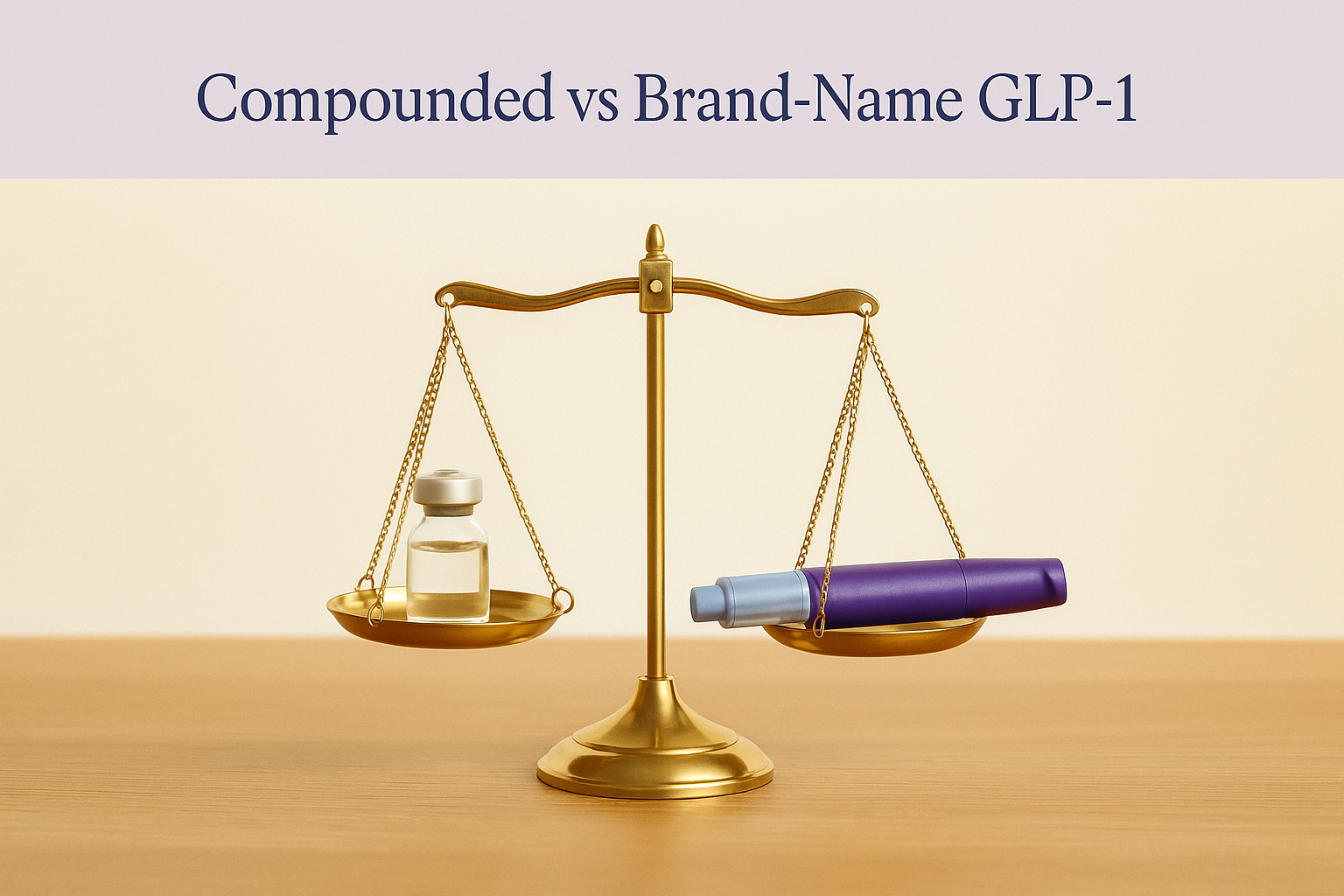
Compounded vs Brand-Name GLP-1: Real Pricing for 2026 and What to Ask Before You Sign Up

Dr. Brandon Kirsch, MD, FAAD
Chief Medical Officer
I want to give you a clean version of the numbers as of May 2026, with the trade-offs framed plainly. This is what I tell my own patients when they ask.
The Brand-Name Pricing
The two GLP-1 medications approved for chronic weight management are semaglutide (sold as Wegovy by Novo Nordisk) and tirzepatide (sold as Zepbound by Eli Lilly). At retail in May 2026, Wegovy is around $1,349 per month and Zepbound is around $1,086 per month, depending on the pharmacy and the specific dose. Each manufacturer runs a direct-to-consumer cash-pay pathway, and the two are structured differently enough that they need to be considered separately.
Lilly Direct. Lilly Direct sells Zepbound vials direct to self-pay patients at roughly $349 to $499 per month depending on dose. This is the lowest sticker price for a brand-name GLP-1 in 2026, and at the lower doses the gap with compounded products is narrow. If you want an FDA-approved product and you can absorb the cost, Lilly Direct should be the first thing on your comparison list.
NovoCare for Wegovy. Novo Nordisk's self-pay program lands higher than Lilly Direct, generally in the $650 to $1,000 range depending on the supply program in effect. The exact terms have moved over the last year; check the current NovoCare page before signing up.
The diabetes-labeled versions of the same drugs, Ozempic (semaglutide) and Mounjaro (tirzepatide), are not approved for obesity and do not have an analogous obesity self-pay program. If you do not have type 2 diabetes, the cash price for Ozempic or Mounjaro lands at $1,000 or more per month with limited workarounds.
The Compounded Pricing
Compounded versions of semaglutide and tirzepatide are prepared by 503A and 503B compounding pharmacies in the United States when the medications are prescribed by a licensed clinician for a specific patient. The compounded forms are not FDA-approved drug products in the way the brand-name versions are. They are prepared per prescription by accredited pharmacies that follow USP compounding standards.
The regulatory environment for compounded GLP-1s changed significantly in 2024 and 2025. The FDA removed tirzepatide from the shortage list in October 2024 and semaglutide in February 2025. After those decisions, the broad shortage justification for compounding semaglutide and tirzepatide closed. 503A pharmacies can still compound patient-specific GLP-1s when there is a documented clinical reason (an allergy to an inactive ingredient in the brand product, a need for a dose the brand pen does not offer, or another patient-specific factor), but the open-shortage rationale is no longer the path.
As of May 2026, the typical telehealth-program pricing for compounded medications looks like this:
Compounded semaglutide from a legitimate 503A pharmacy typically runs $150 to $350 per month, generally inclusive of the consult, the medication, and shipping. Compounded tirzepatide typically runs $300 to $400 per month under the same model. Variation within those ranges reflects differences in dose, additives (some programs include B12 or other adjuncts), and program structure (some are bundled, some charge separately for the consult).
There are programs running well below $150 per month for compounded sema. I would be cautious there. The pricing math gets difficult that far down without cutting corners somewhere, and the somewhere is usually either the consult quality, the pharmacy provenance, or the ongoing clinician access.
The Real Trade-Offs
The pricing gap between brand and compounded is large enough that some patients dismiss the compounded route as "obviously fake" and others dismiss the brand-name route as "obviously price-gouging." Both framings miss the point. Each route has real trade-offs, and which one is right for you depends on your specific situation.
Brand-name advantages. FDA-approved drug product. Manufactured to the same standards every time. Studied in the clinical trials that established the efficacy and safety profile. Dose increments and pen devices are standardized. Insurance, if you have coverage, will cover the brand product, not the compounded version.
Compounded advantages. Substantially lower cash price. Often includes the consult and ongoing clinician access in the program price. Some patients find the dose flexibility (compounded products can be prescribed at intermediate doses not available in the brand pens) useful for adjustments. Available through telehealth programs that handle intake, refills, and shipping in a single workflow.
Brand-name disadvantages. High cost, even with manufacturer programs. Limited availability of intermediate doses (you titrate between the pen sizes that exist). Insurance pre-authorizations can be lengthy and may be denied. Supply shortages have periodically affected availability.
Compounded disadvantages. Not FDA-approved as a drug product. Quality depends on the integrity of the specific compounding pharmacy. The regulatory environment can shift. Compounded versions are not the same as the studied product, and while the active pharmaceutical ingredient is the same molecule, the rest of the formulation (preservatives, additives, concentration) may differ. Compounded semaglutide and tirzepatide have not been studied in the head-to-head trials that established the brand products' efficacy and safety profiles. Treating them as clinically equivalent to the branded versions is an assumption, not an evidence-based conclusion.
Neither route is obviously right. The right route for you depends on your access to insurance coverage, your tolerance for paying retail, and your comfort with the regulatory and quality variability inherent in compounded products.
How to Tell a Legitimate Compounded Program From a Risky One
Compounded does not mean unregulated, but the quality floor varies more than it does with brand-name products, so it is worth knowing what a legitimate operation looks like.
Know the two pharmacy types. 503A pharmacies compound patient-specific prescriptions and are licensed by state boards of pharmacy. 503B outsourcing facilities register with the FDA and are held to stricter cGMP manufacturing standards and federal inspection. Either can be legitimate. A program that will not tell you which type of pharmacy fills its prescriptions, or where that pharmacy is located, is a red flag.
Look for US licensure and accreditation. The pharmacy should be licensed in the US and ideally accredited (for example, PCAB accreditation, plus a clean record with the relevant state board and the NABP). Be wary of anything shipped from overseas or sold without a verifiable pharmacy behind it.
A prescription and a licensed clinician are non-negotiable. Legitimate compounded GLP-1s are dispensed only after a licensed clinician evaluates you and writes a patient-specific prescription. Any site selling "semaglutide" or "research peptides" without a prescription, or shipping from a non-pharmacy source, is not a medical program. It is a risk to your health.
Treat a price that seems too good to be true as a warning. As noted above, compounded semaglutide much below roughly $150 a month is usually the point where something is being cut, whether that is the consult, the pharmacy provenance, or the ongoing clinician access.
Keep the core caveat in view. Compounded GLP-1s are not FDA-approved drug products. The active molecule is the same, but the formulation has not gone through the brand product's manufacturing and trial pipeline. A trustworthy program is upfront about that rather than implying the compounded version is identical to Wegovy or Zepbound.
What to Ask Before You Sign Up Anywhere
Whether you are choosing a brand-name pathway or a compounded telehealth program, three questions will tell you more than the price tag will.
Is the price the same at every dose? Some programs raise the price as the dose increases. Others hold the monthly price flat across the dose range. Flat pricing means the program is not financially incentivized to nudge you toward higher doses, which I think matters. Variable pricing is not necessarily a red flag, but it is worth knowing about up front.
Is the consult included? Some programs charge separately for the initial intake and the monthly follow-ups. Others bundle the consult into the monthly medication price. Bundled is usually simpler and easier to compare across programs. Separate-charge consults can add up if there are dose changes or side effect questions.
Can I pause anytime? A real medication management program lets patients pause therapy when life gets in the way (travel, illness, a planned surgery, a pregnancy attempt, or any other reason) without locking them into a contract or charging cancellation fees. Avoid programs that make pausing or canceling difficult.
Where Insurance Fits
If you have insurance, the math changes substantially. Some commercial plans now cover Wegovy and Zepbound for patients who meet specific BMI and comorbidity criteria, usually a BMI of 30 or higher, or 27 or higher with a weight-related condition. Medicare Part D coverage expanded in mid-2026 for tirzepatide for type 2 diabetes patients but remains complicated for obesity-only indications.
The pre-authorization process for brand-name GLP-1 coverage is usually lengthy and document-intensive. The clinician you work with needs to be set up to handle prior authorizations and appeals, which is a real workflow that not every telehealth platform supports well. If you have insurance and want to use it, ask the program up front whether they handle pre-auths.
For more on the broader decisions around starting therapy, see our five questions before starting a GLP-1 and the side effects spectrum article.
Bottom Line
Brand Wegovy retail is around $1,349 a month. Brand Zepbound retail is around $1,086 a month, with Lilly Direct vials at $349 to $499 per month for self-pay (the lowest brand sticker in 2026). NovoCare for Wegovy lands higher, $650 to $1,000. Compounded semaglutide is $150 to $350 per month from a legitimate 503A pharmacy. Compounded tirzepatide is $300 to $400. Well below $150 for sema is where I get cautious. The three questions worth asking any program are about flat pricing across doses, whether the consult is included, and whether you can pause anytime. The right route for you depends on your insurance situation and your comfort with the trade-offs between FDA-approved brand and compounded alternatives.
Important Information
Compounded medications are prepared by accredited US compounding pharmacies under a licensed prescriber and are not FDA-approved drug products in the way that brand-name medications such as Wegovy, Ozempic, Mounjaro, and Zepbound are. The FDA-determined drug shortages for semaglutide and tirzepatide resolved in 2025, and 503A pharmacies now compound patient-specific GLP-1s only when a documented clinical reason supports the decision. Compounded GLP-1 pricing, availability, and the regulatory environment can shift. The figures in this article reflect May 2026 market conditions and may not hold. GLP-1 medications carry possible side effects including nausea, constipation, gallbladder issues, pancreatitis risk, and temporary hair shedding. GLP-1 therapy requires evaluation and prescription by a licensed clinician. This article is educational and is not medical advice.
Sources
- US Food and Drug Administration labeling for semaglutide (Wegovy, Ozempic) and tirzepatide (Zepbound, Mounjaro).
- US Food and Drug Administration. Compounding and the FDA: Questions and answers. FDA guidance documents.
- Novo Nordisk NovoCare program documentation.
- Eli Lilly LillyDirect program documentation.
- US Pharmacopeia (USP) chapters 795 and 797 (sterile compounding standards).
- STEP-1: Wilding JPH, et al. Once-weekly semaglutide in adults with overweight or obesity. N Engl J Med. 2021;384(11):989-1002.
- SURMOUNT-1: Jastreboff AM, et al. Tirzepatide once weekly for the treatment of obesity. N Engl J Med. 2022;387(3):205-216.
Related Articles

→
GLP-1 Skin + Weight
Five Questions to Ask Before Starting a GLP-1, Especially If You Have Psoriasis or HS
May 18, 2026 · 11 min read

→
GLP-1 Skin + Weight
The Side of Weight Loss Nobody Warns You About: Your Dermatologist Should
May 18, 2026 · 11 min read

→
GLP-1 Skin + Weight
What to Actually Eat on a GLP-1
May 18, 2026 · 11 min read