AI-generated illustration. Not an actual patient or treatment result.
Guttate vs Plaque Psoriasis: How to Tell the Difference and When to Treat Online vs in Clinic

Chief Medical Officer
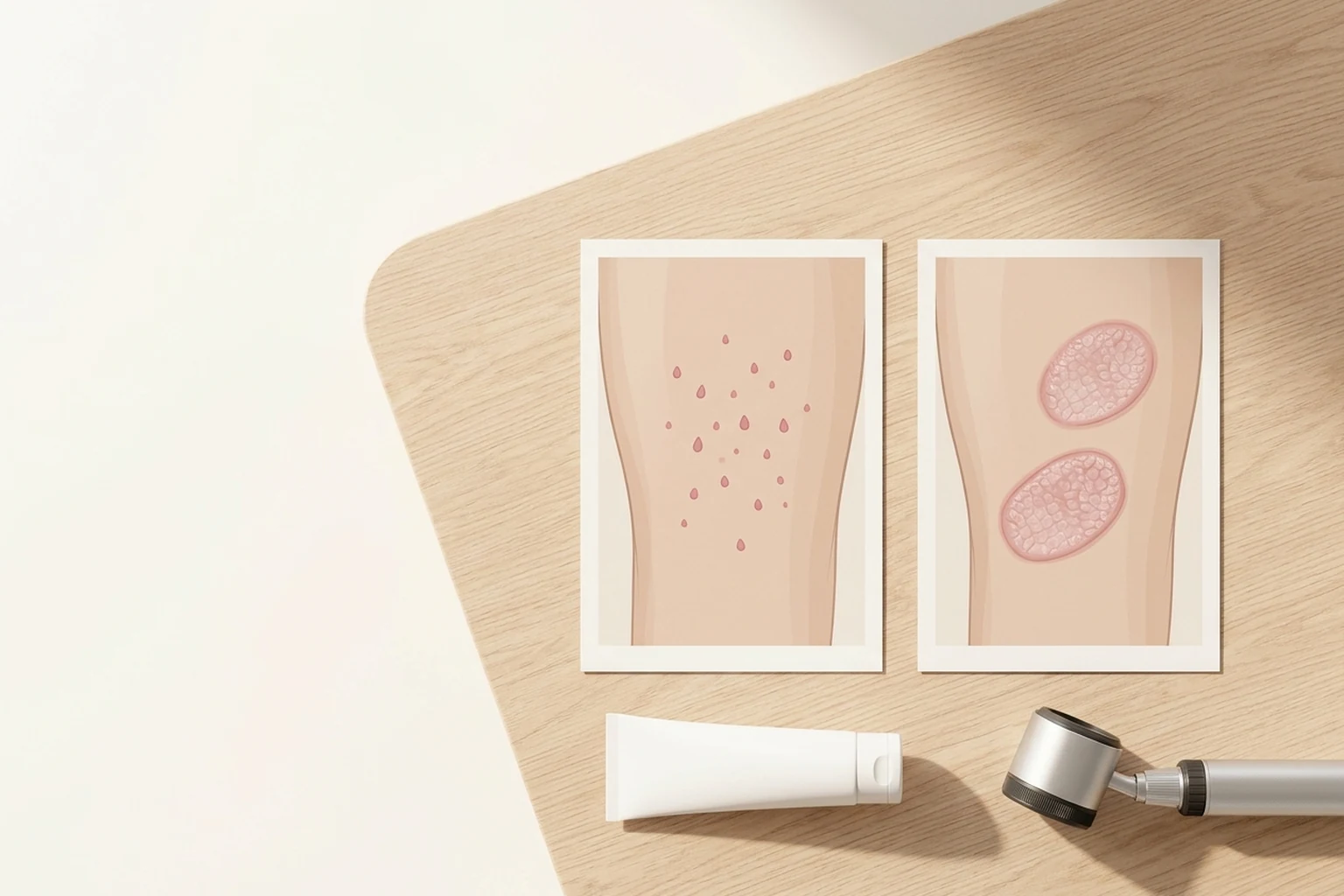
Guttate psoriasis shows up fast as dozens of small, drop-like scaly spots (often weeks after strep throat), whereas plaque psoriasis builds slowly into thicker, larger patches on elbows, knees, and scalp. Telling them apart matters right away, because a brand-new sudden guttate eruption usually deserves an in-person exam and throat check, while established mild-to-moderate plaque psoriasis can be managed cleanly online.
In this article
How do you tell guttate psoriasis from plaque psoriasis?
Both conditions share the same underlying psoriasis immune pathway, and some people experience both at different times in life. Look closely at spot size, onset speed, and recent infections:
| Feature | Guttate psoriasis | Chronic plaque psoriasis |
|---|---|---|
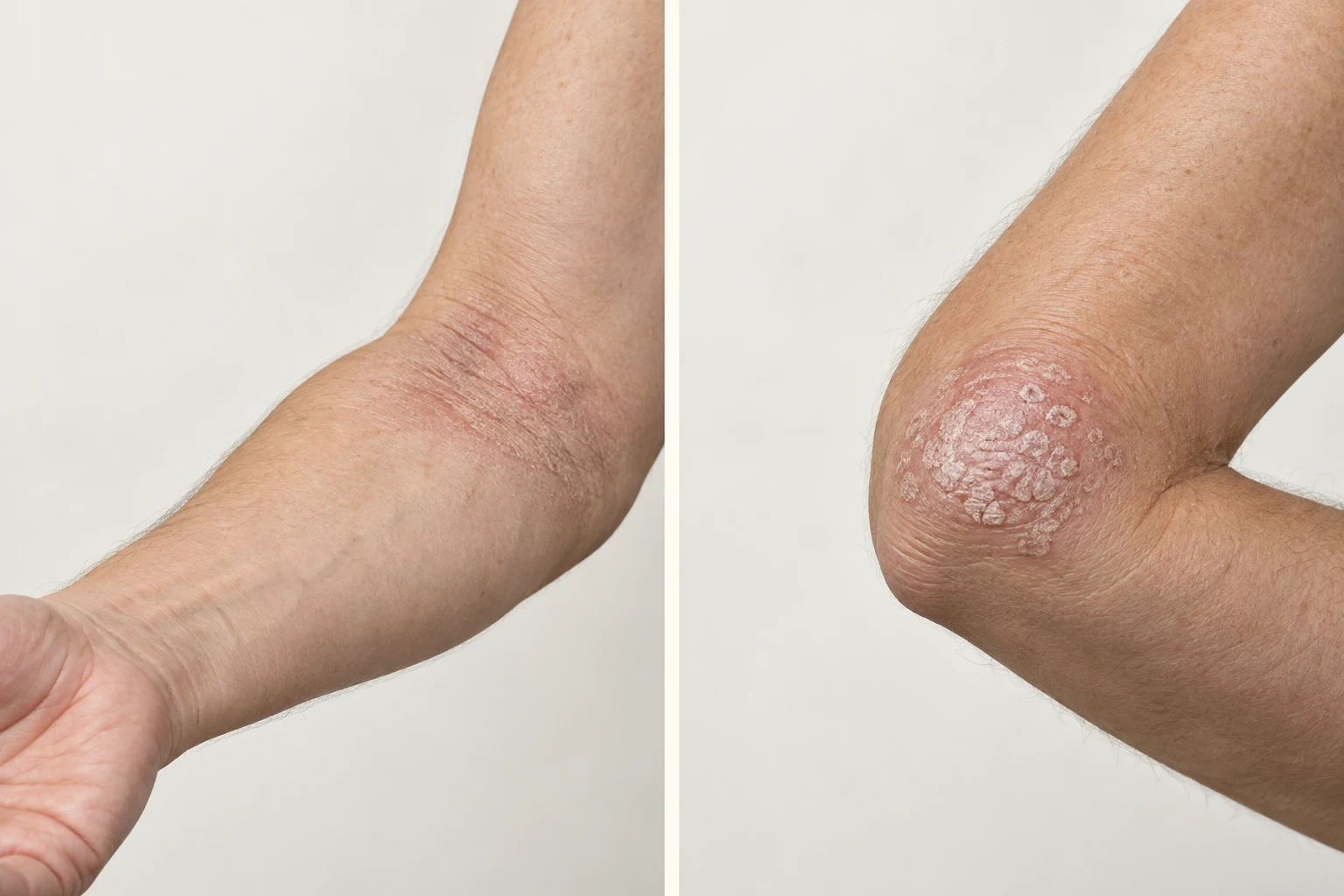
| Appearance | Many small, scattered drop-like pink or red scaly papules across trunk, arms, and thighs | Larger, raised, sharply edged plaques topped with thicker silvery-white scale |
| Typical onset | Sudden eruption over days, often 1 to 3 weeks after strep throat or tonsillitis | Gradual onset and chronic waxing-and-waning course |
| Most common age | Children, teenagers, and young adults (mean age 30.1 years in one 395-patient cohort) | Any age; most common in adults |
| Common body sites | Chest, back, abdomen, upper arms, and thighs | Elbows, knees, scalp, lower back, skin folds, and nails |
| Look-alike rashes to rule out | Pityriasis rosea, viral exanthems, drug eruptions, and secondary syphilis (especially if palms or soles are involved) | Nummular eczema, fungal ringworm (tinea), and seborrheic dermatitis |
If your patches are itchy, oozing, or sit inside elbow and knee creases instead of outside them, read our eczema vs psoriasis guide to compare the two.
Does guttate psoriasis go away on its own, or turn into plaque psoriasis?
Many first episodes clear within 3 to 4 months, yet a meaningful minority return or transition into chronic plaque psoriasis. A 2024 systematic review noted that up to 39% of guttate psoriasis cases progress to chronic plaque psoriasis (Zhou 2024).
Long-term follow-up shows why staying alert matters. In a 2026 retrospective cohort study of 395 patients followed an average of 83 months (nearly 7 years) after their first guttate flare:
- 65.1% (257 of 395) had no recorded recurrence during follow-up.
- 34.9% (138 of 395) had at least one recurrence, and 14.7% (58 of 395) had multiple recurrences.
- 5.6% developed psoriatic arthritis and 8.6% developed metabolic syndrome over time (Kassem 2026).
Do antibiotics clear guttate psoriasis after strep throat?
No, antibiotics treat an active streptococcal throat infection, not the psoriasis spots themselves. Streptococcal pharyngitis precedes guttate flares frequently, noted in about two-thirds of patients in clinical background literature (Nahary 2008). Once the immune cascade has already triggered skin spots, taking antibiotics has not been shown to clear the rash faster.
In a 2019 Cochrane systematic review of 5 randomized trials (162 participants total: 3 trials with 83 guttate psoriasis patients using oral or intramuscular antibiotics, plus 2 trials with 79 chronic plaque psoriasis patients testing oral azithromycin or tonsillectomy), reviewers rated the evidence as very low quality and concluded they were uncertain whether antistreptococcal therapy improves guttate or plaque psoriasis (Dupire 2019). In a controlled trial of 43 young men (ages 19 to 23) with recent strep-associated guttate psoriasis randomized to 14 days of oral penicillin, erythromycin, or no antibiotics, neither antibiotic cleared the rash better than no antibiotics (Dogan 2008). My rule in clinic: swab the throat if you currently have a sore throat, fever, or swollen tonsils and treat an active strep infection properly, yet don't take antibiotics solely hoping to erase skin spots.
What treatments work best for guttate vs plaque psoriasis?
High-quality randomized trials specifically for acute guttate psoriasis remain scarce; a 2019 Cochrane review of non-antistreptococcal treatments found only one tiny 21-patient hospital trial (Maruani 2019). Reviewing 75 published studies (mostly case reports and series, with only 5 randomized trials), a 2024 systematic review found narrowband UVB phototherapy had the most consistent evidence for widespread guttate psoriasis, and recommended topical corticosteroids plus vitamin D analogs (calcipotriol) and phototherapy as first-line care (Zhou 2024). Phototherapy makes practical sense when you have 100 tiny spots scattered across your back where dabbing cream onto each dot is exhausting.
Chronic plaque psoriasis, by contrast, has robust trial data for targeted prescription creams and foams, including calcipotriene plus betamethasone foam (53.3% vs 4.8% clear or almost clear at 4 weeks) (Enstilar label), steroid-free roflumilast 0.3% cream (41.5% vs 5.8% and 36.7% vs 7.1% at 8 weeks) (Zoryve cream label), tapinarof 1% cream (36% vs 6% and 40% vs 6% at 12 weeks) (Vtama label), and systemic pills or biologics for widespread disease. Read our prescription psoriasis cream comparison for the full breakdown.
When can you treat psoriasis online vs when do you need an in-person clinic?
Online dermatology fits best once your diagnosis is clear and plaques are localized or mild to moderate (including chronic plaque psoriasis, scalp plaques, or stubborn localized patches lingering after a guttate flare has calmed). Through the KindleeRx Psoriasis Regimen, licensed clinicians (physician assistants and nurse practitioners working under a board-certified dermatologist's protocols) review your photos and history and reply in under 5 hours on average.
If treatment is appropriate, your clinician selects two prescriptions from 11 listed compounded and prescription formulas (6 containing a steroid, 5 steroid-free), including thick-plaque rescue ointments, steroid-free Calming Daily Cream (roflumilast 0.2% and calamine 5%), scalp solutions, and oral roflumilast 500 mcg tablets (off-label for psoriasis) for broader skin involvement. Automatic refills are $149 for the first 90-day order, then $149 every 90 days before coupons (including the $20 consultation fee, free shipping, and 90 days of unlimited clinician messaging); a one-time purchase is $181.25 before coupons. If your photos look like an acute rash that belongs in an exam room first, a KindleeRx clinician will tell you plainly and refund your order in full, including the consultation fee.
Important Information
KindleeRx offers compounded prescription medications prepared by licensed United States compounding pharmacies under a licensed prescriber's order. Compounded medications aren't approved by the Food and Drug Administration (FDA) and aren't reviewed by the FDA for safety, effectiveness, or quality (FDA compounding guidance). KindleeRx's Calming Daily Cream (roflumilast 0.2% and calamine 5%) isn't Zoryve, isn't a generic of Zoryve (no FDA-approved generic of Zoryve exists), and KindleeRx isn't affiliated with Arcutis Biotherapeutics, Organon, LEO Pharma, or AstraZeneca. Published clinical trial data for branded products (Enstilar, Zoryve, Vtama) reflect those branded products and studied strengths only, not KindleeRx's compounded formulations. Oral roflumilast is FDA-approved for severe chronic obstructive pulmonary disease (Daliresp label); its use in psoriasis is off-label, contraindicated in moderate or severe liver impairment, and carries FDA warnings for psychiatric events (including depression or suicidal thoughts), weight loss, and drug interactions. Eligibility is determined by a licensed clinician after reviewing your health history and photos. Not all patients qualify. Individual results vary. This article is educational and isn't medical advice.
Sources
- Zhou T, et al. Management of Guttate Psoriasis: A Systematic Review. Journal of Cutaneous Medicine and Surgery 2024.
- Kassem R, et al. From Onset to Outcome: A Long-Term Retrospective Single-Centre Study of Guttate Psoriasis. Acta Dermato-Venereologica 2026.
- Dupire G, et al. Antistreptococcal Interventions for Guttate and Chronic Plaque Psoriasis. Cochrane Database of Systematic Reviews 2019.
- Maruani A, et al. Non-Antistreptococcal Interventions for Acute Guttate Psoriasis or an Acute Guttate Flare of Chronic Psoriasis. Cochrane Database of Systematic Reviews 2019.
- Dogan B, et al. Antistreptococcal Treatment of Guttate Psoriasis: A Controlled Study. International Journal of Dermatology 2008.
- Nahary L, et al. An Investigation of Antistreptococcal Antibody Responses in Guttate Psoriasis. Archives of Dermatological Research 2008.
- LEO Pharma. Enstilar (calcipotriene and betamethasone dipropionate) Foam Prescribing Information, revised April 2022. DailyMed.
- Arcutis Biotherapeutics. ZORYVE (roflumilast) Cream Prescribing Information, revised June 2026. DailyMed.
- Organon. VTAMA (tapinarof) Cream Prescribing Information, revised May 2025. DailyMed.
- AstraZeneca. DALIRESP (roflumilast) Tablets Prescribing Information, revised March 2020. DailyMed.
- Food and Drug Administration. Understanding the Risks of Compounded Drugs.