
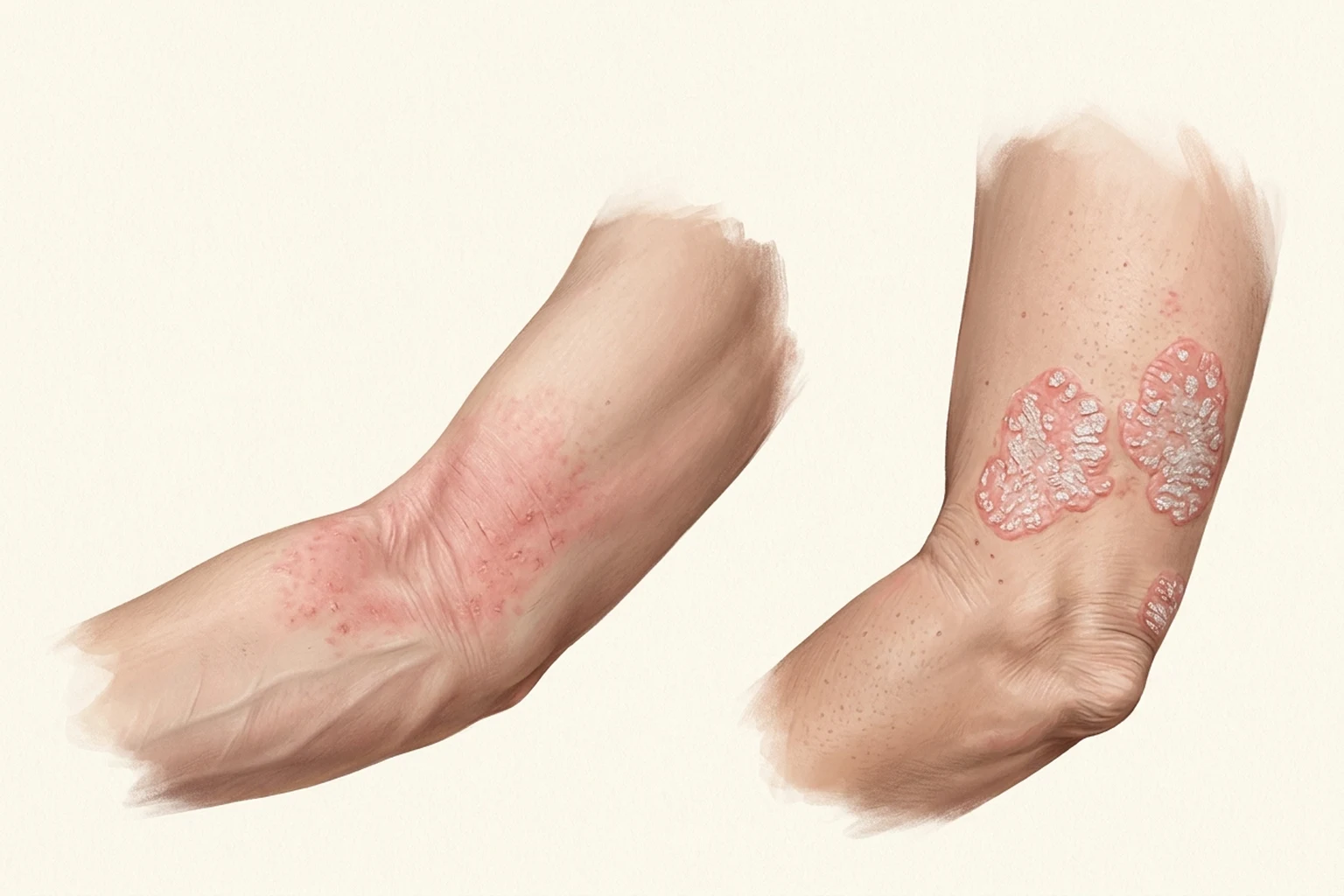
AI-generated illustration. Not an actual patient or treatment result.
The Biologic 'Flip-Flop': Why Dupixent Can Trigger Psoriasis and Psoriasis Biologics Can Trigger Eczema

Chief Medical Officer
Yes, targeted biologic injections can flip one chronic skin disease into its mirror image: Dupixent (dupilumab) can unmask psoriasis in eczema patients, and psoriasis biologics such as IL-17 or IL-23 inhibitors can provoke weeping, intensely itchy eczema in psoriasis patients (Torres 2026). Dermatologists call this two-way immune shift treatment-associated phenotype switching, or the biologic "flip-flop." Recognizing it keeps patients from blaming their injection for "failing" when the skin actually switched immune lanes.
In this article
What is the biologic 'flip-flop' between psoriasis and eczema?
Classic psoriasis is driven largely by type-17 immune signaling (IL-23 and IL-17), whereas atopic dermatitis is driven largely by type-2 immune signaling (IL-4 and IL-13). Those two pathways naturally keep one another in check inside healthy skin (D'Agostino 2026).
When a targeted antibody shuts down one lane completely, a subset of genetically predisposed patients sees the opposite immune lane surge upward:
- Eczema to psoriasis (Dupixent flip): Blocking IL-4 and IL-13 quiets weeping eczema while removing a natural brake on IL-17 and IL-23, producing sharply edged scaly plaques on elbows, scalp, or palms and soles. Dupixent's Food and Drug Administration (FDA) label lists postmarketing new-onset psoriasis (Dupixent label).
- Psoriasis to eczema (IL-17, IL-23, or tumor necrosis factor [TNF]-alpha flip): Blocking type-17 or TNF-alpha signals clears thick silver plaques while letting type-2 itch pathways flare, often in patients who carried quiet childhood allergies or dry sensitive skin (Li 2023).
How long after starting Dupixent or a psoriasis biologic does a switch appear?
Flip-flop rashes rarely happen after the first shot. Instead, they creep in 5 to 6 months into otherwise successful therapy, which is why patients assume they developed a completely unrelated rash:
- Dupilumab-associated psoriasis: In a systematic review of 42 cases, mean latency was 22.65 weeks (roughly 5 months), with almost all cases representing new-onset plaques (Li 2023).
- Biologic-associated eczema in psoriasis patients: Across 51 reviewed cases, mean latency was 24.47 weeks (roughly 6 months), and 48.98% (24 of 49) reported a personal history of atopy (such as asthma, seasonal allergies, or childhood eczema) (Li 2023).
- Late switches still occur: In a broader review of 2,049 paradoxical reactions across 313 articles, onset spanned weeks to months and occasionally emerged more than a full year after starting therapy (Murphy 2022).
Which biologics trigger paradoxical eczema or psoriasis most often?
Historical case totals reflect both biologic mechanism and how long each drug class has been on the market:
| Biologic class | Typical direction of switch | Published cohort signal | Common dermatologist adjustment |
|---|---|---|---|
| TNF-alpha blockers (adalimumab, infliximab, etanercept) | Paradoxical plaque or palmoplantar pustular psoriasis, or eczematous rashes | Accounted for 91.2% (1,869 of 2,049) of historical paradoxical reports (Murphy 2022) | Add targeted topicals for mild flares; switch out of TNF-alpha class if widespread or pustular |
| IL-17 inhibitors (IL-17A blockers secukinumab and ixekizumab, plus brodalumab and bimekizumab) | Psoriasis flipping into itchy eczema (flexural, hand, or generalized) | IL-17A blockers drove 72.55% of reviewed psoriasis-to-eczema switches (Li 2023); estimated incidence of paradoxical eczema across psoriasis biologics is roughly 1% to 3% (Lugli 2026) | Topical steroids or non-steroids first; switch to an IL-23 inhibitor or oral JAK inhibitor if persistent (D'Agostino 2026; Lugli 2026) |
| IL-23 inhibitors (risankizumab, guselkumab, tildrakizumab) | Less frequent psoriasis-to-eczema switch | Historically lowest share (0.01% in earlier review), though increasingly recognized as IL-23 use grows (Murphy 2022; Torres 2026) | Topical therapy or pivot to a JAK inhibitor if severe |
| Type-2 blockers (predominantly Dupixent [IL-4/IL-13]) | Eczema flipping into plaque or palmoplantar psoriasis | 31.8% (47 of 148) of multinational switch cohort, predominantly dupilumab (Torres 2026) | Roughly half manageable without discontinuing dupilumab; severe cases switch to a JAK inhibitor (D'Agostino 2026) |
Do you have to stop your biologic when a flip-flop rash starts?
Not always, and stopping an injection abruptly without a plan often triggers a fierce return of your original disease. Management follows a clear ladder:
- Confirm the new rash first: Your dermatologist checks whether the flare is truly a phenotype switch rather than allergic contact dermatitis, fungal tinea, or a drug reaction. A quick skin biopsy may show mixed psoriasis-and-eczema features on the same slide (D'Agostino 2026).
- Treat localized flips topically while keeping the biologic: In the 2026 Italian two-center series, about half of dupilumab-induced psoriasis cases were manageable without discontinuing Dupixent (D'Agostino 2026). When localized plaques or patches appear alongside a stable biologic, dermatologists often add targeted topical steroids or steroid-free phosphodiesterase-4 creams under supervision.
- Pivot systemically when the flip is widespread: When a switch spreads broadly or resists topicals, dermatologists commonly stop the culprit biologic and move to a broader downstream option such as an oral JAK inhibitor (which modulates shared pathways across both diseases) or switch from an IL-17 blocker to an IL-23 blocker (Torres 2026; D'Agostino 2026).
When do you need an in-person dermatologist versus online topical support?
KindleeRx does not prescribe injectable biologics (Dupixent, IL-17, IL-23, or TNF-alpha blockers) or oral JAK inhibitors. Any patient developing a new spreading rash while on a biologic should coordinate directly with the prescribing dermatologist so they can rule out look-alike rashes and decide whether to stay on, adjust, or switch the systemic medication.
For eligible adults with confirmed mild-to-moderate psoriasis or eczema who are not on complex biologics (or who want convenient self-pay topical options such as steroid-free roflumilast-calamine cream for localized plaques or patches), licensed clinicians (physician assistants and nurse practitioners working under a board-certified dermatologist's protocols) review your complete medication list and photos online and reply in under 5 hours on average. When clinically appropriate, a licensed clinician selects two prescriptions per 90-day plan (steroid-free options are available): the KindleeRx Psoriasis Regimen costs $149 on the first automatic-refill order, then $149 every 90 days before coupons (including the $20 consultation fee, free shipping, and 90 days of clinician messaging), or $181.25 one-time before coupons, and the KindleeRx Eczema Regimen costs $149 on the first automatic-refill order, then $149 every 90 days before coupons (including the $20 consultation fee, free shipping, and 90 days of clinician messaging), or $181.25 one-time before coupons. For a single standalone steroid-free cream useful on mild-to-moderate eczema or psoriasis, compounded Calming Cream (roflumilast 0.2% with calamine 5%, 80 g) costs $70 on the first 90-day automatic-refill order, then $70 every 90 days before coupons (including the $20 consultation fee, free shipping, and 90 days of clinician messaging), or $80 one-time before coupons. Available in 44 states plus Washington, D.C. (excluding Arkansas, Kansas, Maryland, Mississippi, Nebraska, and West Virginia), with a full refund including the consultation fee if treatment is not prescribed. Learn how both conditions compare in eczema versus psoriasis and Zoryve vs Dupixent for eczema.
Important Information
KindleeRx offers compounded topical prescription medications (including Calming Cream, roflumilast 0.2% with calamine 5%) prepared by licensed United States compounding pharmacies alongside standard generic prescriptions when clinically appropriate. Calming Cream is not Zoryve, not a generic of Zoryve, and not approved by the Food and Drug Administration (FDA). Compounded medications are not approved by the FDA and are not reviewed by the FDA for safety, effectiveness, or quality (FDA compounding guidance). KindleeRx does not prescribe Dupixent, IL-17 inhibitors, IL-23 inhibitors, TNF-alpha blockers, or oral JAK inhibitors, and is not affiliated with Regeneron Pharmaceuticals, Sanofi (Dupixent), Arcutis Biotherapeutics (Zoryve), or any medication manufacturer mentioned in this article. Eligibility is determined by a licensed clinician after reviewing your medical history, medications, and photos. Not all patients qualify. Individual results vary. This article is educational and is not medical advice.
Sources
- Torres T, Valenti M, Balato A, Megna M, et al. Treatment-Associated Phenotype Switching Between Psoriasis and Atopic Dermatitis. Journal of the European Academy of Dermatology and Venereology 2026.
- D'Agostino M, Falco GM, De Luca E, De Simone C, et al. The Psoriasis-Eczema Interface: Clinical Classification and Therapeutic Implications From a Bicentric Experience. International Journal of Dermatology 2026.
- Li Y, Liu H, Zhang F. Biologics-Induced Immunophenotypic Cross-Switching in Patients With Psoriasis and Atopic Dermatitis. Indian Journal of Dermatology 2023.
- Lugli AP, Gori N, Ippoliti E, Ambrosio B, Peris K. Upadacitinib as a Potential Option for the Management of Paradoxical Eczema Induced by Interleukin-23 Inhibitors. Dermatology Reports 2026.
- Murphy MJ, Cohen JM, Vesely MD, Damsky W. Paradoxical Eruptions to Targeted Therapies in Dermatology: A Systematic Review and Analysis. Journal of the American Academy of Dermatology 2022.
- Regeneron Pharmaceuticals and Sanofi. DUPIXENT (dupilumab) Injection Prescribing Information, revised April 2026. DailyMed.
- Food and Drug Administration. Understanding the Risks of Compounded Drugs.
Related Articles
Eczema
Eczema vs. Psoriasis: The 5-Minute Guide to Getting the Right Diagnosis
Feb 15, 2026 · 13 min read
Eczema
Zoryve vs Dupixent for Eczema: Cream vs Biologic Injection Compared
Nov 24, 2026 · 12 min read

Psoriasis
Can You Treat Psoriasis Online Without Insurance? Self-Pay Costs and Options
Nov 22, 2026 · 10 min read