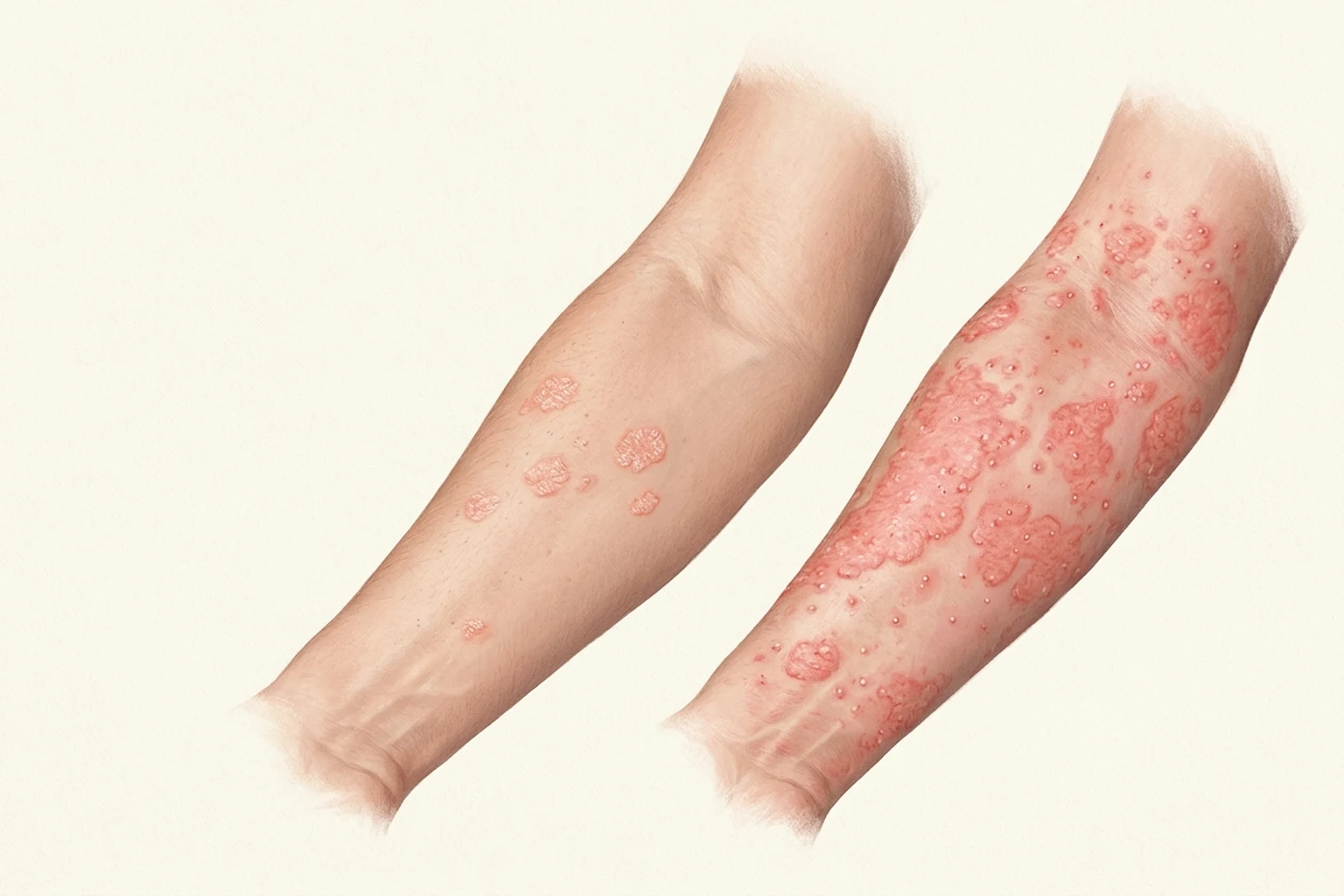
AI-generated illustration. Not an actual patient or treatment result.
Psoriasis Relapse vs Rebound: What Happens After Stopping Oral Steroids or Treatments

Chief Medical Officer
Psoriasis relapse is the gradual return of your usual plaques after stopping a treatment, whereas psoriasis rebound is a rapid surge worse than where you started (at least 125% of baseline severity) or a sudden shift into body-wide redness or pus-filled blisters (Carey 2006). Knowing the difference prevents two common mistakes: panicking when plaques slowly creep back weeks after pausing a cream, or taking urgent-care prednisone without realizing how systemic steroid withdrawal can destabilize skin.
In this article
What is the exact difference between psoriasis relapse and psoriasis rebound?
Dermatologists rely on standardized NPF definitions published by Carey and colleagues so patients and clinicians use the same yardstick (Carey 2006):
| Feature | Psoriasis relapse | Psoriasis rebound |
|---|---|---|
| NPF clinical definition | Loss of 50% of peak PASI improvement achieved during therapy among prior responders (Carey 2006) | PASI of 125% or higher compared with pretreatment baseline, or a shift into pustular, erythrodermic, or sharply inflamed disease (Carey 2006) |
| Typical timeline | Gradual over weeks to months after stopping a cream, light course, pill, or biologic | Rapid onset within 3 months (often days to weeks) of stopping or tapering therapy |
| How the skin looks | Familiar plaques slowly reappearing in your usual spots (elbows, knees, scalp) | Wider, redder, more painful plaques, confluent body-wide redness (erythroderma), or sterile pustules |
| Clinical urgency | Routine dermatology step-up or maintenance restart | Prompt dermatology visit; urgent care or emergency evaluation if fever, chills, or pustules appear |
Gradual relapse after stopping an effective medication is expected biology in a chronic immune-driven condition rather than proof that a treatment "backfired." True rebound is far more aggressive and classically follows abrupt withdrawal of systemic corticosteroids, cyclosporine, or widespread super-potent topical steroids.
How often do oral steroids actually trigger severe psoriasis rebound?
Medical textbooks have warned against oral prednisone and steroid injections in psoriasis for decades due to catastrophic cases of generalized pustular psoriasis and erythroderma. Modern real-world cohort evidence puts that real danger in clearer statistical perspective.
In a landmark retrospective study across the Marshfield Clinic Health System examining 1,970 adults with established psoriasis who received systemic corticosteroids (excluding psoriatic arthritis and topical, intra-articular, or intrabursal injections), researchers measured every documented psoriasis flare occurring during or within 3 months of finishing a first systemic steroid course (Gregoire 2021). The overall flare rate was 1.42%, with 1 severe erythrodermic flare (0.07%) and zero generalized pustular flares.
Two clinical conclusions follow from that study:
- Avoid routine standalone oral steroid bursts for psoriasis: Taking an unsupervised prednisone pack for routine plaques offers brief relief while risking rebound once the burst stops; dermatologists generally rely on targeted topicals, light therapy, non-steroid oral agents, or biologics, and reserve any short supervised steroid course strictly for carefully selected severe flares paired with ongoing topical maintenance.
- Do not panic if you truly needed steroids for another condition: If an emergency clinician prescribes prednisone for severe asthma, poison ivy, or an acute allergic reaction, most psoriasis patients will not suffer a catastrophic flare, yet you should still tell your dermatologist promptly so maintenance skin treatment stays active during the taper.
Which psoriasis treatments keep skin clear longest after stopping?
Not every psoriasis treatment fades at the same speed once plaques flatten. In a foundational comparative review of remission duration, Koo and Lebwohl highlighted clear differences across drug classes (Koo 1999):
- Topical steroids alone clear plaques rapidly, yet plaques tend to relapse faster once stopped abruptly. Stepping down to weekend-only maintenance or transitioning to a non-steroid agent reduces rapid return; review our safety guide on how long you can safely use clobetasol.
- Topical retinoids (tazarotene) and anthralin appeared to induce longer off-treatment remissions than topical corticosteroids or calcipotriene monotherapies in classic comparative reviews (Koo 1999).
- Phototherapy (ultraviolet B and psoralen plus ultraviolet A) historically delivered some of the longest treatment-free remissions among standard dermatology tools (Koo 1999).
- Targeted systemics and biologics maintain high clearance while continued, yet stopping them leads most patients to relapse gradually over weeks to months, which is why dermatologists plan seamless transitions rather than abrupt gaps.
What should you do if urgent care prescribed prednisone for your psoriasis?
If you already started an oral steroid burst such as prednisone or a 6-day methylprednisolone pack, follow three calm steps:
- Do not stop suddenly without medical guidance: Abrupt discontinuation can destabilize both your skin and (on longer courses) your adrenal response. Call the prescriber and your dermatologist the same week.
- Start or maintain targeted skin care right away: Consistent prescription topical therapy during and after the taper helps absorb inflammatory rebound before plaques thicken.
- Watch for emergency rebound warning signs: Seek prompt in-person medical evaluation if redness spreads rapidly over most of your body, skin feels hot or tender, or clusters of pus-filled blisters develop alongside fever or chills.
How do you transition off a flare safely without risking rebound?
Sustainable psoriasis control relies on rotational or steroid-sparing maintenance rather than starting and stopping harsh bursts. Once a short course of a prescription topical steroid flattens thick plaques, shifting to twice-weekly maintenance or a daily steroid-free prescription cream keeps inflammation quiet while protecting skin thickness. Compare daily prescription choices in our guides to the best prescription creams for psoriasis and psoriasis treatment without insurance.
For eligible adults with mild-to-moderate plaque, scalp, or skin-fold psoriasis who want a steady long-term plan without clinic waits, licensed clinicians (physician assistants and nurse practitioners working under a board-certified dermatologist's protocols) review your skin photos and medication history through the KindleeRx Psoriasis Regimen and reply in under 5 hours on average. When clinically appropriate, clinicians select two prescriptions from 11 listed compounded and standard formulas (steroid-free options are available) for $149 on the first 90-day automatic-refill order, then $149 every 90 days before coupons (including the $20 consultation fee, free shipping, and 90 days of clinician messaging), or $181.25 one-time before coupons. Available in 44 states plus Washington, D.C. (excluding Arkansas, Kansas, Maryland, Mississippi, Nebraska, and West Virginia). If treatment is not prescribed, you receive a full refund including the consultation fee. KindleeRx does not offer phototherapy or injectable biologics, and widespread erythrodermic, pustular, or joint-involving rebound requires immediate in-person dermatology care.
Important Information
KindleeRx offers compounded topical prescription medications prepared by licensed United States compounding pharmacies alongside standard generic prescriptions when clinically appropriate. Compounded medications are not approved by the Food and Drug Administration (FDA) and are not reviewed by the FDA for safety, effectiveness, or quality (FDA compounding guidance). Eligibility is determined by a licensed clinician after reviewing your medical history, current medications, and photos. Not all patients qualify. Individual results vary. This article is educational and is not medical advice; never stop a prescribed oral corticosteroid abruptly without speaking with your prescriber.
Sources
- Carey W, Glazer S, Gottlieb AB, Lebwohl M, et al. Relapse, Rebound, and Psoriasis Adverse Events: An Advisory Group Report. Journal of the American Academy of Dermatology 2006.
- Gregoire ARF, DeRuyter BK, Stratman EJ. Psoriasis Flares Following Systemic Glucocorticoid Exposure in Patients With a History of Psoriasis. JAMA Dermatology 2021.
- Koo J, Lebwohl M. Duration of Remission of Psoriasis Therapies. Journal of the American Academy of Dermatology 1999.
- Food and Drug Administration. Understanding the Risks of Compounded Drugs.