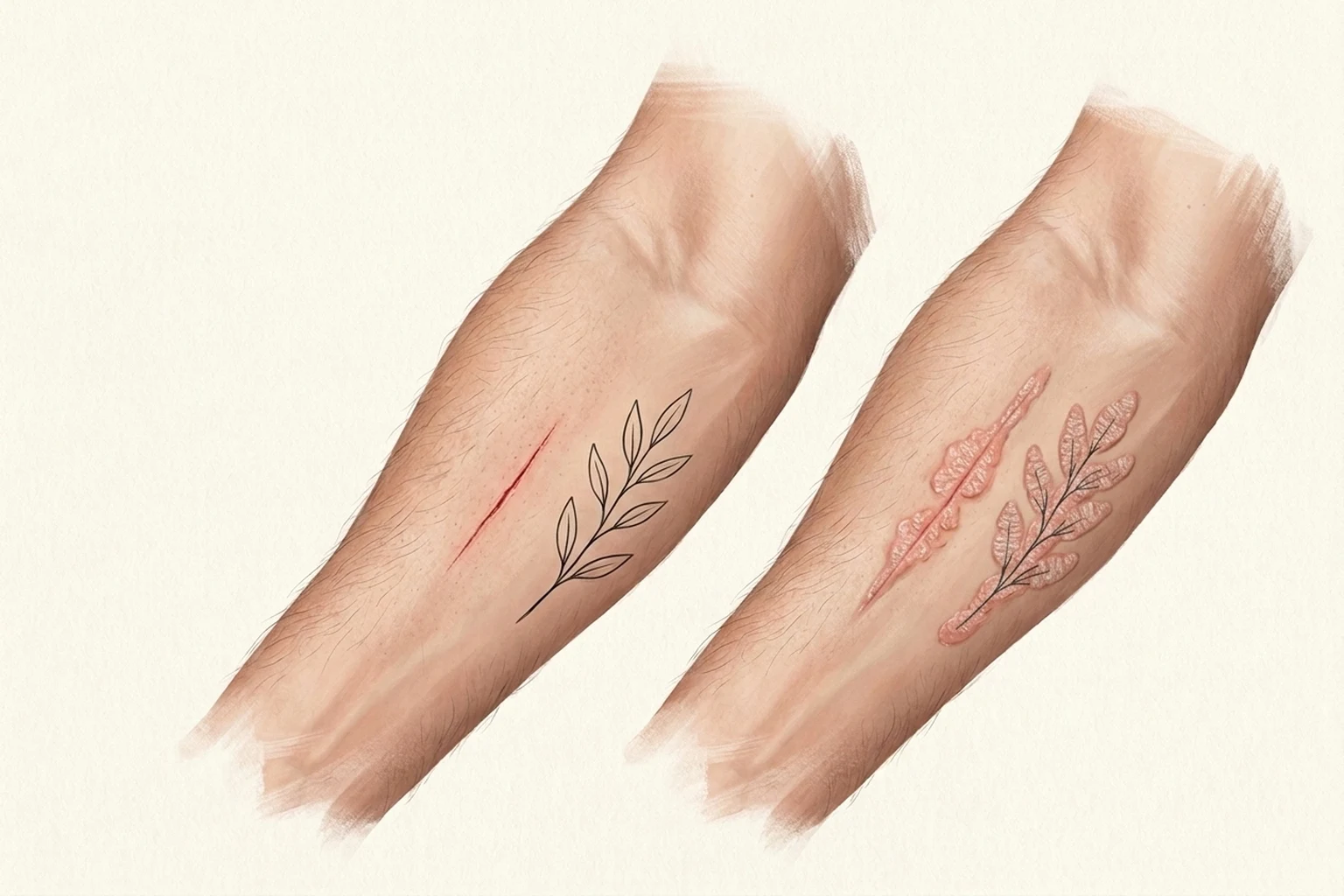
AI-generated illustration. Not an actual patient or treatment result.
The Koebner Phenomenon in Psoriasis: Why Scratches, Tattoos, Sunburns and Scalp Picking Trigger New Plaques

Chief Medical Officer
If a crisp line of psoriasis appears right along a cat scratch, surgical incision, sunburn line, or fresh tattoo weeks after the injury, you are seeing the Koebner phenomenon, a trauma-triggered flare that affects roughly 25% of people with psoriasis (Ji 2019). Understanding how skin trauma converts clear skin into new plaques gives you immediate practical control over everyday triggers you might otherwise miss.
In this article
What is the Koebner phenomenon in psoriasis?
German dermatologist Heinrich Koebner first observed in 1877 that patients with psoriasis developed new scaly plaques tracing the exact path of tattoos, horse bites, and scratches (Weiss 2002). Modern skin-biopsy studies explain why: injuring both the surface layer (epidermis) and upper supporting layer (dermis) activates local mast cells and sensory nerves within days, causing injured keratinocytes to release IL-33 and triggering mast cells and local pathways to elevate IL-6, interleukin-8, IL-17, interleukin-36 gamma, and vascular growth signals that summon psoriatic T cells to the wound (Ji 2019).
Dermatologists also observe an "all-or-none" pattern in experimental injury studies: when a patient is in a Koebner-reactive state, injuring multiple sites tends to trigger plaques at all injured sites rather than only one, and a positive Koebner response predicts higher subsequent disease activity (Eyre 1982; Weiss 2002).
How long after a scratch, sunburn, or tattoo do new psoriasis plaques appear?
The hidden delay tricks most patients. Unlike a hive or bruise that appears in minutes, Koebner plaques typically take 10 to 20 days to build enough extra skin-cell turnover to become visible, although published cases span anywhere from 3 days to many months (Weiss 2002). In experimental injury studies, biopsies of Koebner-positive psoriatic skin already show rising dermal IL-6 and IL-33 signals by days 3 to 7 before visible silver scale arrives (Ji 2019).
Looking back two to three weeks whenever a weirdly geometric or straight-line plaque appears often reveals the forgotten trigger: a weekend sunburn, a tight watchband, a gardening scrape, or a routine blood draw bandage.
Which everyday injuries and habits trigger Koebner flares most often?
Any trauma that disturbs the skin barrier deeply enough can set off the cascade (Ji 2019; Weiss 2002):
| Trigger category | Everyday examples | How to lower your risk |
|---|---|---|
| Mechanical cuts & friction | Surgical incisions, razor nicks, pet scratches, watch straps, bra bands, tight boots | Shave with a lubricated gentle razor, pad friction zones, and coat minor cuts with plain petrolatum |
| Tattoos & cosmetic procedures | Tattoo needles, piercings, waxing, harsh chemical peels, microneedling | Avoid elective tattoos or resurfacing during active psoriasis flares; talk with your dermatologist beforehand |
| Light & heat burns | Sunburn (even mild pink burn), scalding showers, radiation therapy sites | Use broad-spectrum sunscreen daily; controlled ultraviolet light helps psoriasis, whereas sunburn flares it |
| Inflammatory skin rashes | Bug bites, poison ivy, shingles blisters, severe acne, scalp yeast irritation | Calm itch early so scratching does not pile mechanical injury onto an inflammatory rash |
Does scratching scalp psoriasis make plaques spread faster?
Yes. The scalp is one of the highest-friction, most frequently picked zones on the body. Peeling thick white crusts off with fingernails creates tiny microscopic tears across the scalp roof, triggering fresh Koebnerization two weeks later and trapping patients in an endless itch-pick-plaque loop.
Instead of picking dry scale, soften thick crusts overnight with mineral oil or a salicylic acid lotion, rinse gently with lukewarm water, and apply targeted scalp treatment directly to the skin underneath. See our full routine in scalp psoriasis treatment: what works.
How can you prevent Koebner flares and calm early plaques?
You cannot live in bubble wrap, and minor bumps happen. Three practical habits cut down new trauma-triggered plaques significantly:
- Protect minor wounds immediately: Wash scrapes gently and cover with plain fragrance-free petrolatum and a non-irritating bandage so skin heals without dry scabbing and scratching.
- Keep baseline psoriasis controlled: Consistent maintenance therapy calms background skin inflammation and helps keep newly triggered spots smaller and easier to settle (Weiss 2002).
- Treat emerging plaques early: Once a linear pink scaly ridge shows up after a healed scratch or sunburn, early prescription topical care flattens it faster than waiting until it hardens. Compare daily prescription choices in the best prescription creams for psoriasis and psoriasis treatment without insurance.
For eligible adults with mild-to-moderate plaque, scalp, or skin-fold psoriasis who want steady prescription care to keep background inflammation calm, licensed clinicians (physician assistants and nurse practitioners working under a board-certified dermatologist's protocols) review your skin history and photos through the KindleeRx Psoriasis Regimen and reply in under 5 hours on average. When clinically appropriate, a licensed clinician selects two prescriptions from 11 listed options (steroid-free options are available) for $149 on the first 90-day automatic-refill order, then $149 every 90 days before coupons (including the $20 consultation fee, free shipping, and 90 days of clinician messaging), or $181.25 one-time before coupons. Available in 44 states plus Washington, D.C. (excluding Arkansas, Kansas, Maryland, Mississippi, Nebraska, and West Virginia). If treatment is not prescribed, you receive a full refund including the consultation fee. Infected wounds, rapidly spreading post-surgical flares, or widespread severe psoriasis require in-person medical evaluation.
Important Information
KindleeRx offers compounded topical prescription medications prepared by licensed United States compounding pharmacies alongside standard generic prescriptions when clinically appropriate. Compounded medications are not approved by the Food and Drug Administration (FDA) and are not reviewed by the FDA for safety, effectiveness, or quality (FDA compounding guidance). Eligibility is determined by a licensed clinician after reviewing your medical history and photos. Not all patients qualify. Individual results vary. This article is educational and is not medical advice.
Sources
- Ji YZ, Liu SR. Koebner Phenomenon Leading to the Formation of New Psoriatic Lesions: Evidences and Mechanisms. Bioscience Reports 2019.
- Weiss G, Shemer A, Trau H. The Koebner Phenomenon: Review of the Literature. Journal of the European Academy of Dermatology and Venereology 2002.
- Eyre RW, Krueger GG. Response to Injury of Skin Involved and Uninvolved With Psoriasis, and Its Relation to Disease Activity: Koebner and 'Reverse' Koebner Reactions. British Journal of Dermatology 1982.
- Food and Drug Administration. Understanding the Risks of Compounded Drugs.