Editorial image created with artificial intelligence. Illustrative scene; not an actual patient or clinician.
A Dermatologist Ranks Every Psoriasis Treatment: Topicals, Pills, and Biologics

Chief Medical Officer
Psoriasis rarely gives up to a single tube because thick plaques on elbows, flaky scale buried under scalp hair, and tender redness in skin folds each demand a different tool. As a board-certified dermatologist, I rank psoriasis treatments not by marketing hype, but by matching the right formulation to plaque thickness, body site, and whether your joints are involved.
In this article
Notice that Tier 1 has two honest winners depending on severity: paired body-site prescriptions for localized mild-to-moderate psoriasis, and in-person biologics when widespread skin disease or psoriatic arthritis takes hold.
KindleeRx publishes this guide and offers a prescription psoriasis program. Published trial counts come from peer-reviewed medical trials and Food and Drug Administration (FDA) prescribing labels; separate trials cannot be compared head to head.
| Rank | Psoriasis category | Published trial evidence (plain counts) | Best role |
|---|---|---|---|
| Tier 5 | Drugstore coal tar and salicylic acid creams | FDA over-the-counter monograph covers scale softening only (21 CFR 358) | Surface scale helper; rarely clears immune plaques alone |
| Tier 4 | Single-ingredient steroid or retinoid tube alone | Clobetasol scalp foam cleared 39 of 62 (63 in 100) vs 1 of 31 at 2 weeks (Clobetasol label); tazarotene beat vehicle across 318 evaluable patients (Weinstein 1997) | Limited to one body site; strong steroids capped at 2 weeks and off-limits on face or folds |
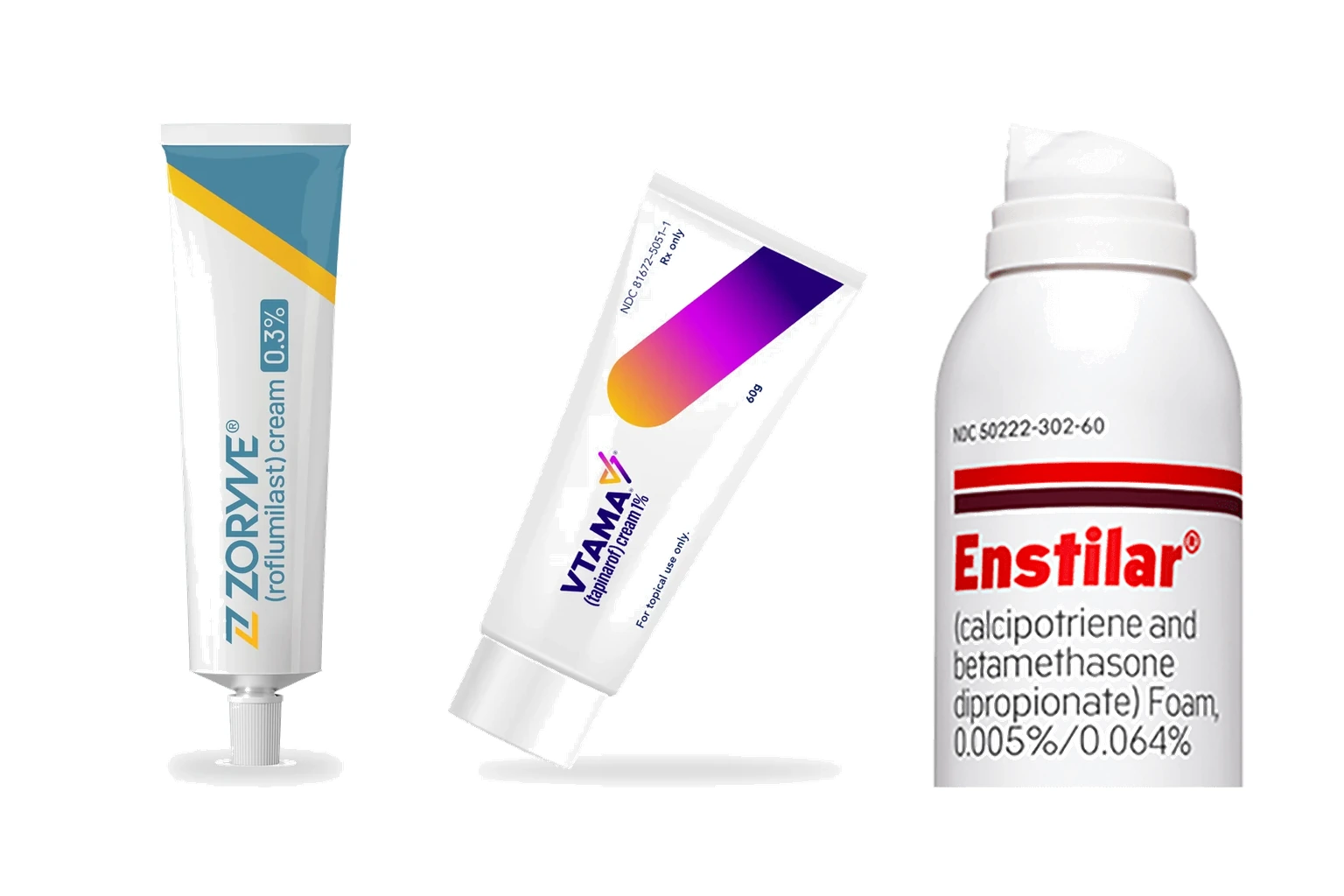
| Tier 3 | Modern steroid-free topicals and steroid/vitamin D foams | Enstilar: 53 in 100 vs 5 in 100 at 4 weeks; roflumilast 0.3%: 38 to 42 in 100 overall and 68 to 71 in 100 in folds (Lebwohl 2022); tapinarof 1%: 35 to 40 in 100 (Lebwohl 2021) | Strong daily non-steroid control for face, folds, and maintenance |
| Tier 2 | Oral phosphodiesterase-4 (PDE4) pills (apremilast; off-label oral roflumilast) | Apremilast: 33 in 100 PASI-75 at week 16 vs 5 in 100 (Papp 2015); oral roflumilast 500 mcg: 8 of 23 (35 in 100) at week 12 vs 0 of 23 (Gyldenløve 2023) | Needle-free option when plaques span too many areas for creams alone |
| Tier 1 | Paired two-prescription body-site plan (mild-to-moderate) OR in-person biologics (severe / psoriatic arthritis) | Online dermatology matched in-person visits across 296 adults (Armstrong 2018); biologics treat widespread skin and joint disease | Match treatment intensity honestly to plaque coverage and joint health |
Why do drugstore coal tar and salicylic acid creams rank last?
Over-the-counter psoriasis creams are legally capped at coal tar (0.5% to 5%) and salicylic acid (1.8% to 3%) (21 CFR Part 358). Those ingredients loosen loose surface flakes and quiet mild itching, which makes them helpful shower add-ons, yet they do not turn off the underlying immune cascade driving thick plaques.
I see many patients stack three or four drugstore jars on the bathroom counter while plaques keep spreading. If shelf products have not flattened plaques after several consistent weeks, stepping up to prescription care saves months of frustration.
How do prescription topical classes compare across body sites?
The Joint American Academy of Dermatology and National Psoriasis Foundation guidelines emphasize matching topical potency and vehicle directly to the skin site (Elmets 2021):
- Thick elbow, knee, and trunk plaques: High-potency topical steroids (such as clobetasol 0.05%, capped at 2 consecutive weeks and 50 g per week on the ointment label), scale-breaking keratolytics (coal tar plus salicylic acid), steroid-plus-vitamin D foams (calcipotriene plus betamethasone cleared about 53 in 100 versus 5 in 100 at 4 weeks, Enstilar label), or topical tazarotene retinoid (shown superior to base across 318 evaluable adults with sustained 12-week post-treatment benefit, strictly contraindicated in pregnancy, Weinstein 1997).
- Scalp plaques: Thick body ointments glue hair together and fail because patients stop applying them. Fast-absorbing liquid solutions and foams win on adherence: clobetasol 0.05% scalp foam cleared 39 of 62 adults (about 63 in 100) at 2 weeks versus 1 of 31 on base (Clobetasol foam label), and steroid-free roflumilast 0.3% foam cleared about 66 in 100 versus 28 in 100 on scalp psoriasis at week 8 (Gooderham 2025).
- Face, ears, and skin folds (inverse psoriasis): High-potency steroids risk thinning and stretch marks inside skin creases. Once-daily steroid-free roflumilast 0.3% cream cleared about 71 in 100 and 68 in 100 skin-fold plaques at week 8 versus 14 in 100 and 19 in 100 on base cream (Lebwohl 2022). Tapinarof 1% cream also cleared about 35 to 40 in 100 overall at week 12 with durable off-treatment remission, though folliculitis occurred in roughly 20 in 100 adults (Lebwohl 2021; Vtama label).
Where do oral pills (apremilast and off-label oral roflumilast) fit?
When plaques dot too many spots on the trunk, arms, and legs to chase with creams alone, oral phosphodiesterase-4 (PDE4) pills offer a needle-free step up without routine biologic injection schedules.
- Apremilast (Otezla, 30 mg twice daily): In the phase 3 ESTEEM 1 trial (844 adults with moderate-to-severe plaque psoriasis), about 33 in 100 achieved at least 75% plaque reduction (PASI-75) at week 16 versus 5 in 100 on placebo (Papp 2015).
- Off-label generic oral roflumilast (500 mcg once daily): In the company-independent Danish PSORRO randomized trial (46 adults with moderate-to-severe plaque psoriasis), 8 of 23 patients (about 35 in 100) achieved PASI-75 at week 12 versus 0 of 23 on placebo, rising to 10 of 23 (about 44 in 100) by week 24 (Gyldenløve 2023). Oral roflumilast is FDA-approved for severe chronic obstructive pulmonary disease (COPD), so psoriasis use is off-label; it is contraindicated in moderate or severe liver impairment and carries FDA warnings for mood changes (including depression or suicidal thoughts), weight loss, headache, insomnia, and stomach upset (Daliresp label).
When are in-person biologics and phototherapy the clear number one choice?
Online topical and oral therapy has clear clinical boundaries, and an honest dermatologist draws that line early. If psoriasis covers a large area of your body, severely disrupts daily life despite prescription topicals, or comes with aching, swollen joints or sausage-shaped fingers and toes, injectable biologics (interleukin-17, interleukin-23, or tumor necrosis factor blockers) or in-office narrowband ultraviolet B phototherapy belong at the top of your list.
Roughly 1 in 5 people with psoriasis (about 20 in 100 across 266 studies covering 976,408 patients) have psoriatic arthritis (Alinaghi 2019). Creams calm skin plaques, never joint inflammation, so joint symptoms always deserve an in-person dermatologist or rheumatologist.
Why does a paired two-prescription plan rank first for mild-to-moderate psoriasis?
Most adults with psoriasis have localized plaques across two or more distinct skin zones, such as thick elbows plus an itchy scalp, or knees plus tender skin folds. A single generic tube cannot handle both safely. Pairing two body-site-matched prescriptions inside an online dermatology program (proven equivalent to in-person visits across 296 adults in a 12-month randomized trial, Armstrong 2018) closes both the prescription-matching gap and the multi-month office wait.
That is how I built the KindleeRx Psoriasis Regimen:
- Two clinician-selected prescriptions in one plan: Licensed clinicians review your 5-minute intake and plaque photos (replying in under 5 hours on average) and select two complementary prescriptions, if appropriate, from 11 listed compounded and prescription formulas (6 containing a steroid and 5 steroid-free; steroid-free options are available).
- Matched to every common plaque zone: Options include Plaque Rescue Ointment (coal tar solution 8%, salicylic acid 6%, clobetasol 0.05%), Scalp Relief Solution, steroid-free Calming Daily Cream (roflumilast 0.2% plus calamine 5%), steroid-free Plaque Precision Cream (tazarotene 0.1%), Soothing Facial Cream, Ease the Itch Lotion, wet-wrap kits, lower-leg formulas, and off-label Systemic Calm Tablets (oral roflumilast 500 mcg) when appropriate.
- Transparent 90-day pricing: Automatic refills are $149 for the first 90-day order and $149 every 90 days (before coupons), including the $20 consultation fee, free shipping (usual delivery 5 to 7 days total), and 90 days of unlimited clinician messaging. A one-time order is $181.25 before coupons. Cancel automatic refills anytime with one click.
Service covers 44 states plus Washington, D.C. (excluding Arkansas, Kansas, Maryland, Mississippi, Nebraska, and West Virginia). If a clinician determines treatment is not appropriate, you receive a full refund including the $20 consultation fee, and every order includes a 90-day satisfaction refund guarantee after clinician review of follow-up photos. Looking only for one gentle steroid-free cream for face or skin folds? Compare The Calming Cream too. Ready to check your fit? Take our 3-tap psoriasis check or view full Psoriasis Regimen details.
Important Information
KindleeRx offers compounded prescription medications prepared by licensed United States compounding pharmacies under a licensed prescriber's order. Compounded medications are not approved by the FDA and are not reviewed by the FDA for safety, effectiveness, or quality (FDA compounding guidance). KindleeRx's Calming Daily Cream (roflumilast 0.2% and calamine 5%) is not Zoryve, is not a generic of Zoryve (no FDA-approved generic exists), and KindleeRx is not affiliated with Arcutis Biotherapeutics, Organon, LEO Pharma, Amgen, or AstraZeneca. Published trial figures for Zoryve, Vtama, Enstilar, Otezla, clobetasol, tazarotene, and oral roflumilast reflect those studied medications and strengths only, not KindleeRx's compounded formulas. Oral roflumilast is FDA-approved for severe chronic obstructive pulmonary disease (Daliresp label); its use in psoriasis is off-label, it is contraindicated in moderate or severe liver impairment, and it carries warnings for mood changes (including depression or suicidal thoughts), weight loss, and stomach upset. Tazarotene is strictly contraindicated in pregnancy. A licensed clinician determines whether treatment is appropriate after reviewing your history and photos. Not all patients qualify. Individual results vary. This guide is educational and is not personal medical advice.
Sources
- Elmets CA, et al. Joint AAD-NPF Guidelines of Care for the Management and Treatment of Psoriasis With Topical Therapy. Journal of the American Academy of Dermatology 2021.
- Merola JF, et al. Prevalence of Psoriasis Phenotypes Among Men and Women in the USA. Clinical and Experimental Dermatology 2016.
- Alinaghi F, et al. Prevalence of Psoriatic Arthritis in Patients With Psoriasis: Systematic Review and Meta-Analysis of 266 Studies. Journal of the American Academy of Dermatology 2019.
- Armstrong AW, et al. Effectiveness of Online vs In-Person Care for Adults With Psoriasis: A Randomized Clinical Trial. JAMA Network Open 2018.
- Lebwohl MG, et al. DERMIS-1 and DERMIS-2 Trials of Roflumilast Cream 0.3% in Plaque Psoriasis. JAMA 2022.
- Gooderham MJ, et al. ARRECTOR Trial of Roflumilast Foam 0.3% for Scalp and Body Psoriasis. JAMA Dermatology 2025.
- Lebwohl MG, et al. Phase 3 Trials of Tapinarof Cream for Plaque Psoriasis (PSOARING 1 and 2). New England Journal of Medicine 2021.
- Papp K, et al. Apremilast in Patients With Moderate to Severe Plaque Psoriasis (ESTEEM 1). Journal of the American Academy of Dermatology 2015.
- Gyldenløve M, et al. Efficacy and Safety of Oral Roflumilast for Moderate-to-Severe Psoriasis (PSORRO): A Randomized Controlled Trial. The Lancet Regional Health - Europe 2023.
- Weinstein GD, et al. Tazarotene Gel, a New Retinoid, for Topical Therapy of Psoriasis. Journal of the American Academy of Dermatology 1997.
- LEO Pharma. Enstilar (calcipotriene and betamethasone dipropionate) Foam Prescribing Information. DailyMed.
- Glenmark. Clobetasol Propionate Foam 0.05% Prescribing Information. DailyMed.
- Organon. VTAMA (tapinarof) Cream Prescribing Information. DailyMed.
- AstraZeneca. DALIRESP (roflumilast) Tablets Prescribing Information. DailyMed.
- United States Code of Federal Regulations. Title 21, Part 358, Subpart H.
- Food and Drug Administration. Understanding the Risks of Compounded Drugs.