

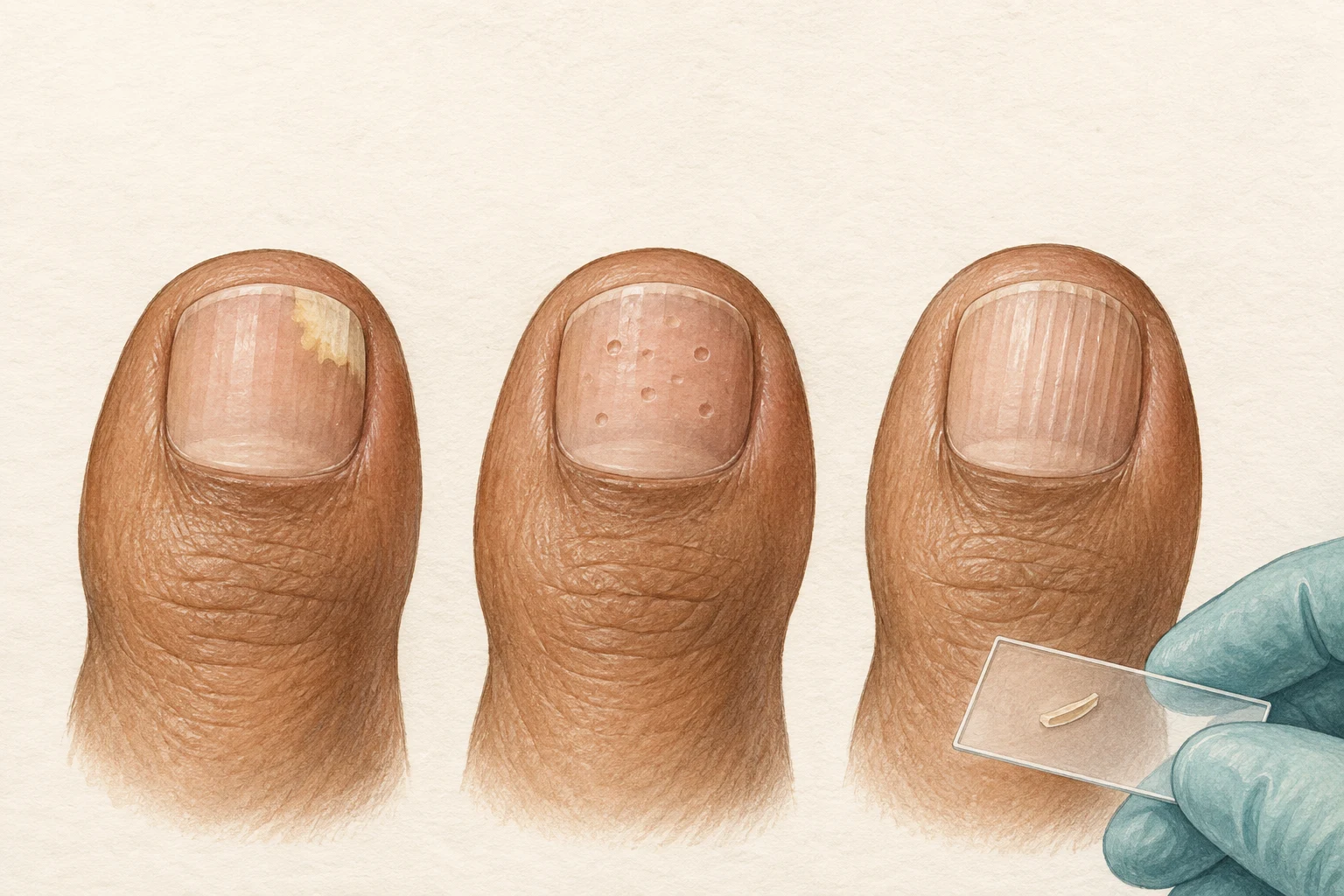
AI-generated illustration. Not an actual patient or treatment result.
Terbinafine Not Working for Toenail Fungus? What to Do Next

Chief Medical Officer
At 3 months, a toenail that still looks infected usually means the nail has not grown out yet, and the drug may still be working. In the label's main trial, people took terbinafine 250 mg daily for 12 weeks, were judged at week 48, and those who reached overall success got there after about 10 months on average (terbinafine prescribing information). I judge terbinafine by the new nail at the base and by a nail test taken at the right time.
In this article
How do you know if terbinafine is working?
Terbinafine is working when a band of clear, normal nail grows out from the cuticle and pushes the damaged nail toward the tip. The label's trial counted "effective treatment" as a negative fungal test plus a clear nail or more than 5 mm of new unaffected growth, and 59% met that bar at week 48 (terbinafine prescribing information). Healthy toenails grow about 1.62 mm a month, and the big toenail grows fastest (Yaemsiri 2010). At that pace, 3 months adds about 4.9 mm. Photograph the nail on day 1 and every 4 weeks, with a ruler beside the toe. A clear edge moving forward from the base is the first good sign I check.
Why does the nail still look bad after 12 weeks of terbinafine?
The damaged nail stays until it grows off the end of the toe. The label says the best visible result comes months after the fungus is cleared and the pills are stopped (terbinafine prescribing information). The American Academy of Dermatology (AAD) says a toenail takes a year or longer to grow out, with discoloration until then (AAD).
The drug also keeps working after the last tablet. In a randomized study of 20 patients, terbinafine was still measurable in toenail clippings 36 weeks after a 12-week course ended (Schatz 1995). In the label's trial, 70% had a negative fungal test at week 48, yet only 38% also had a completely clear nail (terbinafine prescribing information).
Why does terbinafine fail?
Terbinafine fails for four main reasons: the nail was never fungal, it covers the organism poorly, the fungus is walled off, or the infection came back.
- Wrong diagnosis. Of 455 Ontario patients with abnormal-looking toenails, 182 (about 40%) had lab-confirmed fungus (Gupta 1997). In US dermatology records, 76.9% of patients prescribed an antifungal for nail fungus had no confirming test on record (Gupta 2025).
- Wrong organism. In 32,193 Canadian patients, 20.4% of culture-confirmed cases were molds and 7.6% were yeasts (Gupta 2016). The label lists proven clinical activity only against Trichophyton rubrum and Trichophyton mentagrophytes (terbinafine prescribing information).
- A dermatophytoma. This dense fungal mass sits in a biofilm under the nail. In a 2024 review, terbinafine alone cured 67%; adding removal of the mass gave 50% to 100% (Lipner 2024).
- Relapse. About 15% of people cured in the label's trial relapsed when checked at least 1 year after treatment (terbinafine prescribing information).
How common is terbinafine-resistant toenail fungus?
Resistance is uncommon in toenails, and it is rising. A US lab testing toenail samples from 15,683 patients found terbinafine-resistance mutations (in the squalene epoxidase gene) in 3.7% of the Trichophyton detected (Gupta 2023). Among 22,610 dermatophyte-positive toenail samples (from 62,056 submitted) in the same network, the mutation rate climbed from about 2.9% to 6.2% between early 2022 and mid-2023 (Gupta 2024).
You may see higher numbers quoted. A US reference lab found resistance in 18.6% of 271 isolates, though institutions chose which isolates to send, which skews toward hard cases, and the isolates came from every body site (Cañete-Gibas 2023). A mutation predicts reduced sensitivity. It does not prove the pills will fail.
When should you retest the nail?
Retest at least 3 months after the last tablet. The British Association of Dermatologists (BAD) warns that antifungal tablets stay in the nail for months and that testing within 3 months of a course can give false results (BAD 2026). A potassium hydroxide (KOH) slide can also mislead after treatment: of 2,360 culture-negative samples from seven trials, 78.7% still showed fungal threads under the microscope, and in a subset of 94 samples checked, 60% showed damaged threads that may be dead (Ghannoum 2014). Ask for a culture as well, which shows whether the fungus still grows. If you never had a nail test before the first course, ask whether one makes sense now. The label calls for KOH, culture or biopsy confirmation before treatment starts (terbinafine prescribing information).
What is the next step if terbinafine did not work?
The main options are another terbinafine course, itraconazole, adding a topical or thinning the nail, and your clinician may confirm the diagnosis first.
- A follow-up terbinafine course. In a 5-year Icelandic study, 72 people whose infection persisted or returned after a first course (terbinafine or itraconazole) were given terbinafine; 88% reached mycological cure and 76% clinical cure (Sigurgeirsson 2002). In a 2023 analysis, 24 weeks (off-label in the US) beat 12 weeks for mycological cure at 1 year (Gupta 2023).
- Itraconazole. On its label, 200 mg daily for 12 weeks gave mycologic cure in 54% and complete cure in 14% (Sporanox prescribing information). Its boxed warning rules it out for nail fungus in heart failure and lists dangerous interactions with many common medicines, so it needs a medication review.
- Add a topical. Amorolfine lacquer (not sold in the US) plus terbinafine raised 18-month success from 45.0% to 59.2% (Baran 2007).
- Thin the nail. Debridement plus terbinafine raised week-48 clinical cure from 51.4% to 59.8% in 504 patients (Jennings 2006).
How does KindleeRx handle a toenail that did not clear?
A KindleeRx clinician may ask for a nail test before changing the plan. For the full clearing timeline, read how long toenail fungus takes to clear, and if a nail test comes back negative, read what else a thick toenail can be. The complete guide to toenail fungus covers every treatment option.
KindleeRx offers a 90-day prescription nail program that combines oral terbinafine with a compounded topical antifungal when appropriate. The oral part is terbinafine 250 mg once daily for one week each month (21 tablets over 3 months), a pulse schedule that differs from the label's 12 weeks of daily dosing. The topical is a 30 mL compounded solution with itraconazole 1%, terbinafine 3%, urea 20% and tea tree oil 6.6%. Compounded medications are not FDA-approved. Licensed clinicians (physician assistants and nurse practitioners working under a board-certified dermatologist's protocols) review your history, including the earlier course, and prescribe only when appropriate; they reply in under 5 hours on average. Not everyone qualifies, and if nothing is prescribed, the refund is full, including the consultation fee. The program is $99 for the first order with automatic refills, before coupons. Individual results vary.
Sources
- Aurobindo Pharma. Terbinafine tablets USP prescribing information. DailyMed, revised 01/2022.
- Yaemsiri S et al. J Eur Acad Dermatol Venereol 2010.
- American Academy of Dermatology. Nail fungus: Diagnosis and treatment. 2025.
- Schatz F et al. Clin Exp Dermatol 1995.
- Gupta AK et al. Int J Dermatol 1997.
- Gupta AK, Wang T, Tran AN. Skin Appendage Disord 2025.
- Gupta AK et al. J Eur Acad Dermatol Venereol 2016.
- Lipner SR et al. J Am Podiatr Med Assoc 2024.
- Gupta AK et al. J Invest Dermatol 2023.
- Gupta AK et al. Mycoses 2024.
- Cañete-Gibas CF et al. J Clin Microbiol 2023.
- Caplan AS et al. MMWR Morb Mortal Wkly Rep 2023.
- British Association of Dermatologists. Fungal nail infections (patient information leaflet). April 2026.
- Ghannoum M, Isham N, Catalano V. Br J Dermatol 2014.
- Sigurgeirsson B et al. Arch Dermatol 2002.
- Gupta AK et al. Br J Dermatol 2023.
- Janssen. Sporanox (itraconazole) capsules prescribing information. DailyMed, revised 7/2026.
- Baran R et al. Br J Dermatol 2007.
- Jennings MB et al. (IRON-CLAD trial). J Am Podiatr Med Assoc 2006.
Related Articles

Nail Care
How Long Does Toenail Fungus Take to Clear? The Treatment and Regrowth Timeline
Jul 19, 2026 · 5 min read
Nail Care
Is It Really Fungus? The 5 Conditions That Mimic Toenail Fungus
Jul 19, 2026 · 8 min read
Nail Care
Oral vs Topical for Toenail Fungus, and Why the Combination Wins
Jul 19, 2026 · 9 min read