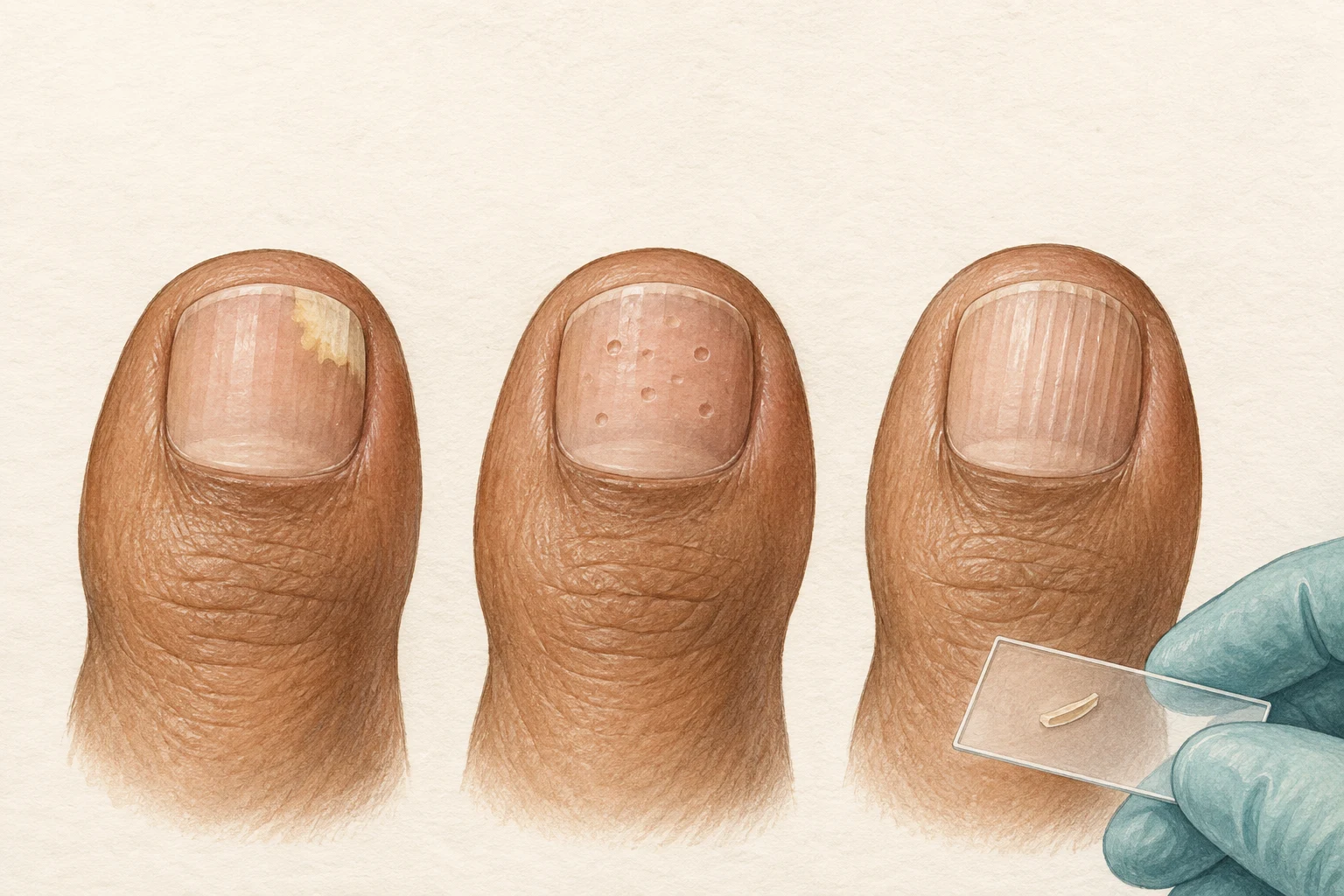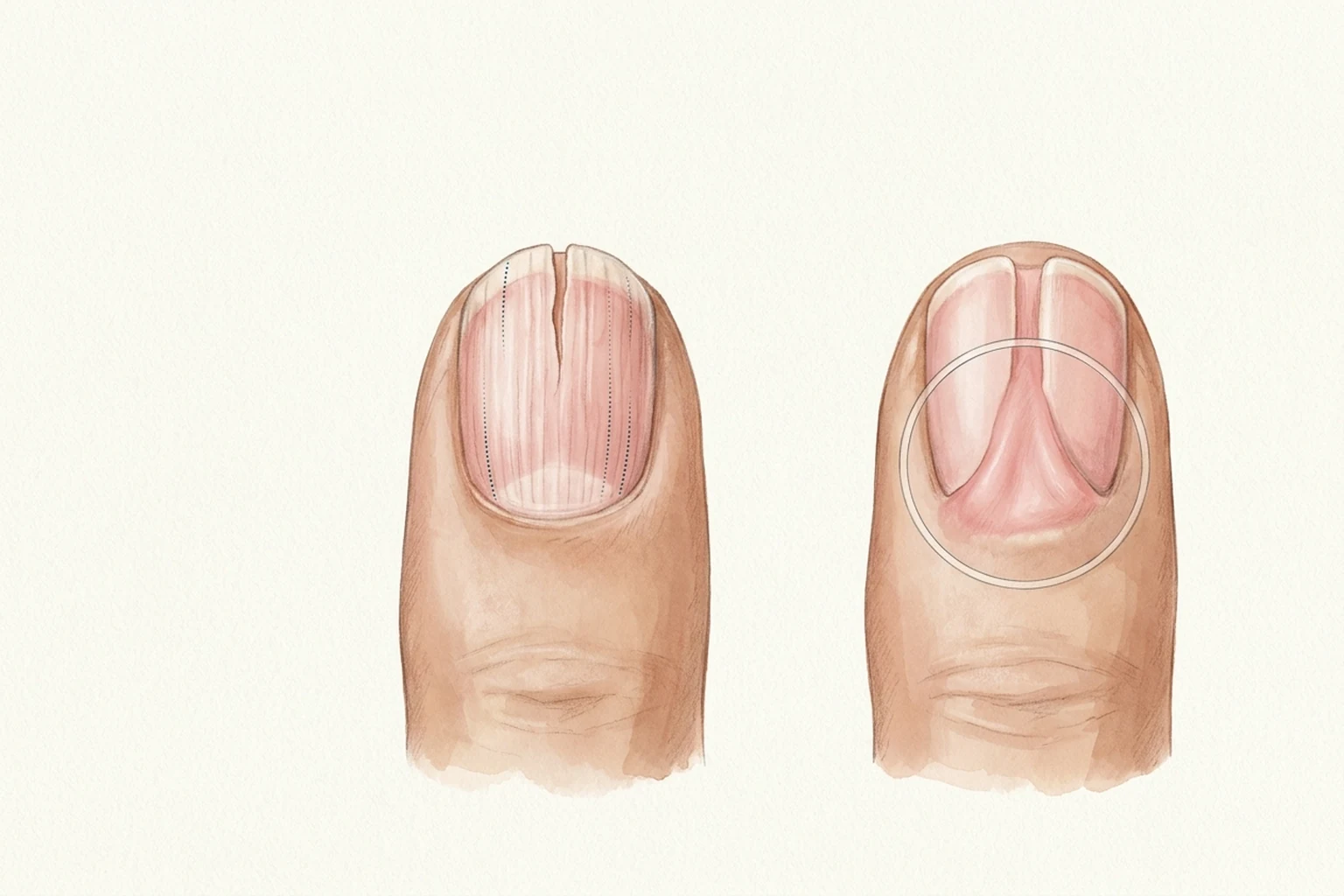
AI-generated illustration. Not an actual patient or treatment result.
Nail Lichen Planus and Dorsal Pterygium: The Scarring Mimic You Cannot Afford to Treat Like Fungus

Chief Medical Officer
Spending six months painting antifungal drops onto a thinning, deeply ridged nail can cost you that nail permanently if the true diagnosis is nail lichen planus (Iorizzo 2020). Recognizing the difference between crumbly fungal thickening and inflammatory matrix thinning tells you when to seek urgent in-person dermatology care.
In this article
What is nail lichen planus, and why is it urgent compared with nail fungus?
Lichen planus is a benign immune-mediated inflammatory condition that can affect the skin (itchy purple flat-topped bumps on wrists and ankles), mouth (white lacy patches), scalp, or nails. Nail lichen planus can appear alongside skin or mouth lesions, or it can strike the nails completely on its own (Gupta 2021; Alrefaie 2023).
Fungal nail infections invade the hard keratin plate slowly over years and almost never obliterate the living growth root. Nail lichen planus attacks the nail matrix directly. Left untreated, inflammation replaces living matrix cells with permanent scar tissue, making prompt diagnosis essential even when early changes look mild (Iorizzo 2020).
How do early nail lichen planus signs differ from fungal nail infection?
Side-by-side visual clues help flag when a nail does not behave like ordinary fungus:
| Feature | Nail lichen planus | Classic toenail fungus (onychomycosis) |
|---|---|---|
| Nail thickness | Thinned, fragile, papery nail plate (Ceccarelli 2022) | Thickened, opaque, yellow-brown plate with chalky debris underneath |
| Surface texture | Prominent longitudinal ridging, roughness, longitudinal fissuring, and distal splitting (Gupta 2021; Ceccarelli 2022) | Crumbling free edge, lifting, and yellow-white streaks creeping backward |
| Cuticle border | Cuticle skin can blur and fuse downward onto the nail bed (dorsal pterygium) (Ceccarelli 2022) | Proximal cuticle boundary remains distinct |
| Hands versus feet | Frequently affects multiple fingernails first, with or without toenails | Predominantly affects great toenails and smaller toenails |
| Risk of delay | Permanent scarring and nail loss (Iorizzo 2020) | Slow spread over months to years; matrix rarely scars |
What is a dorsal pterygium, and can scarred nails grow back?
Dorsal pterygium means a wing-like tongue of skin from the proximal nail fold grows forward and fuses directly onto the exposed nail bed, splitting the remaining nail plate into two narrow wings. Once true scar tissue forms a dorsal pterygium or causes complete anonychia (absent nail plate), medical therapy cannot regrow normal matrix in the scarred zone (Gupta 2021; Ceccarelli 2022).
Stopping inflammation before that scar bridge locks in is why dermatologists treat early thinning and splitting aggressively.
How do dermatologists confirm and treat nail lichen planus?
- Full exam plus fungal rule-out and matrix biopsy: An in-person dermatologist examines all 20 nail units, skin folds, scalp, and oral mucosa, performs mycologic fungal testing, and considers histopathologic biopsy when isolated nails lack classic skin findings (Lee 2022; Gupta 2021; Ceccarelli 2022).
- First-line targeted corticosteroid injections: International expert consensus recommends intralesional triamcinolone acetonide (tiny injections near the nail matrix when a few nails are involved) or intramuscular triamcinolone acetonide (when many nails are flaring), noting that simple topical creams rarely penetrate deeply enough to halt matrix scarring (Iorizzo 2020; Gupta 2021).
- Second-line oral therapies: When injected steroids are insufficient or unsuitable, dermatologists consider oral retinoids or systemic immunosuppressive agents (Iorizzo 2020).
Why does nail lichen planus require in-person dermatology rather than telehealth?
KindleeRx does not diagnose, biopsy, or treat nail lichen planus, and does not provide intralesional or intramuscular steroid injections. Treating scarring nail diseases safely requires in-person dermoscopy, full skin and mucosal inspection, possible nail biopsy, and office-based injectable or systemic therapy. See our guide on when you need an in-person doctor for nail changes and whether it is toenail fungus or something else.
If an in-person evaluation or clear clinical features confirm uncomplicated adult toenail fungus rather than scarring inflammatory disease (review what a negative toenail fungus test means), licensed clinicians (physician assistants and nurse practitioners working under a board-certified dermatologist's protocols) evaluate eligible adults through the KindleeRx Nail Regimen and reply in under 5 hours on average. When clinically appropriate, the 90-day program pairs 21 terbinafine 250 mg pills (off-label pulse schedule) with a 30 mL compounded topical nail solution (itraconazole 1%, terbinafine 3%, urea 20%, tea tree oil 6.6%, and dimethyl sulfoxide [DMSO]) for $99 on the first automatic-refill order, then $99 every 90 days before coupons (including the $20 consultation fee, free shipping, and 90 days of clinician messaging), or $118.75 one-time before coupons. Before prescribing oral terbinafine, your clinician may ask for copies of your earlier liver blood test results, or ask your primary care provider to order a test. Available in 44 states plus Washington, D.C. (excluding Arkansas, Kansas, Maryland, Mississippi, Nebraska, and West Virginia), with a full refund including the consultation fee if treatment is not prescribed.
Important Information
KindleeRx's topical nail solution (itraconazole 1%, terbinafine 3%, urea 20%, tea tree oil 6.6%, and DMSO) is a compounded prescription medication prepared by a licensed United States compounding pharmacy under a prescriber's order. Compounded medications are not approved by the Food and Drug Administration (FDA) and are not reviewed by the FDA for safety, effectiveness, or quality (FDA compounding guidance). Oral terbinafine pulse dosing (21 pills over 3 months) is an off-label schedule. KindleeRx does not diagnose, biopsy, or treat nail lichen planus or scarring nail conditions. Eligibility is determined by a licensed clinician after reviewing your medical history and photos. Not all patients qualify. Individual results vary. This article is educational and is not medical advice.
Sources
- Iorizzo M, Tosti A, Starace M, Baran R, et al. Isolated Nail Lichen Planus: An Expert Consensus on Treatment of the Classical Form. Journal of the American Academy of Dermatology 2020.
- Gupta MK, Lipner SR. Review of Nail Lichen Planus: Epidemiology, Pathogenesis, Diagnosis, and Treatment. Dermatologic Clinics 2021.
- Ceccarelli MA, Gavilanes-Coloma MC, D'almeida L, Azulay D, et al. Description of the Most Severe Signs in Nail Lichen Planus: A Strategy to Contribute to the Diagnosis of the Severe Stage. International Journal of Dermatology 2022.
- Alrefaie Y, Alraddadi A, Alhathal Y, Bamefleh H. Inverse Lichen Planus Associated With Nail Dystrophy. Cureus 2023.
- Lee DK, Lipner SR. Optimal Diagnosis and Management of Common Nail Disorders. Annals of Medicine 2022.
- Food and Drug Administration. Understanding the Risks of Compounded Drugs.