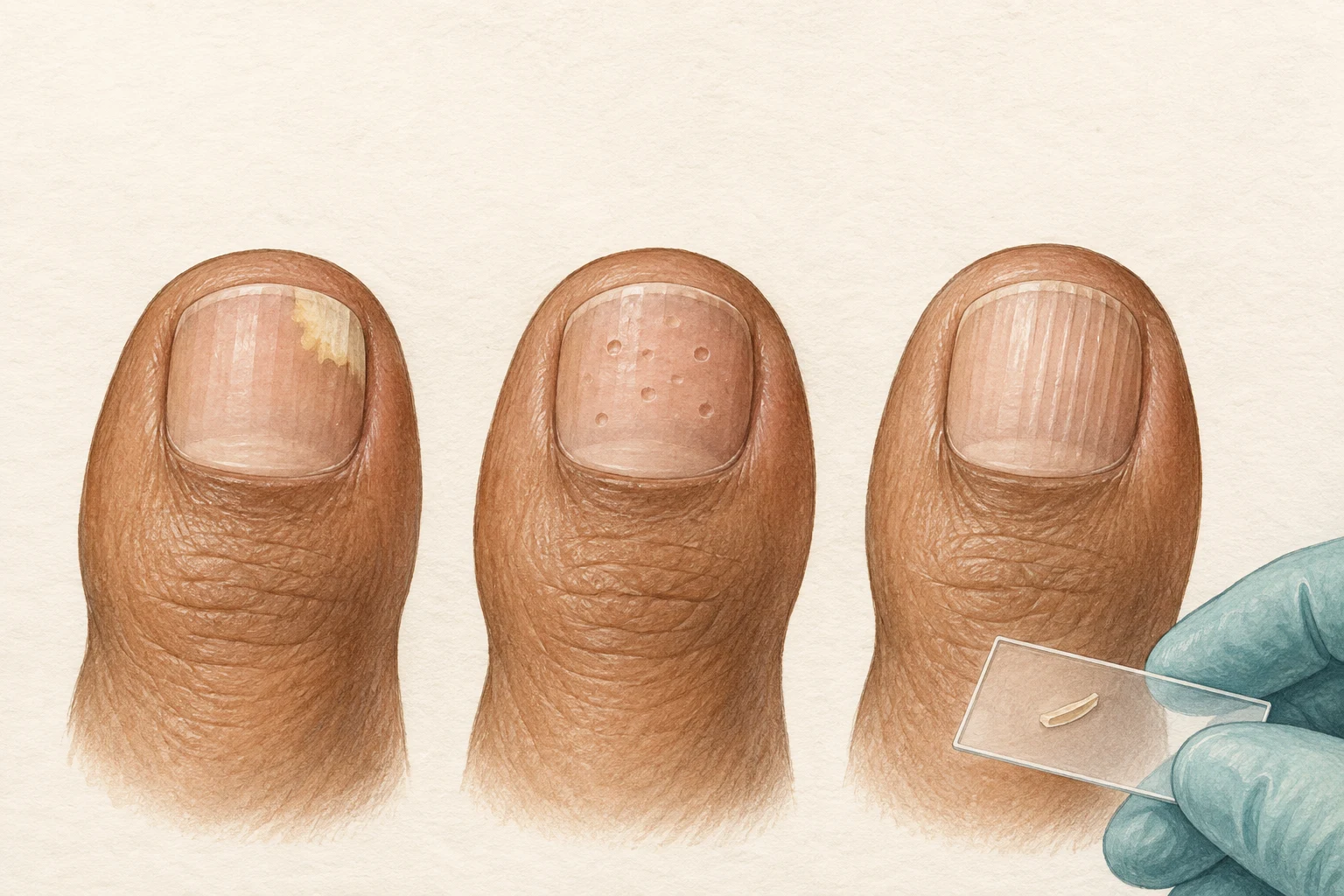
AI-generated illustration. Not an actual patient or treatment result.
My Toenail Fungus Test Was Negative. What Happens Next?

Chief Medical Officer
A negative toenail fungus test does not rule out fungus; the next step is a better sample, a more sensitive test, or a look at other causes. Pooled across 13 studies, a single culture missed about 44% of infections and a single KOH test about 39% (Velasquez-Agudelo 2017). At the same time, up to about 40% of nails that look fungal may be something else (FDA guidance 2016). Both facts matter before anyone starts antifungal pills.
In this article
Does a negative test rule out toenail fungus?
No. A KOH test has a pooled sensitivity of 61% and a culture 56%, so roughly 4 in 10 infected nails can come back negative on one KOH test or one culture (Velasquez-Agudelo 2017).
Negative predictive value is the number that answers your question directly: how often a negative result is correct. In 105 US patients with suspected nail fungus, it was 43% for culture, 58% for KOH and 77% for a PAS-stained clipping (Weinberg 2003). A negative culture in that group was wrong more often than right.
A positive test is more reliable than a negative one. Pooled specificity was 95% for KOH and 99% for culture.
How accurate are the KOH, culture, PAS and PCR tests?
PAS staining of a nail clipping catches the most infections, culture catches the fewest, and KOH sits in between.
| Test | Pooled sensitivity (13 studies) | Pooled specificity | Sensitivity in the studies below |
|---|---|---|---|
| KOH microscopy | 61% | 95% | 55.9% to 80% |
| Fungal culture | 56% | 99% | 29.4% to 59% |
| PAS stain of clipping | 84% | 89% | 88.2% to 98.8% |
Pooled figures come from Velasquez-Agudelo 2017. Single-study figures come from 105 US patients (Weinberg 2003), 493 Korean patients (Jung 2015) and 204 US veterans, where PAS reached 98.8% (Lilly 2006).
Polymerase chain reaction (PCR) testing has less head-to-head data. On 203 split samples, PAS was positive in 109 (53.7%) and a commercial PCR panel in 77 (37.9%); 41 samples were PAS-positive but PCR-negative (Caldwell 2020). That study had no independent reference test, so it cannot give PCR an accuracy figure.
Why do toenail fungus tests come back falsely negative?
The three common reasons are a sample taken from the wrong spot, antifungal medicine still in the nail, and a test that simply missed. In 194 patients, culture yield improved the closer to the nail's base the sample was taken, and drilling under the nail beat scraping at every site (Shemer 2008).
Recent treatment also matters. Terbinafine was still measurable in nail clippings 30 to 36 weeks after a 6- or 12-week course ended, at levels that inhibit fungus (Schatz 1995). The British Association of Dermatologists (BAD) warns that testing within 3 months of a tablet course can give false results, and that a test sometimes fails and has to be repeated (BAD leaflet 2026).
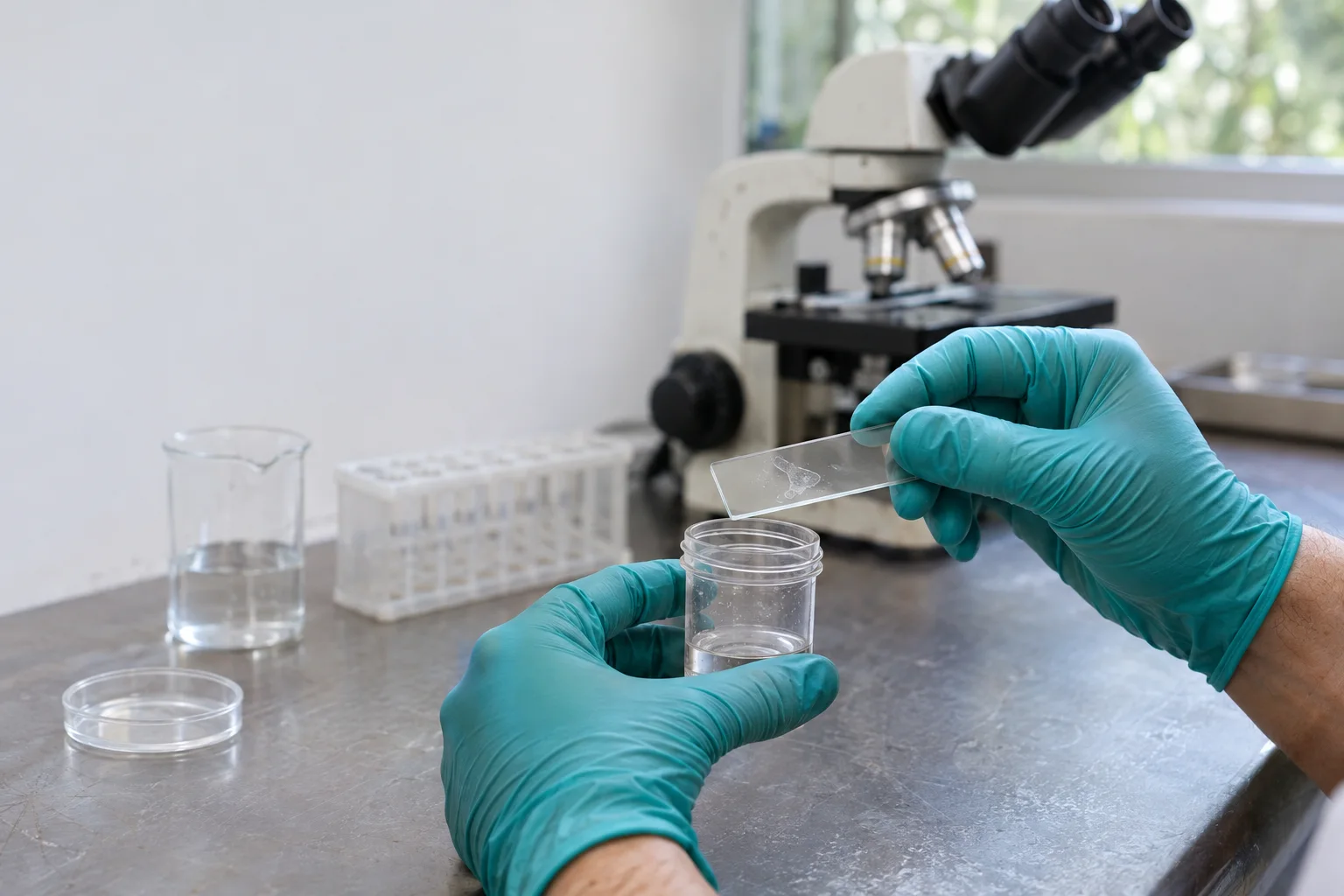
For a home clipping kit, the BAD's instructions are specific: clip the thick, crumbly or discolored part as far back as you can without pain, and add the debris from under the nail.
Should you repeat the test or start treatment anyway?
Repeating the test first often makes sense. The terbinafine label says nail specimens should be tested to confirm the diagnosis before treatment (terbinafine prescribing information). The American Academy of Dermatology (AAD) Choosing Wisely list says not to prescribe oral antifungals without confirmation, noting that about half of nails with suspected fungus are not infected (AAD Choosing Wisely).
In practice, most people start pills without one: only 9.7% of 18,128 US patients prescribed an oral antifungal for nail fungus in 2018 had a confirmatory lab test (Gold 2023).
Here is what I do after a negative result when the nail still looks fungal: take a second sample from the base of the affected area, wait 3 months if tablets were taken recently, and ask for a PAS stain on the clipping. The Weinberg authors recommend PAS when other tests are negative and suspicion stays high (Weinberg 2003). Two good negative samples, including a PAS, push me toward another diagnosis.
What else could it be if it is not fungus?
Look-alikes the FDA names include nail psoriasis, lichen planus and repeated trauma from shoes, running or aggressive nail care, which can look identical to fungus (FDA guidance 2016). The FDA estimates up to about 40% of abnormal-looking nails may not be fungal; the AAD puts it at about half (AAD Choosing Wisely).
In an Ontario survey of 2,001 dermatology patients, 455 had abnormal toenails but only 182 had fungus confirmed by testing (Gupta 1997). That count is a minimum, because only suspected nails were sampled and tests miss some infections. Psoriasis and fungus can also occur together on the same nail. I walk through the differences in is it toenail fungus or something else.
Does a negative test after treatment mean the fungus is gone?
Not on its own. Test no sooner than 3 months after the last tablet (BAD leaflet 2026). The FDA defines mycological cure as a negative stain plus a negative culture (FDA guidance 2016). The reverse trap also exists: in seven trials, 78.7% of 2,360 culture-negative samples at week 52 were still KOH-positive, often showing damaged, possibly dead fungus (Ghannoum 2014).
How can KindleeRx help after a negative test?
The KindleeRx nail program is reviewed online by licensed clinicians (physician assistants and nurse practitioners working under a board-certified dermatologist's protocols), who prescribe oral terbinafine and a compounded topical only when appropriate. If your test was negative and the nail still looks fungal, your clinician may ask for another nail test. Share any nail test reports you have, negative ones included. Not everyone qualifies, and if no treatment is prescribed, the refund is full, including the consultation fee. To see how online care works, read can toenail fungus be treated online, and for every option start with the complete toenail fungus guide.
Sources
- Velasquez-Agudelo V, Cardona-Arias JA. Meta-analysis of the utility of culture, biopsy, and direct KOH examination for the diagnosis of onychomycosis. BMC Infect Dis 2017.
- Weinberg JM, et al. Comparison of diagnostic methods in the evaluation of onychomycosis. J Am Acad Dermatol 2003.
- Jung MY, et al. Comparison of diagnostic methods for onychomycosis, and proposal of a diagnostic algorithm. Clin Exp Dermatol 2015.
- Lilly KK, et al. Cost-effectiveness of diagnostic tests for toenail onychomycosis. J Am Acad Dermatol 2006.
- Caldwell B, et al. Commercial multiplex polymerase chain reaction versus periodic acid-Schiff testing for the diagnosis of onychomycosis. J Am Podiatr Med Assoc 2020.
- Shemer A, et al. Collection of fungi samples from nails: comparative study of curettage and drilling techniques. J Eur Acad Dermatol Venereol 2008.
- Schatz F, et al. Nail incorporation kinetics of terbinafine in onychomycosis patients. Clin Exp Dermatol 1995.
- Ghannoum M, Isham N, Catalano V. A second look at efficacy criteria for onychomycosis: clinical and mycological cure. Br J Dermatol 2014.
- Gupta AK, et al. Prevalence and epidemiology of unsuspected onychomycosis in patients visiting dermatologists' offices in Ontario, Canada. Int J Dermatol 1997.
- Gold JAW, et al. Opportunities to improve guideline adherence for the diagnosis and treatment of onychomycosis. J Am Acad Dermatol 2023.
- US Food and Drug Administration. Medical devices and clinical trial design for the treatment or improvement in the appearance of fungally-infected nails. 2016.
- Aurobindo Pharma. Terbinafine Tablets USP prescribing information. DailyMed 2024.
- American Academy of Dermatology. Choosing wisely: recommendations about treatments, tests, and procedures.
- British Association of Dermatologists. Fungal nail infections: patient information leaflet. 2026.