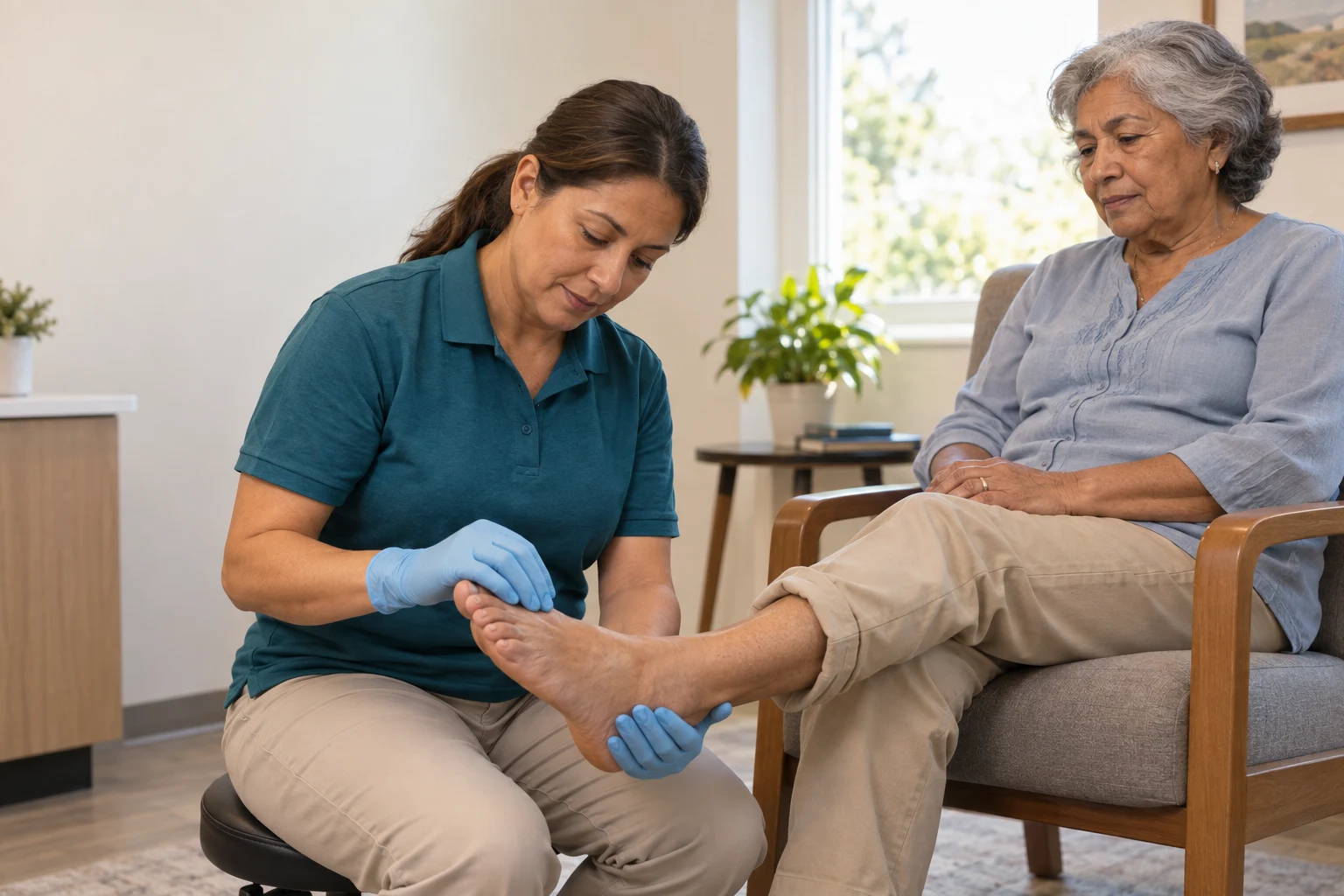
AI-generated illustration. Not an actual patient or treatment result.
Does Toenail Fungus Go Away on Its Own?

Chief Medical Officer
No, toenail fungus rarely goes away on its own. The AAD states that nail fungus almost never clears by itself and that it can spread (AAD). In the inactive-solution (vehicle) groups of three prescription drug programs, only 0% to 5.5% of people had a completely clear, fungus-free toenail after 48 to 52 weeks (Jublia label; ciclopirox label).
In this article
Does toenail fungus ever go away without treatment?
Almost never. A PubMed search for studies that simply followed untreated people over time returned none, so the best measure is the vehicle group of drug trials. Complete cure (a clear nail plus negative lab tests) in those groups was 3.3% and 5.5% in the Jublia trials and 0.5% and 1.5% in the tavaborole trials at week 52 (Jublia label; tavaborole label). In the ciclopirox trials, with monthly trimming of loose infected nail, it was 0.9% and 0% at week 48 (ciclopirox label).
These people had mild to moderate disease and were applying a solution under close follow-up, so the numbers are a stand-in for no treatment, and the best one available. My short answer: plan on it staying until you treat it.
What happens if you never treat toenail fungus?
It tends to dig deeper, damage the nail and spread. Without treatment, the AAD says the fungus can burrow into the skin under the nail, change the nail's shape and sometimes make the nail fall off; severe cases can make walking or standing painful (AAD, symptoms).
It often comes with other fungal infections. Among 2,761 people with toenail fungus, 42.8% had one elsewhere: 33.8% athlete's foot, 7.4% fingernail fungus and 4.2% jock itch, and the overlap depended partly on how long the nail infection had lasted (Szepietowski 2006).
Daily life suffers too. In a telephone survey of 258 people with confirmed nail fungus, 76% had trouble trimming their nails, 74% felt embarrassed, 48% had pain and 38% had discomfort wearing shoes (Drake 1998).
Is untreated toenail fungus dangerous?
For most healthy people, no: the National Health Service (NHS) calls fungal nail infections not serious but slow to treat (NHS). The risks rise with diabetes and with athlete's foot.
In a study of 243 people hospitalized with leg cellulitis and 467 matched controls, toenail fungus was linked to about twice the risk of cellulitis, and athlete's foot between the toes to about 3 times the risk (Roujeau 2004). In 1,285 veterans with diabetes followed for a mean of 3.38 years, those with toenail fungus were about 1.6 times as likely to get a first foot ulcer (Boyko 2006). Both studies show links, which do not prove that the fungus caused the problem.
People with diabetes are also more likely to have it: 26% of 550 diabetic patients had confirmed toenail fungus, clearly more than people without diabetes once age and sex were taken into account (Gupta 1998). I cover foot care in toenail fungus with diabetes or poor circulation.
Does everyone with toenail fungus need treatment?
No. A 2021 evidence review in American Family Physician says treatment decisions should rest on severity, other health conditions and patient preference. The same review warns that untreated nail fungus can cause pain, discomfort and physical impairment (Frazier 2021). The NHS suggests speaking to a pharmacist when the nail's look bothers you or it hurts (NHS).
I recommend treating when the nail hurts, when it is spreading, when you have diabetes or poor circulation, or when you want a clear nail. Treatment helps more than looks: in a review of 30 studies, quality of life improved with every treatment type, more with pills than with topicals (Stewart 2021).
Confirm it first. The Food and Drug Administration (FDA) notes that roughly 40% of abnormal-looking nails may have another cause (FDA guidance 2016). See do you need a doctor for toenail fungus.
What can you do while you wait to start treatment?
Keep it from spreading, and treat any athlete's foot now. The AAD's prevention advice: keep feet clean and dry, wear shower sandals in locker rooms and pool areas, never share nail clippers, disinfect your clippers, treat athlete's foot promptly, and disinfect or throw out old shoes when you start treatment (AAD, prevention).
Athlete's foot matters for the result. In the efinaconazole trials, complete cure at week 52 was 29.4% when coexisting athlete's foot was treated versus 16.1% when it was not, though that comparison was not randomized (Markinson 2015).
Start sooner if you can. Toenails grow only about 1.62 mm a month in healthy young adults (Yaemsiri 2010), and toenail infections may take 12 to 18 months to clear even with treatment (British Association of Dermatologists leaflet 2026).
How does KindleeRx treat toenail fungus?
The KindleeRx nail program pairs oral terbinafine with a compounded topical solution, prescribed together when appropriate, as a 90-day program. The tablets are terbinafine 250 mg once daily for one week each month, 21 tablets over 3 months, which differs from the FDA-labeled schedule of 250 mg daily for 12 weeks. The 30 mL topical contains itraconazole 1%, terbinafine 3%, urea 20% and tea tree oil 6.6%. Compounded medications are not FDA-approved, and individual results vary.
Licensed clinicians (physician assistants and nurse practitioners working under a board-certified dermatologist's protocols) review each case online and reply in under 5 hours on average. Not everyone qualifies for a prescription, and if no treatment is prescribed, the refund is full, including the consultation fee. For every option side by side, start with the complete toenail fungus guide.
Sources
- American Academy of Dermatology. Nail fungus: Overview.
- American Academy of Dermatology. Nail fungus: Signs and symptoms.
- American Academy of Dermatology. 11 tips to prevent nail fungus.
- Bausch Health. JUBLIA (efinaconazole) topical solution 10% prescribing information. DailyMed 2025.
- Mayne Pharma. Tavaborole topical solution 5% prescribing information. DailyMed.
- Padagis. Ciclopirox Topical Solution 8% prescribing information. DailyMed.
- Szepietowski JC, et al. Factors influencing coexistence of toenail onychomycosis with tinea pedis and other dermatomycoses: a survey of 2761 patients. Arch Dermatol 2006.
- Drake LA, et al. Effect of onychomycosis on quality of life. J Am Acad Dermatol 1998.
- NHS. Fungal nail infection.
- Roujeau JC, et al. Chronic dermatomycoses of the foot as risk factors for acute bacterial cellulitis of the leg: a case-control study. Dermatology 2004.
- Boyko EJ, et al. Prediction of diabetic foot ulcer occurrence using commonly available clinical information: the Seattle Diabetic Foot Study. Diabetes Care 2006.
- Gupta AK, et al. Prevalence and epidemiology of toenail onychomycosis in diabetic subjects: a multicentre survey. Br J Dermatol 1998.
- Frazier WT, et al. Onychomycosis: rapid evidence review. Am Fam Physician 2021.
- Stewart CR, et al. Effect of onychomycosis and treatment on patient-reported quality-of-life outcomes: a systematic review. J Am Acad Dermatol 2021.
- US Food and Drug Administration. Medical devices and clinical trial design for the treatment or improvement in the appearance of fungally-infected nails. 2016.
- Markinson B, Caldwell B. Efinaconazole topical solution, 10% efficacy in patients with onychomycosis and coexisting tinea pedis. J Am Podiatr Med Assoc 2015.
- Yaemsiri S, et al. Growth rate of human fingernails and toenails in healthy American young adults. J Eur Acad Dermatol Venereol 2010.
- British Association of Dermatologists. Fungal nail infections: patient information leaflet. 2026.