
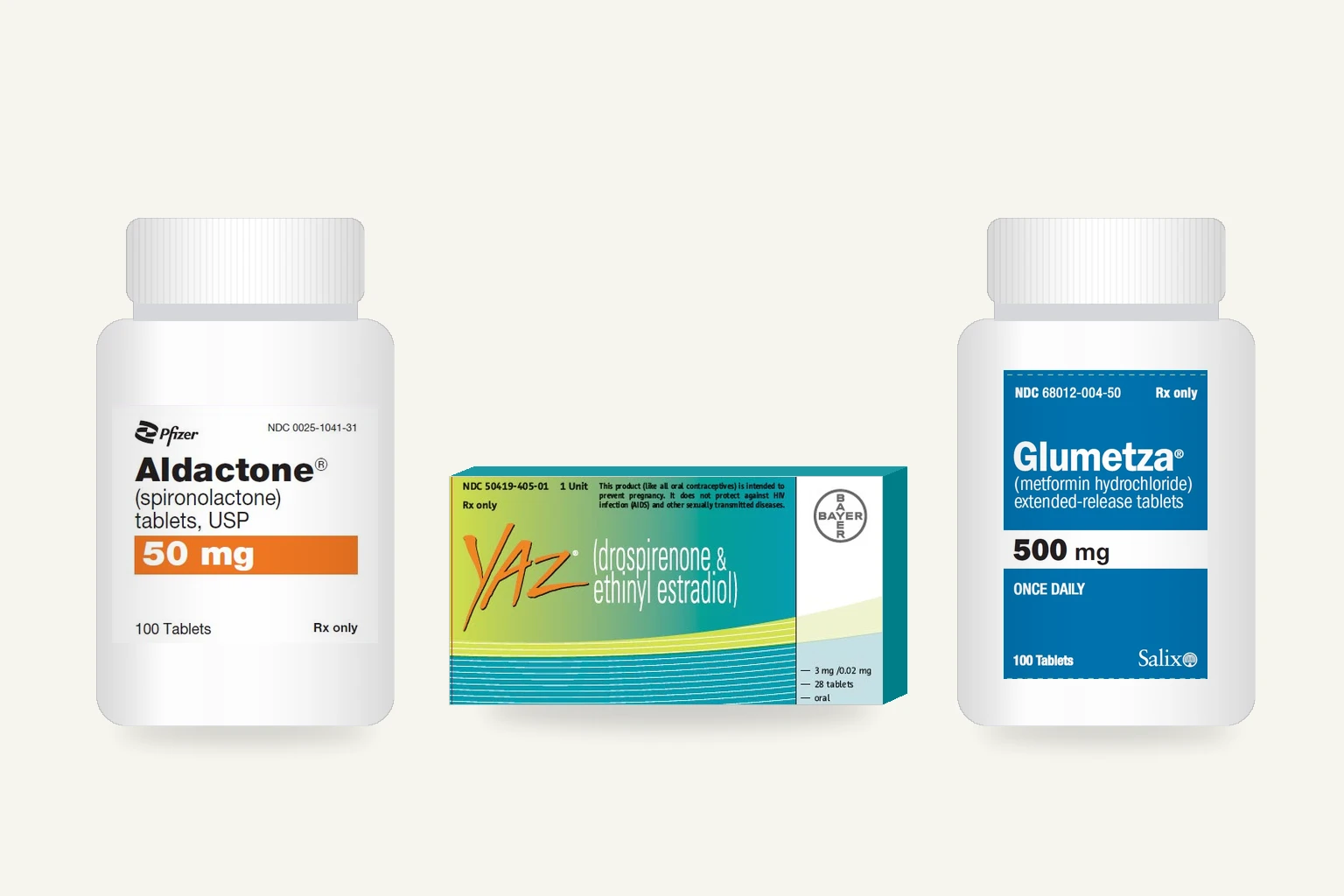
Product labels: Pfizer (Aldactone), Bayer HealthCare Pharmaceuticals (YAZ), and Salix Pharmaceuticals / Bausch Health (Glumetza). Shown to identify the medication classes discussed. KindleeRx is not affiliated with these companies.
Spironolactone, Birth Control, and Metformin for Hidradenitis Suppurativa: Hormonal Flares and Metabolic Screening

Chief Medical Officer
For women whose hidradenitis suppurativa (HS) flares like clockwork before each period or worsened after starting a progestin-only contraceptive, targeted hormonal and metabolic care (led by oral spironolactone, anti-androgenic combined birth control, and metformin) can calm flare frequency without long-term antibiotics (Naik 2026; Huang 2024). Even when blood hormone levels look completely normal on standard labs, hair follicles inside HS-prone folds react sharply to local androgen and insulin signals.
In this article
Why does hidradenitis suppurativa flare right before your period?
HS usually starts shortly after puberty, affects women disproportionately in North America and Europe, and frequently quiets down or changes pattern around pregnancy and menopause. In the days right before bleeding starts, estrogen dips while relative androgen signaling stimulates keratin plugging and inflammatory messengers around apocrine-region hair follicles.
In a 2026 anonymous online survey distributed through United Kingdom and Ireland HS networks (255 respondents), 245 of 255 (96.1%) noticed symptom shifts tied to their cycle, and 244 of those 245 reported premenstrual worsening (Garrett 2026). Online survey samples over-represent people seeking help for cyclic flares, so real-world clinic percentages vary, yet the clinical clue is unmistakable: tracking flares alongside your cycle for 2 to 3 months tells your dermatologist immediately whether hormonal therapy deserves a front-row seat.
How well does spironolactone work for hidradenitis suppurativa and what dose do dermatologists use?
Oral spironolactone (a low-cost generic potassium-sparing blood-pressure pill that blocks androgen receptors at the hair follicle) earned a conditional recommendation for female HS patients in the October 20, 2026 joint American Academy of Dermatology (AAD) and Hidradenitis Suppurativa Foundation (HSF) guidelines (Naik 2026).
- Clinical outcomes: Following an earlier Australian case series of 20 women calling spironolactone a practical, low-cost option (Lee 2015), a retrospective Boston chart review evaluated women taking an average of 75 mg daily over 7.1 months (Golbari 2019). Patients saw meaningful drops in pain, inflammatory lesion counts, and global severity scores, though existing scar tunnels and Hurley stage stayed unchanged.
- Dose reality: In Golbari 2019, women taking under 75 mg daily (averaging 45 mg daily, 25 patients) improved as much as women taking more than 100 mg daily (averaging 112 mg daily, 21 patients). Many dermatologists start at 50 mg to 100 mg daily and adjust to comfort over 3 months.
- Safety and pregnancy boundary: Expect mild increased urination, occasional breast tenderness, or lighter/irregular spotting (which often settles when paired with a combined birth-control pill). Healthy young women with normal kidney function rarely need frequent potassium labs, though older adults or patients taking interacting blood-pressure drugs do. Spironolactone must be stopped before or during pregnancy because anti-androgen exposure can affect fetal development.
Which birth control methods help hidradenitis suppurativa and which can trigger flares?
One of the highest-impact questions on HS forums is: "Did my intrauterine device or implant cause my HS to explode?" Dermatology research confirms that the progestin type inside your birth control matters tremendously.
| Hormonal / Metabolic Option | Typical Effect on HS | Evidence Highlights | Key Precautions |
|---|---|---|---|
| Oral spironolactone (off-label for HS) | Reduces cyclic nodules and flare pain in women | Conditional October 2026 guideline recommendation (Naik 2026); lowered lesions and pain in retrospective chart review (Golbari 2019) | Avoid in pregnancy; takes 8 to 12 weeks for full effect; does not erase deep tunnels |
| Combined oral contraceptive (estrogen + anti-androgenic progestin such as drospirenone) | Often stabilizes or softens premenstrual flares | In a 160-woman cohort, combined users fared markedly better than progestin-only users (Huang 2024); in a 183-patient cohort, users had HS onset nearly 10 years later (Molinelli 2025) | Not suitable for women with migraine with aura, blood-clot history, or smokers age 35 and older; confirm with gynecology |
| Progestin-only methods (levonorgestrel intrauterine device, implant, medroxyprogesterone shot, mini-pill) | Can worsen or trigger HS flares in androgen-sensitive patients | Flagged in North American HS guidelines (Alikhan 2019 Part II) and linked to worse control versus combined pills (Huang 2024) | Never stop contraception abruptly without a backup plan; discuss copper intrauterine device or combined options with gynecology |
| Oral metformin (off-label for HS) | Modest steady anti-inflammatory and insulin-sensitizing help | 18 of 25 patients improved over 24 weeks in an open uncontrolled study, cutting missed workdays from 1.5 to 0.4 monthly (Verdolini 2013) | Extended-release tablets taken with dinner reduce stomach upset; safe option during pregnancy planning (Ozbek 2025) |
In a 2024 retrospective study of 160 adult women with HS (73.1% identifying as Black or African American), women using combined estrogen-progestin contraception were substantially more likely to have stable or improved HS than women using progestin-only contraception (Huang 2024). Similarly, an Italian retrospective cohort of 183 patients observed that women using combined oral contraceptives experienced HS onset an average of 9.8 years later than non-users (Molinelli 2025). If your HS spiked right after getting a hormonal intrauterine device or arm implant, bring that exact timeline to your dermatologist and gynecologist together.
Where does metformin fit for hidradenitis suppurativa and polycystic ovary syndrome?
High insulin levels amplify androgen activity and drive follicular inflammation, which helps explain why polycystic ovary syndrome (PCOS) and insulin resistance overlap frequently with HS. Metformin lowers insulin signaling and quiets inflammatory pathways without suppressing the immune system.
In a 24-week open clinical study of 25 adults with HS who had failed standard treatments, 18 of 25 improved clinically on metformin, 16 of 25 reported meaningful quality-of-life gains, and monthly missed workdays dropped from 1.5 to 0.4 days (Verdolini 2013). Although Verdolini 2013 lacked a placebo group and larger randomized trials are still needed, dermatologists frequently pair extended-release metformin (built up gradually with evening meals to avoid nausea or loose stools) with topicals or biologics in patients with PCOS, prediabetes, irregular periods, or pregnancy plans.
Why do dermatologists screen hidradenitis suppurativa patients for diabetes regardless of age or weight?
Many patients feel blindsided when a dermatologist orders a hemoglobin A1c (HbA1c) blood test for a skin condition. University of North Carolina (UNC) HS specialist Christopher Sayed and colleagues proved why routine screening matters in a landmark study of 250 consecutive HS patients (Ahmad 2021):
- 1 in 5 patients (50 of 250 [20%]) already carried a known type 2 diabetes diagnosis.
- Among the 200 patients without known diabetes who underwent routine clinic screening, 42 of 200 (21%) screened in the prediabetes (dysglycemic) range and 7 of 200 (3.5%) had previously undiagnosed diabetes.
- Crucially, abnormal blood-sugar screens were not limited to older or higher-weight patients: 3 of 16 screened patients (18.8%) with a normal body mass index under 25 and 3 of 22 screened teenagers (13.6%) ages 10 to 19 tested in the prediabetes range.
Catching insulin resistance early protects your heart, kidneys, and future skin flares at the same time. If you are planning a pregnancy or nursing while managing hormonal HS, read our companion guide on HS during pregnancy, breastfeeding, and adolescence.
Important Information
This article is educational and is not personal medical advice. Spironolactone, combined oral contraceptives, and metformin are prescribed off-label for hidradenitis suppurativa in the United States. Spironolactone must not be used during pregnancy, and estrogen-containing contraceptives carry blood-clot risks in certain patients. Never stop or remove contraception without consulting your prescribing clinician. KindleeRx is not affiliated with Pfizer, Bayer, Salix Pharmaceuticals, Bausch Health, or any drug manufacturer named in this article. Always review blood-sugar screening, kidney health, and pregnancy plans with a licensed physician.
Sources
- Naik HB, Yeung H, Frazer-Green L, et al. Joint American Academy of Dermatology-Hidradenitis Suppurativa Foundation guidelines of care for the management of hidradenitis suppurativa. Journal of the American Academy of Dermatology 2026.
- Golbari NM, Porter ML, Kimball AB. Antiandrogen therapy with spironolactone for the treatment of hidradenitis suppurativa. Journal of the American Academy of Dermatology 2019.
- Lee A, Fischer G. A case series of 20 women with hidradenitis suppurativa treated with spironolactone. Australasian Journal of Dermatology 2015.
- Huang CY, Shah SA, Cochrane M, Douglas A, Yang S. Hidradenitis suppurativa disease control associated with type of hormonal contraceptive use. Clinical and Experimental Dermatology 2024.
- Molinelli E, De Simoni E, Dragonetti ML, Belleggia S, Maurizi A, et al. The influence of hormonal combined contraceptive in the onset of hidradenitis suppurativa: a retrospective cohort study. Clinical and Experimental Dermatology 2025.
- Garrett O, Hutchison E, Wainman HE. 'My HS is significantly impacted by my cycle': a cross-sectional study exploring the impact of menstruation and pregnancy on hidradenitis suppurativa. Skin Health and Disease 2026.
- Verdolini R, Clayton N, Smith A, Alwash N, Mannello B. Metformin for the treatment of hidradenitis suppurativa: a little help along the way. Journal of the European Academy of Dermatology and Venereology 2013.
- Ahmad S, Riddle AO, Sayed CJ. Outcomes of Routine Diabetes Screening for Patients with Hidradenitis Suppurativa. Journal of Investigative Dermatology 2021.
- Alikhan A, Sayed C, Alavi A, et al. North American clinical management guidelines for hidradenitis suppurativa: Part II. Journal of the American Academy of Dermatology 2019.
- Ozbek L, Guldan M, Alpsoy E, Vural S. Hidradenitis Suppurativa Treatment During Pregnancy and Lactation: Navigating Challenges. International Journal of Dermatology 2025.
Related Articles

Hidradenitis Suppurativa
Hidradenitis Suppurativa During Pregnancy, Breastfeeding, and Adolescence: Safe Options and 2025-2026 Guidelines
Nov 25, 2026 · 10 min read
Hidradenitis Suppurativa
Hidradenitis Suppurativa: The Complete 2026 Dermatologist Guide (Stages, Causes, and New Guidelines)
Nov 25, 2026 · 14 min read

Hidradenitis Suppurativa
Can Hidradenitis Suppurativa Be Treated Online? What Works Virtually, Costs Without Insurance, and When You Need an Office Visit
Nov 25, 2026 · 12 min read