
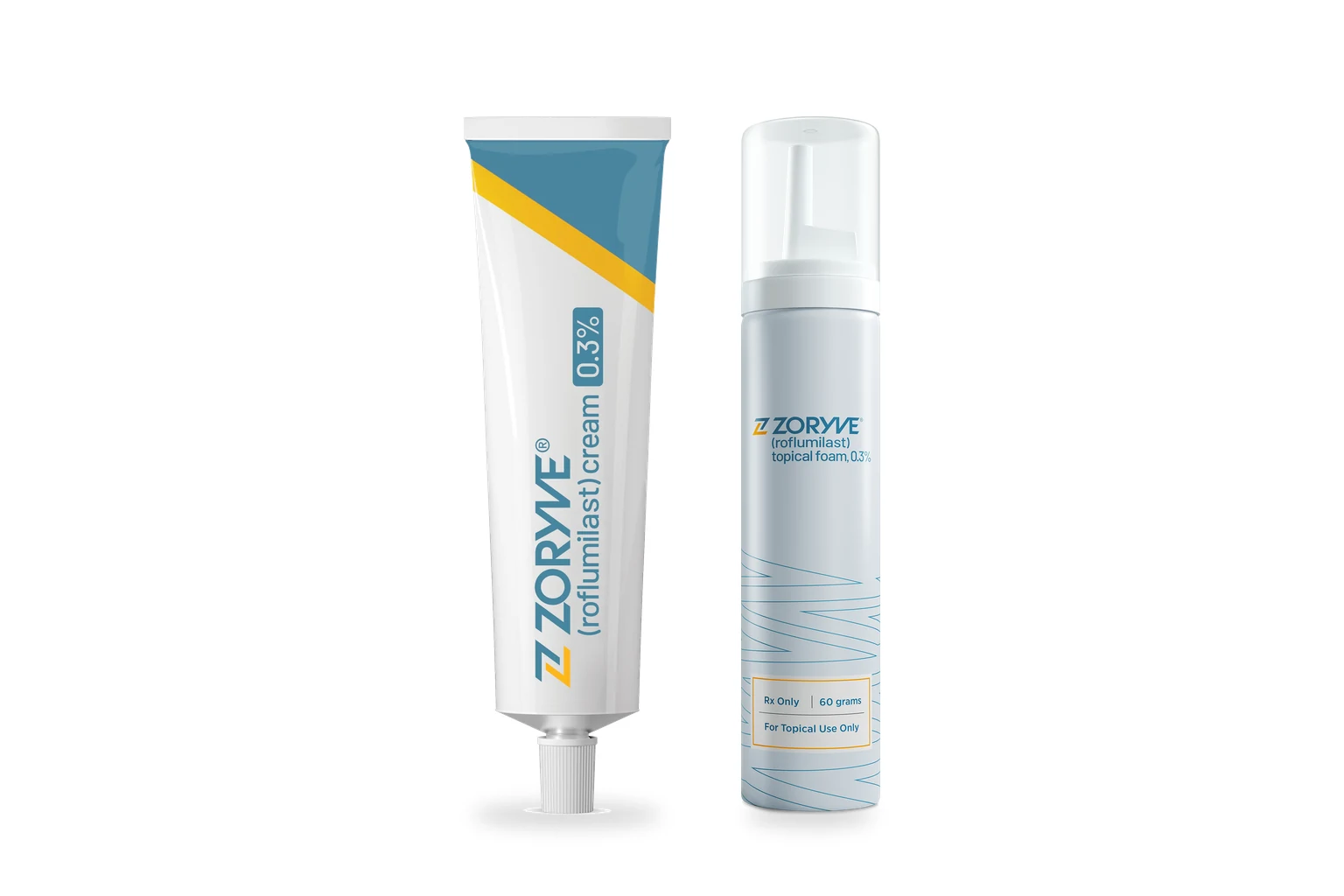
Images: Arcutis Biotherapeutics, maker of Zoryve. Shown to identify the products. KindleeRx is not affiliated with Arcutis Biotherapeutics.
Zoryve Cream vs Foam: Which Strength Treats Which Condition?

Chief Medical Officer
Pick by diagnosis and age: Zoryve cream 0.3% is for plaque psoriasis, cream 0.15% and 0.05% are for eczema, and foam 0.3% is for seborrheic dermatitis and psoriasis of the scalp and body. All four products are roflumilast, a phosphodiesterase-4 (PDE4) inhibitor, applied once daily (Zoryve cream label). The foam has the same 3 mg per gram as the 0.3% cream, and in one three-arm psoriasis trial the 0.3% and 0.15% creams gave similar rates, 28% vs 23% clear or almost clear at week 6 (Lebwohl 2020).
In this article
What is each Zoryve strength approved to treat?
Each strength has its own condition and age range, set by the current labels (revised June 2026):
| Product | Roflumilast per gram | Approved for | Ages | Package |
|---|---|---|---|---|
| Cream 0.3% | 3 mg | Plaque psoriasis, including skin folds | 2 and older | 60 g tube |
| Cream 0.15% | 1.5 mg | Mild to moderate atopic dermatitis (eczema) | 6 and older | 60 g tube |
| Cream 0.05% | 0.5 mg | Mild to moderate atopic dermatitis (eczema) | 2 to 5 | 60 g tube |
| Foam 0.3% | 3 mg | Seborrheic dermatitis | 9 and older | 60 g or 25 g can |
| Foam 0.3% | 3 mg | Plaque psoriasis of the scalp and body | 12 and older | 60 g or 25 g can |
Sources: Zoryve cream label and Zoryve foam label. The foam is not labeled for eczema. The age-2 approval for 0.3% cream rests on small numbers: 11 children aged 6 to 17 on the cream in the main trials and 21 children aged 2 to 5 in a 24-week safety study (cream label). If you are not sure which condition you have, start with eczema vs psoriasis.
Is Zoryve foam only for the scalp?
No. The foam is approved for psoriasis of the scalp and body and for seborrheic dermatitis wherever it appears (Zoryve foam label). In ARRECTOR, patients applied it to the face, scalp, palms, soles, genitals and skin folds, and at week 8 scalp success was 66.4% vs 27.8% on vehicle and body success 45.5% vs 20.1% (Gooderham 2025; foam label). The manufacturer lists the scalp, face, eyebrows, eyelids, in or around the ears, armpits and anywhere with hair as places to use it (Zoryve foam application page).
Is a higher roflumilast percentage stronger or better?
Not in a simple ladder; each strength is matched to a disease and an age. In a 331-patient adult psoriasis trial, 28% on 0.3% cream and 23% on 0.15% cream were clear or almost clear at week 6, against 8% on vehicle (Lebwohl 2020). In a 136-patient eczema trial, the 0.15% and 0.05% creams gave similar average improvements at week 4, though neither separated from the base cream on that main measure (Gooderham 2023).
Age changes the math. On the 0.15% cream, children aged 2 to 5 had about 3.2 times the blood level of roflumilast seen in children aged 12 to 16 (Zoryve cream label). The trial authors note that small children have more skin surface for their weight and often more affected skin, which is why the 0.05% strength was studied for them (Eichenfield 2025).
Can you use Zoryve cream on the scalp or foam on the body?
Foam on the body, yes; cream on the scalp was not studied. The foam's psoriasis approval covers the body as well as the scalp (Zoryve foam label). The psoriasis cream trials did not treat the scalp (Lebwohl 2022), and neither did the eczema cream trials (Simpson 2024).
The manufacturer lists the cream for the face, eyelids, elbows, skin folds and external genital skin such as the groin (Zoryve cream application page). In those trials, a quarter of psoriasis patients had facial plaques and 19% to 24% had skin-fold plaques (Lebwohl 2022). My rule: foam for hair-bearing skin, cream for the rest.
What else is different between Zoryve cream and foam?
The base, the flammability and the storage. The foam was adapted from the 0.3% cream (about 48% water) by adding a propellant (Gooderham 2025). The foam itself is about 65% water and has no fragrance, propylene glycol, polyethylene glycol, isopropyl alcohol or ethanol, and its propellant leaves the skin quickly (Alexis 2026).
Shake the can before each use, apply a thin layer to skin that is not wet, and rub it in completely (Zoryve foam label). Store it upright, never frozen, and below 49°C (120°F). Both forms contain methylparaben and propylparaben, and neither goes in the eyes, mouth or vagina (Zoryve cream label; Zoryve foam label).
Is compounded roflumilast another version of Zoryve?
No. A compounded roflumilast cream is a separate preparation made by a compounding pharmacy, and it is not Zoryve or a generic of it. Compounded drugs are not approved by the Food and Drug Administration (FDA), which does not verify their safety, effectiveness or quality before they are sold (FDA 2025). None of the Zoryve trial numbers above apply to it.
Where does the KindleeRx Calming Cream fit?
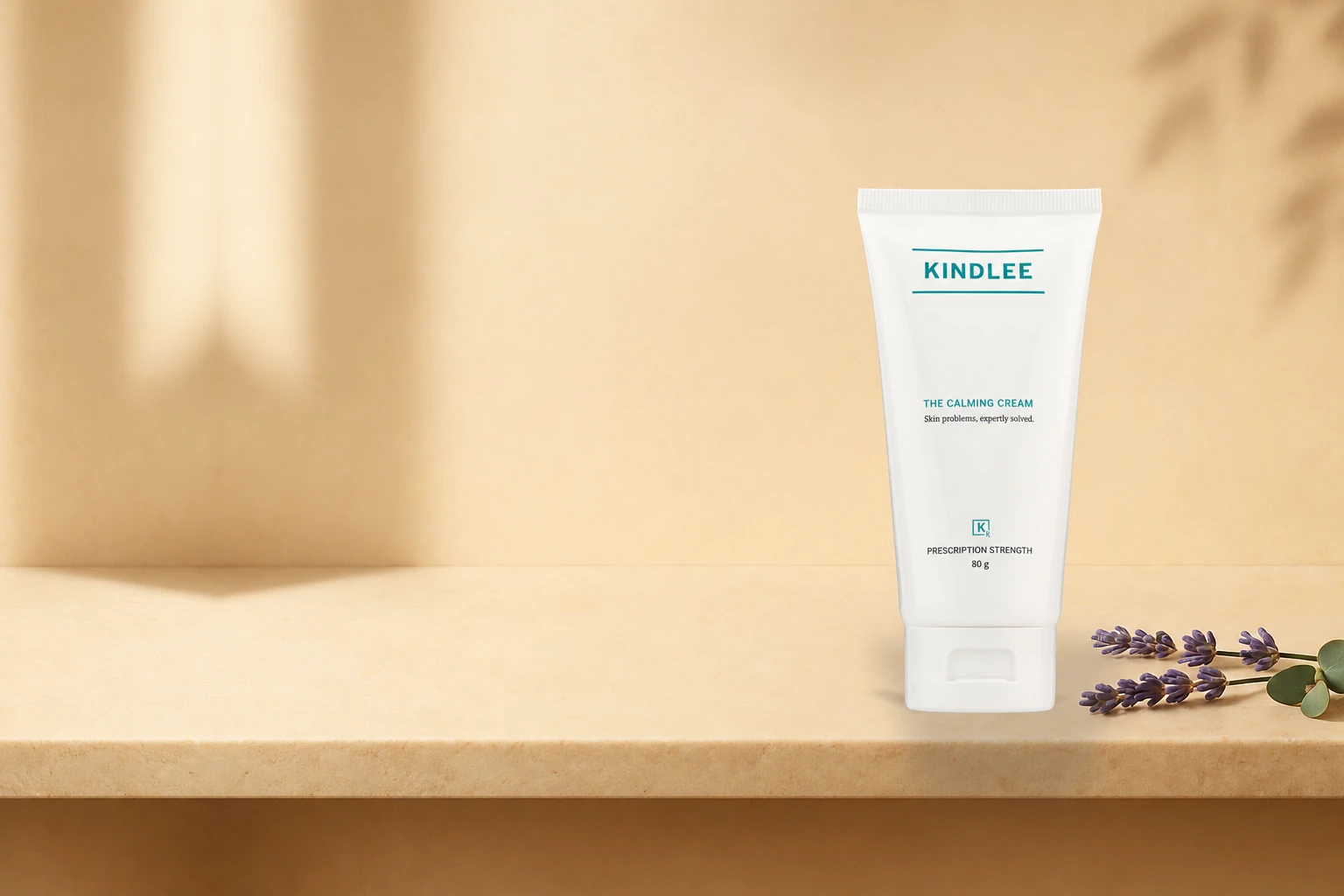
The KindleeRx Calming Cream is a compounded prescription cream with roflumilast 0.2% and calamine 5%, used once daily for mild to moderate eczema or psoriasis when a clinician decides it is appropriate. It is a cream, and the scalp results above come from the foam. Licensed clinicians (physician assistants and nurse practitioners working under a board-certified dermatologist's protocols) review each case online and reply in under 5 hours on average. A prescription is never guaranteed, and if treatment is not prescribed, the refund is full, including the consultation fee. The story behind it is in the roflumilast cream article, and our eczema guide covers the wider options.
Important Information
The KindleeRx Calming Cream is a compounded prescription medication containing roflumilast 0.2% and calamine 5%, prepared by a licensed US compounding pharmacy under a licensed prescriber. It is not Zoryve, it is not a generic of Zoryve, and it is not an FDA-approved drug product. Compounded medications are not reviewed by the FDA for safety, effectiveness, or quality. KindleeRx is not affiliated with Arcutis or Zoryve. Published trial data for branded roflumilast (Zoryve) reflect the branded product and the branded concentrations studied in those trials, not this compounded formula. Eligibility is determined by a licensed clinician after reviewing your information. Not all patients qualify. This article is educational and is not medical advice.
Sources
- Arcutis Biotherapeutics. ZORYVE (roflumilast) cream prescribing information and Patient Information, revised June 2026. DailyMed.
- Arcutis Biotherapeutics. ZORYVE (roflumilast) topical foam prescribing information and Instructions for Use, revised June 2026. DailyMed.
- Arcutis Biotherapeutics. Applying ZORYVE cream. zoryve.com, 2026.
- Arcutis Biotherapeutics. Applying ZORYVE foam. zoryve.com, 2026.
- Lebwohl MG, et al. Trial of roflumilast cream for chronic plaque psoriasis. New England Journal of Medicine 2020.
- Lebwohl MG, et al. DERMIS-1 and DERMIS-2 trials of roflumilast cream 0.3% in plaque psoriasis. JAMA 2022.
- Gooderham M, et al. Roflumilast cream 0.15% and 0.05% in atopic dermatitis, phase 2 trial. Journal of Drugs in Dermatology 2023.
- Simpson EL, et al. INTEGUMENT-1 and INTEGUMENT-2 trials of roflumilast cream 0.15% in atopic dermatitis. JAMA Dermatology 2024.
- Eichenfield LF, et al. INTEGUMENT-PED trial of roflumilast cream 0.05% in children aged 2 to 5. Pediatric Dermatology 2025.
- Gooderham MJ, et al. ARRECTOR trial of roflumilast foam 0.3% in scalp and body psoriasis. JAMA Dermatology 2025.
- Alexis AF, et al. 52-week open-label study of roflumilast foam 0.3% in seborrheic dermatitis. American Journal of Clinical Dermatology 2026.
- US Food and Drug Administration. Compounding and the FDA: Questions and Answers. 2025.
Related Articles
Eczema
Eczema vs. Psoriasis: The 5-Minute Guide to Getting the Right Diagnosis
Feb 15, 2026 · 13 min read
Eczema
I Got Tired of Watching Patients Walk Away From a $900 Cream. So I Built a $70 One.
Jun 13, 2026 · 8 min read
Eczema
The 7 Types of Eczema: A Dermatologist's Complete Guide to Identifying and Treating Each
Feb 10, 2026 · 8 min read