
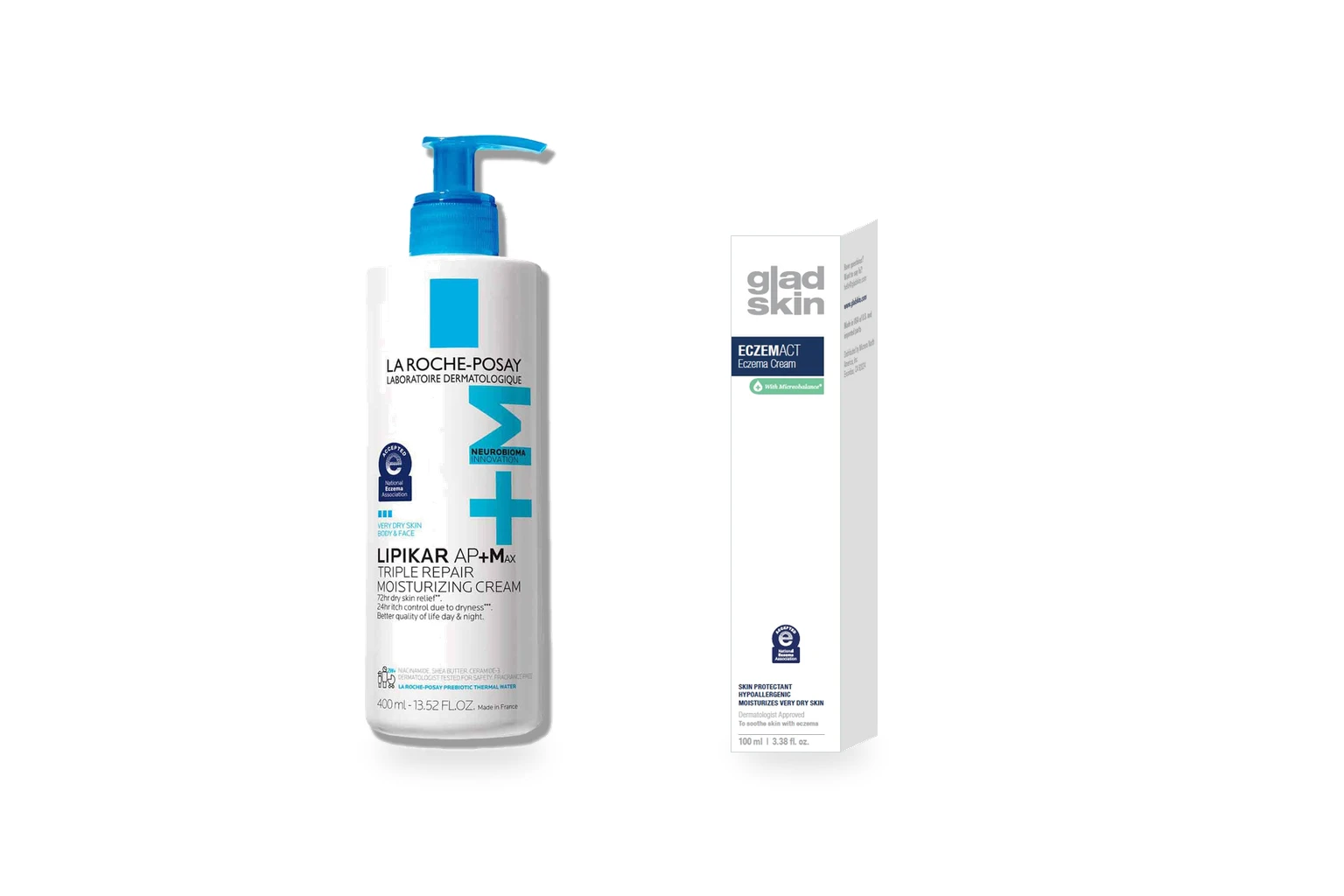
Product images shown for identification. La Roche-Posay (L'Oreal) and Gladskin (Micreos) are trademarks of their respective owners. KindleeRx is not affiliated with or endorsed by these brands.
Topical Probiotics for Eczema: What Clinical Trials Actually Show

Chief Medical Officer
Aisles of "microbiome-balancing" and "probiotic" eczema lotions promise to crowd out flare-causing bacteria naturally, yet the gap between early clinical trials and cosmetic jars on store shelves is huge (Nakatsuji 2021; Locker 2024). Knowing which data come from controlled human trials and which claims belong to cosmetic marketing keeps you from wasting money while your barrier stays inflamed.
In this article
Why does the skin microbiome matter in eczema?
Healthy skin hosts a diverse community of harmless resident bacteria (commensals) that help regulate skin pH, produce protective barrier lipids, and keep hostile microbes in check. During an atopic dermatitis flare, that diversity collapses and Staphylococcus aureus overgrows on cracked, inflamed patches, releasing inflammatory toxins that deepen itching and redness (Nakatsuji 2021).
Researchers asked a logical question: instead of wiping out all surface bacteria with repeated antibiotics, could clinicians apply helpful living human skin microbes (called live biotherapeutic products) to quiet S. aureus directly?
What did early human trials of live skin bacteria actually show?
Two human skin microbes have generated the strongest clinical data so far, and both highlight why dermatologists stay cautiously optimistic rather than calling topical probiotics a proven cure:
| Investigational strain | Human trial design | Measured results | Current clinical limitation |
|---|---|---|---|
| Staphylococcus hominis A9 (ShA9) | Phase 1 randomized, double-blind, 1-week forearm trial in 54 adults with S. aureus-positive eczema (Nakatsuji 2021) | Met primary safety endpoint; cut S. aureus burden and suppressed inflammatory toxin gene signals across all strains; post-hoc subgroup with directly killed S. aureus showed local improvement | No statistically significant eczema severity improvement across the full group at 1 week; not commercially available |
| Roseomonas mucosa (healthy-volunteer strains) | Open-label Phase I/II in 10 adults and 5 children (Myles 2018) plus open-label cohort of 15 children (Myles 2020) | Reduced severity scores, lower topical steroid use, lower S. aureus burden, and colonization persisting up to 8 months without severe adverse events | Open-label without a concurrent placebo arm; strains isolated from eczema patients worsened models, proving exact strain control matters |
Both programs show genuine biology, yet larger, longer, placebo-controlled Phase 2 and Phase 3 trials are still needed before live topical bacteriotherapy enters standard care (Myles 2020; Shobnam 2024).
Why are store-bought 'probiotic' eczema creams different from trial strains?
Three practical realities separate retail skincare jars from experimental clinical trials:
- Preservatives kill live bacteria: Water-based lotions require preservatives so mold and harmful microbes cannot grow inside the bottle. Keeping living skin bacteria alive and stable on a retail shelf remains a major formulation hurdle (Locker 2024).
- Postbiotics and prebiotics are not live probiotics: Most "microbiome" moisturizers contain prebiotics (sugars or thermal water minerals meant to feed resident microbes) or postbiotics (heat-killed bacterial fragments, lysates, or ferments such as Vitreoscilla filiformis or Lactobacillus extracts). These ingredients can be soothing moisturizers, yet they are not living ShA9 or healthy-donor R. mucosa (Han 2024).
- Strain selection and skin compatibility matter: Bacteria adapted to the gut differ from native skin commensals, and matching the right strain to the skin's unique microenvironment is essential (Locker 2024).
What everyday exposures harm healthy skin bacteria?
Supporting the helpful microbes already living on your skin is often more practical than buying expensive specialty creams. In a 2024 Communications Medicine study, researchers found that household benzene, toluene, ethylbenzene, and xylene compounds and isocyanates found in synthetic fabrics (polyester, nylon, and spandex) shifted healthy Roseomonas mucosa and Staphylococcus epidermidis away from protective lipid production while allowing S. aureus to survive longer on synthetic textiles than on natural fabrics (Ratley 2024).
Practical steps that protect both your skin barrier and your native microbiome include:
- Choose breathable natural fabrics next to skin: Favor 100% cotton sheets and base layers over synthetic polyester when flares are active.
- Skip harsh antibacterial body washes: Broad antiseptic washes strip protective resident bacteria alongside unwanted germs.
- Repair the lipid barrier daily: Plain fragrance-free ceramide or petrolatum moisturizers restore normal skin pH and hydration so healthy commensals recover on their own. See our guides to best moisturizers for eczema and natural and holistic eczema remedies.
What evidence-backed treatments calm eczema while microbiome science matures?
When red, itchy patches are actively flaring, proven prescription anti-inflammatory topicals calm the immune cycle fast enough for your skin barrier and resident microbes to rebound together. Compare modern options in our guide to non-steroid eczema creams.
KindleeRx provides clinician-prescribed prescription topicals, not over-the-counter probiotic skincare. For eligible adults with mild-to-moderate eczema, licensed clinicians (physician assistants and nurse practitioners working under a board-certified dermatologist's protocols) review your photos, symptoms, and past treatments through the KindleeRx Eczema Regimen and reply in under 5 hours on average. When clinically appropriate, a licensed clinician selects two prescriptions per 90-day plan (steroid-free options are available) for $149 on the first automatic-refill order, then $149 every 90 days before coupons (including the $20 consultation fee, free shipping, and 90 days of clinician messaging), or $181.25 one-time before coupons. Available in 44 states plus Washington, D.C. (excluding Arkansas, Kansas, Maryland, Mississippi, Nebraska, and West Virginia), with a full refund including the consultation fee if treatment is not prescribed.
Important Information
KindleeRx offers compounded topical prescription medications prepared by licensed United States compounding pharmacies alongside standard generic prescriptions when clinically appropriate. Compounded medications are not approved by the Food and Drug Administration (FDA) and are not reviewed by the FDA for safety, effectiveness, or quality (FDA compounding guidance). No live topical probiotic therapy is FDA-approved to treat eczema. Eligibility is determined by a licensed clinician after reviewing your medical history and photos. Not all patients qualify. Individual results vary. This article is educational and is not medical advice.
Sources
- Nakatsuji T, Hata TR, Tong Y, Cheng JY, et al. Development of a Human Skin Commensal Microbe for Bacteriotherapy of Atopic Dermatitis and Use in a Phase 1 Randomized Clinical Trial. Nature Medicine 2021.
- Myles IA, Earland NJ, Anderson ED, Moore IN, et al. First-in-Human Topical Microbiome Transplantation With Roseomonas mucosa for Atopic Dermatitis. JCI Insight 2018.
- Myles IA, Castillo CR, Barbian KD, Kanakabandi K, et al. Therapeutic Responses to Roseomonas mucosa in Atopic Dermatitis May Involve Lipid-Mediated TNF-Related Epithelial Repair. Science Translational Medicine 2020.
- Ratley G, Zeldin J, Sun AA, Yadav M, et al. Spatial Modeling Connecting Childhood Atopic Dermatitis Prevalence With Household Exposure to Pollutants. Communications Medicine 2024.
- Shobnam N, Ratley G, Zeldin J, Yadav M, et al. Environmental and Behavioral Mitigation Strategies for Patients With Atopic Dermatitis. JAAD International 2024.
- Locker J, Serrage HJ, Ledder RG, Deshmukh S, et al. Microbiological Insights and Dermatological Applications of Live Biotherapeutic Products. Journal of Applied Microbiology 2024.
- Han JH, Kim HS. Skin Deep: The Potential of Microbiome Cosmetics. Journal of Microbiology 2024.
- Food and Drug Administration. Understanding the Risks of Compounded Drugs.
Related Articles
Eczema
Natural and Holistic Remedies for Eczema: What Works, What Doesn't, and the Truth About Coconut Oil
Mar 8, 2026 · 12 min read
Eczema
The Best Moisturizers for Eczema-Prone Skin: Ingredients That Actually Help
Feb 21, 2026 · 12 min read
Eczema
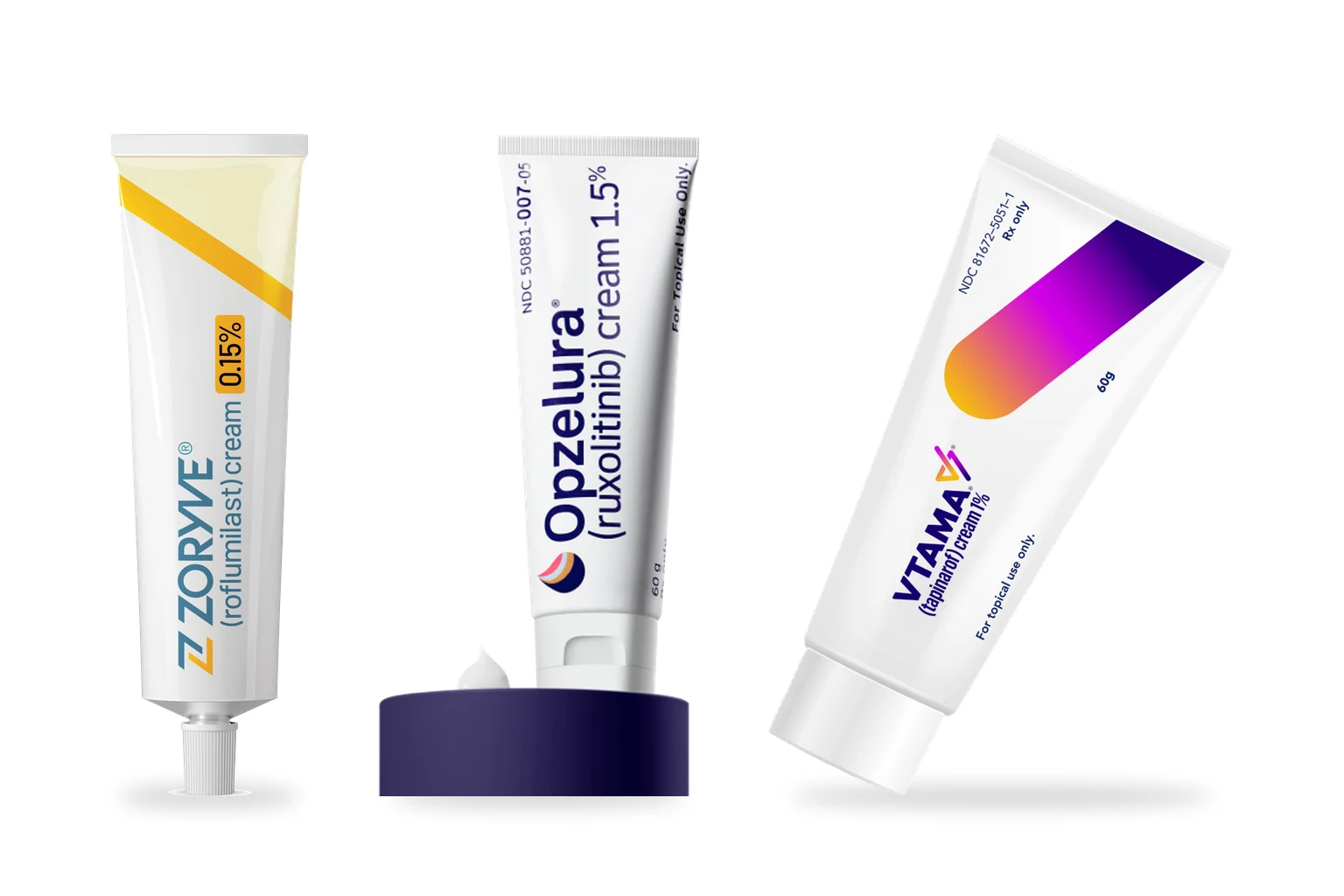
Zoryve vs Opzelura vs Vtama vs Eucrisa: Non-Steroid Eczema Creams Compared
Nov 19, 2026 · 13 min read