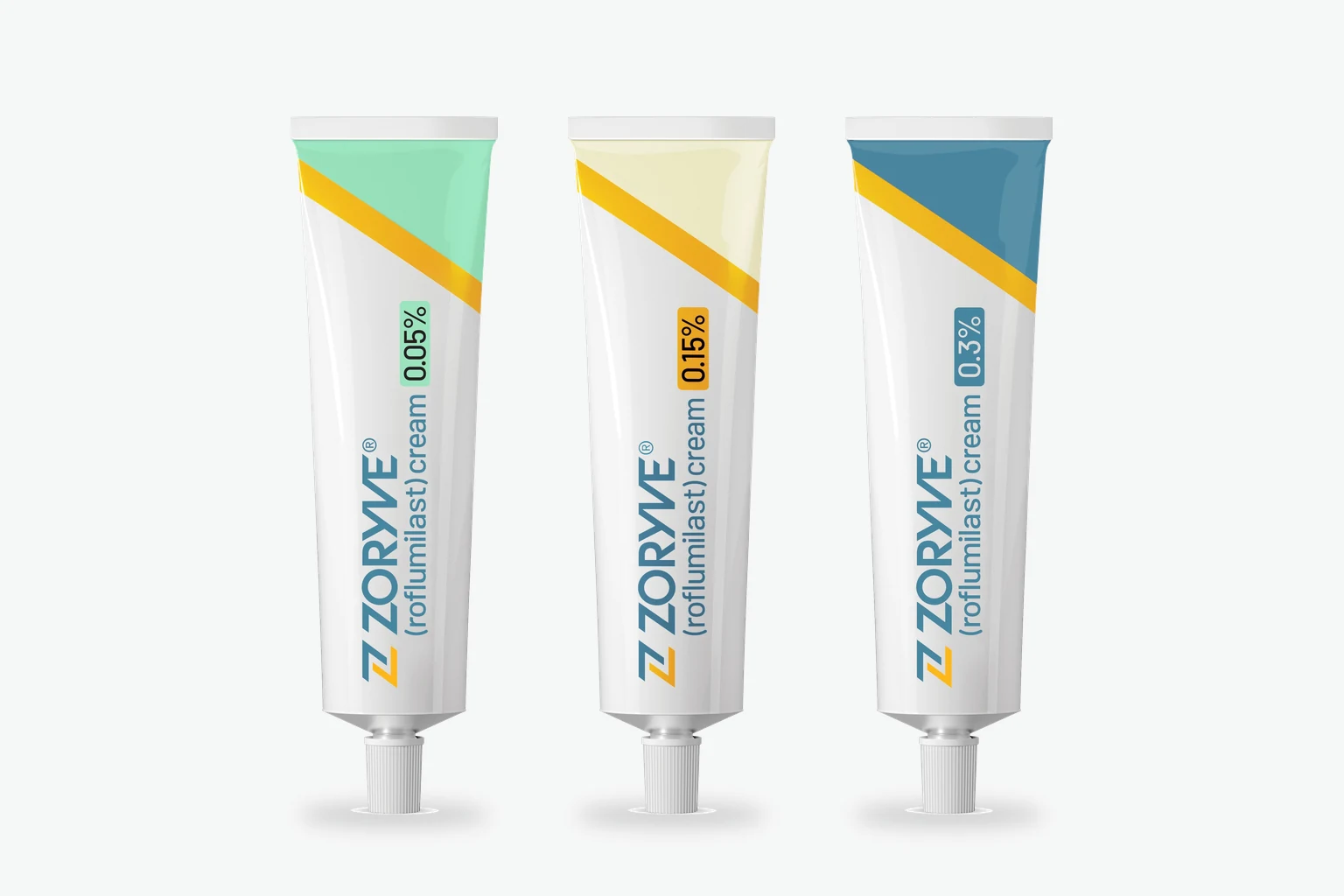
Image: Arcutis Biotherapeutics, maker of Zoryve. Shown to identify the product. KindleeRx is not affiliated with Arcutis Biotherapeutics.
How Long Does Zoryve Take to Work?

Chief Medical Officer
Zoryve starts easing eczema itch within 24 hours, but clearer skin takes 1 to 4 weeks for eczema and 4 to 8 weeks for plaque psoriasis. Zoryve is roflumilast, a phosphodiesterase-4 (PDE4) inhibitor, applied once a day (Zoryve cream label). The trials scored "success" as clear or almost clear skin plus at least a 2-grade improvement on a 5-point scale, and compared Zoryve with its "vehicle", the same cream without the drug. By that measure, 32.0% and 28.9% of eczema patients succeeded at week 4, against 15.2% and 12.0% on vehicle (Zoryve cream label).
In this article
How fast does Zoryve work for eczema?
Visible change starts in week 1 or 2 for some people, and the trials judged the result at week 4. In INTEGUMENT-1, success with Zoryve cream 0.15% was 8.1% vs 0.5% on vehicle at week 1 and 21.2% vs 6.4% at week 2; INTEGUMENT-2 showed 17.7% vs 5.3% at week 2 (Simpson 2024). Those trials enrolled 1,337 people aged 6 and older with mild to moderate eczema.
By week 4, 43.2% and 42.0% reached EASI-75, meaning at least a 75% drop in the Eczema Area and Severity Index (EASI), against 22.0% and 19.7% on vehicle (Simpson 2024). Children aged 2 to 5 on the 0.05% cream moved fast too: 19.2% reached EASI-75 by week 1, and 25.4% vs 10.7% reached success at week 4 (Eichenfield 2025).
When does the itch get better on Zoryve?
For eczema and scalp psoriasis, itch starts to ease within the first day; for body psoriasis, the first measurement was at week 2. Eczema itch scores beat vehicle from 24 hours after the first application in ages 6 and up (Simpson 2024) and in children aged 2 to 5 (Eichenfield 2025). By week 4, itch dropped at least 4 points on a 10-point scale in 33.6% and 30.2% of patients aged 12 and up who started with itch of 4 or more, against 20.7% and 12.4% on vehicle (Zoryve cream label).
The first-day change is small. On the scalp foam, the average itch score fell 0.44 points at 24 hours, against 0.09 on vehicle (Gooderham 2025). The psoriasis cream trials measured nothing before week 2 (Lebwohl 2022). I tell patients to judge the itch at 2 weeks, not day 2.
How long does Zoryve take to work for plaque psoriasis?
Expect a visible change in about a month and the full trial result at 8 weeks. With Zoryve cream 0.3%, success at week 4 was 20.6% vs 2.3% (DERMIS-1) and 19.1% vs 5.3% (DERMIS-2), and the median time to a 50% improvement in the Psoriasis Area and Severity Index (PASI) was 31 and 30 days (Lebwohl 2022).
At week 8, success reached 41.5% and 36.7%, against 5.8% and 7.1% on vehicle (Zoryve cream label). Skin-fold psoriasis did better: 71.5% and 67.5% vs 13.8% and 17.4% (same label). Itch fell at least 4 points by week 8 in 67.5% and 69.4%, against 26.8% and 35.6% (Lebwohl 2022). If you are not sure your rash is psoriasis, read eczema vs psoriasis first.
How long does Zoryve foam take for scalp psoriasis and seborrheic dermatitis?
Both separate from vehicle by week 2. In scalp psoriasis (ARRECTOR trial, ages 12 and up), scalp success on Zoryve foam 0.3% was 30.4% vs 11.7% at week 2 and 53.8% vs 19.5% at week 4, and scalp itch fell at least 4 points in 46.2% vs 16.8% at week 4 (Gooderham 2025). At week 8, the label reports scalp success of 66.4% vs 27.8% (Zoryve foam label).
For seborrheic dermatitis (STRATUM trial), success was 43.0% vs 25.7% at week 2, 73.1% vs 47.1% at week 4, and 79.5% vs 58.0% at week 8 (Blauvelt 2024). The vehicle foam did well on its own, and the phase 2 authors suggested the base itself helps (Zirwas 2023). In a 52-week open study, clear or almost clear skin rose from 56.4% at week 4 to 76.0% at week 24 (Alexis 2026).
What if Zoryve is not working after 4 or 8 weeks?
The label sets no cutoff, so here is my rule: give eczema 4 weeks and psoriasis or seborrheic dermatitis 8 weeks of daily use, then decide. The label says only to apply once daily, with no point at which to reassess (Zoryve cream label). Those week-4 and week-8 marks are where the trials measured their main result.
Partial improvement is a reason to keep going. New psoriasis patients in an open extension went from 26.7% clear or almost clear at week 4 to 56.1% at week 12 and 73.2% at week 24 (ClinicalTrials.gov NCT04286607). Children aged 2 to 5 with eczema reached 63.1% clear or almost clear at week 56, among those still enrolled (Eichenfield 2026). Check your technique, too. Trial patients treated every affected spot daily, even after it cleared (Lebwohl 2022). If I see no change at all by those marks, I change the treatment plan.
Does this timeline apply to compounded roflumilast?
No, these timelines belong to Zoryve, and I won't borrow them for a compounded cream. Every figure on this page comes from trials of branded Zoryve at the strengths and in the base tested in those trials. Compounded drugs are not approved by the Food and Drug Administration (FDA), which means the FDA does not verify their safety, effectiveness or quality before they are sold (FDA 2025). I use the same check-in points with any roflumilast cream: 4 weeks for eczema, 8 weeks for psoriasis.
How does KindleeRx treat eczema and psoriasis?
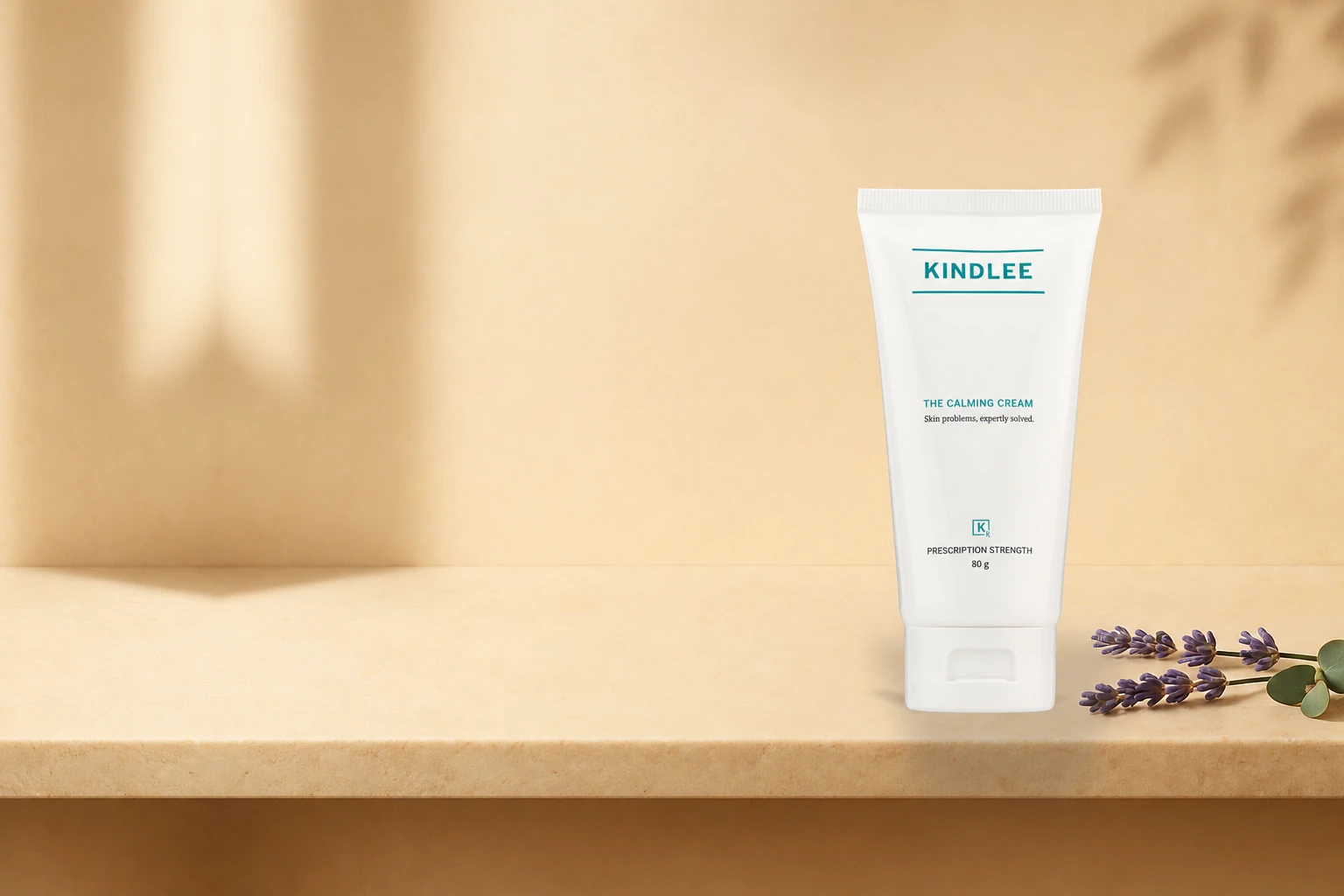
The KindleeRx Calming Cream is a compounded prescription cream with roflumilast 0.2% and calamine 5%, applied once daily for mild to moderate eczema or psoriasis when a clinician decides it fits. Licensed clinicians (physician assistants and nurse practitioners working under a board-certified dermatologist's protocols) review each case online and reply in under 5 hours on average. A separate licensed pharmacy prepares and ships the medication. A prescription is never guaranteed, and if treatment is not prescribed, the refund is full, including the consultation fee. For why I built a roflumilast option, see the roflumilast cream article, and for the bigger picture, our eczema guide.
Important Information
The KindleeRx Calming Cream is a compounded prescription medication containing roflumilast 0.2% and calamine 5%, prepared by a licensed US compounding pharmacy under a licensed prescriber. It is not Zoryve, it is not a generic of Zoryve, and it is not an FDA-approved drug product. Compounded medications are not reviewed by the FDA for safety, effectiveness, or quality. KindleeRx is not affiliated with Arcutis or Zoryve. Published trial data for branded roflumilast (Zoryve) reflect the branded product and the branded concentrations studied in those trials, not this compounded formula. Eligibility is determined by a licensed clinician after reviewing your information. Not all patients qualify. This article is educational and is not medical advice.
Sources
- Arcutis Biotherapeutics. ZORYVE (roflumilast) cream prescribing information and Patient Information, revised June 2026. DailyMed.
- Arcutis Biotherapeutics. ZORYVE (roflumilast) topical foam prescribing information, revised June 2026. DailyMed.
- Simpson EL, et al. INTEGUMENT-1 and INTEGUMENT-2 trials of roflumilast cream 0.15% in atopic dermatitis. JAMA Dermatology 2024.
- Eichenfield LF, et al. INTEGUMENT-PED trial of roflumilast cream 0.05% in children aged 2 to 5. Pediatric Dermatology 2025.
- Eichenfield LF, et al. INTEGUMENT-OLE extension in children aged 2 to 5. Pediatric Dermatology 2026.
- Lebwohl MG, et al. DERMIS-1 and DERMIS-2 trials of roflumilast cream 0.3% in plaque psoriasis. JAMA 2022.
- ClinicalTrials.gov. NCT04286607, DERMIS-OLE posted results.
- Gooderham MJ, et al. ARRECTOR trial of roflumilast foam 0.3% in scalp and body psoriasis. JAMA Dermatology 2025.
- Blauvelt A, et al. STRATUM trial of roflumilast foam 0.3% in seborrheic dermatitis. Journal of the American Academy of Dermatology 2024.
- Zirwas MJ, et al. Phase 2a trial of roflumilast foam 0.3% in seborrheic dermatitis. JAMA Dermatology 2023.
- Alexis AF, et al. 52-week open-label study of roflumilast foam 0.3% in seborrheic dermatitis. American Journal of Clinical Dermatology 2026.
- US Food and Drug Administration. Compounding and the FDA: Questions and Answers. 2025.