
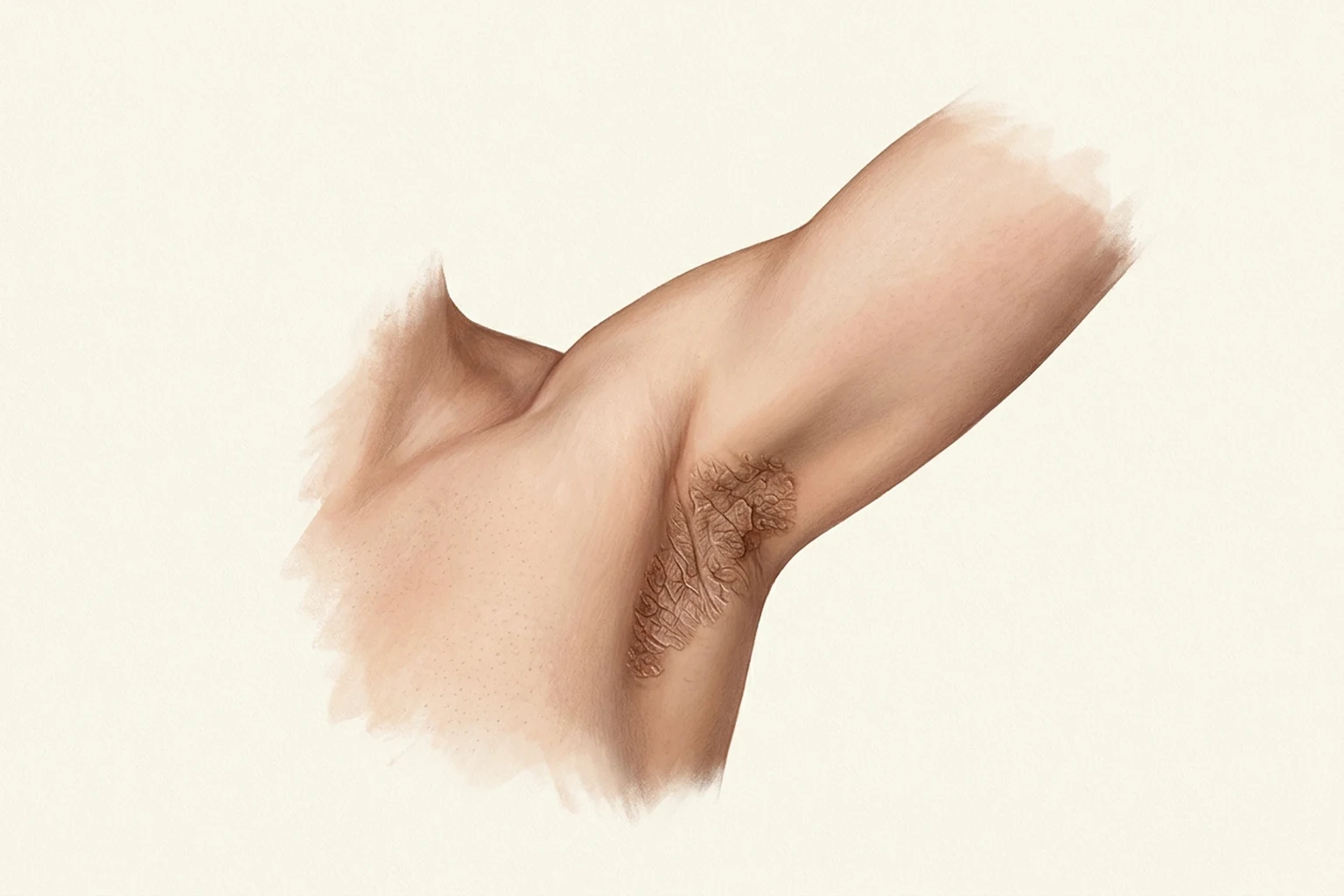
AI-generated illustration. Not an actual patient or treatment result.
Stubborn Armpit or Groin Rash? Granular Parakeratosis From Laundry Sanitizers (Benzalkonium Chloride)

Chief Medical Officer
If a scaly, red-to-brown skin-fold rash in the groin, armpits, or waistband refuses to clear on antifungal creams, antibiotics, or hydrocortisone, check your laundry room for a liquid laundry sanitizer containing benzalkonium chloride (BAK) (Dear 2022). Dermatologists have documented a surge of granular parakeratosis linked directly to quaternary-ammonium laundry rinse aids since antibacterial laundry additives became household staples.
In this article
What is granular parakeratosis, and how does it look?
Granular parakeratosis is a distinctive skin-barrier reaction in which outer dead skin cells retain microscopic protein granules (keratohyalin) instead of shedding normally. Rather than looking like wet red eczema, the skin often takes on a symmetric, reddish-brown, dry, multilayered or crinkled "stuck-on" scale across warm, friction-prone folds (Dear 2022; Tian 2021).
Classic clues that separate it from simple fungal jock itch or inverse psoriasis include:
- Location matching clothing friction: The groin, inner thighs, buttocks, armpits, waistband, and undergarment-covered zones flare symmetrically, sometimes sparing the spinal midline where fabric hangs loosely away from the back (Fang 2026).
- Brownish, papery sheets of peeling skin: As redness fades, sheets of thick brownish scale peel away cleanly.
- Negative fungal swabs: Fungal microscopy and periodic acid-Schiff stains come back completely negative (Fang 2026).
How do benzalkonium chloride laundry sanitizers trigger this rash?
Laundry sanitizers marketed as "bleach-free fabric disinfectants" are poured into the fabric-softener compartment so they sit on clothes during the final rinse cycle. Their active quaternary-ammonium antiseptic, benzalkonium chloride (often listed as alkyl dimethyl benzyl ammonium chloride), bonds electrostatically to cotton and synthetic fibers and stays behind after drying.
Once sweat warms damp underwear, athletic wear, or towels against skin folds, residual BAK leaches into the outer skin layer and disrupts normal skin-cell maturation. In a 2026 case report of generalized granular parakeratosis following regular use of a 0.5 g/L BAK laundry sanitizer, the rash spread across the groin, armpits, elbow creases, and undergarment zones in a patient with a history of eczema, then resolved completely within about 1 month of eliminating BAK and rinsing garments (Fang 2026).
Why do antifungal creams, antibiotics, and steroids fail?
Granular parakeratosis is thought to be a toxic-irritant keratinization reaction, not an infection. Antifungals like clotrimazole or terbinafine and oral antibiotics cannot clear a chemical residue continuously re-applied every time you pull on freshly washed underwear (Dear 2022). Potent topical steroids may briefly mute redness, yet the brown peeling bounces right back until the contaminated fabric source is broken, and overusing strong steroids in thin groin or armpit folds risks permanent stretch marks and skin thinning.
How do you clear benzalkonium chloride out of clothes and your washer?
Stopping the bottle alone often fails for weeks if antiseptic film remains inside the washer drawer and fabric weave. Follow the exact decontamination checklist documented across cured dermatology series (Dear 2022; Fang 2026):
- Audit every laundry bottle: Stop any liquid laundry sanitizer, antibacterial rinse aid, or fabric conditioner listing benzalkonium chloride or alkyl dimethyl benzyl ammonium chloride (also check antiperspirants and soothing wipes for BAK).
- Clean the washing machine first: Scrub out the fabric-softener tray and run at least one hot empty wash cycle (or tub-clean cycle) to flush trapped sanitizer residue.
- Rewash affected clothes and towels repeatedly: Wash underwear, workout gear, sheets, and towels two to three times in plain fragrance-free detergent with extra rinse cycles (occasionally heavily impregnated older undergarments are easiest to replace).
- Soothe the barrier while scale sheds: Apply plain fragrance-free petrolatum or bland barrier cream twice daily; most rashes settle visibly within 2 to 4 weeks once exposure truly stops.
When should a persistent skin-fold rash be evaluated by a clinician?
Skin-fold rashes can also represent true inverse psoriasis, intertrigo (moisture and yeast inflammation), allergic contact dermatitis (from fragrances or preservatives), or bacterial erythrasma. Read our checklists on skincare ingredients to avoid with eczema, everyday eczema triggers, and inverse and genital psoriasis treatment.
If a fold rash does not begin settling within 2 to 3 weeks after eliminating laundry sanitizers, or if you have oozing cracks, fever, or worsening pain, have a clinician examine the skin. KindleeRx does not diagnose or treat granular parakeratosis. For eligible adults with confirmed mild-to-moderate eczema or inverse psoriasis who want gentle, steroid-free prescription options suited to sensitive folds, licensed clinicians (physician assistants and nurse practitioners working under a board-certified dermatologist's protocols) review your intake, product list, and photos online and reply in under 5 hours on average. When clinically appropriate, a licensed clinician selects two prescriptions per 90-day plan (steroid-free options are available): the KindleeRx Eczema Regimen costs $149 on the first automatic-refill order, then $149 every 90 days before coupons (including the $20 consultation fee, free shipping, and 90 days of clinician messaging), or $181.25 one-time before coupons, and the KindleeRx Psoriasis Regimen costs $149 on the first automatic-refill order, then $149 every 90 days before coupons (including the $20 consultation fee, free shipping, and 90 days of clinician messaging), or $181.25 one-time before coupons. For a single steroid-free option suited to sensitive areas, compounded Calming Cream (roflumilast 0.2% with calamine 5%, 80 g) costs $70 on the first 90-day automatic-refill order, then $70 every 90 days before coupons (including the $20 consultation fee, free shipping, and 90 days of clinician messaging), or $80 one-time before coupons. Available in 44 states plus Washington, D.C. (excluding Arkansas, Kansas, Maryland, Mississippi, Nebraska, and West Virginia), with a full refund including the consultation fee if treatment is not prescribed. Uncertain persistent brown scaly plaques needing a skin biopsy belong with an in-person dermatologist.
Important Information
KindleeRx offers compounded topical prescription medications (including Calming Cream, roflumilast 0.2% with calamine 5%) prepared by licensed United States compounding pharmacies alongside standard generic prescriptions when clinically appropriate. Compounded medications are not approved by the Food and Drug Administration (FDA) and are not reviewed by the FDA for safety, effectiveness, or quality (FDA compounding guidance). KindleeRx does not diagnose or treat granular parakeratosis and does not perform in-office skin biopsies or fungal scrapings. Eligibility is determined by a licensed clinician after reviewing your medical history and photos. Not all patients qualify. Individual results vary. This article is educational and is not medical advice.
Sources
- Dear K, Gan D, Stavrakoglou A, Ronaldson C, Nixon RL. Hyperkeratotic Flexural Erythema (More Commonly Known as Granular Parakeratosis) With Use of Laundry Sanitizers Containing Benzalkonium Chloride. Clinical and Experimental Dermatology 2022.
- Tian CJ, Purvis D, Cheng HS. Granular Parakeratosis Secondary to Benzalkonium Chloride Exposure From Common Household Laundry Rinse Aids. New Zealand Medical Journal 2021.
- Fang M, Zhang J, Qu Z, Hu B, et al. Granular Parakeratosis Associated With the Use of Laundry Sanitizers Containing Benzalkonium Chloride: A Case Report. Frontiers in Allergy 2026.
- Food and Drug Administration. Understanding the Risks of Compounded Drugs.
Related Articles
Example: Fragrance
Eczema
Which Common Ingredients Should People with Eczema Avoid?
Feb 27, 2026 · 8 min read
Psoriasis
Inverse and Genital Psoriasis: Which Creams Are Safe for Skin Folds?
Nov 19, 2026 · 10 min read
Eczema
Understanding Eczema Triggers: A Dermatologist's Guide
Mar 20, 2026 · 3 min read