

AI-generated image. Not an actual patient or treatment result.
Terbinafine Cost Without Insurance: Generic Pills, Visits, and Online Options

Chief Medical Officer
Without insurance, generic oral terbinafine 250 mg tablets cost roughly $12 to $18 per 30-tablet fill with a free pharmacy discount coupon (roughly $36 to $54 for a full 12-week, 84-tablet supply), but the real out-of-pocket total depends on what you pay for the prescriber visit, follow-up care, and any lab testing.
In this article
How much does generic terbinafine cost without insurance?
Because terbinafine has been generic for decades, the cash pharmacy price is low compared with branded topical solutions. On its FDA label, standard daily dosing for toenail onychomycosis is one 250 mg tablet daily for 12 weeks (84 tablets total), which achieved 70% mycological cure and 38% complete cure at week 48 (terbinafine label).
| Route to oral terbinafine | Medication cost (cash) | Visit and follow-up fees | What is included |
|---|---|---|---|
| In-person dermatology or podiatry + retail pharmacy | ~$12 to $18 per 30 tablets (~$36 to $54 for 84 tablets with coupon, GoodRx) | Billed separately for initial office consult + any follow-up visits or lab bills | Hands-on foot exam, in-office nail trimming or biopsy if needed; oral pills filled at local pharmacy |
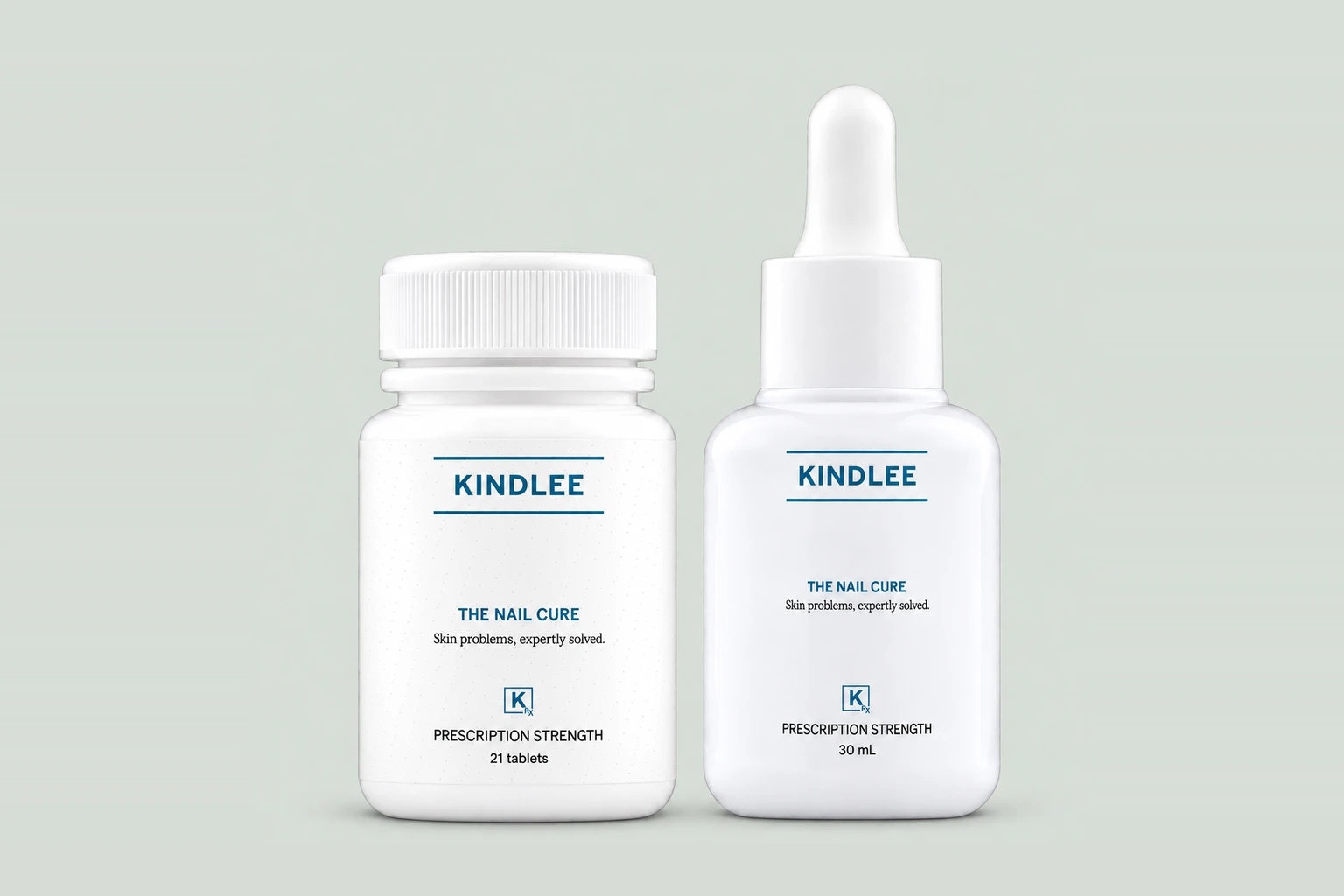
| KindleeRx Nail Regimen (details) | Bundled: $99 first 90-day automatic-refill order, then $99 every 90 days (before coupons); $118.75 one-time (before coupons) | $20 consult fee and 90 days unlimited clinician messaging included; free shipping | 21 oral terbinafine 250 mg tablets (off-label pulse) + 30 mL 5-ingredient compounded topical if prescribed; full refund if not prescribed |
Public pharmacy prices vary by ZIP code, pharmacy chain, and discount card; the November 2026 ranges above reflect typical coupon cash listings rather than uninsured list prices, which can be much higher if you do not present a coupon at checkout.
Why is the total self-pay cost much higher than the pharmacy pill price?
Three clinic-side charges routinely turn a low-cost generic prescription into a much bigger cash bill:
- Initial specialist visit fee: Self-pay new-patient dermatology or podiatry visits are billed separately from your prescription, and long access delays compound the frustration (in a dermatology wait-time survey, 55% of patients reported waiting 3 months or longer for an appointment, Rivera 2026).
- Follow-up and medication-adjustment visits: If you develop side effects, have a drug-interaction question, or need a renewal check at 3 months, each office follow-up typically carries its own charge.
- Separate diagnostic lab bills: If an office clips your nail for potassium hydroxide (KOH) microscopy, fungal culture, or periodic acid-Schiff (PAS) pathology staining, or orders a new blood panel, the outside laboratory bills separately from the doctor's office fee.
Do you have to pay out of pocket for liver tests or nail clippings?
Not in every case:
- Liver blood tests: KindleeRx does not make a liver blood test a requirement before starting terbinafine. Before prescribing oral terbinafine, your clinician may ask for copies of your earlier liver blood test results, or ask your primary care provider to order a test. In a retrospective review of 4,309 oral terbinafine courses, ALT rises during treatment (3.5%) matched baseline rates (3.6%) and 99.9% of checks did not change therapy (Stolmeier 2018). If a clinician does ask for a new baseline hepatic panel because of your history, ask the lab for its cash self-pay rate up front before your blood is drawn. For full liver-monitoring and alcohol details, read terbinafine liver tests and alcohol safety.
- Nail confirmation tests: A nail clipping is not automatically required to start online care, though your clinician may ask for a nail test when photos are unclear or prior prescription treatment failed.
How does an online bundled terbinafine plan compare on total cost?
When you have no insurance and no red-flag foot symptoms, a flat-fee online program removes surprise visit and follow-up charges. KindleeRx's Nail Regimen costs $99 for the first 90-day order with automatic refills, then $99 every 90 days (cancel anytime with one click), or $118.75 for a one-time purchase, before coupons.
Every order includes the $20 consultation, evaluation by licensed physician assistants and nurse practitioners working under a board-certified dermatologist's protocols (replies in under 5 hours on average), 21 oral terbinafine 250 mg tablets (off-label pulse: 1 tablet daily for 1 week each month) plus a 30 mL compounded topical solution (itraconazole 1%, terbinafine 3%, urea 20%, tea tree oil 6.6%, and dimethyl sulfoxide [DMSO]) when prescribed, free shipping, and 90 days of unlimited clinician messaging. Itemized receipts are available in the portal for health savings account or flexible spending account (HSA/FSA) reimbursement. Available across 44 states plus Washington, D.C. (excluding Arkansas, Kansas, Maryland, Mississippi, Nebraska, and West Virginia).
If a clinician decides oral or topical treatment is not appropriate for you, you receive a full refund including the $20 consultation fee. Orders also carry a 90-day satisfaction refund guarantee (consultation fee included, after follow-up photos and clinician review).
How can uninsured patients avoid wasting money on treatments that fail?
- Skip months of drugstore bottles: Over-the-counter topical antifungals rarely penetrate the thick keratin nail plate (Gupta 2013; American Academy of Dermatology (AAD)), yet 55.5% of United States adults with superficial fungal infections try nonprescription products first (Benedict 2022).
- Avoid paying cash for unproven laser packages: A 2020 Cochrane review found low-quality evidence showing little or no difference in 52-week fungal clearance for 1064-nm neodymium-doped yttrium aluminum garnet (Nd:YAG) laser versus sham or no treatment (Foley 2020).
- Expect realistic outgrowth timing: A big toenail takes 12 to 18 months to grow out clear (AAD), so judge early success by clear new nail at the base rather than buying new products every month. See our full toenail fungus treatment cost without insurance comparison or start with our complete toenail fungus guide.
Important Information
KindleeRx's topical nail solution (itraconazole 1%, terbinafine 3%, urea 20%, tea tree oil 6.6%, and DMSO) is a compounded prescription medication prepared by a licensed United States compounding pharmacy under a prescriber's order. Compounded medications are not approved by the FDA and are not evaluated by the FDA for safety, effectiveness, or quality (FDA compounding guidance). Oral terbinafine pulse dosing (21 tablets over 3 months) is an off-label regimen that differs from the FDA-approved 12-week daily schedule. Published cure rates cited for daily oral terbinafine and combination trials reflect those specific studied regimens, not KindleeRx's exact formula. Eligibility is determined by a licensed clinician after reviewing your medical history, medications, and nail photos. Not all patients qualify. Full refund including the consultation fee if treatment is not prescribed, or within 90 days under the satisfaction guarantee (follow-up photos and clinician review required). Individual results vary. This article is educational and is not medical advice.
Sources
- GoodRx. Generic Terbinafine Cash Pricing (checked November 2026).
- Aurobindo Pharma. Terbinafine Hydrochloride Oral Tablets Prescribing Information. DailyMed 2026.
- Stolmeier DA, Stratman HB, McIntee TJ, Stratman EJ. Utility of Laboratory Test Result Monitoring in Patients Taking Oral Terbinafine or Griseofulvin for Dermatophyte Infections. JAMA Dermatology 2018.
- Shemer A, et al. Combination of Oral Terbinafine and Topical Ciclopirox Compared to Oral Terbinafine for Onychomycosis. Journal of Dermatological Treatment 2005.
- Foley K, et al. Topical and Device-Based Treatments for Fungal Infections of the Toenails. Cochrane Database of Systematic Reviews 2020.
- Benedict K, Gold JAW, Wu K, et al. High Frequency of Self-Diagnosis and Self-Treatment in a Nationally Representative Survey About Superficial Fungal Infections in Adults, United States, 2022. Journal of Fungi 2022.
- Gupta AK, Simpson FC. Investigational Drugs for Onychomycosis. Expert Opinion on Investigational Drugs 2013.
- Rivera LV, Gonzalez RM, Torres LM, et al. Dermatology Appointments as an Indicator of Systemic Healthcare Issues. Cureus 2026.
- American Academy of Dermatology. Nail Fungus: Diagnosis and Treatment.
- Food and Drug Administration. Understanding the Risks of Compounded Drugs.
Related Articles
Nail Care
Toenail Fungus Treatment Cost Without Insurance: Self-Pay Options Compared
Nov 24, 2026 · 11 min read

Nail Care
Terbinafine and Your Liver: Blood Tests, Alcohol and Drug Interactions
Nov 19, 2026 · 9 min read

Nail Care
Best online toenail fungus treatment: Which option fits you?
Sep 15, 2026 · 7 min read