
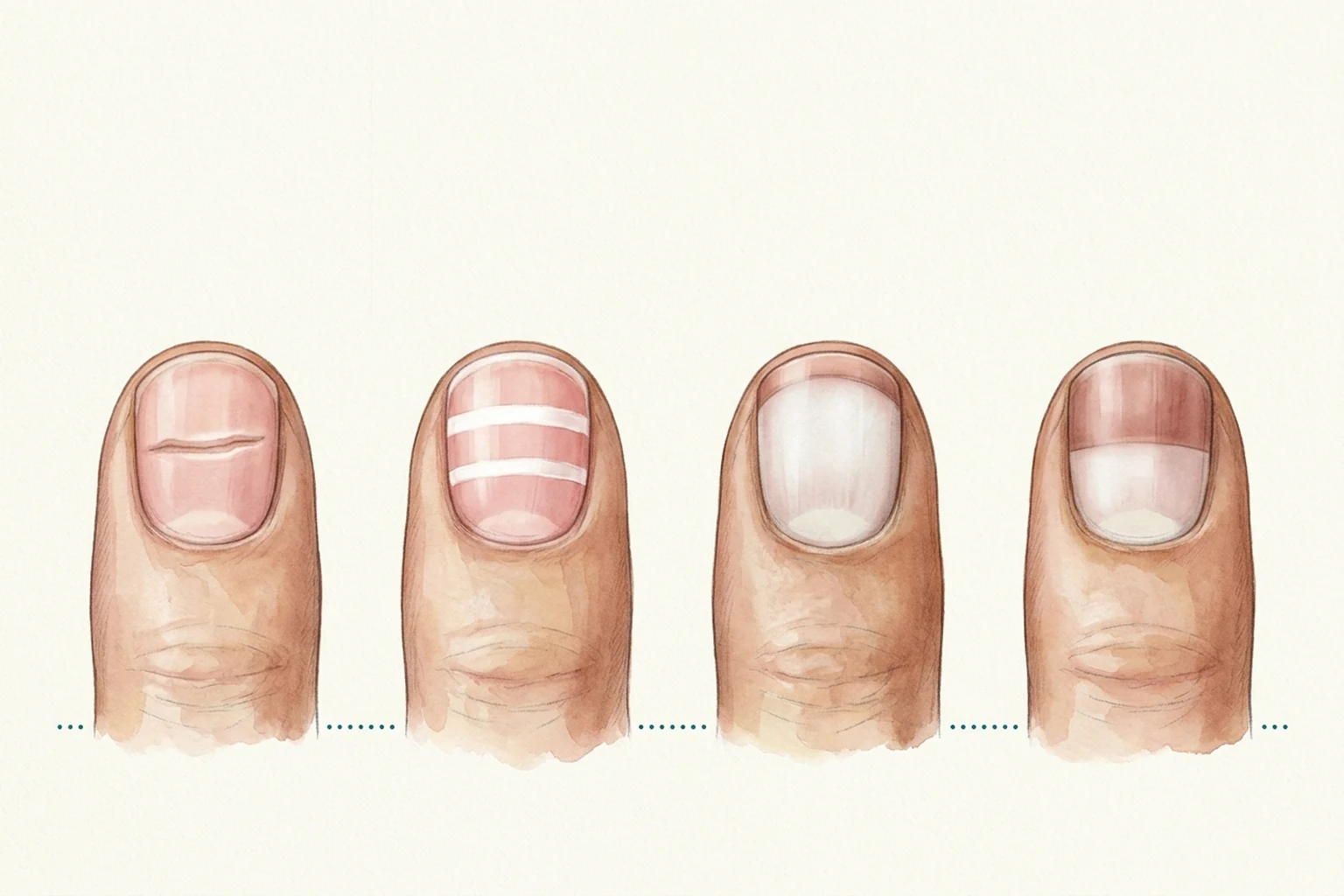
AI-generated illustration. Not an actual patient or treatment result.
Horizontal Nail Lines and Two-Tone Nails: Beau's, Mees', Muehrcke's, Terry's, and Half-and-Half Clues

Chief Medical Officer
Your nails record systemic stress much like growth rings inside a tree trunk. When matching grooves, paired white bands, or two-tone color changes show up across most of your fingernails, antifungal drops are the wrong tool and a medical checkup is the right one (Iorizzo 2022; Tully 2012).
In this article
Why are matching horizontal lines across several nails almost never fungus?
Fungal nail infections enter from the outside edge of one or a few nails (most commonly toenails) and spread asymmetrically. By contrast, when every fingernail shows an identical crosswise dent or color shift at the same distance from the cuticle, something affected all ten nail roots at the exact same time through the bloodstream, such as a high fever, major surgery, chemotherapy cycle, or change in liver, kidney, or blood protein levels (Fawcett 2004; Lee 2022).
How do you tell Beau's lines, Mees' lines, and Muehrcke's lines apart?
Dermatologists separate horizontal bands by checking three physical details: whether you can feel a dent, whether the band fades when you press the nail, and whether it moves toward the fingertip over weeks (Mirfazaelian 2011; Iorizzo 2022):
| Nail sign | Feel & press test | Moves as nail grows? | Key clinical associations |
|---|---|---|---|
| Beau's lines | Palpable horizontal groove indented into the nail surface | Yes (grows out at roughly 3 mm/month on fingernails) | Temporary matrix pause after severe illness, high fever, surgery, chemotherapy, or severe cold/Raynaud's (Fawcett 2004; Saraswat 2020) |
| Mees' lines | Smooth (impalpable) single or multiple white bands; does not fade when pressed | Yes (true leukonychia inside the nail plate) | Chemotherapy, heavy-metal toxicity (such as arsenic), or severe systemic illness (Mirfazaelian 2011; Iorizzo 2022) |
| Muehrcke's lines | Smooth paired horizontal white bands; blanches/fades when pressed | No (vascular nail-bed change stays fixed in place) | Low blood albumin (hypoalbuminemia) from kidney, liver, or nutritional states, or chemotherapy (Fawcett 2004; Saraswat 2020) |
| Terry's nails | Smooth; most of nail looks frosted white with narrow pink-brown rim at tip | No (nail-bed apparent leukonychia) | Liver cirrhosis, congestive heart failure, diabetes, renal failure, or normal aging (Meegada 2020) |
| Lindsay's (half-and-half) nails | Smooth; base half dull white, outer half pink to brown | No (nail-bed vascular change) | Chronic kidney disease (Raja 2021; Iorizzo 2022) |
What do Terry's nails and Lindsay's half-and-half nails suggest?
Both patterns belong to apparent leukonychia, meaning the white haze comes from fluid or blood-vessel changes in the nail bed underneath rather than a defect inside the nail plate itself (Iorizzo 2022).
- Terry's nails turn roughly 80% or more of the nail frosted ground-glass white, leaving only a thin 1 to 2 mm pink or brown strip at the tip. While older adults can see mild versions with normal aging, new Terry's nails warrant checking liver function, heart health, blood sugar, and kidneys (Meegada 2020).
- Lindsay's half-and-half nails divide the nail roughly 50/50 (white near the cuticle, reddish-brown across the outer half) and serve as a classic bedside prompt to check serum creatinine and kidney function (Raja 2021).
Neither pattern proves an internal disease by itself, yet either one justifies routine blood work with your primary care clinician.
What do nail shedding (onychomadesis) and splinter hemorrhages mean?
- Onychomadesis (painless shedding from the base): A deep Beau's line that pauses matrix growth completely can separate the entire old nail from its root weeks after hand-foot-and-mouth disease, severe viral fevers, chemotherapy, antiepileptic drugs, or autoimmune flares; a healthy new nail typically pushes the old plate forward smoothly (Hardin 2015).
- Splinter hemorrhages: Tiny dark red or brown vertical threads near the nail tip usually follow harmless fingertip bumps or psoriasis on one or two nails. However, multiple new splinter hemorrhages appearing near the base of several nails alongside unexplained fever, chills, night sweats, or a heart murmur require urgent medical evaluation to rule out infective endocarditis (Fawcett 2004; Tully 2012).
Which doctor should evaluate systemic nail patterns versus nail fungus?
KindleeRx does not evaluate systemic internal illness, order general liver, kidney, or albumin blood panels, or diagnose Beau's, Mees', Muehrcke's, Terry's, or Lindsay's nails. Bring multi-nail horizontal lines, two-tone nails, or unexplained shedding to your primary care physician or an in-person dermatologist. Learn more in is it toenail fungus or something else and when you need a doctor for nail problems.
If instead you are an adult dealing with thick, crumbly, yellow-brown fungal toenails without systemic red flags (review nail fungus symptoms), licensed clinicians (physician assistants and nurse practitioners working under a board-certified dermatologist's protocols) review your intake and photos through the KindleeRx Nail Regimen and reply in under 5 hours on average. When clinically appropriate, the 90-day program pairs 21 terbinafine 250 mg pills (off-label pulse schedule) with a 30 mL compounded topical nail solution (itraconazole 1%, terbinafine 3%, urea 20%, tea tree oil 6.6%, and dimethyl sulfoxide [DMSO]) for $99 on the first automatic-refill order, then $99 every 90 days before coupons (including the $20 consultation fee, free shipping, and 90 days of clinician messaging), or $118.75 one-time before coupons. Before prescribing oral terbinafine, your clinician may ask for copies of your earlier liver blood test results, or ask your primary care provider to order a test. Available in 44 states plus Washington, D.C. (excluding Arkansas, Kansas, Maryland, Mississippi, Nebraska, and West Virginia), with a full refund including the consultation fee if treatment is not prescribed.
Important Information
KindleeRx's topical nail solution (itraconazole 1%, terbinafine 3%, urea 20%, tea tree oil 6.6%, and DMSO) is a compounded prescription medication prepared by a licensed United States compounding pharmacy under a prescriber's order. Compounded medications are not approved by the Food and Drug Administration (FDA) and are not reviewed by the FDA for safety, effectiveness, or quality (FDA compounding guidance). Oral terbinafine pulse dosing (21 pills over 3 months) is an off-label schedule. KindleeRx does not evaluate systemic internal diseases or order general diagnostic laboratory panels for systemic nail signs. Eligibility is determined by a licensed clinician after reviewing your medical history and photos. Not all patients qualify. Individual results vary. This article is educational and is not medical advice.
Sources
- Iorizzo M, Starace M, Pasch MC. Leukonychia: What Can White Nails Tell Us? American Journal of Clinical Dermatology 2022.
- Mirfazaelian H, Namazi MR, Daneshbod Y. Mees' Lines. The Scientific World Journal 2011.
- Fawcett RS, Linford S, Stulberg DL. Nail Abnormalities: Clues to Systemic Disease. American Family Physician 2004.
- Tully AS, Trayes KP, Studdiford JS. Evaluation of Nail Abnormalities. American Family Physician 2012.
- Meegada S, Verma R. Terry's Nails. Clinical Case Reports 2020.
- Raja SM. Chronic Kidney Disease Entertained From Lindsay's Nails: A Case Report and Literature Review. Clinical Case Reports 2021.
- Saraswat N, Sood A, Verma R, Kumar D, Kumar S. Nail Changes Induced by Chemotherapeutic Agents. Indian Journal of Dermatology 2020.
- Hardin J, Haber RM. Onychomadesis: Literature Review. British Journal of Dermatology 2015.
- Lee DK, Lipner SR. Optimal Diagnosis and Management of Common Nail Disorders. Annals of Medicine 2022.
- Food and Drug Administration. Understanding the Risks of Compounded Drugs.
Related Articles
Nail Care
Is It Really Fungus? The 5 Conditions That Mimic Toenail Fungus
Jul 19, 2026 · 8 min read

Nail Care
Do You Need a Doctor for Toenail Fungus?
Jul 19, 2026 · 8 min read
Nail Care
Nail Fungus Symptoms: How to Tell If You Have It (and What to Do Next)
Apr 9, 2026 · 8 min read