
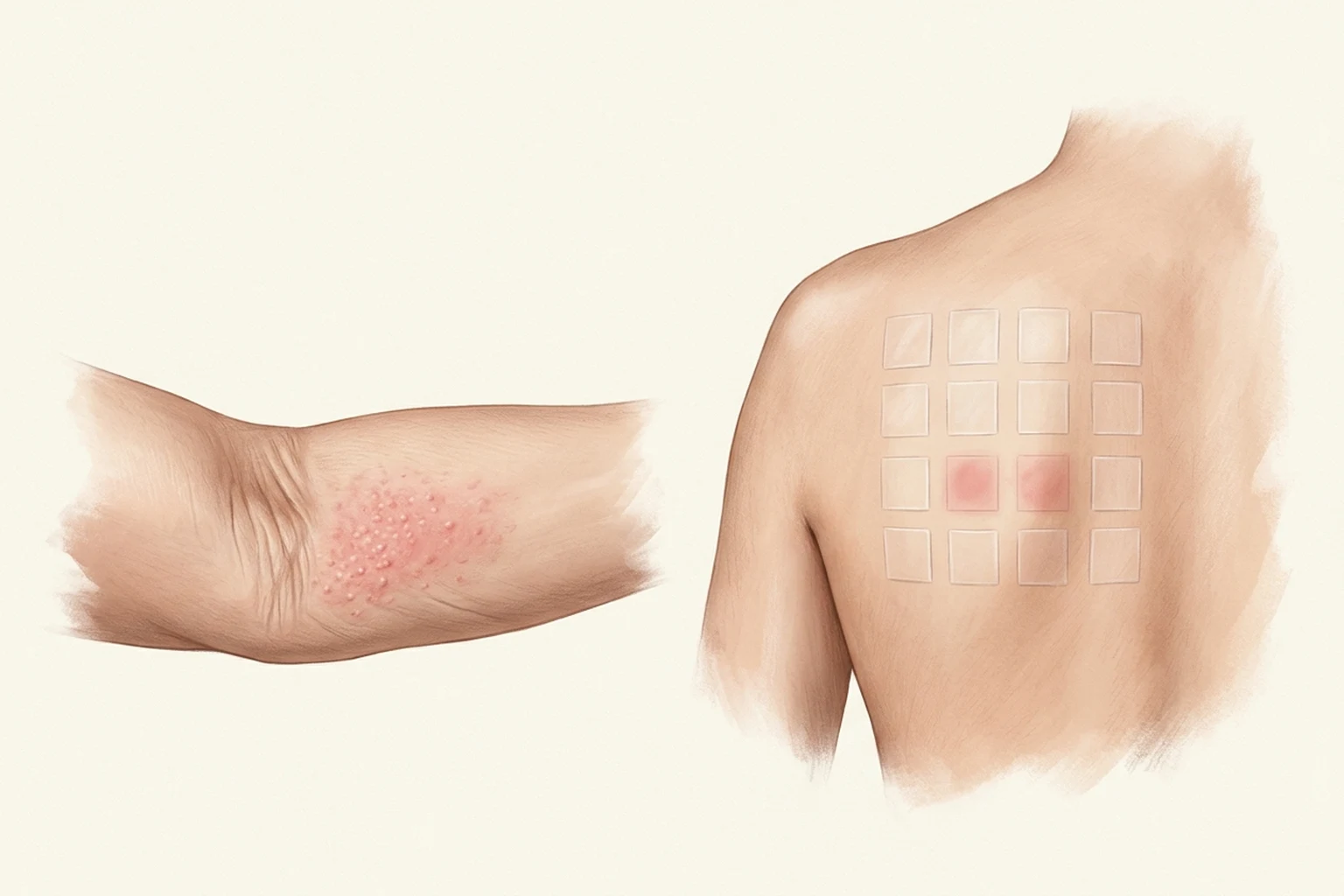
AI-generated illustration. Not an actual patient or treatment result.
Allergic to Your Eczema Cream? Topical Steroid Allergy and the Paraben and Lanolin Paradoxes

Chief Medical Officer
Yes, you can become allergic to your own eczema cream, either to the topical corticosteroid molecule itself or to preservatives and emollients like parabens, lanolin, or propylene glycol sitting inside the base. In a 17,978-patient North American patch-test series, 741 patients (4.12%) tested positive to at least one corticosteroid (Pratt 2017). That reaction stays hidden for months in many clinics, since the steroid's anti-inflammatory effect partially masks the redness of the allergy it is causing.
In this article
Can you actually be allergic to a topical steroid cream?
Yes. Topical corticosteroids are designed to calm skin inflammation, so a delayed contact allergy to a steroid rarely looks like an explosive poison-ivy rash. Instead, dermatologists watch for three subtle clues:
- Eczema that plateaus or slowly creeps outward exactly where you apply hydrocortisone, triamcinolone, or another steroid cream.
- Sudden worsening of chronic hand eczema or lower-leg stasis dermatitis right after starting or stepping up a steroid ointment.
- A temporary rebound flare every time you try to taper off, since the drug's anti-inflammatory action fades faster than the allergic skin reaction underneath.
In the NACDG analysis of 17,978 consecutive patch-tested patients from 2007 through 2014, 741 patients (4.12%) reacted to one or more corticosteroids. Positivity was highest for tixocortol-21-pivalate (2.26%), followed by budesonide (0.87%), hydrocortisone-17-butyrate (0.43%), clobetasol-17-propionate (0.32%), and desoximetasone (0.16%) (Pratt 2017).
Which topical steroids cross-react, and which ones are least likely to trigger allergy?
Corticosteroid molecules bind skin proteins differently depending on their chemical ring substitutions. Dermatologists use traditional structural groups (A, B, C, D1, and D2) alongside the modernized three-cluster model introduced by Marie Baeck and colleagues to predict safer swaps (Baeck 2011).
| Modern cluster (legacy groups) | Common examples | NACDG patch-test signal | Practical clinical takeaway |
|---|---|---|---|
| Group 1 (Groups A, D2 & budesonide) | Hydrocortisone, hydrocortisone butyrate, prednicarbate, budesonide, methylprednisolone | Highest: tixocortol 2.26%, budesonide 0.87%, hydrocortisone-17-butyrate 0.43% (Pratt 2017) | Non-methylated structures bind skin proteins readily and drive the vast majority of steroid contact allergies (Baeck 2011) |
| Group 2 (Group B acetonides) | Triamcinolone acetonide, fluocinonide, fluocinolone, desonide, halcinonide | Moderate; screened primarily with budesonide and triamcinolone | Very widely prescribed for eczema; patients allergic here may cross-react with Group 1 |
| Group 3 (Groups C & D1) | Desoximetasone, betamethasone dipropionate, clobetasol propionate, mometasone furoate | Lowest: clobetasol 0.32%, desoximetasone 0.16% (Pratt 2017) | Halogenated steroids methylated at carbon 16 sensitize least often and frequently serve as safe bridges while avoiding Group 1 triggers (Baeck 2011) |
One reassuring finding from the NACDG dataset: 70.7% of corticosteroid-allergic patients reacted to only one tested steroid (Pratt 2017). Testing positive to over-the-counter hydrocortisone does not mean every prescription steroid is off limits, and non-steroid topicals sidestep steroid cross-reactivity completely.
What are the paraben paradox and the lanolin paradox?
Sometimes the active steroid molecule is innocent, and an inactive preservative or moisturizer ingredient in the tube is driving the flare. Two classic dermatology traps make these vehicle allergies maddening to catch without expert guidance:
- The paraben paradox: Parabens have been used as preservatives in creams and lotions for over 70 years and remain among the least allergenic preservatives available on healthy skin, which is why the American Contact Dermatitis Society (ACDS) named paraben mix its "(Non)Allergen of the Year" (Fransway 2019). Blindly avoiding parabens often pushes shoppers into "paraben-free" formulas preserved with far stronger allergens like methylisothiazolinone. The paradox is that when a paraben cream goes onto broken, inflamed skin (weeping eczema, leg ulcers, or stasis dermatitis), higher penetration can trigger contact dermatitis even though a routine patch test placed on normal back skin reads negative.
- The lanolin paradox: Lanolin (wool alcohol) sits inside many popular heavy healing ointments. In the general European population, lanolin allergy is uncommon at roughly 0.4%, yet ACDS named lanolin its 2023 Allergen of the Year due to its high-risk link to atopic dermatitis, stasis dermatitis, leg ulcers, and perianal or genital dermatitis (Jenkins 2023). Just like parabens, lanolin contact dermatitis on raw eczema skin frequently produces false-negative patch tests on healthy skin, while some patch-positive patients tolerate lanolin normally on healed skin.
Vehicle simplicity matters during flares. Plain white petrolatum ointments contain fewer preservatives and stabilizers than water-based creams. Review our full checklist of skincare ingredients to avoid with eczema.
How is topical steroid allergy different from topical steroid withdrawal?
Patients whose rash burns or spreads after applying a steroid cream often worry online about topical steroid withdrawal. The two problems have different mechanisms and very different fixes:
- Topical steroid allergy is a localized delayed allergic immune reaction (type IV hypersensitivity) to a specific steroid structure or its cream vehicle. It happens even on short courses or mild over-the-counter hydrocortisone, clears once you eliminate that allergen class, and can be confirmed on formal patch testing (including delayed 7-day readings, since steroids suppress early patch-test redness).
- Topical steroid withdrawal refers to rebound burning and diffuse redness reported mainly after prolonged, frequent misuse of mid- to high-potency steroids on thin skin such as the face or groin. Read our evidence review of topical steroid withdrawal facts and our guide to safe topical steroid use for eczema.
What should you do if your eczema worsens on prescription creams?
- Audit both the active drug and the vehicle: Check whether your ointment contains lanolin alcohol, propylene glycol, fragrances, or preservatives, and switch to plain fragrance-free petrolatum for basic moisturizing until a clinician evaluates the flare.
- Ask an in-person dermatologist about formal patch testing: Comprehensive patch testing screens tixocortol-21-pivalate, budesonide, preservative panels, lanolin, and your own personal creams so you stop guessing.
- Consider steroid-free prescription options: Modern non-steroid topicals such as phosphodiesterase-4 inhibitors avoid corticosteroid cross-reactivity entirely.
- How KindleeRx can help with mild-to-moderate eczema: KindleeRx does not perform in-office patch testing, so suspected multi-allergen contact dermatitis belongs with an in-person dermatologist. For eligible adults with mild-to-moderate eczema who want clinician-guided topical options without office waits, licensed clinicians (physician assistants and nurse practitioners working under a board-certified dermatologist's protocols) review your skin history, current creams, and photos and reply in under 5 hours on average. Through the KindleeRx Eczema Regimen, clinicians select two prescriptions from 10+ listed formulas (steroid-free options are available) for $149 on the first 90-day automatic-refill order, then $149 every 90 days before coupons (including the $20 consultation fee, free shipping, and 90 days of clinician messaging), or $181.25 one-time before coupons. For a single standalone steroid-free option, clinicians may prescribe compounded Calming Cream (roflumilast 0.2% with calamine 5%, 80 g) at $70 first 90-day autoship, then $70 every 90 days before coupons (including the $20 consultation fee, free shipping, and 90 days of clinician messaging), or $80 one-time before coupons. Available in 44 states plus Washington, D.C. (excluding Arkansas, Kansas, Maryland, Mississippi, Nebraska, and West Virginia). If treatment is not prescribed, you receive a full refund including the consultation fee.
Important Information
KindleeRx provides compounded prescription medications prepared by licensed United States compounding pharmacies under a licensed prescriber's order, alongside standard prescription options when appropriate. Compounded medications are not approved by the Food and Drug Administration (FDA) and are not reviewed by the FDA for safety, effectiveness, or quality (FDA compounding guidance). KindleeRx's Calming Cream (roflumilast 0.2% and calamine 5%) is not Zoryve and is not a generic of Zoryve; KindleeRx is not affiliated with Arcutis Biotherapeutics (Zoryve). Eligibility is determined by a licensed clinician after reviewing your health history and photos. Not all patients qualify. Individual results vary. This article is educational and is not medical advice.
Sources
- Pratt MD, Mufti A, Lipson J, et al. Patch Test Reactions to Corticosteroids: Retrospective Analysis From the North American Contact Dermatitis Group 2007-2014. Dermatitis 2017.
- Baeck M, Chemelle JA, Goossens A, Nicolas JF, Terreux R. Corticosteroid Cross-Reactivity: Clinical and Molecular Modelling Tools. Allergy 2011.
- Fransway AF, Fransway PJ, Belsito DV, et al. Parabens. Dermatitis 2019.
- Jenkins BA, Belsito DV. Lanolin. Dermatitis 2023.
- Food and Drug Administration. Understanding the Risks of Compounded Drugs.
Related Articles

Eczema
Topical Steroids for Eczema: Benefits, Safety, and the Rise of Steroid-Free Options
Mar 2, 2026 · 13 min read

Eczema
Topical Steroid Withdrawal: What It Is, How Common It Is and Who Is at Risk
Nov 19, 2026 · 9 min read
Example: Fragrance
Eczema
Which Common Ingredients Should People with Eczema Avoid?
Feb 27, 2026 · 8 min read