
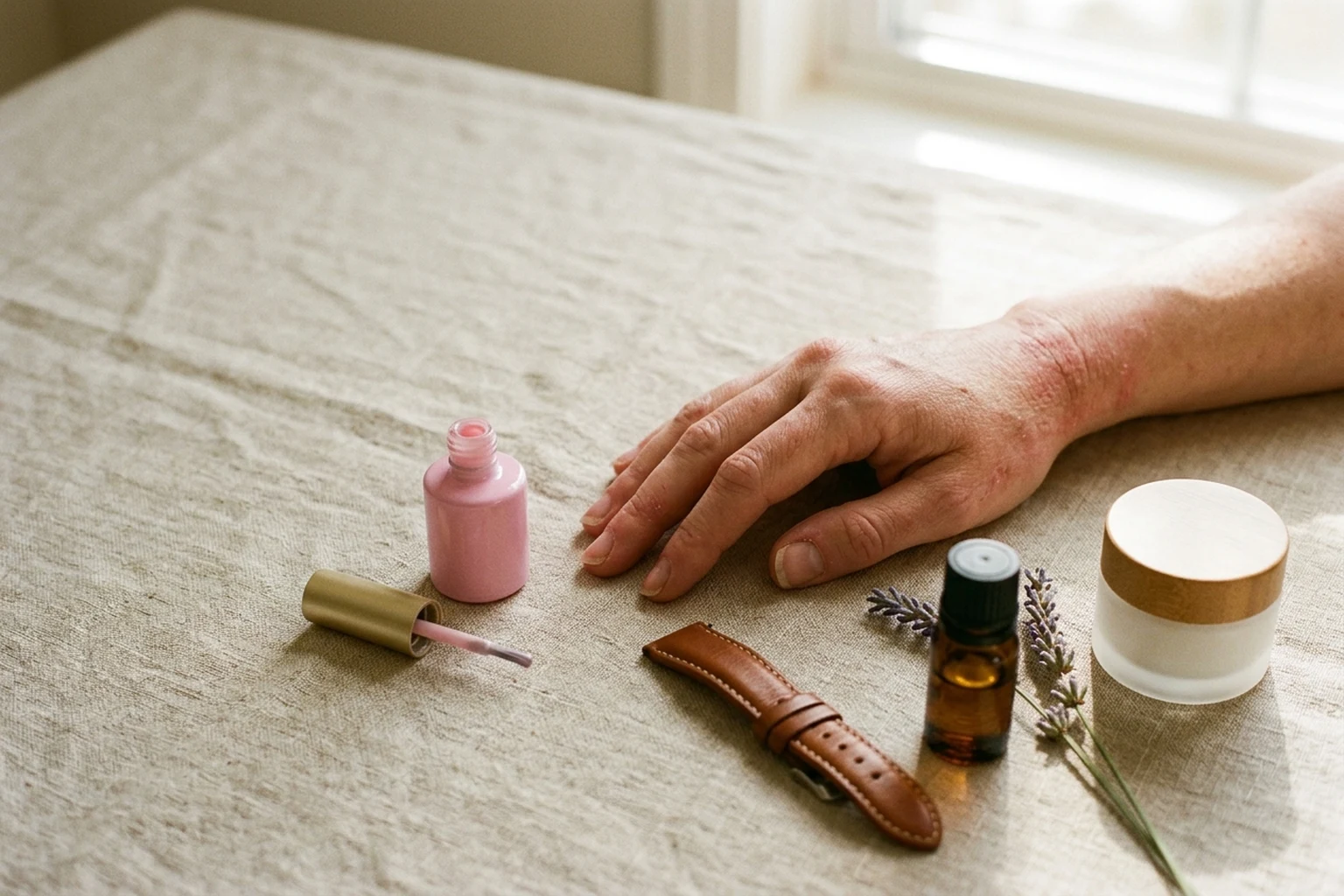
AI-generated image. Not an actual patient or treatment result.
Hidden Everyday Eczema Triggers: Preservatives, Oxidized Fragrances, Leather Sofas and Gel Nails

Chief Medical Officer
When eczema stubbornly sticks to one distinct body map, such as eyelids, fingertips, neck, waist, or the backs of thighs, an everyday hidden allergen is often refueling the rash faster than prescription creams can calm it (Houle 2025). Knowing the modern culprits that top dermatology patch-test clinics turns detective work into relief.
In this article
Which hidden contact allergens top North American patch tests right now?
Standardized testing across 12 North American referral centers (3,056 patients tested to 80 baseline allergens) shows that modern allergy patterns extend far beyond costume jewelry and perfume (Houle 2025):
| Top allergen | NACDG 2021 to 2022 positivity | Where it hides daily | Typical rash map |
|---|---|---|---|
| Nickel & cobalt | 24.9% (nickel 5%) & 9.2% (cobalt) (Houle 2025) | Jean snaps, watchbacks, eyeglass frames, phone cases, keys, leather dyes (cobalt) | Belly button, earlobes, wrists, cheek (phone contact), fingertips |
| Methylisothiazolinone (MI) & MCI/MI | 11.5% (MI) & 9.0% (MCI/MI) (Houle 2025) | Shampoos, body washes, dish soaps, wet wipes, liquid laundry detergents, craft glues/slime, wall paints | Hands, eyelids, face, perianal skin (flushable wipes) |
| Oxidized botanicals (linalool & limonene hydroperoxides) | 10.1% (linalool hydroperoxides) (Houle 2025) | Lavender oil, citrus oils, tea tree oil, "natural" soaps and lotions exposed to air | Face, neck, forearms, hands |
| Surfactants & conditioners | Oleamidopropyl dimethylamine & dimethylaminopropylamine rose in 2021 to 2022 (Houle 2025); top eyelid culprits (Alley 2026) | Cocamidopropyl betaine-related surfactants (oleamidopropyl dimethylamine, dimethylaminopropylamine) and cetrimonium chloride in foaming washes and shampoos | Eyelids, scalp margins, forehead, sides of neck ("rinse-off pattern") |
Why can 'unscented' or 'natural' products still trigger eyelid or facial eczema?
Three label traps catch careful shoppers every week:
- Essential oils oxidize in open bottles: Pure lavender oil (linalool) and citrus oils (limonene) start weakly allergenic and turn into potent hydroperoxide contact allergens once exposed to air in bathroom bottles, driving 10.1% patch-test positivity for linalool hydroperoxides (Houle 2025).
- "Unscented" is not "fragrance-free": Unscented creams frequently hide masking fragrances such as Balsam of Peru or botanical extracts to cover raw chemical odors.
- Rinse-off shampoos hit the eyelids first: In a 5-year review of 245 eyelid dermatitis patients, shampoos and makeup were the leading personal products triggering reactions, driven by foaming surfactants (cocamidopropyl betaine relatives), cetrimonium chloride, carmine pigment, MI, formaldehyde, fragrances, and nickel (Alley 2026). See our full eyelid and facial eczema guide and skincare ingredients to avoid.
What unexpected household items cause allergic rashes on hands, legs, or backs?
Dermatologists constantly uncover offbeat triggers that patients never associate with skincare:
- Gel manicures and acrylic nail kits (acrylates and 2-hydroxyethyl methacrylate): Uncured ultraviolet-light gel polish sensitizes fingertips and causes mystery eyelid and neck rashes from touching your face during the day, even when the skin around the nails looks fairly calm.
- Homemade craft slime in children: In a 2025 systematic review of 62 published pediatric chronic hand eczema case reports, allergic contact dermatitis caused 71%, and homemade slime (28 cases) plus store-bought slime (8 cases) were the single biggest triggers, driven by MCI/MI preservatives in liquid glue and detergents; removing the trigger resolved 53% (33 of 62) of cases (Yeung 2025).
- Leather chairs and sofas ("sofa dermatitis"): Severe itchy eczema sharply outlining the back, buttocks, and posterior thighs has been traced to sachets of dimethyl fumarate found inside furniture (Lammintausta 2010) and leather fungicides such as TCMTB, which accounted for 7 of 7 leather-sofa cases in a Belgian patch-test series (Herman 2023).
Why do standard allergy blood tests miss contact dermatitis completely?
Allergic contact dermatitis is a delayed T-cell immune reaction (type IV), not the immediate immunoglobulin E (IgE) antibody reaction that drives hives, peanut allergy, or seasonal sneezing. Blood allergy panels and 15-minute skin-prick tests look only for IgE antibodies, so they come back falsely reassuring for nickel, MI, fragrances, and acrylates. Formal patch testing places tiny chambers of suspected chemicals on the upper back for 48 hours and reads reactions at 48 hours and again at 72 to 96 hours (or day 7 for steroids).
How do you calm allergic flares while hunting down the trigger?
- Run a 2-week product strip-down: Drop all scented washes, wet wipes, essential oils, botanical creams, and gel nail products, switching to one plain fragrance-free syndet bar and plain white petrolatum.
- Photograph and bring labels to a patch-test clinic: Over one-fifth (21.1%) of NACDG patients reacted to items outside the standard 80-allergen panel (Houle 2025), so bringing your actual shampoo, moisturizer, and workplace gloves gives patch testing far higher accuracy.
- Calm acute skin inflammation safely: Targeted prescription anti-inflammatory creams settle itching and repair the barrier while you eliminate the culprit. Review our guide to understanding eczema triggers.
KindleeRx does not perform in-office patch testing. If you suspect a complex occupational or multi-product contact allergy, book formal patch testing with an in-person board-certified dermatologist. For eligible adults with uncomplicated mild-to-moderate eczema or contact flares who want prompt clinician-guided prescription topicals while simplifying their routine, licensed clinicians (physician assistants and nurse practitioners working under a board-certified dermatologist's protocols) review your photos and product list through the KindleeRx Eczema Regimen and reply in under 5 hours on average. When clinically appropriate, a licensed clinician selects two prescriptions per 90-day plan (steroid-free options are available) for $149 on the first automatic-refill order, then $149 every 90 days before coupons (including the $20 consultation fee, free shipping, and 90 days of clinician messaging), or $181.25 one-time before coupons. Available in 44 states plus Washington, D.C. (excluding Arkansas, Kansas, Maryland, Mississippi, Nebraska, and West Virginia), with a full refund including the consultation fee if treatment is not prescribed.
Important Information
KindleeRx offers compounded topical prescription medications prepared by licensed United States compounding pharmacies alongside standard generic prescriptions when clinically appropriate. Compounded medications are not approved by the Food and Drug Administration (FDA) and are not reviewed by the FDA for safety, effectiveness, or quality (FDA compounding guidance). KindleeRx does not perform in-office patch testing. Eligibility is determined by a licensed clinician after reviewing your medical history and photos. Not all patients qualify. Individual results vary. This article is educational and is not medical advice.
Sources
- Houle MC, DeKoven JG, Atwater AR, Reeder MJ, et al. North American Contact Dermatitis Group Patch Test Results: 2021-2022. Dermatitis 2025.
- Alley DR, Abi H, Hylwa S, Neeley A, et al. Eyelid Dermatitis: A 5-Year Retrospective Review From a Metropolitan Contact Dermatitis Clinic. Dermatitis 2026.
- Yeung KCY, Lowe J, Ho JSS, Molin S. Patterns of Pediatric Chronic Hand Eczema: A Systematic Review With Focus on Causes and Management. Journal of Cutaneous Medicine and Surgery 2025.
- Lammintausta K, Zimerson E, Hasan T, Susitaival P, et al. An Epidemic of Furniture-Related Dermatitis: Searching for a Cause. British Journal of Dermatology 2010.
- Herman A, Marot L, Baeck M. Sofa Dermatitis: Value of Patch Test With 2-(Thiocyanomethylthio)benzothiazole. Contact Dermatitis 2023.
- Food and Drug Administration. Understanding the Risks of Compounded Drugs.
Related Articles
Example: Fragrance
Eczema
Which Common Ingredients Should People with Eczema Avoid?
Feb 27, 2026 · 8 min read
Eczema
Facial and Eyelid Eczema: Your Complete Guide to Treating Sensitive Skin Safely
Mar 12, 2026 · 9 min read
Eczema
Understanding Eczema Triggers: A Dermatologist's Guide
Mar 20, 2026 · 3 min read