
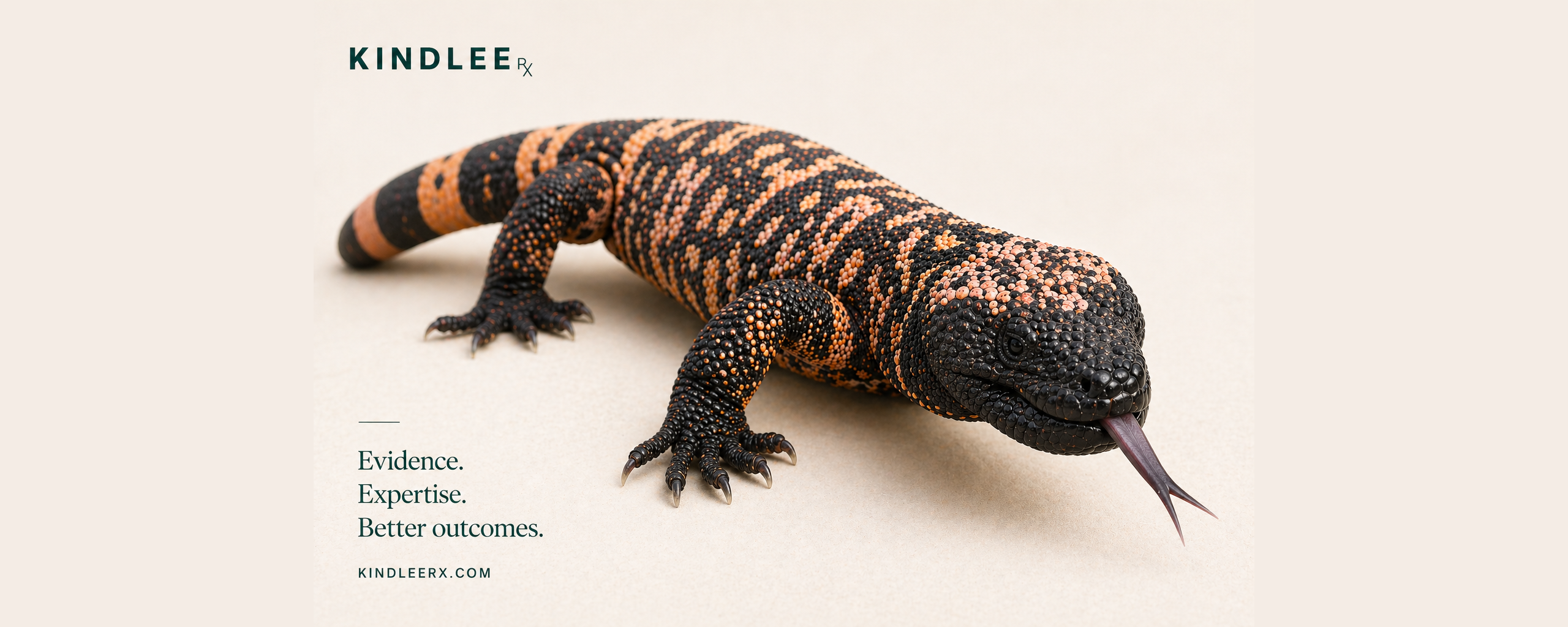
Walk into the Sonoran Desert in late spring. The air is dry and the rocks still hold yesterday's heat. Most reptiles you might see are quick and lean. But under a creosote bush, you might find something different. A thick-bodied lizard, almost two feet long, banded in black and salmon pink. Its forked tongue flicks the air. It moves slowly. Its name is the Gila monster, and it has changed modern medicine more than any animal you have probably never thought about.
GLP-1 Skin + WeightApril 28, 2026 · 7 min read
The Gila Monster Behind Modern Weight Loss: How Desert Venom Became GLP-1 Therapy

Dr. Brandon Kirsch, MD, FAAD
Chief Medical Officer
The Puzzle of a Lizard That Doesn't Eat
The Gila monster (Heloderma suspectum) has a problem most animals do not. It eats only three or four times a year. When it does hunt, it can swallow a meal that weighs a third of its body weight in a single sitting. Then it slips back under a rock and digests for months.
That alone is unusual. What is more unusual is how its body manages blood sugar between meals. A human fasting that long would crash. A Gila monster maintains stable glucose for months, then shifts smoothly into digestion when a meal finally arrives.
In the early 1980s, that puzzle caught the attention of an endocrinologist named John Eng at the Bronx Veterans Affairs Medical Center.
Dr. John Eng and the Hunt for a Hormone
Eng was studying gut hormones. He had read older work showing that Gila monster venom caused dramatic effects on the pancreas of mammals exposed to it. In clinical terms, that meant the venom contained something that told the pancreas to do something. Eng wanted to know what.
The Gila monster does not strike with fangs like a snake. It bites and chews, and venom flows from grooves in its lower teeth into the wound. The bite is slow, painful, and rarely fatal to humans. But chemically, the venom is rich.
For nearly a decade, Eng worked through the proteins in that venom. In 1992, he isolated a molecule he named exendin-4. It was a peptide, 39 amino acids long, and it looked remarkably similar to a human hormone called glucagon-like peptide-1, or GLP-1. There was just one critical difference. Human GLP-1 broke down in the bloodstream within 2 to 3 minutes. Exendin-4 was stable for hours.
The Gila monster had evolved a long-acting version of a hormone we already had.
Why That Difference Matters
GLP-1 in humans is a smart hormone. After you eat, your gut releases it. It tells your pancreas to release insulin, slows the rate at which food leaves your stomach, signals your brain that you are full, and quiets the hormone glucagon, which would otherwise tell the liver to dump sugar into the blood.
It is the body's own appetite and blood sugar regulator. The problem is that human GLP-1 is gone before it can do much. Our bodies break it down almost as fast as we make it.
The Gila monster's exendin-4 does the same things, but for hours instead of minutes. That difference, repeated across months of fasting, is exactly what lets a lizard maintain stable blood sugar between rare meals in a punishing desert environment.
For humans, the implication was direct. If we could turn exendin-4 into a medication, we could replicate the effects of our own GLP-1 with a single dose that lasted hours instead of seconds.
From Venom to Vial
In 2005, after more than a decade of additional development, the FDA approved exenatide under the brand name Byetta. It was the first GLP-1 receptor agonist available for type 2 diabetes. Patients who had been struggling to control their blood sugar saw real improvement. Many also lost weight. The weight loss was not the original goal of the drug. It was a side effect that turned out to matter.
Pharmaceutical companies took notice. If the Gila monster's molecule could be refined further, the next generation could last days instead of hours. Two important molecules followed.
- Liraglutide (Victoza for diabetes, Saxenda for weight loss) was approved in 2010. Once-daily dosing.
- Semaglutide (Ozempic for diabetes, Wegovy for weight loss) followed in 2017. Once-weekly dosing. Average weight loss in clinical trials was around 15% of body weight.
Then came tirzepatide (Mounjaro, Zepbound) in 2022. Tirzepatide is a dual agonist, meaning it activates both the GLP-1 receptor and a second receptor called GIP. Average weight loss in clinical trials reached roughly 20% of body weight, with some patients losing significantly more.
Each generation built on the last. The original blueprint was a desert lizard's venom.
Why This Story Matters Clinically
I have spent years in clinical medicine and pharmaceutical drug development. Stories like this are not common. Most modern drugs are designed in laboratories from chemical scaffolds. The GLP-1 class is different. Its starting point was an evolutionary solution to a real biological problem, refined over fifty million years before any human looked at it.
That matters for two reasons.
First, the underlying mechanism is not synthetic in the way most drugs are. GLP-1 receptor agonists use signaling pathways our bodies already have. They turn up the volume on a hormone we naturally produce. That is part of why they are well tolerated by most patients.
Second, the story shows what is possible when scientists pay attention to biological oddities. A lizard that eats four times a year is not where most drug discovery teams would start. John Eng saw the puzzle and pulled on it for more than a decade. Tens of millions of patients today benefit from his persistence.
The Modern GLP-1 Patient
Today, GLP-1 receptor agonists like semaglutide and tirzepatide are among the most studied medications in medicine. Hundreds of clinical trials, tens of millions of prescriptions, and years of follow-up data. The newer molecules are far improved over exenatide, but every one of them traces back to the same starting point in the Sonoran Desert.
For patients who struggle with weight despite genuine effort with diet and exercise, GLP-1 therapy works because it addresses the biology directly. Hunger, satiety, blood sugar, and fat metabolism are all governed by hormones, and those hormones can be supported by the right medication and the right clinical oversight.
Any patient considering GLP-1 therapy should have a full medical review first. Treatment is appropriate when the science fits the patient's history, health, and goals.
The story of GLP-1 medicine started with a thick-bodied lizard hiding under a rock in Arizona. It is now changing how we treat one of the most common and most frustrating chronic conditions in modern life.
Sources
- Eng J, Kleinman WA, Singh L, Singh G, Raufman JP. Isolation and characterization of exendin-4, an exendin-3 analogue, from Heloderma suspectum venom. J Biol Chem. 1992;267(11):7402-7405.
- DeFronzo RA, et al. Effects of exenatide (exendin-4) on glycemic control and weight over 30 weeks in metformin-treated patients with type 2 diabetes. Diabetes Care. 2005;28(5):1092-1100.
- Wilding JPH, et al. Once-weekly semaglutide in adults with overweight or obesity. N Engl J Med. 2021;384(11):989-1002.
- Jastreboff AM, et al. Tirzepatide once weekly for the treatment of obesity. N Engl J Med. 2022;387(3):205-216.
- Drucker DJ. Mechanisms of action and therapeutic application of glucagon-like peptide-1. Cell Metab. 2018;27(4):740-756.
Related Articles

→
GLP-1 Skin + Weight
Visceral Fat, IL-6, and Why Your Skin Cares What's Around Your Waist
May 18, 2026 · 9 min read

→
GLP-1 Skin + Weight
How GLP-1 Medications Work: The Science Behind Semaglutide and Tirzepatide
Mar 21, 2026 · 7 min read

→
GLP-1 Skin + Weight
GLP-1 Weight Loss: What to Expect in Your First 3 Months
Mar 21, 2026 · 9 min read